








Stripe is no longer a payment company
 Core Viewpoint

 If AGI is really close, AI should have already created tremendous economic value, but where is that value?
Author: Will Awang, Duka Fintech
In June 2025, in a small bar temporarily set up in Stripe's office, Irishman John Collison recorded the first episode of a podcast. The show is called Cheeky Pint, a phrase commonly used by the Irish and British meaning "taking a break to have a drink." Sitting across from him was Greg Brockman. When Brockman joined, Stripe was just getting started, relying on a few lines of code to facilitate online payments; he was Stripe's first engineer, later becoming CTO, and left in 2015 to co-found OpenAI.
Throughout the episode, the two discussed payment only once. The rest of the conversation was entirely about AI. At one point, Brockman recalled something a board member told him in 2018: If AGI is really close, AI should have already created tremendous economic value, but where is that value? He said that at the time, it was a fair criticism, but now, the situation has clearly changed.
In September 2026, the Stripe Tour landed in China for the first time. A similar small bar was set up at the Shanghai venue, where we interviewed Kevin Miller, who is responsible for Stripe's payments, risk, customer support, and global business, as well as Agentic Commerce. Like that podcast episode, our conversation with him focused more on AI than on payments.
In a letter to investors in August this year, Stripe wrote that they view January 1 as the beginning of the singularity: in Stripe's data, the speed of new company formations has begun to surge. Stripe's mission has always been to "elevate the internet GDP," and under the singularity, this GDP no longer comes solely from websites designed for people and click-to-purchase.
New AI companies are born global, charging by token or result; consumers are starting to let agents place orders and make payments on their behalf. To get such an AI economy running, a few lines of payment code are clearly no longer sufficient.
In August this year, Stripe announced it would acquire OpenRouter: a company that does not handle payments but manages where AI tokens are spent, serving as an entry point to the AI economy.
Having started with payments, Stripe can no longer be defined as just a payment company.
1. If not a payment company, then what is it?
(Stripe Tour Shanghai)
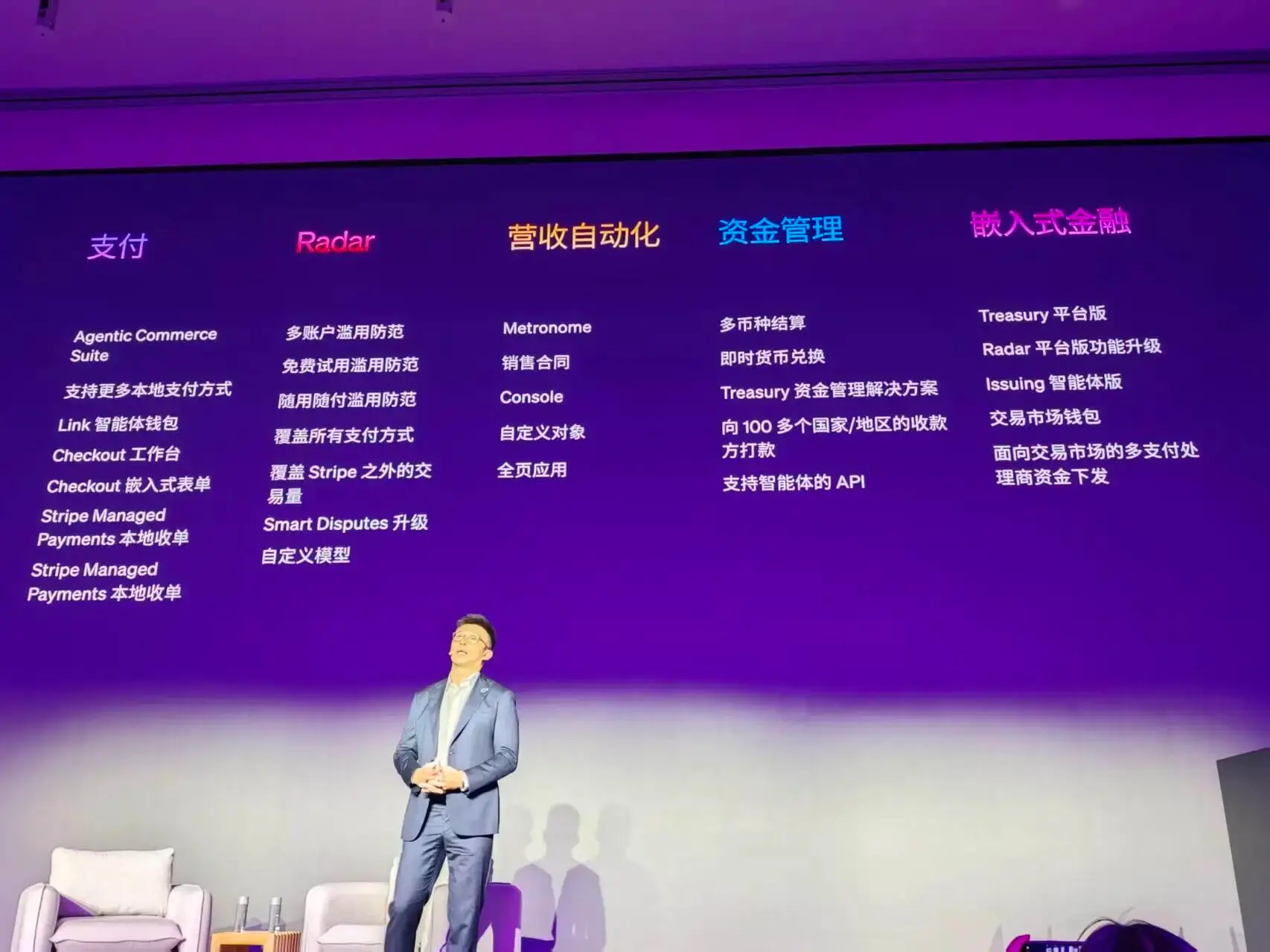
At the Shanghai venue, Stripe divided all its products into five categories: Payments, Radar (Risk Control), Revenue Automation, Fund Management, and Embedded Finance, with payments occupying only one category.
The positioning in Stripe's press release has also shifted from "financial infrastructure platform" and "programmable financial services company" to "building economic infrastructure for AI" at the Sessions conference in April this year. By September in Shanghai, the positioning remained the same, with the wording changing from "finance" to "economy," and the target audience shifting from businesses to AI.
At the bar, we posed this question to Kevin: Is Stripe still a payment company? His answer was: Stripe is essentially financial infrastructure. When discussing Stripe's mission to "elevate the internet GDP," he added: that is, the part of the economy connected to the internet.
Previously, he spent 17 years at AWS, overseeing S3 and, before leaving, managing AWS's global data centers. He joined Stripe last year. In his view, financial infrastructure and cloud infrastructure are fundamentally similar, with the difference being that it is not just a technical job; one must understand the customer's business: where to grow, which markets to enter, and how to quickly respond to the market.
Clearly, the globally born AI economy requires more than just payments.
Many of the previous generation of internet companies and SaaS companies grew up on Stripe. Now it's the turn of AI companies: 88% of the Forbes AI 50 are Stripe customers. At this year's Sessions, Stripe expanded its mission from just collecting payments to supporting the global growth of AI companies, helping businesses adapt to AI, token fraud prevention, and enabling agents to become economic entities.
In Patrick Collison's words, AI represents the largest platform migration in the economy since the internet, and the vast majority of this wave of companies and startups are built on Stripe.
Stripe's move beyond payments is entirely reasonable. Payments are the easiest part of this business to compare, and fees will only get thinner. By 2025, the money that has flowed through Stripe will reach $19 trillion. Relying solely on payments, Stripe's revenue will struggle to grow faster than transaction volume in the long term.
However, products outside of payments are different. According to Stripe's annual disclosures, the revenue suite, including Billing, Tax, Invoicing, and the newly acquired usage-based billing platform Metronome, is expected to achieve an annualized revenue of $1 billion this year, up from $500 million a year ago. It has doubled in a year, and once these products are adopted, they are difficult to replace.
"The infrastructure of the AI economy" is how Stripe positions itself. Our view is more direct: payments are just cash flow; what Stripe is truly doing this year is business above the cash flow.
Above the cash flow are three things: the revenue of AI companies, the costs of AI companies, and the payment authority of agents.
2. AI companies are born global, but they need more than just payments
The new generation of AI companies does not have a "going global" phase. In Shanghai, Stripe's statement is: from "moving towards global" to "born global." MiniMax only sent two engineers, and they completed the integration in two weeks, subsequently commercializing in over 100 countries.
Kevin mentioned in the interview that this is the number one change he sees in Chinese companies: building with a global perspective from day one, with the initial question being how to deliver capabilities worldwide.
According to Stripe's statistics, from 2024 to 2025, the total cross-border payment volume of users in Greater China is expected to grow by about 48%, and the number of newly launched AI companies is expected to increase by 78%. Sarita also noted that among the top 100 AI companies on the platform, 14 are from China. Many Chinese companies can sell their products to multiple countries globally within just 6 to 12 months.

(Stripe Tour Shanghai)
However, being born global does not mean automatic global reach. For every additional market sold, there is a need for a local payment method, a tax system, a fraud model, and a set of dispute rules. The past approach was to tackle one country at a time: set up a company, register a tax number, and find a local acquiring bank. For an AI company, this route is too slow.
Stripe's approach is to take over this entire process. Atlas handles company registration; Managed Payments allows digital goods companies to enter 195 markets, with Stripe's Link acting as the Merchant of Record, handling payments, indirect taxes, fraud prevention, disputes, and customer service; in the future, there will also be multi-currency settlements, currency exchanges, fund management, card issuance, and loans.
The benefits of this business to Stripe are clear. If a company's registration, selling, collecting payments, and currency exchange all go through Stripe, Stripe stands to gain more from each piece of revenue, making it less likely to be replaced.
For Chinese AI companies preparing to go global, the initial questions have also changed. Previously, they would first ask which country to set up a company in; now they first ask if the product can be sold directly to the world. In this process, payments are just one part.
3. Tokens have become the billing unit of the AI era
(Stripe Tour Shanghai)
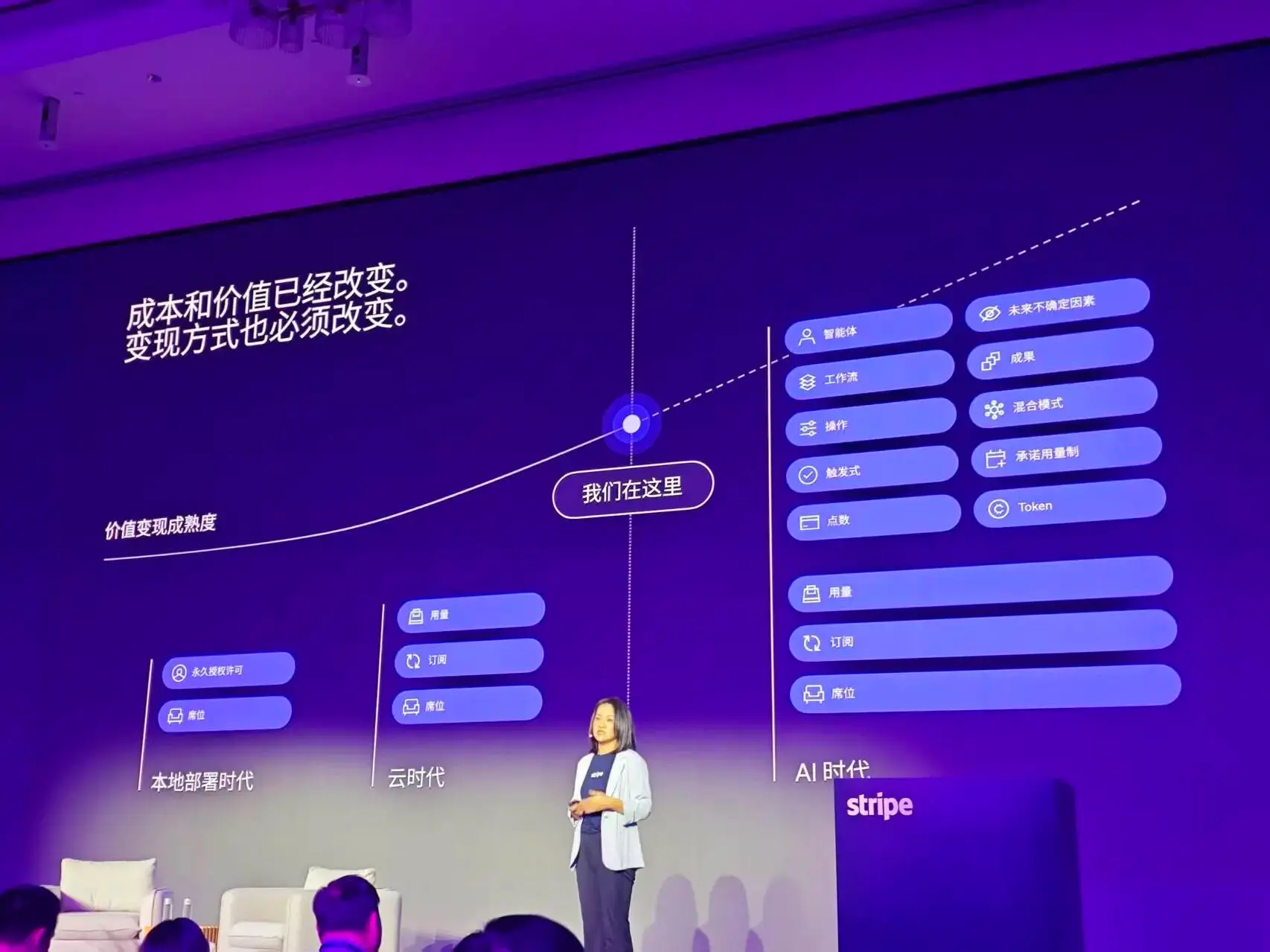
Costs and values have changed, and monetization methods must also change.
The diagram depicts three eras of software charging. In the on-premises era, charges were based on perpetual licenses and seats. In the cloud era, usage and subscriptions were added. In the AI era, billing units suddenly emerged in dozens of forms: agents, workflows, single operations, outcomes, points, committed usage, and tokens. A point on the curve is marked with "We are here."
Abhi Tiwari added in the interview that the most common model now is a hybrid one, where a basic subscription is charged first, and excess is billed by usage; the trend is moving towards outcome-based payments.
Charging by outcomes is also the most challenging. Melina Lee, General Manager of Stripe's Greater China Enterprise Clients, stated that Chinese AI companies, whether they are large models, content, consumer-facing images and videos, or enterprise services, are growing rapidly, but charging is their biggest headache: what counts as an outcome, how much is the outcome worth, and how much cost is behind it—each customer's answer varies, making it hard to standardize and scale. What Stripe aims to do is help businesses see the costs behind each outcome clearly.
Kevin compared token expenses to a new cloud bill. The early days of cloud computing and large-scale token usage are very similar. But at some point, companies will definitely ask: where is the money actually going? He has seen this firsthand in cloud computing, where a batch of companies emerged specifically to help businesses correlate cloud expenses with each business line, ensuring that expenses are truly managed. He said OpenRouter is already doing this, and tokens will soon become actual expenditures in dollars or other currencies that businesses must take seriously.
This time, Stripe did not wait for others to enter this business.
Measurement. In the product diagram from Shanghai with five columns, Metronome is listed at the top of the "Revenue Automation" column. This usage-based billing platform was signed for acquisition by Stripe in December 2025 and completed in January this year, reportedly for about $1 billion. Its clients include OpenAI, Anthropic, Databricks, and NVIDIA, which charge customers based on tokens and GPU seconds.
Pricing. Stripe Billing now supports billing based on token consumption: AI applications can set a markup on top of the original cost of the model, with the system automatically tracking the latest prices of each model, recording the tokens consumed by each customer, and including the markup in the bill.
Routing, which refers to the acquisition of OpenRouter mentioned at the beginning. Revenue and costs are areas Stripe wants to manage on both ends. Most of its past large acquisitions have focused on helping businesses collect and manage money; acquiring OpenRouter means it has moved to the other side of the ledger, starting with managing AI expenses. Melina also mentioned that OpenRouter can route traffic between expensive and inexpensive models, ensuring money is spent where it should be.
Measurement, pricing, and routing are interconnected. The tokens sold and spent by an AI company now have the opportunity to reconcile within the same system. Both ledgers need to be maintained because, for AI companies, tokens are both the largest cost and the primary unit of revenue. Keeping this ledger for them is akin to sitting at the core of their operations.
Where the bill is, there is the entrance.
IV. Agentic Commerce Suite: Enabling Traditional Brands to Be Understood by AI
When people browse online stores, they look at the pages. Agents do not look at pages; they want structured data: what the product is called, how much it costs, whether it is in stock, and how to pay. The effort merchants previously put into their homepage, detail page, and checkout page is not understood by agents.
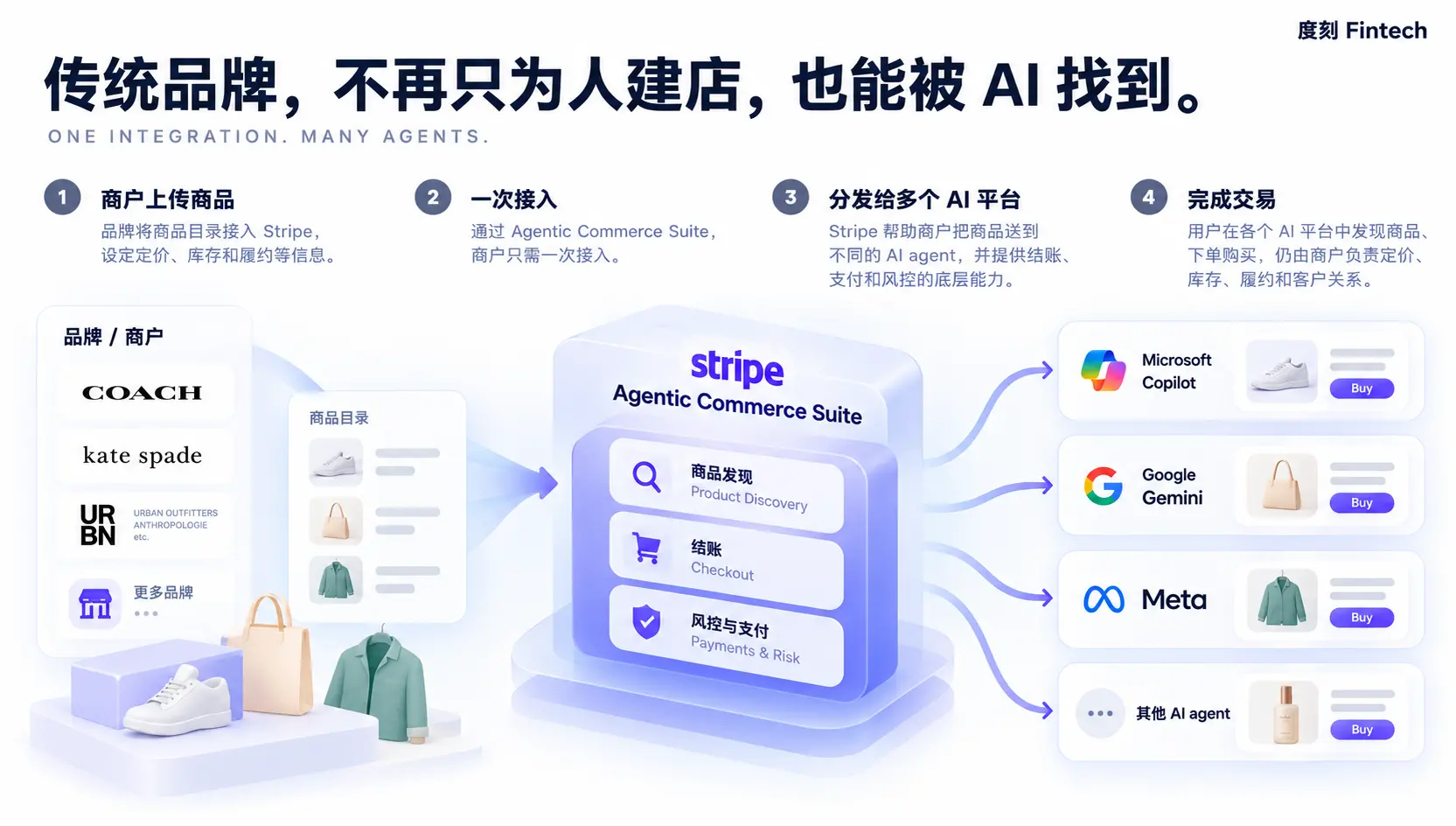
In Shanghai, Stripe condensed it into three words: product discovery, checkout, risk control, and payment. This is the three-part link of the Agentic Commerce Suite. After merchants upload their product catalogs to the Stripe backend and select which AI agents they want to sell through, Stripe helps deliver the products to these AI platforms and provides the underlying capabilities for checkout, payment, and risk control; pricing, inventory, fulfillment, and customer relationships remain in the hands of the merchants.
Stripe calculated how troublesome this used to be. Each time a merchant connects a new AI agent, they have to build an interface separately, adapt to the other party's product catalog specifications and API requirements, which could take up to six months. Now it has become a single connection.
Most of the connections are traditional brands, with Coach, Kate Spade, and URBN (which owns Anthropologie, Urban Outfitters, etc.) on the list. The distribution end is even more critical: the shopping checkout in Microsoft Copilot is supported by Stripe; in April's Sessions, Stripe announced a partnership with Meta to enable direct checkout in Facebook ads and with Google to allow merchants to sell in AI Mode and Gemini.
It does not bet on any single AI platform, but all platforms ultimately need to settle payments.
Stripe has its own calculations in this. If more and more purchases occur on AI platforms, and the checkout is not handled by Stripe, its transaction volume will be intercepted. Rather than betting on which platform will win, it is better to enable different platforms to share its checkout infrastructure as much as possible.
But this only solves half the problem. The Agentic Commerce Suite manages how merchants are found by agents and how orders are taken. The issue on the other end of the transaction is more challenging: the one pressing the purchase button is no longer a person; who has the authority to decide whether this money can be spent?
V. Agentic Payment: When Agents Have the Wallet
We asked Kevin in an interview: what is the iPhone moment for agents? He shared a small story: a Stripe colleague told him that his mother recently started asking whether to use Instinct or Muse. Even the older generation is choosing agents, and he feels this moment may have arrived.
His judgment is that within three to four years, most transactions on the internet will involve agents in some way, either in finding products or in checkout.
He himself is a user. On the day of the interview, he needed to send an anniversary gift, but since he was not at home and did not know which flower shop to choose, he directly asked the agent to order flowers.
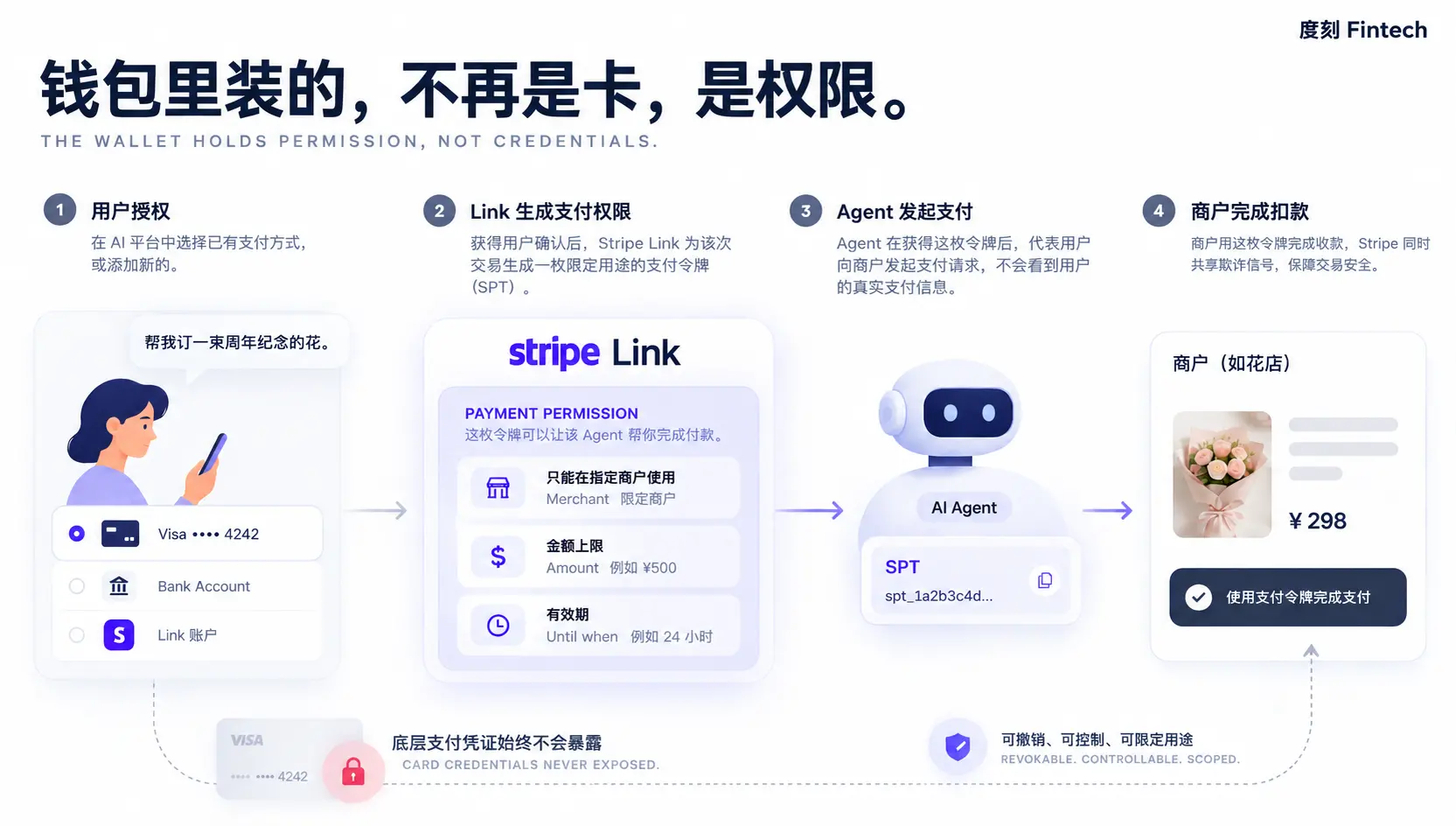
However, when an agent spends money for someone, the first question cannot be avoided: who gets the card number? If given to the agent, the agent could be compromised; if given to the merchant, it adds another point of potential leakage. Stripe's answer is called "Shared Payment Token" (SPT): after the agent obtains customer authorization, it initiates payment using the customer's preferred payment method while not exposing the underlying credentials.
The buyer first calls an existing payment method on the AI platform or adds a new one. After obtaining buyer authorization, a limited-use payment token is sent with the order request to the seller, while Stripe shares fraud signals with the seller, who then uses this token to complete the charge. The token is only valid for the specified merchant, has amount and time limits, and can also be revoked. What the seller receives is a payment permission that delineates the scope, while the underlying payment credentials remain hidden.
The idea behind this design, Kevin wrote about last year on Stripe's blog: in traditional e-commerce, whoever has the card is considered trustworthy; agents act on behalf of people, and trust cannot be inferred; it must be explicitly granted, limited in scope, and executed by code. In Shanghai, he expressed it differently: Stripe Link is like the last gate for funds to flow out; even if many agents shop and perform tasks for him in the future, which money can be spent is still decided by him through Link. With this gate, he can let go.
When discussing agent payment, the outside world tends to break it down: protocols are one set, wallets are another, and tokens are yet another, then debating whose standards will prevail. However, Stripe has already integrated these components into real products with its partners.
Launched on September 8, Meta's personal agent Muse processes payments directly through Link's agent wallet, requiring user confirmation of the total amount for each purchase in the dialogue box, while Muse itself cannot see the payment information. The checkout in Microsoft Copilot uses Stripe's payment token.
The wallet has been issued, but not every door is open. Less than two weeks after Muse launched, Amazon blocked it from entering, citing that Muse entered the site without permission and did not indicate it was an automated program while browsing. For an agent to spend money, merely having a wallet is not enough; there must also be merchants willing to let it in. This is also the reason for the existence of the previous chapter, Agentic Commerce Suite.
On the merchant side, Stripe aims to become the interface for agents entering the commercial world; on the buyer side, it wants to be the gate for agents to obtain spending permissions. The wallet also has another meaning for Stripe: in the past, it primarily stood on the merchant's side, with buyers' payment credentials held by banks and wallets; in the agent era, Link allows Stripe to directly participate in how consumers grant payment permissions to machines.
What is stored in the wallet is no longer a card, but permissions.
VI. When AI Begins Trading, Stripe Starts Selling Judgments
In agent transactions, the seller across the table is increasingly likely to be a program. Many behavioral characteristics previously used in e-commerce to determine whether a person is trustworthy are becoming ineffective, and sellers need to rely more on signals left by accounts, payments, and the entire network.
What Stripe sees has already been trained into a model. By 2025, it will release its self-developed payment foundation model, trained on hundreds of billions of transactions, capable of capturing subtle signals in each payment that hundreds of specialized models cannot detect. After switching to this model, the identification rate of attacks on large merchants increased by 64%.
This capability now not only manages payments but also starts managing tokens. Sarita Singh, head of Stripe Greater China, Southeast Asia, and Korea, mentioned in an interview that they have seen increasing AI abuse over the past six months. With real computational costs, free trials have become an entry point for exploitation. According to Stripe President Will Gaybrick in the a16z podcast, at one point, one in every six free trial registrations for Cursor was malicious; ElevenLabs blocks about 2,000 such registrations daily using Stripe's signals.
The risk control checkpoints have also shifted: moving forward to registration, determining if there are multiple accounts for one person; extending backward to usage, assessing whether customers will use up tokens without paying.
E-commerce fears stolen cards, while AI companies fear stolen computational power.
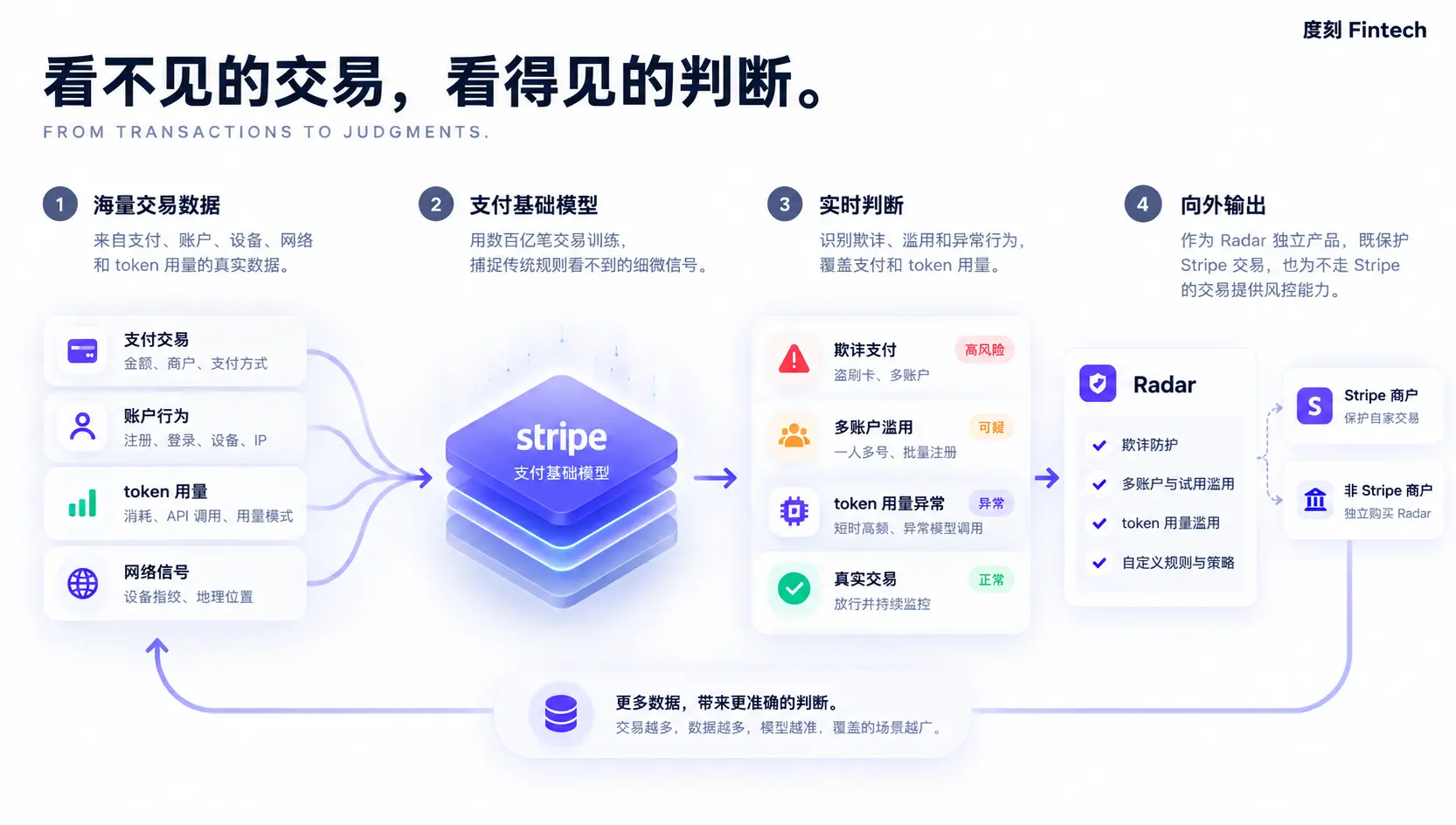
This judgment has already been separately charged by Stripe and is sold to transactions that do not go through its own channel. Regardless of whether Stripe processes payments, businesses can purchase Radar separately. DoorDash began using it to score non-Stripe transactions back in 2024.
This creates a cycle: the more transactions Stripe processes, the more accounts, payments, and token usage it sees; the more data it has, the more accurate the models and risk control become; the more accurate the judgments, the more Radar can be sold to transactions that do not go through Stripe, bringing back new data.
Payment companies charge for channels, while Stripe begins to turn the data left by channels into another business.
For AI companies, the differences between payment service providers are no longer just rates and coverage but also include who understands accounts, tokens, and agents better, and who can better judge what happens behind a transaction.
Meanwhile, it is not just what Stripe sells that is changing; even the entities using Stripe are evolving. By 2025, agent access to Stripe documentation has increased more than tenfold, now accounting for nearly 40%; in command-line tools, 70% of API resource requests come from agents. The Stripe Projects launched in April this year goes further: agents can open databases, hosting, and domains themselves, obtain keys, and pay through Stripe.
If Muse is an agent shopping for consumers, Projects is an agent buying infrastructure for software. What Stripe faces is no longer just people and companies, but machines themselves.
Conclusion
Returning to the summary of Stripe's products. Most of the items mentioned in the previous chapters do not fall under the "payment" column. In Gaybrick's words, Stripe has grown from a payment product to about thirty products.
For a company selling AI, Stripe starts from Atlas registration, capturing its revenue from global sales, charging per token, and currency settlement; OpenRouter then allows it to encounter the costs of another side of the model.
For a traditional brand wanting to integrate AI, the Agentic Commerce Suite delivers products to various agents, while Stripe provides the checkout and payment backend.
On the consumer side, Link and payment tokens address the third question: when an agent buys something on behalf of someone, who has the authority to spend the money. Underneath these lines, Radar is judging the authenticity.
Payments are transactions. Money flows from the buyer to the seller, and what Stripe has done in the past is to ensure this flow runs smoothly. Now it also wants to manage where this money comes from and who gets to spend it. Revenue, costs, permissions.
Value lies above the flow.
In the previous generation, it was the cash register for software companies. In this generation, it wants to become the infrastructure of the AI economy.

(Stripe Tour Shanghai)

 Risk warning



Popular articles





