








The storm of U.S. Treasury yields sweeps Wall Street: Nasdaq falls nearly 1%, semiconductors face a bloodbath, Chinese concept stocks stand independently against the trend

 Stocks, bonds, and gold all fell on the same day, and the common effect of asset diversification weakened. The market's concerns about "higher and longer interest rates" became one of the important factors affecting the day's market performance. This also explains why growth stocks like Meta, ARM, and Qualcomm saw declines far exceeding the overall market, while Nvidia's buyback benefits could only help itself.
On September 28, Monday, all three major U.S. stock indices closed lower, but the real driver of the day's market was not the stocks themselves—rather, it was the bond market. The yield on the 10-year U.S. Treasury bond closed at 5.23%, and the 30-year bond at 5.53%, both reaching their highest levels since 2007 and 2004, respectively, which directly lowered the valuation anchor for overvalued tech stocks. More concerning was that stocks, bonds, and gold all fell on the same day, diminishing the typical asset diversification effect, with market worries about "higher rates for longer" becoming one of the key factors influencing the day's market. This also explains why growth stocks like Meta, ARM, and Qualcomm saw declines far exceeding the broader market, while Nvidia's buyback benefits could only stand alone.
Data Overview
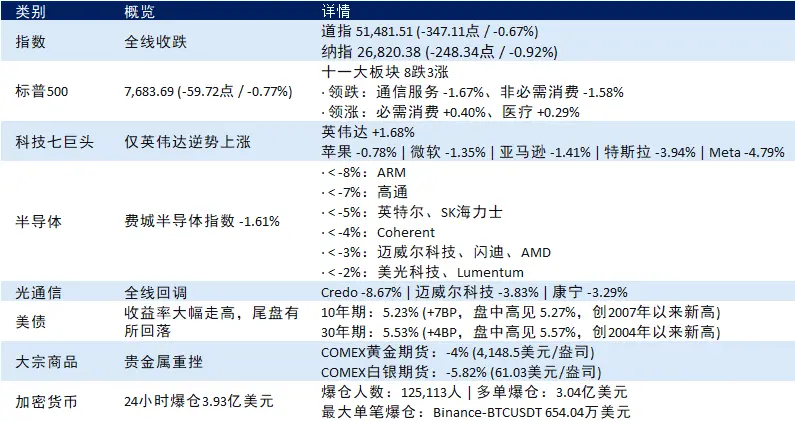
Stocks, Bonds, and Gold All Decline, Market Pricing in "Higher Rates for Longer"
The most noteworthy outcome of the day was not how much oil prices rose, nor how much a particular sector fell, but rather the simultaneous decline of stocks, bonds, and gold—three traditionally hedging assets. The traditional hedging relationship temporarily failed, and the market is focusing on pricing a single variable: higher rates for longer.
The starting point of this pricing chain was the escalation of tensions between the U.S. and Iran pushing oil prices up, with Brent crude breaching $100 during the session, thereby reinforcing inflation and interest rate hike expectations, pushing the 10-year U.S. Treasury yield to a multi-year high of 5.23%. Ultimately, the valuation anchor for overvalued tech stocks was revised downwards, with growth stocks like Meta, ARM, and Qualcomm declining far more than the broader market; gold, as a non-yielding asset, saw its opportunity cost rise with the increase in real interest rates, causing gold prices to plummet by 4%; bond prices were also pressured due to soaring yields. Oil prices and geopolitical conflicts acted as catalysts, but the true driver of the day's market was the re-pricing of all risk assets after U.S. Treasury yields reached multi-year highs.
Nick Twidale, Chief Market Analyst at AT Global Markets, reminded in a client report: "Geopolitical developments may keep global market volatility high."
Sector Breakdown: Semiconductors Hit Hard, Nvidia the Only Exception
The sell-off in the semiconductor sector was the most concentrated. The Philadelphia Semiconductor Index fell by 1.61%, but the declines at the individual stock level far exceeded the index performance. ARM dropped over 8%, Qualcomm over 7%, Intel and SK Hynix over 5%, with storage and optical communication stocks nearly all suffering losses.
Nvidia's counter-trend rise was the most notable individual stock event of the day. The company announced an additional $150 billion in stock buyback authorization, bringing its total buyback scale to $235 billion. This news somewhat offset the pressure on its valuation from the high interest rate environment and reflected management's judgment on the current stock price level.
MongoDB plummeted over 18%, marking its worst single-day performance since March. This was one of the largest declines at the individual stock level for the day, but it was driven by company-specific factors and had a lower correlation with the macro interest rate environment.
Gold mining stocks were all heavily impacted. AngloGold fell by 6.34%, IGO fell by 5.35%, Royal Gold fell by 4.82%, Newmont Mining fell by 4.41%, Barrick Gold fell by 4.17%, and Kinross Gold fell by 3.77%. The sharp drop in gold prices directly affected the earnings expectations of mining companies.
Chinese Concept Stocks Show Independent Trends
Against the backdrop of overall weakness in U.S. stocks, Chinese concept stocks rose against the trend, with the Nasdaq Golden Dragon China Index closing up 1.12% at 5751.39 points.
Among popular Chinese concept stocks, Maizhi Smart rose over 16%, NetEase rose nearly 5%, BOSS Zhipin rose over 4%, Beike rose over 3%, Huazhu Group rose over 3%, Zai Ding Pharmaceutical rose nearly 3%, and Li Auto rose nearly 2%. Kingsoft Cloud fell over 5%, Hesai Technology fell over 4%, and GDS Holdings fell over 3%.
On that day, Chinese concept stocks showed some divergence from the movements of major U.S. tech stocks, indicating that different markets and sectors reacted inconsistently to rising interest rates. Besides U.S. Treasury yields, their performance may also have been influenced by multiple factors such as individual stock fundamentals, valuations, market sentiment, and capital flows.
Institutional Analysis: JPMorgan Turns Bullish Before Non-Farm Payrolls, Goldman Sachs Warns of "Strong Index, Weak Confidence"
JPMorgan's trading department on Monday upgraded its stance on U.S. stocks from tactical neutral to bullish, citing reasons including stronger-than-expected economic activity, continued consumer resilience, robust corporate earnings growth, and the expectation that bond yields will stabilize. Andrew Taylor, Global Market Intelligence Head, stated in a client report that the downward volatility in oil prices and stabilizing yields are improving the risk-reward ratio, leading the team to abandon its previous cautious stance ahead of Friday's non-farm payroll data.
JPMorgan strategist Mislav Matejka released a report the same day noting that valuations for large tech stocks represented by the "Magnificent Seven" have fallen to a 10-year low, with the price-to-earnings ratio premium of large-scale cloud providers relative to the S&P 500 compressed to a low of over one standard deviation, indicating that the valuation correction process is largely nearing its end. The firm maintains an overweight position on semiconductors while holding a relatively cautious view on the software sector. However, JPMorgan also clearly stated that the tech sector is unlikely to return to the previously extreme strong performance.
Goldman Sachs provided a different perspective: the current U.S. stock market exhibits a "strong index, weak confidence" pattern. The S&P 500 index has risen 14% year-to-date, but Goldman Sachs' U.S. equity sentiment indicator has dropped to -0.9, matching the low from March. The median of S&P 500 constituents is 16% below its own 52-week high, and market breadth indicators have fallen to their lowest levels since the internet bubble era. Goldman Sachs believes this divergence means that if uncertainties around interest rates and economic growth dissipate, there is room for both the overall market to rise and for lagging stocks to rebound.
What to Watch Next
The direction of U.S. Treasury yields remains the most critical variable for the current U.S. stock market. Whether the 10-year yield can stabilize above 5.2% and whether the 30-year yield will continue to break above 5.5% will determine whether the valuation anchor for overvalued assets needs further downward adjustment.
This week, the U.S. September non-farm payroll report is set to be released, with the market expecting about 100,000 new jobs, down from a previous value of 160,000, and the unemployment rate is expected to rise from 4.1% to 4.2%. The current market is pricing in a roughly 66% probability of a 25 basis point rate hike by the Federal Reserve in October. If the data is significantly strong, it may reinforce rate hike expectations and exert further upward pressure on yields; if the data is weak, it may alleviate interest rate pressures to some extent. JPMorgan adjusted its view ahead of the non-farm data release mainly based on its judgments regarding economic activity, consumer resilience, corporate earnings, and bond yield trends.
Regarding oil prices, Trump stated that U.S. and Iranian negotiators have exchanged information through mediators but did not disclose specific details, only saying, "We will win" and "The situation will be resolved soon." Any changes in the Middle East situation could trigger a new round of volatility in energy prices, thereby re-pricing inflation expectations and interest rate paths.
Data Note: The above market data is based on the closing of U.S. stocks on September 28. Cryptocurrency liquidation data is based on CoinGlass statistics. U.S. Treasury yields distinguish between closing levels (10-year at 5.23%, 30-year at 5.53%) and intraday highs (10-year at 5.27%, 30-year at 5.57%).
Disclaimer: The content of this article is for general information and market commentary purposes only, compiled from publicly available information as of the time mentioned in the text. Relevant market data, expectations, and probabilities may change with market conditions. The views and investment strategies cited from third-party institutions, analysts, or other individuals only represent those third parties at a specific time and do not represent the views or recommendations of BIT. This article does not constitute investment advice, investment research, an offer, solicitation, or recommendation for any securities, investment products, or trading strategies, nor should it be the basis for any investment decisions. Financial markets carry risks, and securities prices and market performance may fluctuate; past performance and historical market trends do not represent or guarantee future results. Investors should independently assess relevant risks based on their own circumstances and seek professional advice when necessary.
 Risk warning



Popular articles





