








Dragonfly Managing Partner Speech Full Text: Agents + Crypto, What is Real, What is Self-Comfort?
 Core Viewpoint

 It is not your agent that needs encryption, it is you that needs encryption.
Compiled by: ChainCatcher
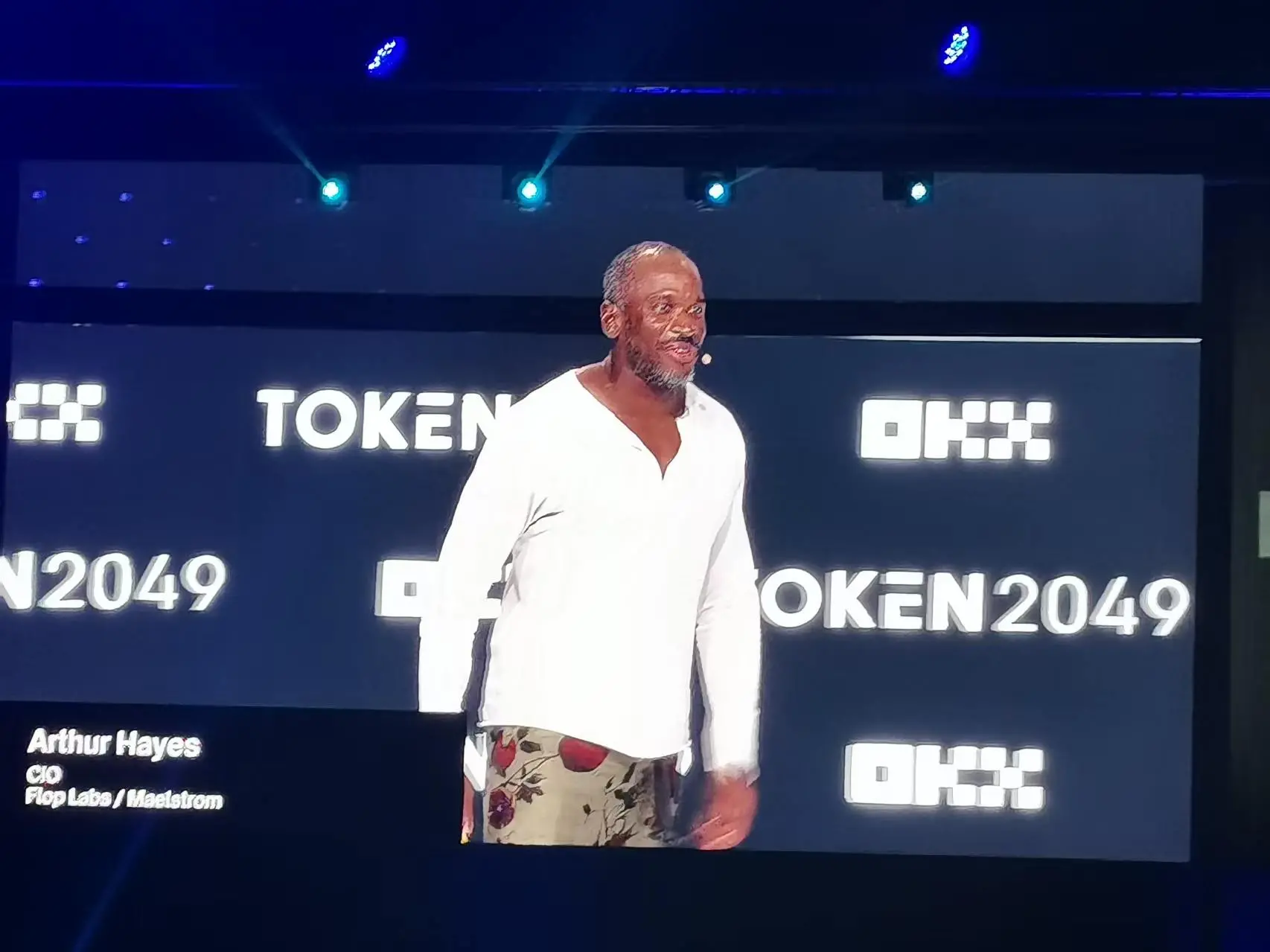
On October 7, at the TOKEN2049 conference in Singapore, Haseeb Qureshi, Managing Partner of Dragonfly, delivered a keynote speech titled "Agents + Crypto: What's Real & What's Cope." Below is the full text of the speech, organized by AI.
1. Confession: I Was Wrong
First, a self-reflection. I have been discussing agents and crypto for some time, and I was wrong. I once asserted that agents would all use crypto, and that traditional financial systems could never be ready before agents went live. That turned out to be incorrect. The reality is: your agent does not need crypto; you need crypto.
Let's recall the market narrative from earlier this year: everyone was saying that agentic payments would explode, the curve was trending upwards, "It's so obvious—real users of crypto won't be ordinary humans, but AI."
2. Reality: Agents Are Using Credit Cards
That curve only extended to last November. What happened afterward? It turned downwards. It turns out agents are not using x402 (Coinbase's agent payment protocol) on a large scale—90% of the payment volume on x402 is just exploiting rewards, which is very "crypto."
But agents are indeed here: various consumer-grade agent products are growing rapidly, and OpenAI is also involved. What are they using? Cards, credit cards, just like all of us. Companies like Rain, Visa, Ramp, and Stripe have launched agentic card products—generating sub-cards under your main card, with limit settings and spending restrictions. All these companies are clearly aware that agentic commerce will be a big deal, and they are ready for it.
I am also using an agent. I set it up with a crypto wallet, but the things it can buy today are limited; I also gave it a card—most of the things it helped me buy were with the card. In the current consumer payment scenario, cards are basically the answer. Cards are certainly not omnipotent: they are ubiquitous in developed markets like the United States, but not everywhere in the world, while agents will be everywhere. So cards are not the only answer, but the narrative from earlier this year that "agents will use crypto, and traditional systems won't be ready"—was wrong; the systems are already prepared.
This is the "cope" part: aside from conventional uses like international payments and large transfers, the intersection of agents and crypto is not as significant as the narrative suggested earlier this year—what agents will do with crypto is quite similar to what you do with crypto today. But agents will fundamentally change other aspects of crypto, and that is the key point.
3. Agents Make Difficult Things Easy: Governments Are Being Overwhelmed
The most important realization about agents is: agents make difficult things easy. Governments around the world are feeling this, and they are panicking—because government services have long relied on a vast bureaucratic maze, betting that ordinary people cannot easily navigate this system: submitting court lawsuits, filing complaints with the Consumer Financial Protection Bureau (CFPB), applying for benefits, lodging housing complaints, all blocked by layers of thresholds.
Now, almost every such service around the world is experiencing an explosion in applications—governments are being "overwhelmed" by AI agents: agents faithfully represent their owners in consuming public services. The problem is: governments were never designed for "everyone to easily submit complaints." These systems are actually "secret rationing systems"—relying on "too difficult, too annoying" to implicitly limit access, and this mechanism has failed in the age of agents.
4. Agents Make Crypto Reliable: Protecting You from Your Own Foolishness
"Making difficult things easy" also applies to another area: crypto itself is too difficult—people don't know how to use wallets, don't understand gas fees, don't get cross-chain bridges, so ordinary people are afraid to use it. And ordinary people are not just afraid; they are really making mistakes: getting hacked, falling for phishing, getting trapped in honeypots, with a significant proportion of assets permanently lost due to such errors just by looking at on-chain records.
This means one of the biggest ways agents change crypto is by making it more reliable—protecting you from your own foolishness.
Why do we trust banks? To be honest, I have been in crypto for over a decade, and I still feel nervous when transferring a large amount of money with a wallet—what if I accidentally send money to North Korea? But I never have that worry when transferring money in a bank account because banks protect me from my own foolishness: if I really tried to send money to North Korea, the bank would stop me. This works because there is an intelligent layer—banks—sitting between me and my money, acting as my intelligent agent to manage mistakes.
Once AI becomes the API to crypto, the same thing will happen in the crypto world: you will never be phished, hacked, or scammed; you won't mistakenly enter a fake interface due to DNS poisoning; if a contract is attacked, the agent will check for you first; you think you copied an address, but it actually belongs to North Korea—agents will always verify for you. Agents will never be lazy, will never skip steps, will never get tired, and will never make the mistakes you would make. Five years from now, the way we use crypto will not be the same as today, and people's trust relationship with crypto will also be reshaped.
5. Privacy Has Never Been a Right; It's Friction
My view may be harsh: privacy has never been a right, and we have never truly had effective privacy—it is actually a form of rationing. It's not that the government doesn't allow you to assert rights, but rather that the reality of "it's too troublesome" filters everyone out.
A U.S. Supreme Court Justice made it clear in a GPS tracking case: in the pre-computer era, the greatest protection of privacy was neither constitutional nor statutory, but practical—it's not the law that grants you privacy, but the reality that "the police don't have the time to follow every suspect 24/7" that protects you.
Technology has changed the balance. Dario Amodei, founder of Anthropic, pointed out the same thing in his confrontation with the U.S. Department of Defense: powerful AI makes it possible to "automatically and on a large scale piece together a complete picture of anyone's life"—our data has long been scattered in various leaks, and information about everyone is floating in the dark web. The only thing that could previously stop others from piecing together "who you are and what you are doing" was cost.
The recent controversy surrounding the U.S. camera company Flock is an excellent example: having cameras at street corners is already common and not illegal; the difference lies in scale—when every street corner has a camera, and AI can instantly retrieve all footage, the sheer number becomes a qualitative change, and suddenly the government can "always know where everyone is." The only change is technology.
The crypto world is seeing the same thing: physical attacks against crypto holders are expected to rise significantly in 2025-2026, with reported physical attacks reaching an all-time high. For those whose holdings are publicly traceable, the past self-comfort was "who would bother with this? I'm just a small fry." Previously, bad actors had to invest significant effort to target you; today, you no longer need that motivation.
6. Under the Panopticon: AI Empowers the State, Crypto Empowers Individuals
This "Panopticon" is a significant part of the reason for crypto's existence. In this dimension, the two technological directions are opposite: AI fundamentally empowers the state—it eliminates the traditional constraints of the state being "too slow, too stupid, and unable to understand data"; whereas crypto, on the contrary, shifts power from the government to individuals. In a world where the government is becoming increasingly powerful and capable of seeing everything, crypto is your only hedge.
But the historical dilemma of privacy is: people say they care about privacy, but their actions tell a different story—they willingly hand over chat records to Meta, ChatGPT, and Google. Privacy only wins when it is "easy," never because it is "important." History repeatedly proves: the internet only saw encrypted connections become the default when Let's Encrypt made HTTPS certificates nearly free—previously, SSL was slow and expensive, only used on checkout pages; chat tools only became widely used when Signal became user-friendly and WhatsApp implemented end-to-end encryption, allowing billions to truly adopt them. Recently, Zcash has been demonstrating the same thing: UX improvements can directly explain the increase in shielded address usage.
My core judgment is: AI will bring about the same transformation for privacy. Your AI agent will become your guardian against privacy violations: when your agent is powerful enough, you just need to say "make me invisible"—erase my public footprint, provide me with top-notch operational security, delete all information about me from the dark web, and simulate "if you were a bad actor, how would you find me, attack me." Privacy protocols like Zcash are indeed still difficult to use today, but when agents become your interface to crypto, all of this will come at zero cost to you—"don't use Bitcoin for this, use Zcash; don't use plaintext, use encrypted text."
7. The Final Piece: Private AI
The final piece of the complete picture is private AI. Take the privacy-protecting AI platform Venice (part of Dragonfly's investment portfolio) as an example: it is equivalent to "private ChatGPT," operating on an encrypted track. You can even use it completely anonymously—just register with an Ethereum address and pay with stablecoins.
I believe this will be the most important battle in the realm of civil liberties over the next decade: first, how to protect oneself from the encroachment of expanding state power; second, how to maintain control over AI—AI will become the most politicized technology of the next decade.
8. Conclusion
The stories that "agents will use crypto to do everything they do"—I believe are unfounded. For most consumers, agents will use the same things as you. But my ultimate conclusion is: it is not your agent that needs crypto; it is you who needs crypto.

 Risk warning


Popular articles





