He Yi: Binance All in AI, hopes financial products will be as simple as scrolling through short videos
 Core Viewpoint
 He Yi elaborates on Binance's All in AI strategy: using AI to lower the financial usage threshold, promoting the expansion from trading to wealth management, payments, and financial management. Emphasizing security, data, and continuous investment as core barriers (with a net investment threshold of one hundred million dollars per year), and proposing a vision for personalized, conversational products to achieve financial equity, while reiterating the business logic of earning revenue through transaction fees and not gambling against users.
Source: Binance Square
Compiled by: Wu Says Blockchain
On October 6, 2026, Binance co-founder He Yi shared insights during a Chinese AMA at the Binance Smart Product Launch Conference, discussing topics such as AI strategy, financial equity, product interaction, and user data, while also addressing the platform's business model and her personal situation.
He Yi stated that Binance adopts an All in AI strategy, hoping to help ordinary users understand investment logic through AI, thereby narrowing the gap in investment knowledge and tool usage. She believes that competition in financial AI depends not only on models and programming capabilities but also on security, data, and continuous investment, with a net annual investment of one hundred million dollars being a threshold. She cited the iPad and short videos as examples, suggesting that financial products should lower the barriers to use, making trading, wealth management, and payments simpler.
In the Q&A session, He Yi recalled her early investment days when she also followed FOMO, reminding users not to look for trading hints in her and CZ's tweets. She also addressed questions about personalized recommendations and whether user data is used for model training, stating that Binance's revenue comes from transaction fees and does not involve betting against users. At the end of the live stream, she revealed that she is pregnant again, and her workload has not decreased, with her overall health and life situation being good.
Guest speeches do not represent Wu Says' views and do not constitute any investment advice; please strictly follow local laws and regulations. The audio transcription and compilation were completed by GPT and may contain errors.
From Trading to More Comprehensive Financial Services
I have previously mentioned that Binance aims to become the future financial infrastructure. In this process, we see AI has arrived. This is particularly like electricity and light bulbs have been invented, but the products we use and the overall user experience may still be at the level of a candle factory. The candlesticks we see in K-line charts every day indeed resemble a "candle factory." Therefore, this year we are very clear that we need to drive the entire product change with blockchain technology and AI technology.
Although trading may be the product everyone is most concerned about, wealth management is life, and payments are daily routines. Our trading is no longer limited to crypto assets; we have also included precious metals and traditional stock-related assets, while developing functions such as wealth management and payments. Investment may still have gains and losses, so it is essential to manage risk well. When users place their assets on the platform, it is a trust in us, which makes us feel that we need to invest more energy, cost, and resources in security every day.
The Square is our social product. Sometimes in the crypto circle, one might feel a bit lonely; I have felt this way myself. Many people understand the crypto circle as a gray industry or find this industry strange. If you often invest and trade, you may not work much, and your relatives and friends might feel that even if you make money, it is "not a proper job." We hope everyone can find more like-minded friends in the Square and provide a platform for creators with insights who might be drowned out in larger social media.
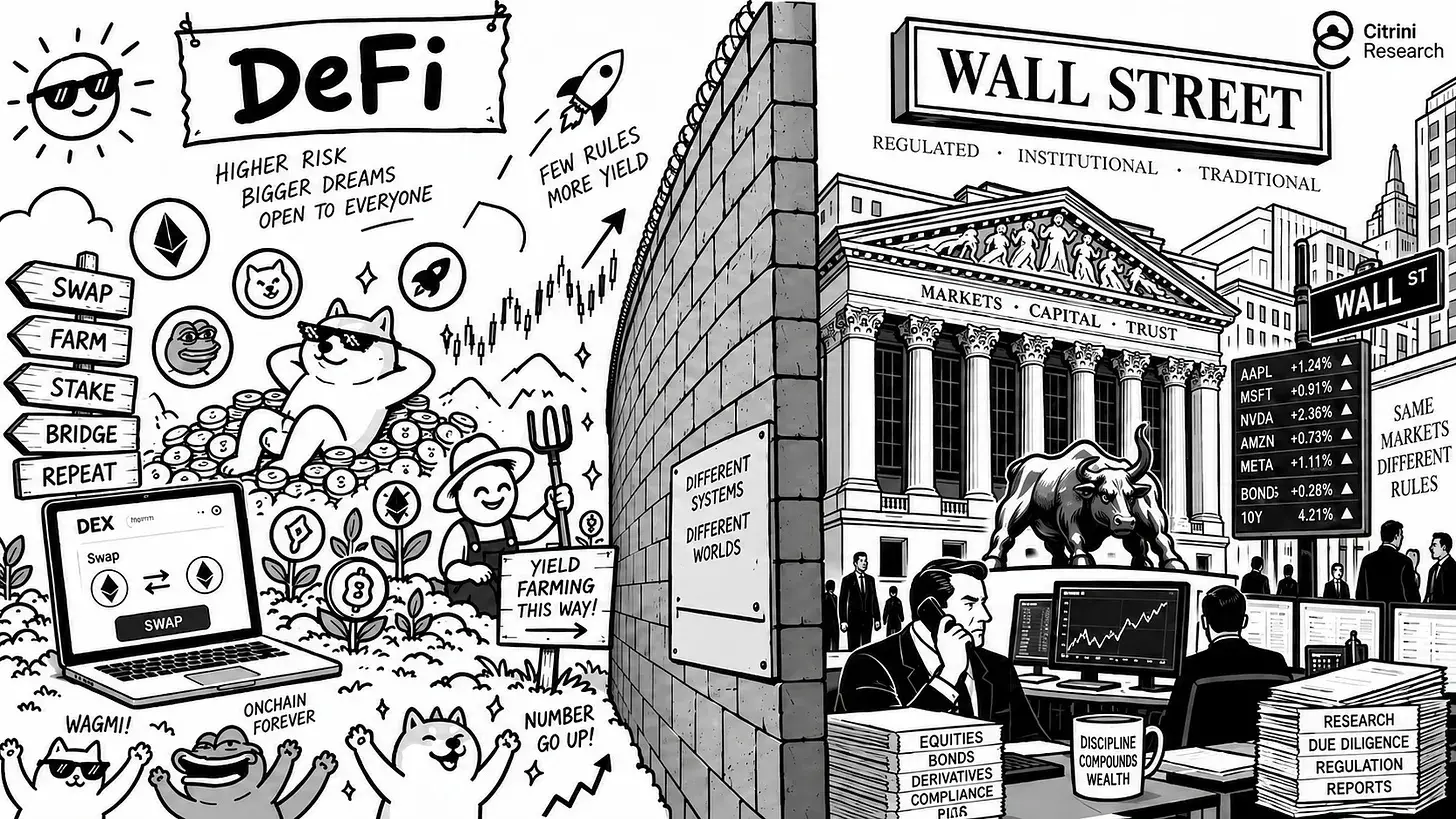
Regardless of whether it is blockchain or AI, no matter how strong the technology, it ultimately needs to serve users. We try to keep technology "under the table" as the support for the entire platform. In the past, we often said we needed to compete with traditional finance and defeat Wall Street, but after all these years, I believe this is actually a process of integration. The world is not black and white; change is also gradual and spirals upward.
Why is Binance All in AI?
For Binance, one of our major strategies is to fully invest in AI, which is to be All in AI. I hope ordinary users can gain financial equity from this, which can be called financial equity or information equity. We hope to present the relatively mature analytical methods in the financial industry, whether on-chain analysis or investment analysis, in a simple and structured way. Even without any investment background, AI can help users understand the underlying logic of investments and learn about different analytical methods that align with their preferences.
I often think about what I would truly need if I were an ordinary user; if I were a user with AI programming skills and entrepreneurial abilities, what could Binance offer me? I may not be a professional product manager or a technical person, but I feel I am good at standing on the user's side and looking at what kind of products are needed from the user's perspective.
Why is there a "net annual investment of one hundred million dollars" threshold in the financial sector?
We can all use agents and AI programming to create a strategy, and it can indeed run. Some friends might say that placing orders and writing strategies can also be done with AI programming. But for Binance to do this, in addition to models, computing power, and programming capabilities, there are several very important foundations: platform security, data, and users.
Our advantages are, first, security protection, and second, the existing underlying data of Binance, including historical and current data. There is a lot of publicly available code in the programming field on GitHub, but when it comes to trading or financial data, you will find there is not that much free and open data. Those who have done AI training should understand the importance of clean data. We have a data foundation accumulated over the past nine years and hope to layer security protections to turn seemingly unattainable AI into AI that ordinary people can truly use.
If we compare startups with companies like Binance, I simply believe that in the financial field, a net annual investment of one hundred million dollars is a threshold. Of course, it is not that having a lot of money determines the outcome, but it will become a threshold. Smaller companies may indeed run faster, while larger companies have more foundational data and security accumulation. After all, we are in an industry where "if security is not done well, everything else is zero."
I also followed FOMO when I first learned to invest; how can AI narrow the gap?
Essentially, Binance is addressing the issue of "freedom of money." In Chinese, I feel we are trying to solve the problem of financial equity. This includes several levels, the first being the right to know. The investment markets in Europe and America are relatively mature, and many users are familiar with investing and buying stocks, but there are many countries in the world where people have no concept of stocks or investments at all.
Before I turned twenty, I may not have had a clear concept of investment; I only started trading stocks in 2008 and gradually understood investment. Before that, I felt there was no place to learn, and I basically followed FOMO, similar to many newcomers in the field.
I hope that through AI, a new user can understand that macro environments and breaking news can affect markets and prices. For individual projects, whether it is a coin or a stock, the company's financial reports, public information, income, buybacks, etc., may all relate to its performance. Many people buy coins or stocks just because friends say "buy this for sure to make money," and then they follow suit. We hope to present the driving factors behind price fluctuations.
Of course, you could say that when everyone can use AI to learn this knowledge, everyone returns to the same starting point. But this is still meaningful because it continuously narrows the gap between those who have no concept of investment and those who do, gradually leveling this disparity.
The second is to lower the entry barrier. Registering and becoming a user with traditional brokers may have relatively high barriers. We hope to allow users to participate in stock investments with five dollars through blockchain and AI. AI not only helps with trading but can also assist in wealth management. For users in high-inflation countries, holding stablecoins and participating in wealth management is also a form of financial equity. On one hand, it is about equity in capability; on the other hand, it is about equity in barriers. As for users who already know how to trade, they can continue to learn and research to use tools better.
We hope users start with beginner-friendly products, using clear, structured, plug-and-play features that are easy to use, and then further experience AI Pro, and later try writing their own code. I might be a typical example of self-learning, so I hope to give users such opportunities. I believe this may be the direction that Binance and the entire financial industry will take in the AI era.
We hope to make trading as simple as scrolling through short videos, allowing everyone to have their own agent
I believe "less is more." The biggest problem with current products is that there is too much content, and many novice users cannot understand it at all. This is also why we allow complete customization of the homepage: keep what is useful to you and remove what is not. As personal AI and personalized AI continue to iterate, ultimately, the homepage on your phone may be completely different from others. Next, we hope to delegate many tasks to AI through dialogue while retaining information about market changes and breaking news that you want to pay attention to.
I believe Apple has created an epoch-making product; even a three-year-old child knows how to open and use an iPad. Essentially, it has lowered the barriers to use through the product. TikTok and Douyin are also remarkable, simplifying the operations of uploading, interacting, and watching. I have worked on mobile video products, and before this product form appeared, video products had barriers for many users. But now, whether it is a three or four-year-old child or an elderly person in their eighties, uploading and receiving information is very smooth. It is not surprising that such products can win because they align with human nature and greatly lower the barriers to use.
I hope that one day Binance can also achieve zero barriers for finance, trading, and daily payments. This is also why we started doing voice input and output. I believe typing itself is a forced behavior that we have to learn, and I hope that in the future, even typing and inputting these operations can be eliminated. Simplicity is not only reflected on the homepage but also in interactions; this is a continuously evolving process, and of course, there will be many challenges. Many people ask what Binance's biggest challenge is, and my answer is talent.
I am not a trader, and I feel it is difficult for ordinary people to learn such complex trading knowledge. So I often think about what I hope Binance's products would be like as an ordinary user. For example, you tell AI to buy a certain amount when BTC reaches a certain price, and it can help you execute it without needing to study complex trading pages. I often lack patience when trading; sometimes I place an order but it does not get executed because the price has risen, and the original quoted price cannot be fulfilled, so I can only wait. With AI products, you tell it your requirements and conditions, and it can help you complete the task.
At this stage, I hope AI can smoothly complete these actions: you give the conditions, and it helps you execute. This has already been realized, but I hope to further enhance it. In the future, I hope it can judge your preferences, whether you are a long-term holder or a trader, whether you prefer dollar-cost averaging or grid trading, and then recommend some structured investment strategies that you only need to confirm. We also hope everyone can have their own personal agent like Iron Man.
Will user holdings be used to train AI? Will recommendations differ based on treatment?
Regarding whether there will be different treatments based on capital amount or VIP level, I believe there is no such distinction. Our logic is to structure existing knowledge and then make recommendations based on individual behavioral preferences. For example, I am a typical non-trading user; pushing trading content to me every day is useless; I may be more concerned about what happens in the market daily.
This is also why I encourage everyone to customize their homepage. If you always use the default template and do not interact much with the platform, we will not understand your behavior and profile as well. We may not delve into particularly detailed personal data but rather categorize users based on interests and behaviors, similar to how TikTok tags users with interest categories.
As for whether the data provided by users will be used for model training and whether it can be turned off autonomously, our current exploration of user data may not have reached such a deep level yet, but we will consider this suggestion.
Those who make money say "I love you," while those who lose money curse me for cutting leeks; what exactly does Binance profit from?
The market always has fluctuations; some people make money while others lose money. In recent years, every day feels like living in "a world of ice and fire." Those who made money message me daily, saying "I love you"; those who lost money curse me daily, claiming that the money they lost must have gone into He Yi's pocket.
But Binance has a fundamental principle: only earn the money that belongs to us. Our logic is to earn transaction fees. First, we do not gamble against our users; second, we will not take a single cent from our users. If there are problems, we take responsibility. We are definitely not a perfect platform, but we will do our best to continuously evolve. Where everyone puts their money is where they place their trust.
I also hope everyone takes a more cautious view of the money they hold. Some friends think meme coins are a good opportunity, that they can "take a chance and turn a bicycle into a motorcycle," but don’t obsessively watch my or CZ's tweets for every word. The tokens that emerged in the last cycle did not come from obsessing over words, and this has become a profit-making method for some token issuing groups. Don’t be so FOMO, don’t let others lead you by the nose, and have your own independent judgment.
He Yi Talks About Recent Health Condition: Reveals She is Pregnant Again
Recently, due to some special health reasons, I have indeed been physically weak and have been tweeting less. But I will still try to look at the product feedback and needs everyone has raised to solve problems for you. I just received many private messages asking what health issues I have and telling me to take care of myself. Actually, it’s fine; it’s a good thing.
During the event in Hong Kong this year, I was actually pregnant, but because I was too tired at the time, I couldn’t keep that baby. I feel that maybe this little one just wanted to say, "I want this mom." So now I happen to be pregnant again.
My daily work has not decreased; I am still sitting in the little cubicle you see in the photos, chatting with everyone, so I am indeed a bit busier and more tired. But overall, whether it’s Binance, life, or health, everything is quite good.

 Risk warning