The September CPI will be released tonight, with the core at 0.2% or 0.3%—the final test before the Federal Reserve's October decision

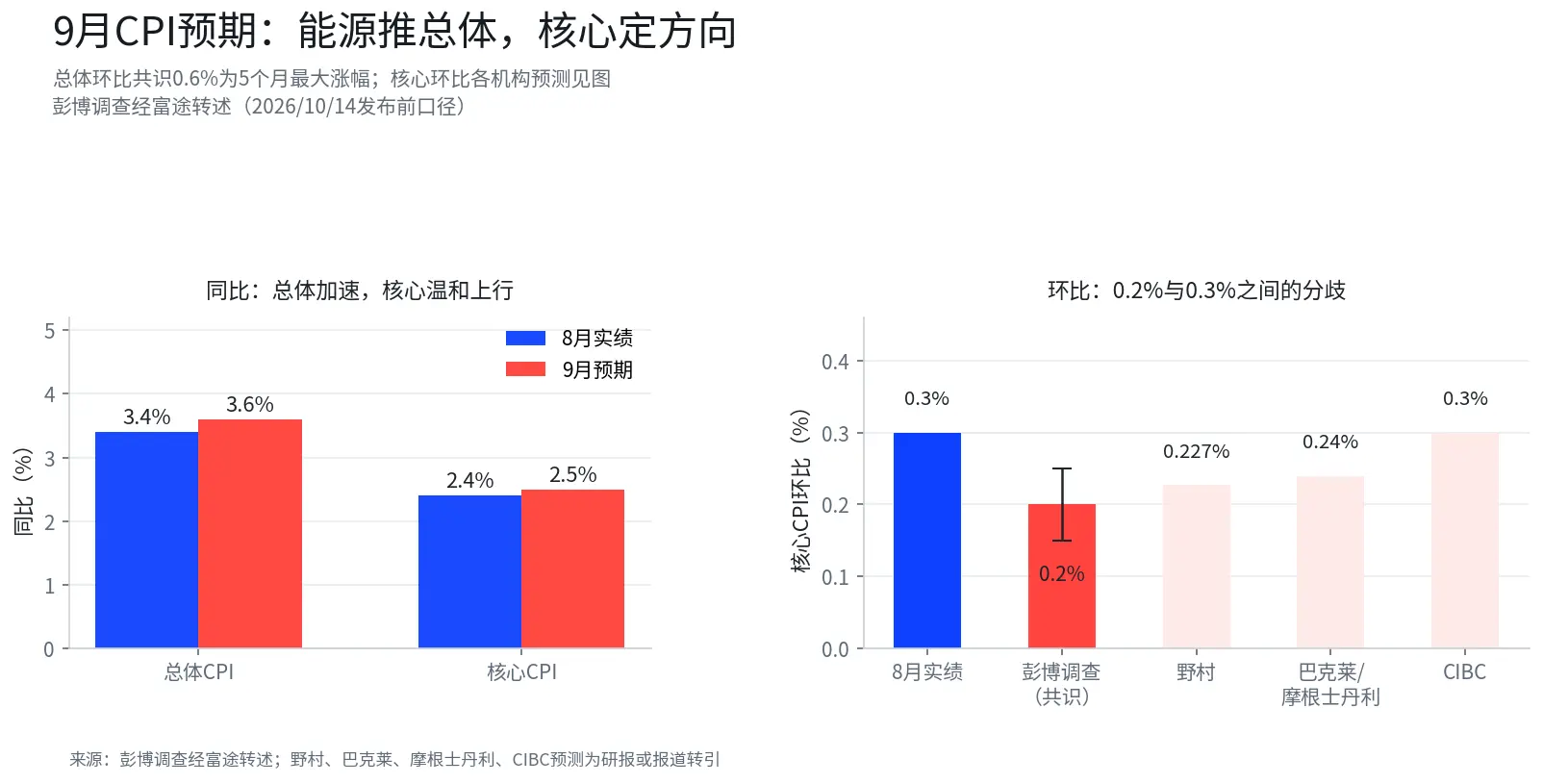
Introduction: At 20:30 tonight, the market will receive the last inflation report before the FOMC meeting on October 27-28. The market needs to guard against not just a jump in overall CPI, as the rise in energy prices is already a consensus, but rather the direction in which core CPI deviates from expectations. A 0.2% increase corresponds to a continuation of the status quo in October, while a 0.3% increase corresponds to a renewed expectation of interest rate hikes. New York Fed President John Williams also provided a new anchor on Tuesday, stating that one more rate hike this year is appropriate, there is no need for rate hikes in 2027, and that he has not seen widespread price pressures outside of the AI and energy sectors. This report will test both directions.
I. The Jump in Overall Inflation Should Be Attributed to Energy
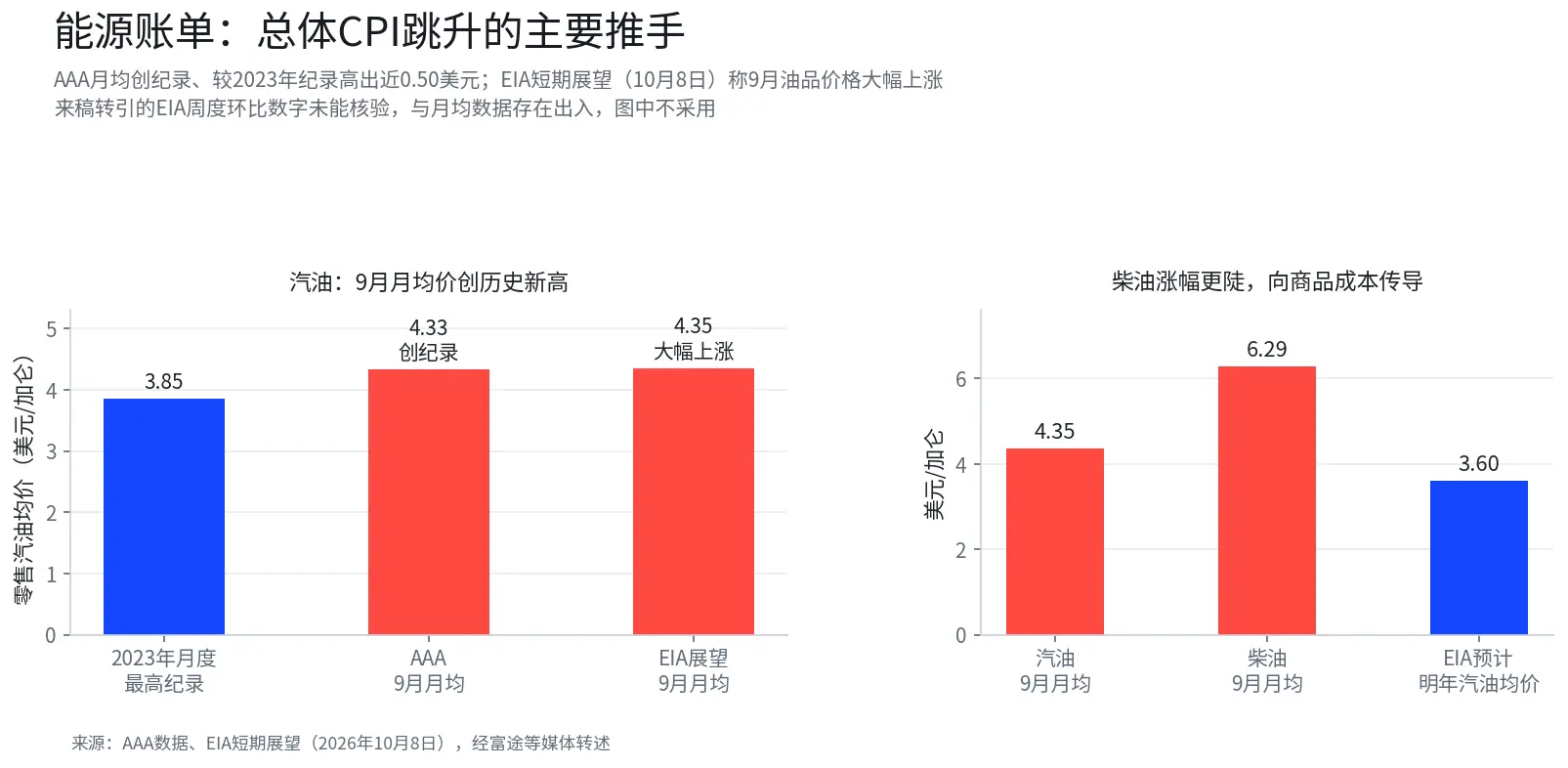
The biggest disturbance in the September CPI data came from energy. According to AAA data, the average retail price of gasoline in September reached a record $4.33 per gallon, nearly $0.50 higher than the previous monthly record set in 2023. The EIA stated in its short-term outlook released on October 8 that retail gasoline and diesel prices in the U.S. rose significantly in September, with gasoline averaging about $4.35 and diesel about $6.29, driven by rising crude oil prices and higher refining margins. The month-on-month increase figures from the EIA's weekly survey (approximately +7.3%, year-on-year +37.6%) could not be independently verified and differ from the aforementioned monthly average data, so the text only uses directional statements. Overall CPI is expected to rise by 0.6% month-on-month and about 3.6% year-on-year, which is the market's consensus pricing in response to the energy shock.
The jump in energy is not the core issue. Bank of America economist Stephen Juneau believes that if core inflation comes in at 0.2% month-on-month, market expectations for interest rate hikes will not significantly heat up. If it reaches 0.3%, it may reignite speculation that the Fed needs to continue tightening in October (as reported by Futu).
II. Three Reasons for the Slowdown in Core Inflation, and Three Counterarguments
The baseline expectation is for core inflation to slow to 0.2% month-on-month, down from 0.3% in August. Support comes from three areas.
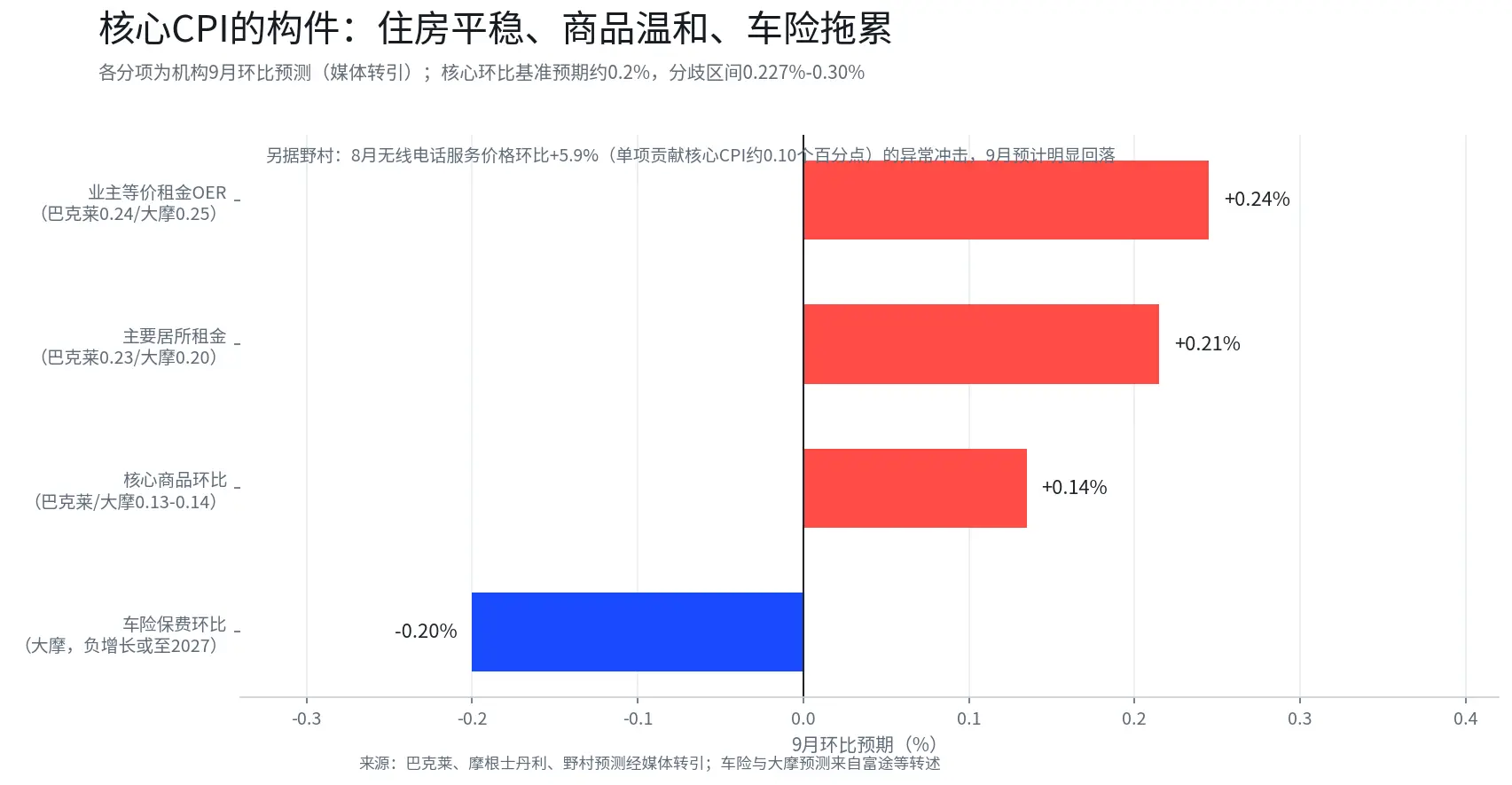
First, a technical retreat in wireless telephone service prices. The core CPI exceeded expectations in August mainly due to a month-on-month surge of 5.9% in wireless telephone service prices, contributing about 0.10 percentage points. Nomura believes this temporary shock will significantly fade in September, predicting a month-on-month core inflation of 0.227%, while also indicating that airfares, medical costs, and housing still have upward pressure (as reported by Futu).
Second, housing inflation is stabilizing. According to public reports, the housing component is the largest single item in the CPI (with a weight of about 35%, the 35.3% mentioned could not be independently verified). Barclays predicts a month-on-month increase of 0.24% for owners' equivalent rent and 0.23% for primary residence rent in September. Morgan Stanley predicts these figures to be 0.25% and 0.20%, respectively, noting that housing inflation has averaged about 0.24% since May, slightly lower than the pre-pandemic long-term trend of about 0.26%.
Third, core goods lack upward momentum. Barclays and Morgan Stanley predict that core goods will maintain a month-on-month increase in the range of 0.13% to 0.14%, essentially flat with August. Morgan Stanley predicts a month-on-month decrease of 0.20% in auto insurance premiums, with negative growth potentially continuing until 2027 (as reported by the media). The slowdown in core goods indicates that the current surge is mainly driven by localized energy shocks, with limited diffusion to core consumption and services.
Counterarguments are also specific. The RBC economist Mike Reid team believes the likelihood of a significant slowdown in core inflation is limited; if core inflation remains high for a second consecutive month, the possibility of an interest rate hike in October may arise again. The upward risks listed by Futu include airfares, hotel costs, auto parts, and the recent surge in diesel prices transmitting to commodity costs. CIBC Chief Economist Avery Shenfeld expects a core inflation of 0.3% and believes there will be a rate hike this month, reasoning that "there are still too many categories growing at over 3%."
III. The Divergence Between 0.2% and 0.3%, Where Does the Market Stand?
CME FedWatch shows that traders currently believe there is about a 77% probability that the Fed will keep interest rates unchanged this month, compared to about 51% a month ago (as reported by Futu, data from October 14. The 17% probability of a rate hike mentioned differs from this statistic, and the text adopts the approximately 77% corresponding to just over 20%). The market has now priced in the cumulative expectation of three rate hikes, including September (as reported by Futu). The path judgments from investment banks also show stratification; Piper Sandler's Kurt Lewis expects the Fed to reassess the inflation outlook after accumulating three rate hikes. Stifel's Lindsey Piegza believes at least three to four more rate hikes are needed to control inflation (this view only represents the judgment of the relevant institution). Williams' statement on Tuesday serves as an anchor in the opposite direction, suggesting that one more rate hike this year is appropriate, no further tightening is needed in 2027, and there are no signs of labor market pressures pushing inflation.
IV. Policy Background: The Minutes Mentioned Energy and AI as Causes of Inflation
The minutes from the September meeting (released on October 7) show that 19 officials unanimously supported raising rates by 25 basis points to a range of 3.75% to 4.00%, marking the first rate hike since July 2023. Most participants believe that further increases in the target rate range may be appropriate this year, while emphasizing an open attitude toward each meeting. The minutes point out that ongoing geopolitical tensions have driven up crude oil and refined oil prices, and the surge in AI-related investments has also intensified inflationary pressures. Fed staff raised their inflation forecasts for 2026 to 2028, expecting inflation to return to 2% by 2029, a year later than the July forecast. Several officials observed that the impact of AI construction seems to be strengthening, while the effects of tariff increases are diminishing. Some officials also believe that the current level of interest rates has only a moderate limiting effect. These statements, when placed alongside Williams' dovish remarks, indicate that the internal divisions within the Fed are focused on the pace rather than the direction, with tonight's core CPI being the next input variable in this divergence.
V. Three Numbers to Watch Tonight
First, the relative position of core CPI month-on-month at 0.24%. A figure of 0.2% or lower would cool expectations for rate hikes, providing breathing room for high-valuation assets. A figure above 0.25% could raise expectations for a December rate hike, and long-term yields may retest previous highs.
Second, the month-on-month change in the housing component. If OER and rent continue to fall in the range of 0.2% to 0.25%, the baseline path for core inflation will not be disrupted. If it rises again, the narrative of core slowdown needs to be re-evaluated.
Third, core service prices. The core service growth rate in August was about 3% (according to reports), and price increases in the service sector often persist for several months, with their trends reflecting inflation stickiness better than overall CPI. Thursday's PPI will also be used for the Fed's preferred core PCE calculation, and both data sets will enter the input list for the October 28 meeting.
Based on the overall situation and public information, one possible scenario is that the overall reading is slightly high, while the core meets or is close to expectations, allowing for the continuation of pricing for no action in October. If the core falls on the side of 0.3%, the consensus on pace adjustments needs to be reassessed.
Data Explanation
CPI Expectations: Bloomberg survey as reported by Futu, statistics before the release on October 14, 2026.
Energy Prices: AAA monthly average, EIA short-term outlook (October 8). The month-on-month figures from the EIA's weekly survey could not be independently verified and differ from the monthly average data.
Component Predictions: Barclays, Morgan Stanley, Nomura, RBC, CIBC, and Bank of America are research reports or economist statements as reported by the media.
Meeting Minutes and Official Statements: September FOMC minutes (released on October 7) and Williams' statement on Tuesday, as reported by the media.
Rate Hike Probability: CME FedWatch as reported by Futu, data from October 14.
Disclaimer: The content of this article is for general information and market commentary purposes only, compiled based on publicly available information as of the time mentioned in the text. Relevant market data, expectations, and probabilities may change with market conditions. The views and investment strategies of third-party institutions, analysts, or other individuals quoted in this article only represent the views of the relevant third parties at a specific time and do not represent the views or recommendations of BIT. This article does not constitute investment advice, investment research, an invitation, solicitation, or recommendation for any securities, investment products, or trading strategies, nor should it be the basis for any investment decisions. Financial markets carry risks, and securities prices and market performance may fluctuate; past performance and historical market trends do not represent or guarantee future results. Investors should independently assess the relevant risks based on their circumstances and seek professional advice when necessary. BIT's Hong Kong stock trading services are not provided to residents of Hong Kong or users in other restricted jurisdictions.
 Risk warning