How should merchants choose a cryptocurrency payment solution? A comprehensive comparison of security, settlement efficiency, ease of integration, and fees

 Cryptocurrency payment is not the same type of product. This article categorizes market solutions into four types: internal platform payments, on-chain payment gateways, hybrid solutions, and fiat settlement processors. It compares solutions such as Binance Pay, Coinbase Business, SuperEx Pay, BitPay, and NOWPayments from four dimensions: security, settlement efficiency, ease of access, and fees, and finally provides a checklist for pre-access evaluation.
First Clarification: Cryptocurrency Payments Are Not the Same Product
1. Internal Platform Payments
Both the payer and the merchant are within the same platform ecosystem, and funds are transferred through an internal ledger.
Advantages include:
No need to wait for block confirmations;
Typically does not incur on-chain Gas;
Payment status can be confirmed instantly;
More suitable for high-frequency, small-value payments.
The limitation is that both the payer and the merchant usually need to have corresponding platform accounts.
2. On-chain Payment Gateway
The system generates an on-chain address for the order, and users can pay from any compatible wallet.
This method is more open, but payment speed and actual costs can be affected by blockchain network, number of confirmations, and Gas fluctuations.
3. Hybrid Payment Solutions
Hybrid solutions support both on-chain receipts and internal platform settlements. Merchants can choose different paths based on customer source, order amount, and payment scenario.
4. Fiat Settlement Payment Processors
Customers pay with cryptocurrency assets, and the payment service provider is responsible for conversion, settling funds to merchants in fiat currencies like USD or EUR.
This model is closer to traditional payment processors but usually requires stricter corporate certification and may incur higher overall fees.
Core Comparison of Five Payment Solutions
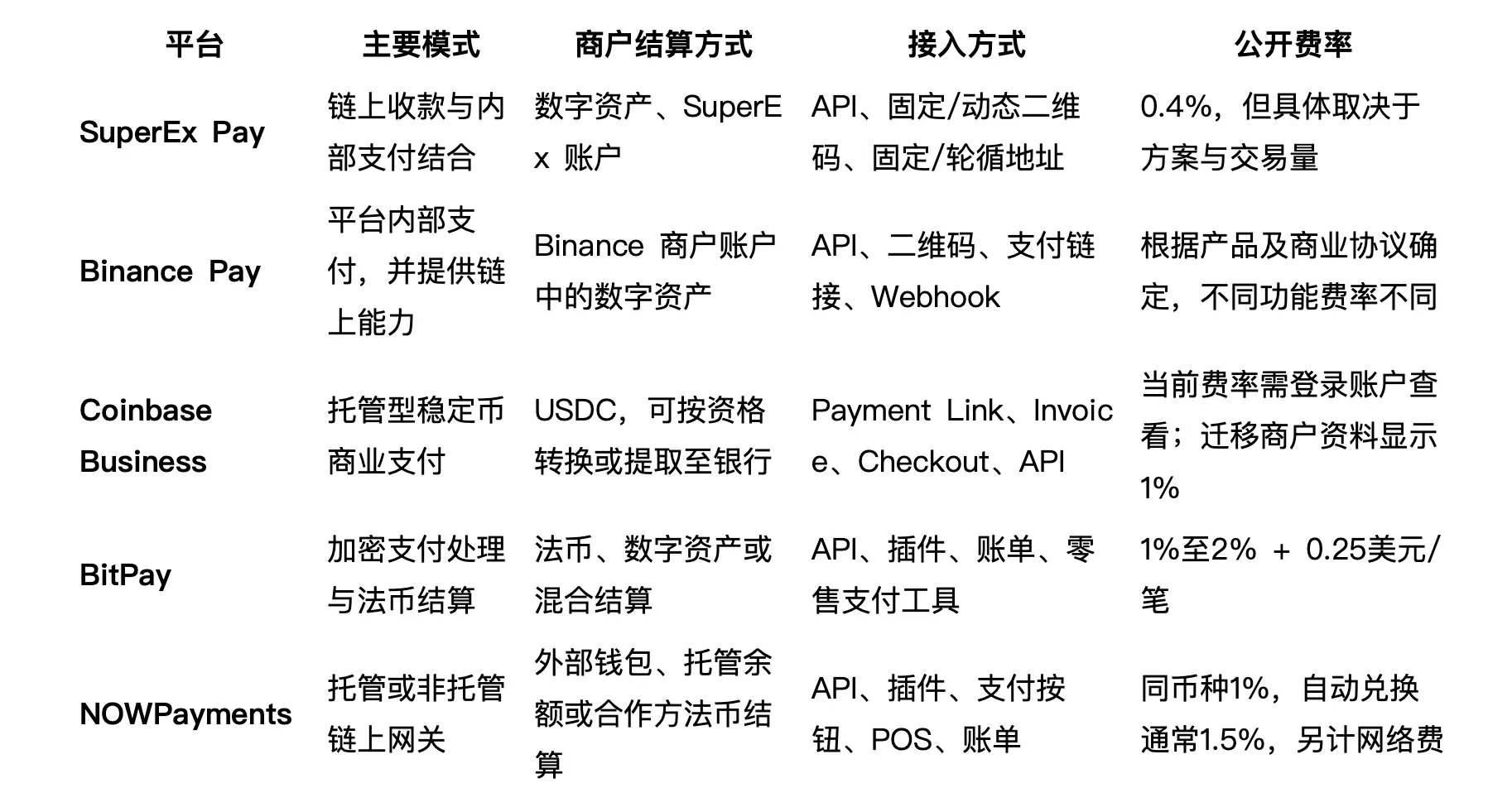
These numbers cannot be compared in isolation from the settlement path. For example, internal payments may not have Gas but require both parties to use the same ecosystem; non-custodial gateways, while more open, may incur network costs at the receipt, processing, and final withdrawal stages.
Binance Pay: Large User Ecosystem and Mature Interface
The core advantage of Binance Pay is its existing user ecosystem. Payers can complete payments via the Binance App by scanning a code or using a payment link, while merchants receive settlement assets in their Binance merchant accounts.
Its merchant tools include:
Native API;
QR codes and Checkout;
Deep Link;
Webhook with RSA signature verification;
Full and partial refunds;
Merchant management backend;
Order inquiry and reporting functions.
Binance Pay's internal payments can be confirmed instantly and avoid regular on-chain Gas, but this experience relies on the payer using a Binance account. Official materials indicate that refunds can be initiated through the backend or API and returned to users in the settlement assets received by the merchant.
Why can't rates be summarized in a single number?
Different products of Binance Pay may adopt different charging models. For example, merchant payments, Mini Programs, bulk payments, and withdrawals may not necessarily use the same rates, and some fees depend on merchant agreements and regions.
Therefore, merchants cannot infer that commercial receipts are also free just because personal transfers may be free.
Which merchants are suitable?
Customers mainly come from the Binance ecosystem;
Need a wide range of digital asset payment options;
Require mature APIs, refund, and Webhook mechanisms;
Wish to quickly cover online business in multiple countries and regions.
Main Limitations
Account and regional qualifications of both parties may affect usage;
Merchants usually need to complete certification;
Specific rates need to be confirmed based on products and contracts;
Internal payments will create a certain platform dependency.
Coinbase Business: Connection of Stablecoins, Banks, and Financial Systems
In 2026, Coinbase gradually migrated the merchant capabilities of the original Coinbase Commerce to Coinbase Business. Therefore, new merchants should not continue to integrate based on the functions and rates of the old Commerce version.
Coinbase Business currently offers:
Payment Links;
One-time or reusable payment links;
Professional invoices and recurring billing;
Checkout and API;
Team permissions;
Reporting and integration with QuickBooks, NetSuite, Xero;
USDC settlement and eligible USD conversion and bank connections.
Its formal payment suite primarily uses stablecoins. The official help center indicates that customers can pay with USDC or USDT, while merchant funds settle in USDC in the Coinbase Business account. Current fees need to be viewed by logging into the account; materials released by Coinbase for migrating merchants show a rate of 1%.
Which merchants are suitable?
Qualified businesses operating in the U.S. or Singapore;
Merchants wishing to primarily accept stablecoins;
Companies needing bank account, financial report, and accounting software connections;
Businesses looking to reduce the impact of cryptocurrency price volatility.
Main Limitations
Coinbase Business currently mainly targets qualified businesses in the U.S. and Singapore;
Uses a custodial model;
The range of payment currencies is smaller than multi-currency on-chain gateways;
Old Commerce merchants need to re-migrate APIs and certification methods;
Current rates should be based on the corporate account page and final contract.
SuperEx Pay: Low Rates and Hybrid Payment Scenarios
SuperEx Pay is not a single on-chain receipt tool but an integrated solution that combines on-chain receipts and SuperEx internal ledger.
In the on-chain receipt part, merchants can use:
Fixed Address Payments: Provide users with a fixed recharge address for long-term use, suitable for high-repeat long-term customers;
Rotating Address Payments: Generate a dedicated address for each order with a validity of 30 minutes, suitable for high concurrency, event-driven, and cost-sensitive businesses.
In the internal platform payment part, SuperEx Pay provides:
Fixed QR Code, suitable for offline stores and long-term placement receipts;
Dynamic QR Code, suitable for e-commerce, H5, Web, and dynamic orders;
Zero Gas for payers;
Instant confirmation for merchants;
Binding amount with order number;
API and system-level reconciliation.
The official merchant page of SuperEx Pay lists a rate of 0.4%, with specific rates depending on the specific merchant plan and transaction scale. Compared to payment solutions that charge a fixed fee per transaction, this structure is more friendly to small, high-frequency businesses.
Which merchants are suitable?
Platforms that already have a SuperEx user base;
High-frequency, small-value online services;
Offline stores or counter-style receipts;
Merchants needing fixed address services for long-term users;
Businesses requiring both on-chain receipts and internal instant payments;
Cross-border merchants sensitive to transaction fees.
What should be noted?
The zero Gas advantage of internal payments only applies to ledger settlements within the SuperEx ecosystem. Users initiating on-chain payments from external wallets may still incur blockchain network fees.
Additionally, merchants should confirm before formal integration:
Whether the required currencies and networks are open;
Refund and abnormal order handling rules;
API permissions, key rotation, and Webhook verification methods;
Withdrawal fees and limits;
Whether the merchant's region and industry meet access requirements;
Whether external fiat withdrawal channels are needed.
BitPay: Suitable for Mature Merchants Emphasizing Fiat Settlement
BitPay is closer to traditional payment processors. After consumers pay with digital assets, merchants can choose to receive:
Local fiat currency;
Digital assets;
A combination of fiat and digital assets.
BitPay supports daily batch settlements and provides billing, API, e-commerce, and retail payment tools. Its advantage lies in relatively mature fiat settlement and compliance processes, rather than pursuing the lowest surface rates.
Its public rates are tiered based on monthly transaction volume:
Below $500,000: 2% + $0.25 per transaction;
$500,000 to $999,999: 1.5% + $0.25 per transaction;
$1,000,000 and above: 1% + $0.25 per transaction.
High-risk industries may be subject to higher rates. When refunding, the merchant's ledger may also bear miner fees.
Which merchants are suitable?
Need regular settlements to bank accounts;
Emphasize corporate compliance and financial processes;
Have a high average transaction value;
Wish to transfer the management of cryptocurrency price volatility to payment processors.
Main Limitations
Overall rates are relatively high;
The fixed fee of $0.25 per transaction significantly impacts small orders;
Bank deposits do not equal immediate payment confirmation and may still require waiting for bank processing;
Corporate review and compliance processes are usually stricter.
NOWPayments: Multi-Currency Coverage and Flexible Access
NOWPayments' advantages focus on asset coverage and access methods. The platform supports over 350 assets and provides:
Payment API;
E-commerce plugins;
Payment buttons and links;
Billing;
Subscription payments;
Mass Payout;
Custody API;
Customer account management;
Offline POS solutions;
Fiat withdrawal and recharge provided by partners.
Merchants can choose a non-custodial process to send funds to their own wallets or enable custodial balances to reduce some repetitive on-chain operations.
Its current standard rates are:
Same currency payments without conversion: 1% + network fee;
Automatic conversion or fixed rate payments: 1.5% + network fee;
Manual conversion within custodial accounts: 1%;
Withdrawals and bulk payments: platform service fee 0%, but network fees may still apply;
Qualified custom merchants can obtain a minimum agreement rate of 0.3%, but this is not the standard rate.
Which merchants are suitable?
Merchants wishing to accept a large number of different tokens;
Need plugins, APIs, subscriptions, or bulk payments;
Wish to choose custodial or non-custodial modes;
Customer wallet sources are
Security Cannot Be Judged Solely by "Whether Blockchain Is Used"
Blockchain transactions are irreversible, but that does not mean the entire payment system is automatically secure.
What merchants really need to review is:
Whether API keys can restrict permissions;
Whether IP whitelisting and key rotation are supported;
Whether Webhooks have verifiable signatures;
Whether repeated callbacks can cause duplicate shipments;
Whether the order interface supports idempotency;
Who controls refund permissions;
After a merchant account is hacked, whether the attacker can modify the withdrawal address;
What processing mechanism the platform adopts when custodial funds encounter anomalies;
In a non-custodial model, who holds the private keys;
Whether employee accounts support tiered permissions;
Whether it is possible to export complete order, refund, and settlement records.
Therefore, "custodial" and "non-custodial" are not simply a matter of superiority or inferiority.
Custodial solutions reduce the burden of merchants managing private keys but increase platform and account security risks. Non-custodial solutions allow merchants to directly control assets but require them to bear the security of wallets, private keys, and on-chain operations.
For Small Orders, Fixed Fees May Be More Important Than Rates
Assuming an order value of $20, calculated only based on public processing fees, without considering network fees, exchange price differences, taxes, and commercial agreements:
SuperEx Pay calculated at 0.4%: approximately $0.08;
NOWPayments charges a 1% fee for payments in the same currency: approximately $0.20, plus network fees;
If Coinbase applies a 1% fee rate: approximately $0.20;
BitPay charges a percentage fee of $0.40 at the minimum transaction volume tier + a fixed fee of $0.25, totaling $0.65;
Binance Pay cannot use a unified public figure due to different commercial products and contracts.
For high-ticket businesses, $0.25 may be negligible; however, for game items, digital content, small subscriptions, and offline retail, the fixed fee will significantly compress profits.
The total cost should be estimated according to the following formula: Comprehensive payment cost = processing fee + network fee + exchange fee or price difference + withdrawal fee + refund cost + development and maintenance cost + capital fluctuation risk.
Final Checklist Before Merchant Onboarding
Before formal signing and development, at least confirm the following issues:
Whether the country and industry of the merchant are supported;
Whether KYC or KYB is required;
Which tokens and specific networks are supported;
What assets the merchant ultimately receives;
How long the exchange rate is valid;
Who bears the network fee, the user or the merchant;
How underpayments, overpayments, and duplicate payments are handled;
Whether partial refunds are supported;
Whether there is a minimum settlement amount;
Whether there are withdrawal fees, exchange fees, and hidden price differences;
Whether the Webhook supports signatures and retries;
Whether the API provides a sandbox and idempotency mechanism;
Whether financial and tax records can be exported;
Whether there are backup payment channels in case of service interruption;
How historical data and balances are migrated after cooperation ends.
Conclusion
There is no one-size-fits-all cryptocurrency payment solution for all merchants.
SuperEx Pay's differentiated advantage lies in combining on-chain payments with internal instant payments while keeping public rates capped at a maximum of 0.4%. This design is particularly suitable for merchants who value low costs, high concurrency, small payments, and the integration of online and offline.
Binance Pay has a mature platform ecosystem, Coinbase Business is more suitable for stablecoins and corporate financial management, BitPay focuses on fiat settlement and compliance processes, while NOWPayments has advantages in multi-currency coverage and onboarding flexibility.
The true professional selection criteria are not "which supports the most currencies," but rather:
Can customers make payments smoothly, can merchants confirm quickly, can funds be settled as needed, can every cost be accurately calculated, and can risks be tracked and handled when they occur?
Only by placing payment, settlement, reconciliation, refunds, and exit mechanisms on the same flowchart can merchants find the truly suitable cryptocurrency payment infrastructure for long-term business.
Disclaimer
This article is compiled based on publicly available pages, help centers, and developer documentation of various platforms as of October 23, 2026, and is intended for industry research and product comparison only. It does not constitute commercial, legal, tax, compliance, or financial advice. The rates, supported regions, currencies, networks, merchant admission requirements, and settlement policies of each platform may be adjusted at any time. Merchants should review the latest contracts, rate pages, and local regulatory requirements before onboarding, and complete technical and financial verification through small real transactions.

 Risk warning



Popular articles