"Historic Plunge" in Turn! Google's Illness, Amazon Also Caught It
 Core Viewpoint


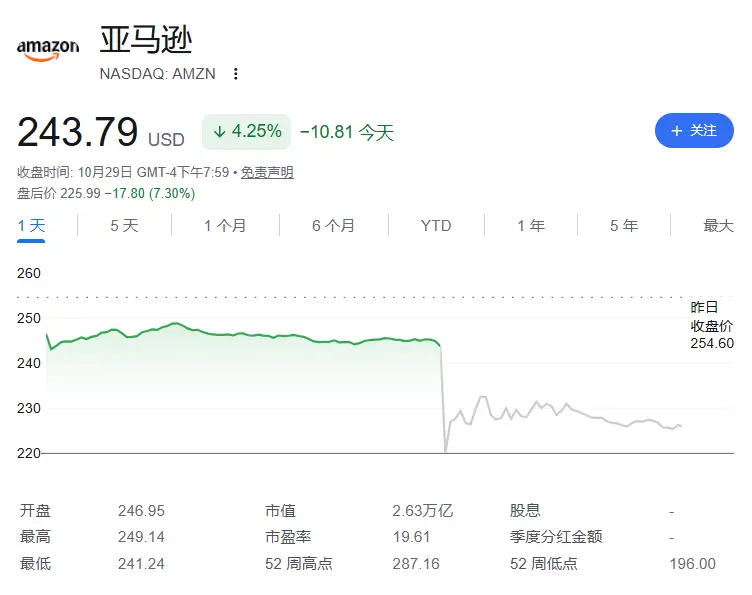
 Amazon AWS accelerated growth for the sixth consecutive quarter to 39%, but the growth rate of e-commerce online sales fell to a three-year low, and advertising growth hit a historic low. Capital expenditures far exceeded expectations, and free cash flow turned negative at $42.4 billion over the past 12 months. The stock price plummeted after hours, resonating with Alphabet's 13% drop on the same day, as market concerns about the imbalance between tech giants' AI investments and core business growth are being released.
Author: Long Yue
The cloud computing business continues to accelerate, yet it cannot hide the fatigue at the core of e-commerce—Amazon is undergoing a market test similar to that of Google.
The third-quarter financial report shows that Amazon's total revenue grew by 12% year-on-year to $201.9 billion, below analyst expectations. AWS revenue growth has accelerated for six consecutive quarters, but online retail sales growth has fallen to a three-year low, and advertising revenue growth has also hit the lowest level on record. Meanwhile, third-quarter spending on devices and property exceeded $77 billion, far exceeding market expectations, with free cash flow recording a negative $42.4 billion over the past 12 months.
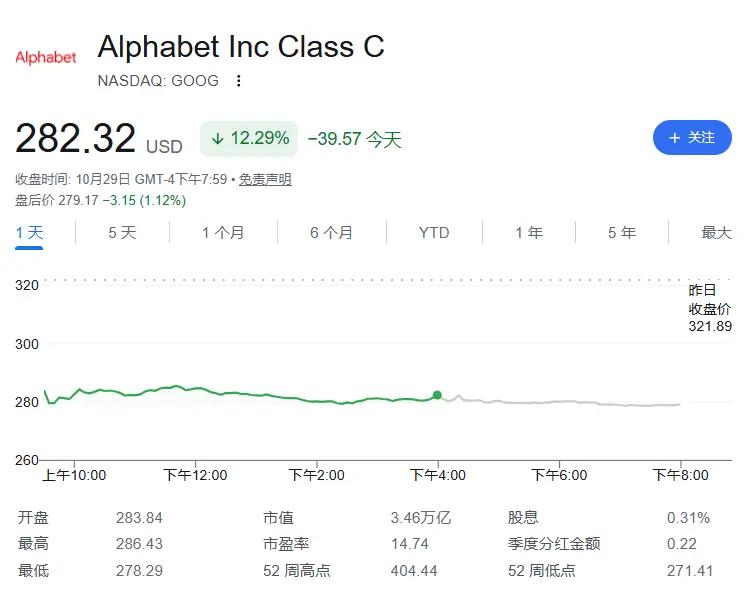
After the financial report was released, Amazon's stock price fell about 7% in after-hours trading, having previously accumulated a rise of about 5.6% this year. This decline is highly similar to the experience of Alphabet during the same period— the latter's stock plummeted 13% on Thursday due to search and advertising revenue falling short of expectations, marking the largest single-day drop in the stock's history.
AWS Accelerates, but the "Exceeding Expectations" Threshold Has Been Raised by Microsoft
AWS revenue grew by 39% year-on-year to $46 billion in the third quarter, up from 37% growth in the previous quarter, marking the sixth consecutive quarter of acceleration. CEO Andy Jassy stated during the earnings call that AWS's core computing and storage leasing business is growing at "the fastest pace in years" and expects AWS to achieve over 40% year-on-year growth annually for the next two years.
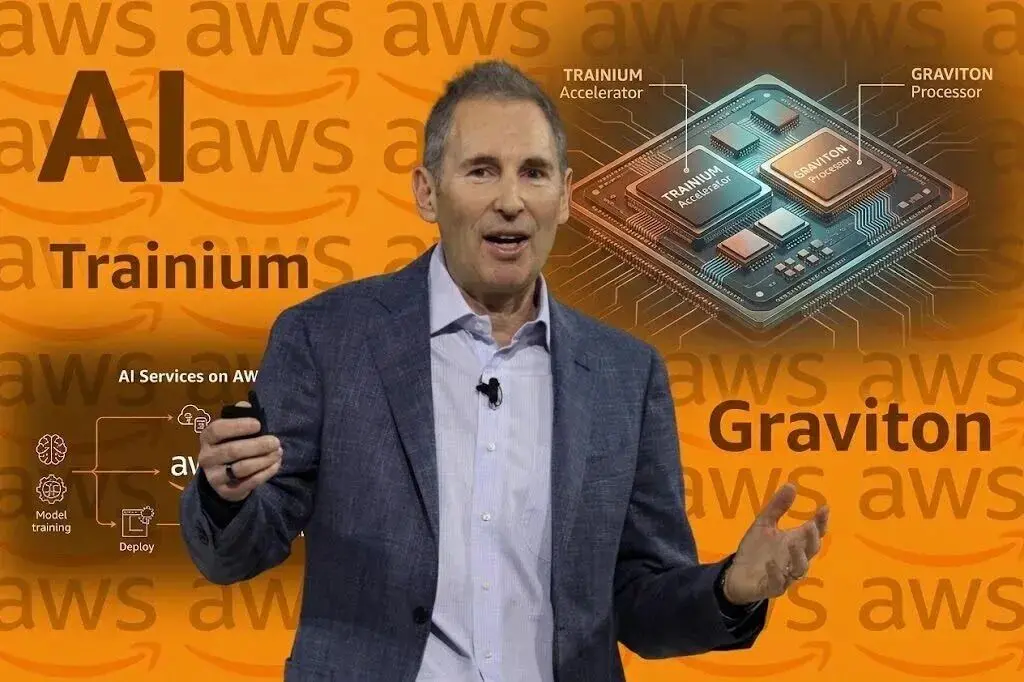
AWS's growth is partly benefiting from demand from AI companies like OpenAI and Anthropic—both of which rely on Amazon servers to run their models. Jassy also revealed that the company's self-developed AI chip, Trainium, will begin sales to external customers by the end of 2027.
However, AWS's impressive performance has not fully reassured the market. eMarketer analyst Sky Canaves stated, "AWS's accelerated growth has not met the inflated expectations, nor has it surpassed the higher competitive benchmarks set by Microsoft and Google. The improvement in cloud business operating margins is a positive signal, but it may not be enough to alleviate market concerns about the sharp rise in capital expenditures and the subsequent significant decline in free cash flow."
In contrast, Microsoft announced a 48% growth in cloud business revenue on the same day, and capital expenditures remained restrained, with its stock price dropping less than 1% on Thursday.
E-commerce Growth at a Three-Year Low, Prime Day Timing Adjustment to Blame
Online sales in the third quarter grew only 2% to $68.5 billion, the lowest growth rate since the beginning of 2023. Amazon attributed part of this to the timing adjustment of the Prime Day shopping festival—this year, Prime Day in most major markets was moved from the third quarter to the second quarter, resulting in related sales revenue not being counted in this quarter.
Research firm M Science analyst John Tomlinson believes that the relative weakness on the retail side is "partly" related to the timing adjustment of Prime Day, but he also pointed out, "There is a bit of a crack here. The market is very focused on the scale of AI spending by various companies."
Sky Canaves further noted that the timing adjustment of Prime Day "does not fully explain the weakness in online store and advertising growth, indicating that consumer pressure may be becoming more apparent—consumers are starting to hold back where they can save, which has a chain effect on advertisers' willingness to spend."
In terms of advertising, third-quarter revenue grew by 11%, the slowest growth rate since Amazon began disclosing this data separately in 2020. In contrast, from the second quarter of 2025 to the second quarter of 2026, Amazon's advertising business saw quarterly growth rates exceeding 20%.
Capital Expenditures Soar, Free Cash Flow Deeply Negative
Amazon's spending on devices and property in the third quarter exceeded $77 billion, far exceeding analyst expectations. Over the past 12 months, free cash flow recorded a negative $42.4 billion, compared to a positive $14.8 billion in the same period last year—this reversal is mainly due to a $94.8 billion year-on-year increase in property and equipment purchases during the same period.
The company maintained its previous forecast of approximately $220 billion in capital expenditures for 2026, but Jassy stated during the call that capital expenditures for 2027 will "significantly" increase further.
This pace of spending has made investors uneasy. Bloomberg reported that even a highly diversified company like Amazon has not been able to offset market concerns about the speed of AI investments with the robust growth of its cloud business.
Fourth Quarter Guidance Below Expectations, Consumer Concerns Emerge
Amazon expects fourth-quarter (holiday shopping season) revenue to be between $240 billion and $247 billion, with analysts previously averaging expectations of $244.5 billion, and the midpoint of the guidance slightly below expectations. The fourth-quarter operating profit guidance is between $28.5 billion and $33.5 billion, with analysts' average expectation of about $33 billion, and the lower end of the guidance significantly below market expectations.
Third-quarter operating profit was $17.8 billion, up from $11.4 billion in the same period last year.
Jassy emphasized the health of the company's core business during the call. He pointed out that grocery and household goods sales approached $250 billion in the 12 months ending in September, growing three times faster than overall e-commerce and accounting for about half of all product sales units in the third quarter. The shopping chatbot Alexa for Shopping had over 400 million users in the past 12 months, up from 350 million disclosed in the previous quarter.
However, these positive signals did not reverse the downward trend in after-hours stock prices.
Sharing the Same Fate as Alphabet, Market Sentiment Resonates Strongly
The market reaction faced by Amazon mirrors the situation of Alphabet during the same period. Alphabet's third-quarter report showed that search advertising revenue grew by 12% year-on-year to $63.3 billion, below market expectations of $64.9 billion, with free cash flow recording a negative $9.1 billion, and its stock plummeted 13% on Thursday.
Alphabet's management characterized the lag in AI search monetization as a deliberate choice during the call, with CEO Sundar Pichai comparing the current phase to the mobile transition a decade ago: "Just like we focused on creating the best search user experience before monetization a decade ago, we are doing the same now." However, the market did not buy this narrative.
The shared predicament of the two companies reflects the same market proposition: AI investments are visibly suppressing the cash flow and growth of core businesses, while the timeline for monetization remains unclear. In contrast, Microsoft, with its high growth in cloud business and relatively restrained capital expenditures, has become one of the few tech giants to satisfy investors during this earnings season.
 Risk warning Risk warning




Popular articles