Bank of America Hartnett: The contradiction between AI and ABB is igniting, and the real pressure relief window for tech stocks will have to wait until next year
 Core Viewpoint


 Bank of America warns that the surge in bond issuance by hyperscale cloud providers is exacerbating the structural contradictions between ABB (Anything but Bonds) and AI. However, U.S. investment-grade tech bonds have fallen to a 30-year low relative to the overall bond market returns, becoming an "overlooked valley." The true relief for tech stocks may have to wait until the first half of 2027, when easing geopolitical tensions, falling oil prices, and the end of the interest rate hike cycle are expected to promote looser financial conditions.
Author: Bu Shuqing, Wall Street Journal
The surge in AI mega-scale capital expenditures is colliding with structural pressures in the bond market, putting pressure on the tech stock bull market. Bank of America Merrill Lynch's latest fund flow report indicates that this contradiction is unlikely to be resolved in the short term, and the real window for risk asset relief may not come until the first half of 2027.
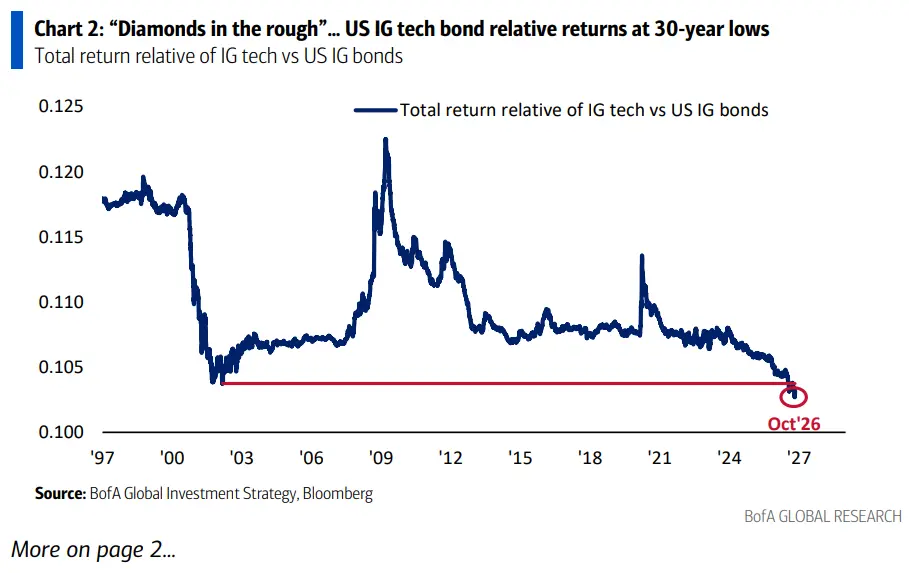
According to the "Flow Show" weekly report released by Bank of America's global investment strategy team on October 29, the debt issuance scale of AI mega-scale cloud computing companies (hyperscalers) is expected to reach $182 billion in 2026, a sharp increase from $17 billion in 2024, leading to a bond supply shock that is suppressing tech bond performance—U.S. investment-grade tech bonds' total return relative to the overall investment-grade bond index has fallen to a 30-year low.
At the same time, global central banks have raised interest rates 42 times in the past six months, the U.S. dollar has strengthened, U.S. Treasury yields have risen, and the momentum of tech stocks has been significantly hindered, with the Nasdaq 100 index hitting the upper limit of 30,000 points and the Philadelphia Semiconductor Index down 20% from its peak.
Bank of America strategist Michael Hartnett pointed out in the report that policymakers will not allow bond yields to rise uncontrollably, threatening stock market wealth and bank collateral; the threat of yield curve control (YCC) or quantitative easing (QE) will effectively suppress bond yields.
However, the real relief for risk assets and AI stocks still relies on a decline in bond yields and easing financial conditions, and this "relief valve" is most likely to be realized in the first half of 2027 through geopolitical peace progress, a significant drop in oil prices, and the end of the interest rate hike cycle. This week, global stock funds saw an inflow of $56.6 billion, with China's stock market seeing an inflow of $25.7 billion in a single week, the largest scale since April 2025.
Surge in AI Capital Expenditures, Tech Bonds Become "Neglected Lowlands"
The capital expenditure expansion of AI mega-scale companies is reshaping the bond market landscape.
According to Bank of America data, the free cash flow of related companies is expected to plummet from $240 billion in 2024 to negative $180 billion in 2027, while capital expenditures are projected to soar from $240 billion in 2024 to an estimated $1.2 trillion in 2027.
To fill this funding gap, mega-scale companies are issuing bonds aggressively. Debt issuance in 2026 has reached $182 billion, while stock issuance during the same period was $89 billion, compared to only $17 billion in debt issuance in 2024. Large-scale stock financing means the era of large-scale stock buybacks is coming to an end—buyback amounts for mega-scale companies have dropped sharply from $105 billion in 2024 to an annualized approximately $14 billion in 2026.
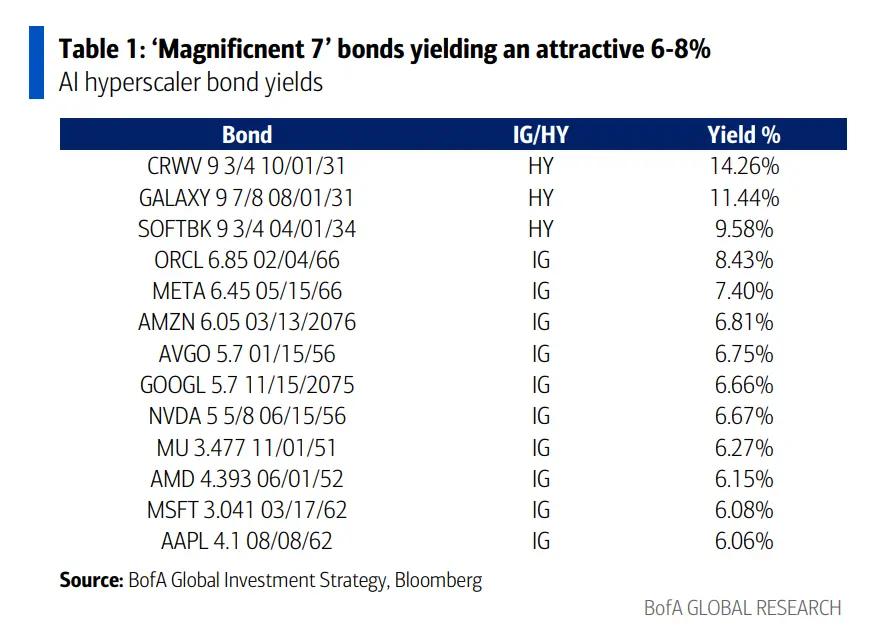
Bank of America believes that this backdrop makes tech bonds "neglected lowlands" (diamonds in the rough). The total return of U.S. investment-grade tech bonds relative to the overall investment-grade bond index is at a 30-year low. In terms of specific yields, the long-term investment-grade bond yields of tech giants like META, Amazon, Google, and Nvidia generally range from 6% to 8%, with some high-yield bonds yielding as much as 9% to 14% (see Table 1). Bank of America recommends that investors pay attention to this relative value opportunity.
Structural Contradictions Between "ABB" and AI
Bank of America summarizes the asset allocation pattern of the 2020s into four super trends, including ABB (Anything but Bonds), ABD (Anything but Dollar), and AI (Artificial Intelligence).
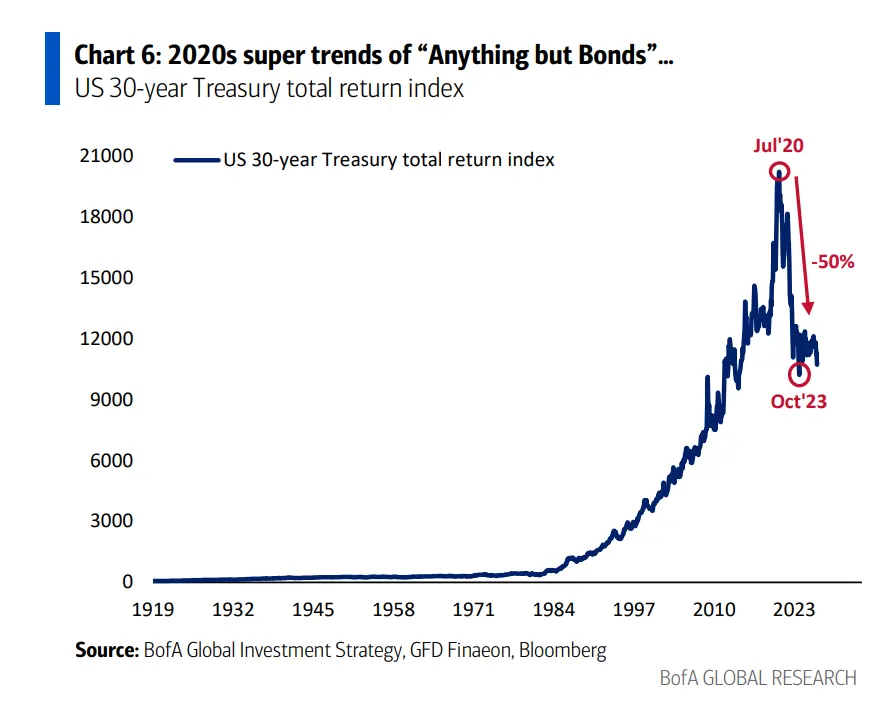
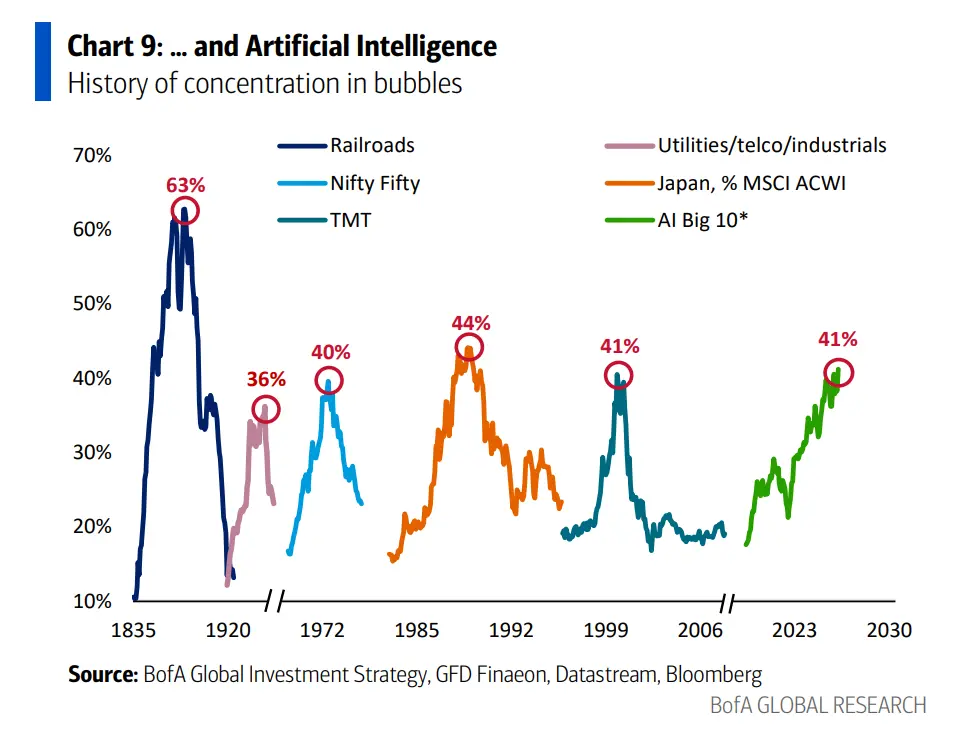
Now, the inherent tension between ABB and AI is becoming increasingly prominent.
The report points out that from social unrest in Brazil and France to budget disputes in the UK, global voters are generally demanding that governments increase spending to address inequality. Governments are well aware that austerity policies face social risks, and political populism and polarization trends are difficult to reverse. This means that asset allocators will maintain a structurally underweight position in bonds and hold positions that benefit from a steepening yield curve.
However, it is precisely the bond yields pushed up by this "ABB" logic that are constraining the AI stock bull market— the bond market is acting as a "disciplinary enforcer" of the surge in AI mega-scale capital expenditures. Bank of America notes that although the policy-level threats of YCC/QE will effectively suppress the disorderly rise of bond yields, the real rebound of risk assets and AI stocks requires a substantial decline in bond yields and easing financial conditions, and the maturation of this condition is most likely dependent on: significant drops in oil prices due to geopolitical peace progress and the end of the global interest rate hike cycle—Bank of America points to this window in the first half of 2027.
This Week's Fund Flows: China Hits Over a Year High, Gold Sees First Net Outflow
This week's global fund flows show a clear divergence. Stock funds saw a net inflow of $56.6 billion (including $75.9 billion into ETFs and a $19.6 billion outflow from active funds), bond funds had a net inflow of $15.4 billion, cash saw a net inflow of $3.4 billion, cryptocurrency had a net outflow of $500 million, and gold had a net outflow of $1.7 billion.
Notable specific flows include: China's stock market saw an inflow of $25.7 billion in a single week, the largest scale since April 2025; Japan's stock market saw an inflow of $6.8 billion, the largest single-week inflow since May 2013; European stock markets saw an outflow of $2.3 billion, the largest single-week outflow since July 2026; gold experienced its first net outflow since July 2026; TIPS saw an inflow of $1.1 billion, the largest scale since June 2026, indicating rising inflation expectations.
By sector, the tech sector recorded a net inflow for the fifth consecutive week ($5.3 billion), while the materials sector saw an outflow of $1.2 billion, the largest since July 2026. Bank of America's private client asset management scale reached $4.6 trillion, with a stock allocation ratio of 66%, bonds at 17.5%, and cash at 9.4%; over the past four weeks, private clients have continued to buy municipal bonds, industrial and healthcare ETFs, while selling consumer staples, emerging market debt, and discretionary consumer ETFs.
Bull-Bear Indicator Retreats, Election Risks Emerge
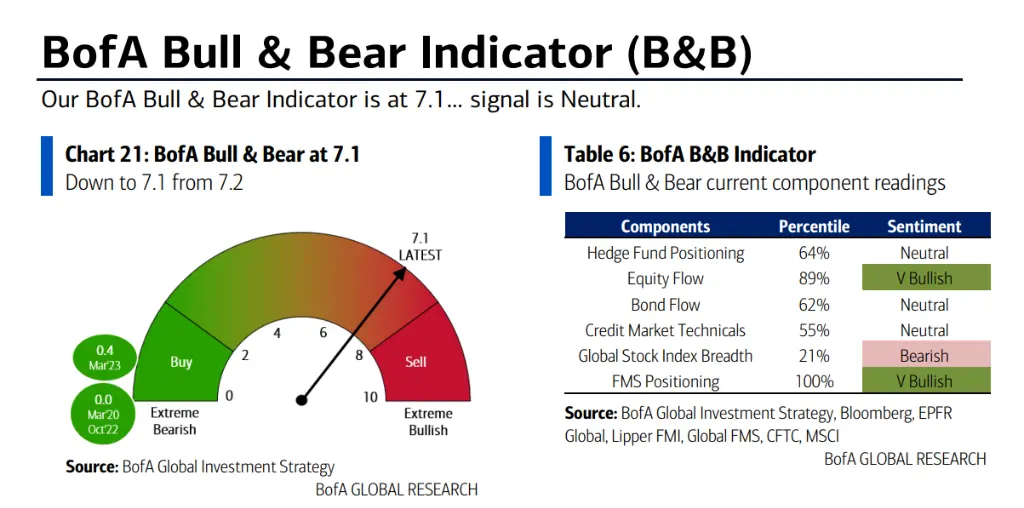
Bank of America's Bull & Bear Indicator slightly retreated from 7.2 to 7.1 this week, with the current signal being "neutral." The retreat in the indicator is mainly due to the weakening breadth of global stock indices and the widening spreads of high-yield bonds and subordinated bank debt, partially offset by strong stock fund inflows.
Regarding political risks, Bank of America points out that the risk of a Democratic sweep (DEM sweep) is being priced in by the market, but the scenario of the Democrats winning 53 Senate seats and bond yields jumping has not been fully priced in. Regardless of the election outcome, voters' demands for "affordability" pose negative impacts on tech, banking, and energy monopolies, while being relatively favorable for the discretionary consumer sector.
In terms of China, Bank of America notes that Chinese bond yields have hit a new low, the renminbi has appreciated over 20% against the New Taiwan Dollar in the past year, Chinese tech stocks (CQQQ) have dropped 32% since June, and deflation in China has become a global issue. Bank of America recommends shorting oil prices in the first half of 2027, arguing that peace progress will boost supply; however, if a drop in oil prices does not lead to a rebound in the euro and yen, it will be an important signal that China's deflation has become a new negative factor globally.
2026 Asset Returns: Commodities Lead, Bonds Lag
From the year-to-date cross-asset performance, commodities lead with a 91.6% increase, while crude oil (WTI) has risen 79% this year. U.S. stocks are up 14%, global stocks are up 9.6%, the dollar is up 3.9%, and cash returns are 3.1%. High-yield bonds have slightly decreased by 0.5%, investment-grade bonds are down 2.5%, government bonds are down 3.3%, gold is down 7.1%, and Bitcoin is down 8.4%.
From the overall perspective of the 2020s, Bank of America data shows that the annualized return on 10-year U.S. Treasury bonds is negative 4%, gold's annualized return is 15%, and the Nasdaq index's annualized return is 17%, confirming the ongoing effectiveness of the four super trends of ABB, ABD, and AI.
 Risk warning
 Risk warning





Popular articles