BlackRock led the retreat, with $1.6 billion disappearing from the ETH ETF
 Core Viewpoint


 In October, the net outflow of the US spot ETH ETF was about 1.6 billion dollars, with BlackRock's ETHA accounting for nearly 90%.
Written by: Wealthy
BlackRock Leads the Retreat, $1.6 Billion Disappears from ETH ETF
In October 2026, something quite awkward happened on Wall Street. It was BlackRock that brought ETH into the securities account, yet it was also BlackRock's counter that saw the largest outflow of ETH funds in October.
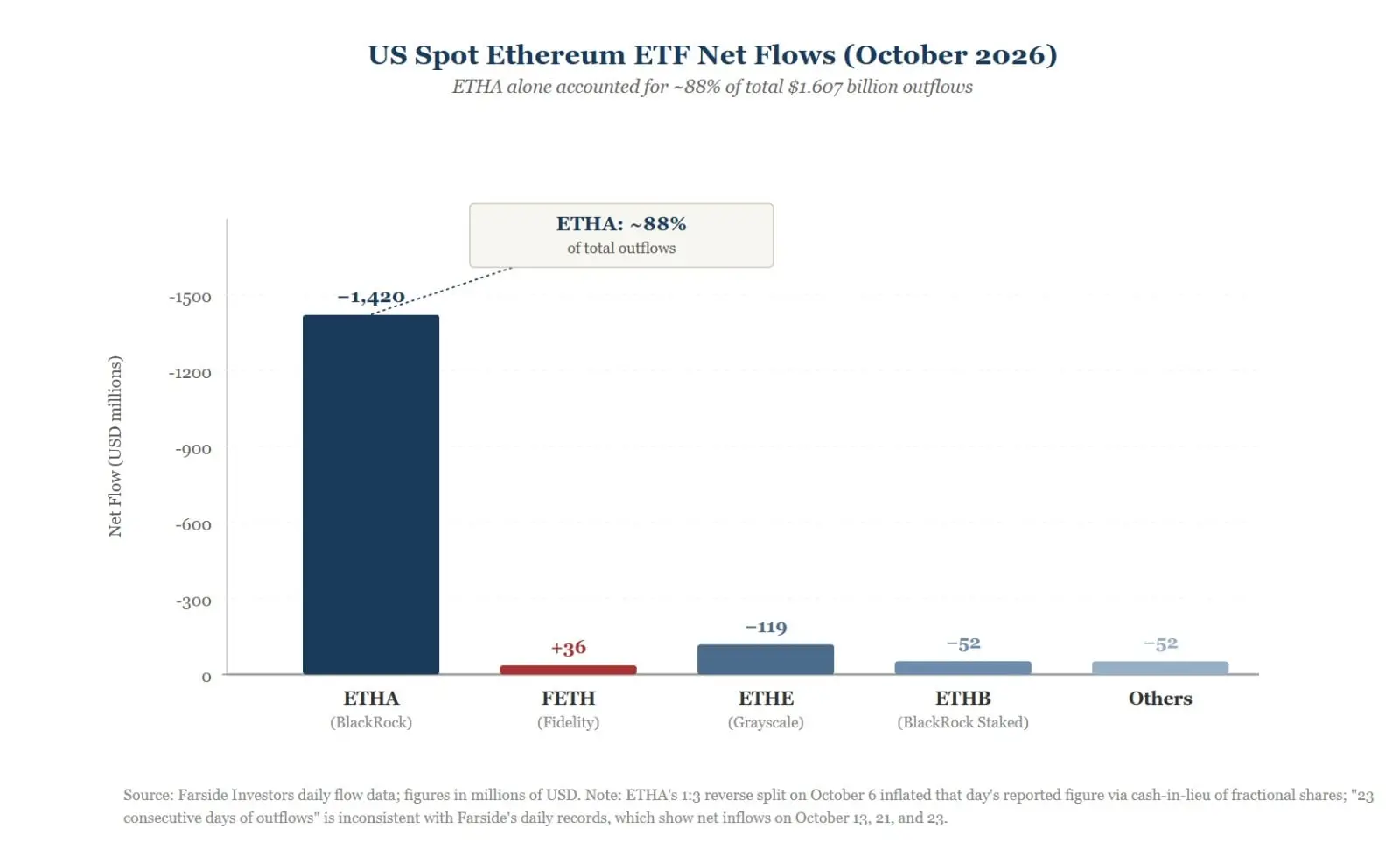
Here's how the accounting goes. According to daily records from Farside Investors, as of October 30, the U.S. spot ETH ETF had a net outflow of approximately $1.607 billion in October, with the ETHA fund accounting for about $1.42 billion, nearly 90%. Over twenty-two trading days, there were net outflows on nineteen days and net inflows on three days. The claim circulating online of "twenty-three consecutive days of outflows" does not match Farside's daily table, as there were small inflows on October 13, 21, and 23, so this record can be disregarded for now.
There is also a confusing account that needs clarification. On October 6, ETHA had a single-day outflow of $201.9 million, coinciding with a three-for-one reverse stock split. The SEC filing specified that fractional shares would be settled in cash, so the figures for that day were inflated. However, from October 7, 12, 14, 19, 22, and throughout the rest of the month, ETHA was bleeding every day; one stock split could not support a month's worth of redemptions.
With such concentrated outflows, one must ask: who is selling, and where did the money go?
Selling ETH Does Not Mean Abandoning ETH: Where Did the Money Go?
Many headlines say "BlackRock is selling ETH," which sounds straightforward but is misleading. ETHA is a product issued by BlackRock, and the shares are held by investors. When a client checks out, the doorman only keeps the accounts; he cannot say that the doorman sold the house. The actual redemption orders are placed by the fund's shareholders, which include institutions and authorized participants engaged in arbitrage. After redemption, the portion of ETH behind the shares is either sold or handed over to authorized participants for processing, which will affect the spot market. However, Farside only reports amounts, not names, so it cannot disclose who sold.
Looking at other counters, Fidelity's FETH had a net inflow of about $36 million in October, while Grayscale's ETHE saw an outflow of about $119 million, and BlackRock's own ETHB had an outflow of about $52.3 million. Some are entering, some are exiting; this is not a full retreat but rather a selection of how to take ETH.
So, is the money just being moved elsewhere to continue holding ETH? The data can only prove that ETHA is flowing out, but it cannot prove where it is going. To see the direction clearly, one must wait for disclosures like 13F filings, which are submitted quarterly and are somewhat delayed.
On a macro level, there are a few clues. Wintermute mentioned in its analysis on October 12 that the Federal Reserve's meeting minutes made the market more confident that there would be further rate hikes by the end of the year, with the ten-year U.S. Treasury yield remaining high while the S&P 500 reached new highs. That week, the U.S. spot BTC ETF saw outflows of about $680 million, and the ETH ETF had outflows of about $540 million. When interest rates are high, assets without cash flow struggle, and BTC was no exception. In terms of price, Cointelegraph reported that ETH had dropped from about $2,700 to $2,438 by October 21, a decrease of 9.7%. Prices fell, redemptions increased; these two events pushed each other, but just because they occurred simultaneously does not clarify which is the cause and which is the effect.
However, the macro environment treats every counter equally, yet 90% of the outflows are concentrated on ETHA, which necessitates examining the product itself. ETHA sells the ups and downs of ETH. By buying it, one profits from the price difference but does not receive the staking rewards that one would get from holding ETH. It's like buying a ticket to a game; you can enter the stadium to watch, but the advertising revenue from the stadium does not concern you. In years of low interest rates, this ticket can be reasonably purchased. When interest rates rise, government bonds offer coupon payments, and money market funds provide interest; holding an exposure that only profits from price differences places the opportunity cost on the table. ETHA is also the largest and most convenient entry point for institutional allocations, so to reduce ETH positions, the easiest way is to sell it.
This explanation is not universally accepted. Grayscale's ETHE has long offered staking, yet it also saw outflows in October, but its management fee is as high as 2.5%, with a heavy historical burden, making direct comparisons difficult. A more cautious statement would be that the macro environment is the wind, and the product structure has leaks; when the wind is strong, the leaks take on water first.
BlackRock has also noticed the leaks, and its solution is to launch another product.
A Ticket Without Returns: Why Is BlackRock Launching ETHB?
BlackRock is well aware of the flaw of a ticket without returns. On March 12, 2026, the iShares Staked Ethereum Trust, code ETHB, was listed on Nasdaq. According to the prospectus, the fund stakes 70% to 95% of its ETH, with 82% of the rewards going to shareholders and the remaining 18% divided among the issuer, custodian Coinbase, and validator node service providers. The management fee is 0.25%, reduced to 0.12% for the first twelve months within the first $2.5 billion in assets. On the day of listing, the assets were approximately $107 million. It is not the first; REX-Osprey jumped the gun in September 2025, and Grayscale was ahead of BlackRock, making BlackRock the third.
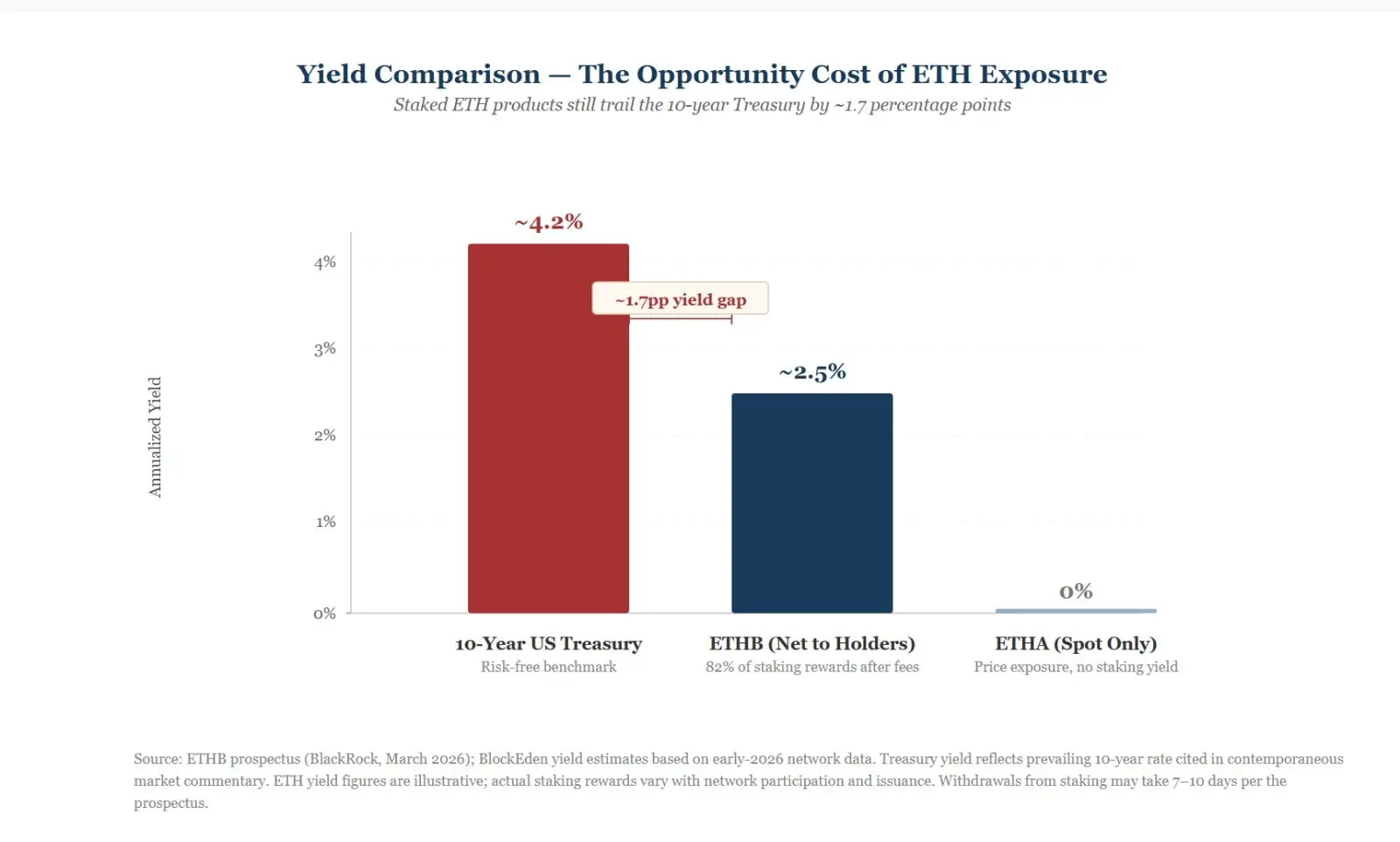
There is a calculation worth making here. Some research blogs estimate that at the beginning of 2026, staking yields about 3% annually, and after deducting the 18% share, shareholders receive about 2.5%. The same material indicates that the ten-year U.S. Treasury yield is about 4.2%. ETHB fills a gap, but this gap is even shorter than government bonds. The prospectus also states that exiting from validator nodes and withdrawing requires queuing, with the longest scanning taking seven to ten days, meaning part of the yield is the price of liquidity.
So, don’t rush to say that the money from ETHA has all gone to ETHB. In October, ETHB itself was also experiencing outflows, and the data only supports one statement: the same issuer, two types of ETH, with different performances.
BlackRock has not left Ethereum; it is pondering how to package the same ETH so that people are willing to continue holding it. Packaging can solve how to hold it but cannot determine how much the held item is worth. That leads us to ask, where does the value of ETH come from?
The Value Paradox of Ethereum: Does a More Prosperous Network Make ETH More Valuable?
Stocks are valuable because companies make profits and distribute dividends. ETH has no board of directors and no income statement; what justifies its value?
Academia has offered an explanation. A paper by scholars Lin William Cong, Ye Li, and Neng Wang titled "Tokenomics: Dynamic Adoption and Valuation," published in 2021 in The Review of Financial Studies, uses a dynamic model to argue that the value of a token comes from the aggregate of user transaction demands, unlike traditional valuation that discounts future cash flows. The more people use the platform, the more valuable the token becomes; the more valuable the token, the more people are willing to get on board early. This mutual pull forms the theoretical basis for "the more prosperous the network, the more valuable the token."
This model has a premise: users must hold the token to trade on the platform. When this premise is compared to Ethereum's ledger, the paradox emerges.
After EIP-1559, the base fees for transactions are burned, and the busier the network, the more is burned, giving ETH a reputation for deflation at one point. With the Dencun upgrade in 2024 introducing blobs, L2 data publishing became very cheap, leading to a reduction in L1 burns. Research from CMCC indicates that Ethereum's quarterly transaction fee burn dropped from about $1.1 billion in Q1 2024 to about $300 million in Q3, a decrease of 73%. By April 2026, some media reported that approximately 1,700 new ETH were issued daily, while only fifty to sixty were burned. Everstake provided an annualized net issuance of about 0.7% to 0.8% in May. The Fusaka upgrade in December last year set a minimum fee for blobs to try to support the burn amount, but the effectiveness still needs to be observed.
With less being burned and issuance continuing, who is receiving the issued money? It goes to those who are staking. Staking rewards are not paid by external customers but are newly issued ETH from the protocol, effectively meaning the network is printing money to pay those who guard it.
This matter has been studied in academia. A working paper by Lin William Cong, Zhiheng He, and Ke Tang titled "The Tokenomics of Staking" incorporates staking into a dynamic model, suggesting that staking leads to wealth redistribution, and using a batch of stakable token data, they found that higher staking rates correlate with higher subsequent excess returns. This paper should be used with caution; it is a working paper from April 2025 that has not undergone peer review, and the subjects studied are a batch of tokens, not specifically Ethereum. Its earlier version was presented at an academic conference in 2023, where a reviewer questioned whether the returns from that carry strategy were solely due to these tokens being more sensitive to the overall crypto market's fluctuations, i.e., beta. Thus, it provides a perspective rather than a conclusion.
Applying this perspective to ETH, I also push it further, calculating beyond the paper. Rewards come from new issuance; the number of ETH held by non-stakers remains unchanged, while their proportion of the total supply slightly decreases. The previously mentioned net issuance is less than 1% annually, which is not significant; the real difference lies in whether the rewards are distributed. ETHA holders do not receive them, which is the direction indicated in the ledger; as for how much they lose, that needs to be calculated separately.
Thus, as the network becomes busier, tokens do not necessarily become scarcer. The security of the network relies on staking, the rewards from staking depend on issuance, and who ultimately bears the burden of issuance depends on how much is burned that year.
The Prosperity of Infrastructure and the Dilemma of Tokens: Who Has Taken Away Ethereum's Economic Value?
An analysis by Blockworks discusses the same strange phenomenon: users are trading more, especially stablecoins, and rollups are pushing blobs to record levels, yet L1 fee revenue is far below that of 2021 to 2022. The capture of fees has moved up the stack, going to L2 sequencers, MEV supply chains, and applications, while L1 has become a low-margin but very reliable settlement platform. Coin Metrics' data is even more straightforward: in Q1 2025, blob fees accounted for only 0.07% of total fees.
To put it metaphorically, Ethereum is like a highway; to encourage more traffic, tolls are kept very low. There are more cars, and service areas, gas stations, and car washes are making money, while the toll booth operators just watch the traffic flow. The road is indeed becoming increasingly important, but importance and profitability are two different matters.
Stablecoin settlement, tokenized cash, and RWA issued by institutions are all moving to Ethereum. 21Shares' outlook for 2026 acknowledges this while pointing out that fee compression, L2 value spillover, and moderate net issuance have made the threshold for throughput to become lasting value higher. To reprice ETH, we need to see total fees rise, or align the interests of L2 with the mainnet, or have capital flow assist with yield differences.
There is a sharper question here. Traditional financial institutions issuing tokenized government bonds and settling with stablecoins seek Ethereum's settlement and security, but it is not necessary to hold ETH as a position on their balance sheets. Banks operate online, and I haven't heard of anyone buying an "internet token" on their balance sheet. Buying some ETH to pay for gas is an operating cost, not a portfolio investment. Institutions need infrastructure, and the need to hold ETH is two separate propositions, with a gap in between. The width of this gap is still being debated by researchers. In Everstake's May review, some advocate for changing the reward curve, some argue to maintain the status quo, and some believe the focus should be on L1 value capture; this review leans towards the latter: the issue lies in value capture, not in issuance.
What Are Institutions Actually Abandoning: Three Futures for ETH?
Are institutions abandoning Ethereum? October's data cannot answer such a big question. What can be said is that what is being sold may not be ETH, but a way of holding it: no interest paid, and no guarantee of network dividends. This is an inference, not a conclusion. Looking ahead, there are probably three paths.
One is macroeconomic recovery. As interest rates fall, risk assets are re-accepted, and money returns to ETFs. The sequence to watch is: money flows back before prices, indicating someone is building positions in advance; if prices rise and money comes in, that is chasing the market.
One is product iteration. Whether staking products can continue to attract funds, and whether ETHA will amend its rules to include staking, are variables. It has been calculated that the net yield of ETHB still does not reach government bonds; it needs to wait for interest rates to decline for its persuasive power to increase.
One is deteriorating value capture. Money has returned to BTC ETFs, but not to ETH ETFs, and the exchange rate of ETH to BTC continues to decline, with net issuance remaining positive, and blob revenue not taking off. This indicates that the problem has shifted from the broader environment to ETH itself. The mainnet date for the Glamsterdam upgrade is still uncertain, and the upgrade of the Hoodi testnet has been postponed to October 22 as announced by the Ethereum Foundation. This cannot prove it has caused redemptions, but it has made those waiting for the next positive news less patient.
Returning to the beginning. The first person to issue tickets saw the audience leaving; among those leaving, some complained that the tickets had no returns, while others complained that the profits made from the event were not shared with ticket holders. BlackRock's counter is down $1.6 billion, which is a matter on the books. Off the books, the road is getting better and better; is there a way at the toll booth to have passing cars leave a little toll money?
 Risk warning Risk warning