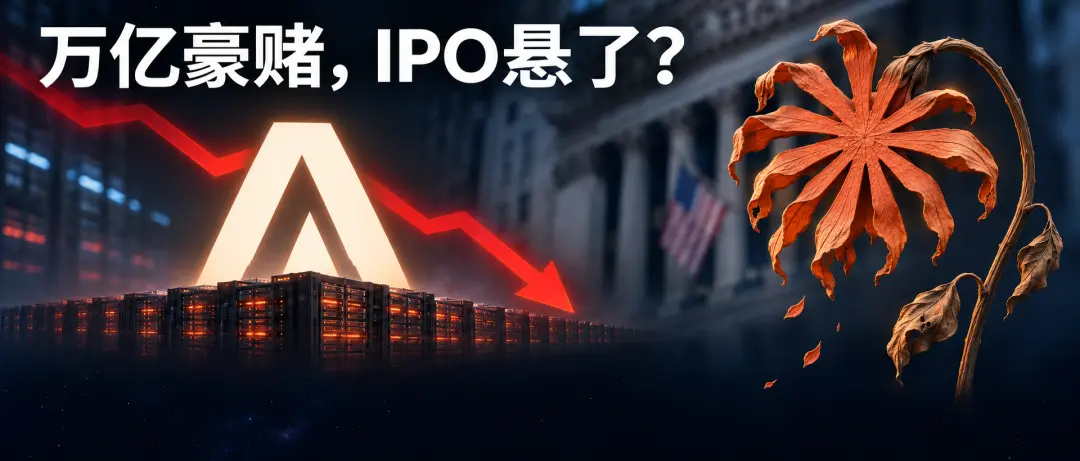
OpenAI raised 10 billion USD, Anthropic was asked to lower prices: trillion-dollar valuation questioned
 Core Viewpoint


 The AI industry is undergoing a repricing in the capital market.
Author: Joanne
Editor: Xu Qingyang
The two most expensive financing rounds in the AI industry are facing the same question: how much are investors still willing to pay for growth?
On November 6, local time in the United States, OpenAI completed the first tranche of its $11 billion financing round, with a valuation of $1.25 trillion, but this shows a significant gap from the initial financing target.
Almost simultaneously, Anthropic, which is preparing to launch its IPO, is also facing skepticism from investors, with some institutions believing its $1.5 trillion valuation is already too high and even demanding the company further lower its offering price.
The timing of Anthropic's IPO has also begun to show uncertainty. Whether the roadshow, originally scheduled for next week, can proceed as planned has become a topic of discussion among investors.
Both companies were previously seen as the most valuable assets in the AI industry, but now they are facing tightening financing conditions. This change involves not only valuation adjustments but also exposes the increasingly unavoidable contradictions between AI commercialization, computing power investment, and capital returns.
The AI industry is undergoing a repricing in the capital market.
OpenAI's Financing Plan Continues to Shrink
On November 6, informed sources revealed that OpenAI had completed the first tranche of its approximately $11 billion financing, with funds received the same day, corresponding to a company valuation of $1.25 trillion.
This funding is just part of the latest financing round. OpenAI still plans to complete the remaining financing in the coming weeks, with the total round expected to reach $20 billion.
However, compared to the initial plan, the financing scale has significantly shrunk. OpenAI initially hoped to raise about $30 billion, with a valuation target reaching $1.5 trillion. Subsequently, the company adjusted its financing target to $20 billion, with the valuation also lowered to $1.25 trillion.
SoftBank and Abu Dhabi investment firm MGX are important participants in this round of financing. According to previous disclosures, OpenAI has also approached investment institutions such as Founders Fund, Coatue, Sequoia Capital, and Andreessen Horowitz.
This round of financing has a special background: OpenAI is racing to complete fundraising before Anthropic goes public.
On October 19, Reuters reported that OpenAI was accelerating its financing progress, hoping to lock in institutional investors before Anthropic's expected IPO in mid-November. The two companies are competing for a significant portion of the same funding sources.
OpenAI's Chief Financial Officer Sarah Friar stated in an interview on November 6 that the company's revenue grew by 70% in the third quarter, with enterprise sales reaching twice that of the same period last year.
She also mentioned that the recent results of the U.S. midterm elections did not significantly alter OpenAI's planned IPO schedule, and the company still hopes to go public in 2027.
OpenAI's desire to complete financing quickly is also related to its infrastructure investments. The company needs to prepare sufficient funds for data centers, chip procurement, and long-term computing power contracts, while also providing a more solid balance sheet for the planned IPO in 2027.
However, the $11 billion first tranche also brings a practical question: with a valuation of $1.25 trillion, can OpenAI continue to attract investors under the original conditions to complete the remaining financing?
For OpenAI, this round of financing is not just a simple capital supplement.
In March of this year, OpenAI had just completed a financing round totaling $122 billion, with a post-money valuation of $852 billion. This round was participated in by strategic investors such as Amazon, NVIDIA, and SoftBank, with long-term investors like Microsoft continuing to provide support. OpenAI stated at the time that the funds would be used for model development, product expansion, and infrastructure construction.
In just over half a year, OpenAI's valuation has further progressed from $852 billion to $1.25 trillion, maintaining an extremely high valuation level among private tech companies globally. However, the reduction of the financing target from $30 billion to $20 billion also indicates a change in investors' attitudes towards high capital investments.
Anthropic's $2 Trillion Valuation Difficult to Maintain
The shrinking financing scale of OpenAI reflects the caution in the private equity market, while the valuation changes of Anthropic are directly related to the upcoming IPO of AI companies.
Anthropic has submitted its listing documents to the U.S. Securities and Exchange Commission (SEC), planning to go public on NASDAQ under the ticker symbol ANT. Previously, market expectations for Anthropic's IPO valuation had reached as high as $2 trillion. According to earlier circulated financing and listing arrangements, the company was expected to raise hundreds of billions of dollars through the IPO, potentially breaking the record for the largest IPO financing in tech history.
However, with changes in the market environment, the $2 trillion valuation target has begun to lose support.
On November 6, investor expectations for Anthropic's IPO pricing further declined. Some investors believe that the $1.5 trillion valuation is already too high, even calling it a barely achievable target. Other investors believe that a valuation range of $1 trillion to $1.25 trillion may be more realistic.
This represents a significant gap compared to the previous expectation of $2 trillion. Based on a $1 trillion valuation, the expected valuation has already halved.
Max Kettner, head of multi-asset strategy at HSBC, believes that a valuation of around $1 trillion may be a more prudent choice, helping to reduce the risk of severe price fluctuations in Anthropic's early trading.
D.A. Davidson analyst Gil Luria also stated that the best way to ensure a good IPO performance for Anthropic is to reasonably determine the offering price, rather than blindly pursuing a higher valuation.
The valuation changes of Anthropic are particularly noteworthy because the company does not lack growth data.
In May of this year, Anthropic announced the completion of a $65 billion Series H financing, with a post-money valuation of $965 billion. This round of financing was participated in by institutions such as Altimeter Capital, Dragoneer, Greenoaks, and Sequoia Capital, with strategic partners like Amazon also providing previously committed investments.
At that time, Anthropic stated that its annualized revenue run rate had exceeded $47 billion, and the adoption of Claude by enterprise customers was accelerating.
From a private financing valuation of $965 billion to the previously expected $2 trillion IPO valuation, Anthropic achieved a significant valuation premium in a short period. However, this expectation is based on the premise of sustained high-speed growth in future revenue, continuous expansion of enterprise customers, and the ability to achieve returns on AI infrastructure investments.
Now, investors are beginning to reassess these conditions.
Investors Begin to Calculate Return Cycles
The cooling expectations for financing from OpenAI and Anthropic are also driven by a larger change: the capital market's investment logic in the AI industry is adjusting.
In the past two years, investors were most concerned about who could first train a more powerful model, who could obtain more GPU and data center resources, and who could gain a leading position in the next round of technological competition. As long as a company could prove its technological advantages and growth potential, there was significant room for financing scale and valuation to rise.
Now, this logic is being challenged.
First, the scale of investment in AI infrastructure is continuously expanding. Large tech companies like Microsoft, Amazon, Google, and Meta are consistently increasing capital expenditures, with data center construction, chip procurement, and power supply becoming significant expenditures for AI industry expansion. The computing power demands of model companies are intertwined with the capital investments of cloud service providers, forming a massive investment chain.
However, infrastructure investments do not necessarily lead to commensurate revenue. Data centers require time from planning and construction to operational deployment, and chip procurement and long-term computing power contracts mean that companies must bear costs in advance. If the commercialization speed of AI applications cannot keep pace with infrastructure expansion, the investment return cycle may further extend.
Secondly, the public market is beginning to demand more sustainability from AI investments.
In early November, U.S. tech stocks experienced a noticeable adjustment, with investors reassessing the AI capital expenditures, data center construction plans, and future profitability of large tech companies. The results of the U.S. midterm elections also increased market concerns about the resistance to data center construction. Local residents' opposition to rising electricity prices, energy consumption, and land use may affect the approval and construction progress of some projects.
For OpenAI and Anthropic, these changes are not distant industry risks. Their business models heavily rely on external computing power supply, and the construction capabilities, financing costs, and capital expenditure arrangements of cloud service providers will all impact the expansion speed of model companies.
At the same time, both companies face different competitive pressures.
OpenAI has a large consumer base for ChatGPT and continues to expand in areas such as enterprise services, developer platforms, and programming tools. According to financing materials released by the company in March of this year, its ChatGPT has surpassed 900 million weekly active users, with over 50 million paid subscribers, and enterprise business revenue accounting for more than 40%. OpenAI also stated that the number of tokens processed by its API per minute has exceeded 15 billion.
Anthropic, on the other hand, focuses more on the enterprise market, with products like Claude Code driving adoption among developers and enterprise customers. The latest documents show that the company has over 11,900 customers who contributed at least $100,000 in revenue over the past 12 months, and its enterprise customer base is rapidly expanding.
The commonality between the two companies is that they both need to continuously invest massive amounts of capital to maintain model capabilities and computing power supply. The difference is that OpenAI needs to further expand revenue scales in consumer and enterprise markets, while Anthropic needs to prove that its enterprise business growth can cover the costs brought by long-term computing power contracts.
What the capital market now needs to see is not just how much model capabilities have improved or how fast user numbers have grown, but also how much computing power cost is required for every additional dollar of revenue, whether long-term contracts can be fulfilled, and when enterprises can form stable cash flows.
This is also why both companies can still achieve trillion-dollar valuations but find it difficult to continue financing according to previous expectations.
For the entire AI industry, valuation adjustments will also change the financing environment for startups. In the past, having advanced models, ample computing power, and rapidly growing user scales could be important conditions for obtaining high financing. In the future, investors may place more emphasis on the quality of enterprise revenue, customer retention, inference costs, and cash flow performance.
When capital is no longer willing to easily pay the full premium for future growth, AI companies must also answer a more practical question: how much money does technological leadership actually require to burn, and when can it create value that matches it?
 Risk warning
 Risk warning

Popular articles