Tron Industry Weekly Report: Macro tightening institutions withdraw investment, BTC launches the defense of 60,000, detailed explanation of the on-chain intelligent all-in-one brokerage platform Travix

 Travix is an all-in-one brokerage platform for on-chain agents that combines AI-driven quantitative trading with verifiable blockchain execution. The platform offers a 24/7 perpetual contract market covering cryptocurrency assets, stocks, foreign exchange, and commodities through a unified account.
I. Outlook
1. Macroeconomic Summary and Future Forecast
Macroeconomic Market Review (November 16, 2026 - November 22, 2026):
This week, the global macro market exhibited characteristics of "strong inflation stickiness, rising hawkish expectations from the Federal Reserve, economic growth divergence, and significant adjustments in risk assets." U.S. core retail sales in October increased by 0.6% month-on-month, exceeding expectations, indicating that consumption remains resilient; however, industrial output fell by 0.4% month-on-month, with the manufacturing and real estate markets continuing to face pressure. The minutes from the Federal Reserve's October meeting signaled further tightening, with the market widely expecting a 25 basis point rate hike in December. Due to the dual impact of high interest rate expectations and the revaluation of AI tech stocks, U.S. stocks experienced severe adjustments, with the Nasdaq index dropping about 10% for the week, the S&P 500 index falling by 8.6%, and the Dow Jones Industrial Average declining by about 8%. Meanwhile, safe-haven funds flowed into U.S. Treasuries, with the yield on the 10-year U.S. Treasury falling from over 5% to about 4.9%. Overall, the core contradiction in the market has shifted from merely worrying about the Federal Reserve's tightening to a dual pressure of "high inflation coexisting with economic slowdown and the difficulty of maintaining high valuations in tech stocks," leading to a significant decline in global risk appetite.
Macroeconomic Outlook for the Coming Week (November 23, 2026 - November 29, 2026):
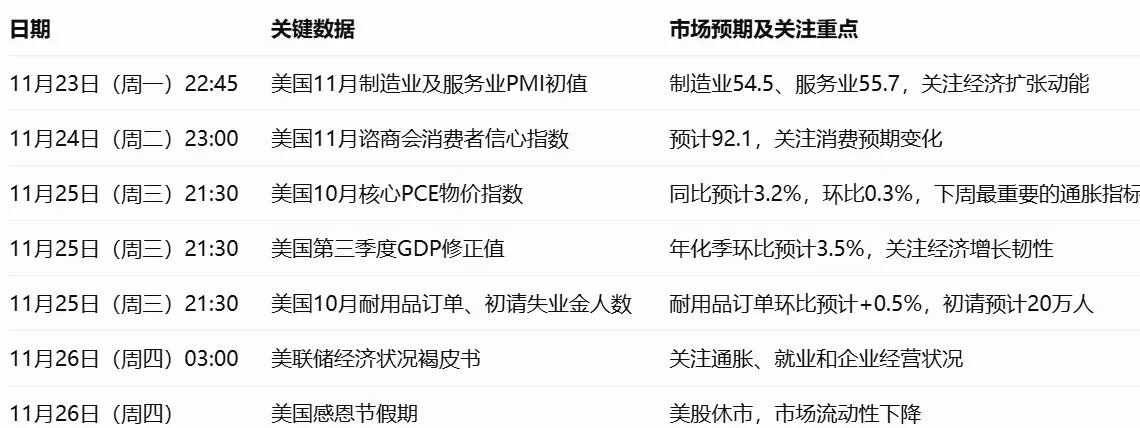
Next week, the market's core focus will be on the U.S. October PCE inflation data, the revised Q3 GDP, November PMI, and consumer confidence data, with the PCE released on November 25 becoming a key basis for assessing the Federal Reserve's rate hike intensity in December. Currently, the market expects the overall PCE year-on-year to rise to 3.8%, with core PCE increasing by 0.3% month-on-month. If inflation exceeds expectations, it may further strengthen the Federal Reserve's hawkish stance, pushing the dollar and U.S. Treasury yields to rebound, continuing to suppress U.S. stocks and crypto assets; conversely, if inflation is below expectations, it may alleviate tightening concerns and lead to a technical recovery in risk assets. Additionally, inflation data from Japan and Australia, as well as the Bank of Korea's interest rate decision, are also worth monitoring. Considering the shortened trading hours and decreased market liquidity due to the U.S. Thanksgiving holiday, it is expected that U.S. stocks will maintain a high volatility pattern next week, with tech stocks having the opportunity for a rebound after overselling, but overall risk appetite is unlikely to sustain recovery before a significant decline in inflation and a shift in Federal Reserve policy expectations.
2. Cryptocurrency Industry Market Changes and Warnings
Cryptocurrency Market Review (November 16, 2026 - November 22, 2026):
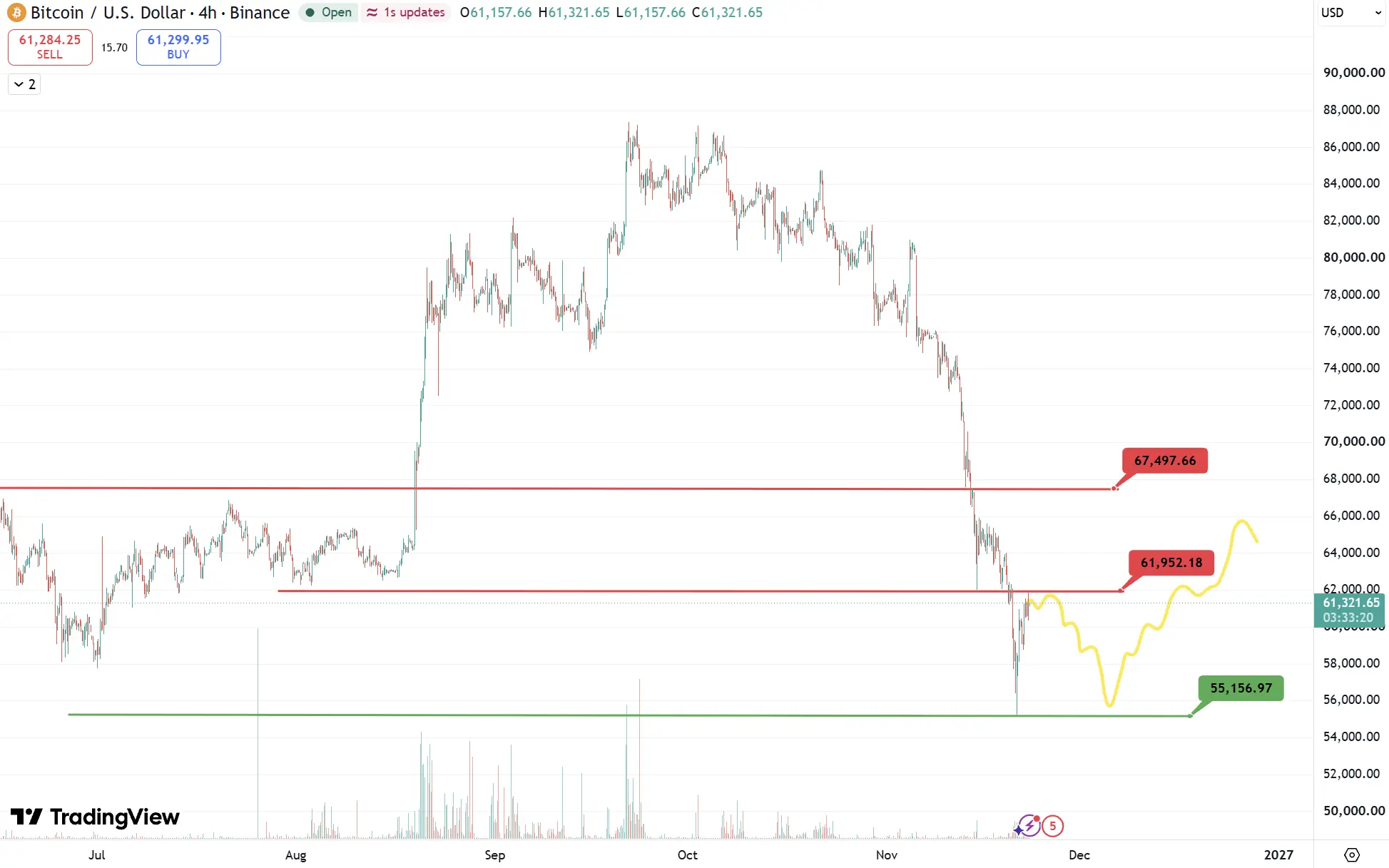
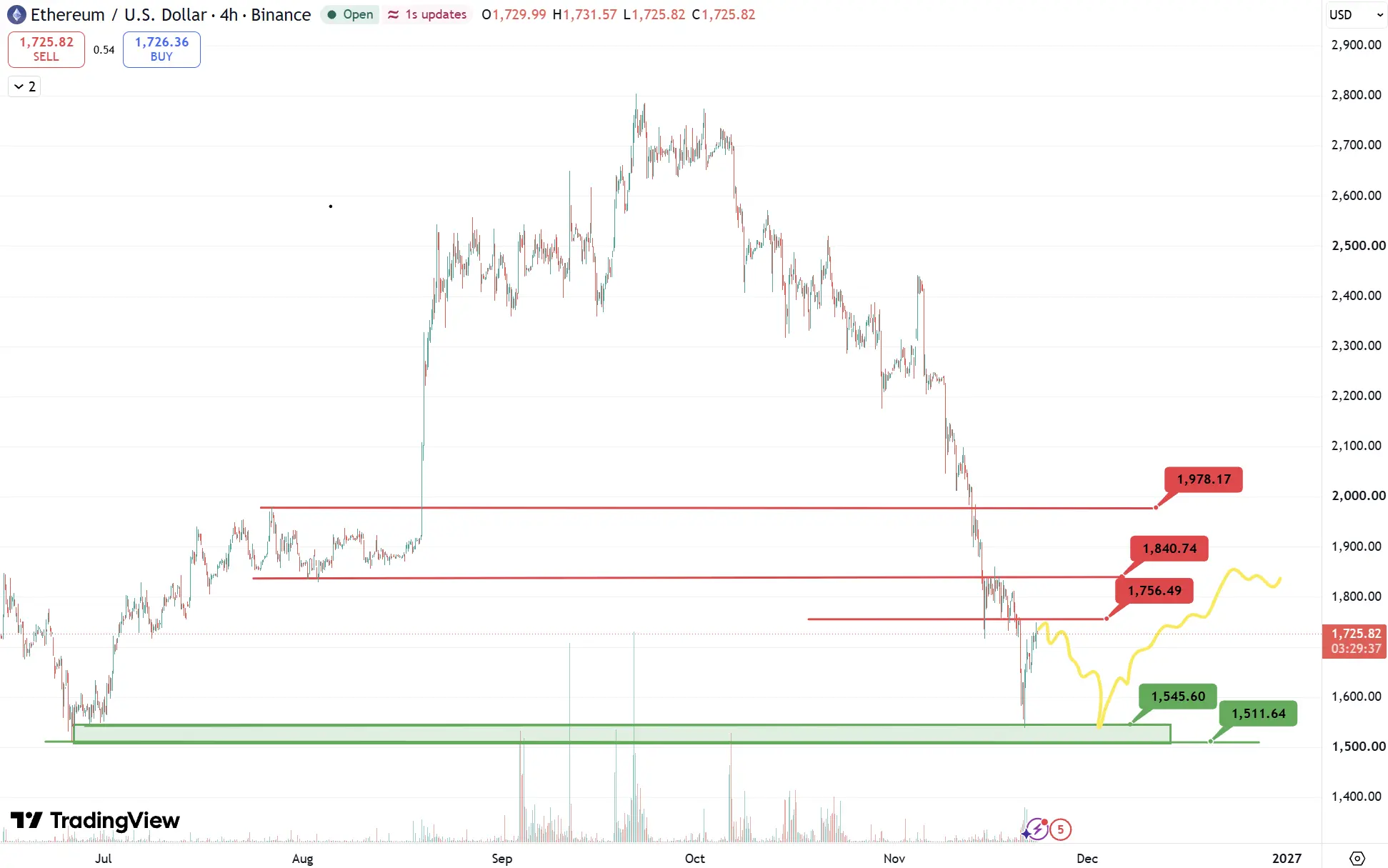
This week, the cryptocurrency market continued its significant downward trend, primarily driven by rising hawkish policy expectations from the Federal Reserve, adjustments in the U.S. tech sector, and ongoing withdrawals of institutional funds. Bitcoin (BTC) fell below $60,000 during the week, dipping to around $57,000 on November 20-21, a decline of over 10% from the previous week; Ethereum (ETH) also weakened, dropping to around $1,748 on November 20, while altcoins generally faced pressure, with the market fear index falling to around 10, indicating extreme fear. The minutes from the Federal Reserve's meeting released on November 18 signaled further rate hikes, combined with concerns over AI sector valuations and tech stock sell-offs, leading to synchronized pressure on global risk assets. Meanwhile, Bitcoin spot ETFs continued to see fund outflows, and concentrated liquidations of leveraged long positions further amplified the decline, with the market showing clear signs of deleveraging and liquidity contraction. Overall, this round of decline is not merely an internal adjustment within the cryptocurrency industry but rather a result of macro tightening expectations, institutional fund withdrawals, and declining risk appetite.
Outlook for the Coming Week (November 23, 2026 - November 29, 2026):
The cryptocurrency market is expected to maintain a weak oscillating pattern, with short-term opportunities for a rebound after overselling, but lacking clear conditions for a trend reversal. BTC should focus on the effectiveness of support in the $57,000 - $60,000 range; if the U.S. tech sector stabilizes and ETF fund outflows slow, prices may rebound to the $65,000 - $68,000 range; conversely, if the Federal Reserve's rate hike expectations continue to strengthen and institutional funds keep withdrawing, it may test previous lows again and seek further support downward. ETH and altcoins are expected to face greater volatility pressure, with market funds possibly continuing to concentrate on BTC and stablecoins. Key indicators to watch next week include Federal Reserve policy expectations, U.S. stock performance, especially the Nasdaq, BTC spot ETF fund flows, and changes in derivatives leverage. Overall, the market is currently in a confidence recovery phase after deleveraging, with short-term rebounds likely to be technical corrections, and sustained increases will require improvements in macro liquidity expectations and renewed institutional fund inflows.
3. Industry and Sector Hotspots
From November 16 to 22, 2026, the primary market financing hotspots in the cryptocurrency industry focused on stablecoin payments, cross-border settlements, on-chain financial infrastructure, and the integration of traditional finance with crypto assets, reflecting that capital is continuously leaning towards projects with practical application scenarios and commercialization capabilities. Notably, the stablecoin issuer Tether's investment arm participated in a $30.1 million Series C financing for the Brazilian fintech platform Nomad, demonstrating the trend of crypto capital penetrating cross-border financial services and emerging markets in Latin America.
The on-chain derivatives trading platform Variational completed a $110 million Series B financing, led by Bain Capital Crypto, becoming the most notable financing event of the week; the stablecoin settlement platform Codex secured $30 million in Series A financing, and the Brazilian stablecoin infrastructure project Avenia received $25 million in funding, further highlighting the capital-raising ability of the stablecoin payment and financial infrastructure sector.
II. Market Hotspot Sectors and Potential Projects of the Week
1. Overview of Potential Projects
1.1. Detailed Explanation of Total Financing Exceeding $5 Million, Led by Amber ------ Creating a Cross-Asset Event-Driven Trading Platform, Travix, with Verifiable Transactions and Transparent AI Decision-Making
Introduction
Travix is an on-chain omnichannel brokerage platform that combines AI-driven quantitative trading with verifiable blockchain execution. The platform offers a 24/7 perpetual contract market covering crypto assets, stocks, forex, and commodities through a unified account. Its trading agent engine supports users in generating, backtesting, optimizing, and executing personalized strategies, while the financial world model analyzes multidimensional data to identify probability changes and their impact on assets. Travix integrates ZK-verified settlement, self-custody, liquidity vaults, smart order routing, portfolio margining, and API infrastructure, supporting trading workflows for both individuals and institutions.
The Travix protocol is a sovereign application chain built on the Cosmos SDK, equipped with a ZK-Validium verification layer. This architecture consists of four main pillars.
(1) TravixCore: Implements a sovereign chain with dual finality semantics, achieving millisecond soft confirmations and minute-level hard finality through Groth16 proofs; its novel margin-aware order book tree (TravixOBT) allows all operations to reach Θ(log N) complexity, providing native privacy through a TEE+ZK mixed masking order protocol, and is equipped with a verifiable AI proof layer (inference proof).
(2) Travix AI Agent Infrastructure: A decoupled architecture for cognition and execution, employing market state adaptive strategy manifolds, formally separating static strategy logic from dynamic parameters constrained by market states, allowing AI-generated strategies' risk control to adapt in real-time to implied volatility, funding rates, and cross-asset correlations.
(3) Oracle Terminal: An event trading engine based on information theory, modeling changes in predictive market probabilities as Kullback-Leibler surprise, with a calibrated transmission network and combined exponential time decay and Bayesian cross-event dependencies, generating asset-level force field vectors for automated position management. This article provides formal definitions, complexity analysis, and mathematical frameworks, establishing these mechanisms as original contributions in the fields of verifiable computation, AI transparency, and event-driven finance.
Project Analysis
- Travix Technology Stack
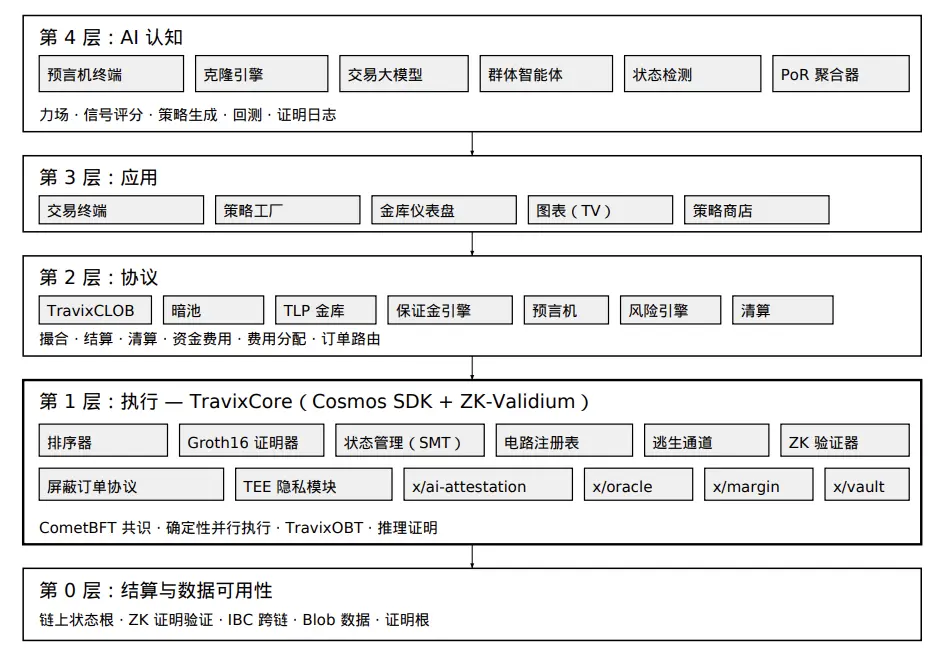
Figure 1: Travix Technology Stack. The thick border indicates the trust boundary (Layer 1). The x/ai-attestation module anchors AI decision transparency to the cryptographic state of the chain.
- Transaction Lifecycle
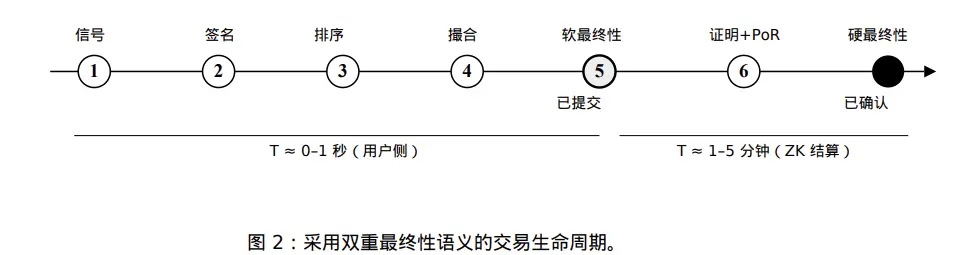
A transaction goes through seven deterministic stages:
(1) Signal generation (AI or manual);
(2) Signing via session key or private key;
(3) Entering fast or slow channel sorting;
(4) Matching in a parallel execution engine;
(5) Achieving soft finality through MsgSubmitBatch (status: SUBMITTED);
(6) Generating Groth16 proof (asynchronous, including PoR proof root);
(7) Achieving hard finality through MsgSubmitProof (status: CONFIRMED, cryptographically irreversible).
AI-initiated transactions will also generate proof products, which are submitted along with transaction data in stage 6.
- The AI---Verifiable---Privacy Trilemma
Definition 1 (AI---Verifiable---Privacy Trilemma). Derivative protocols pursue three properties:
(A) AI Native: The protocol integrates machine learning reasoning into execution;
(V) Verifiable: All state transitions, including AI decisions, can be proven correct or audited;
(P) Privacy: Order parameters are hidden. Existing protocols can achieve a maximum of two items.
Travix addresses the three dilemmas through layered separation: AI is located at layer 4 and anchored through on-chain proof (PoR), verifiability is provided by Groth16 at layer 1, and privacy is provided by TEE+ZK shielding orders at layer 1.
TravixCore: Sovereign Verifiable Chain
- Cosmos SDK Sovereign Application Chain
TravixCore is implemented based on the Cosmos SDK and uses CometBFT consensus; it can autonomously control block time, fee model, validator set, and upgrade plans, and supports IBC cross-chain interoperability. The transaction logic is implemented as a protocol-level module that can directly access the state machine, thus avoiding EVM overhead.
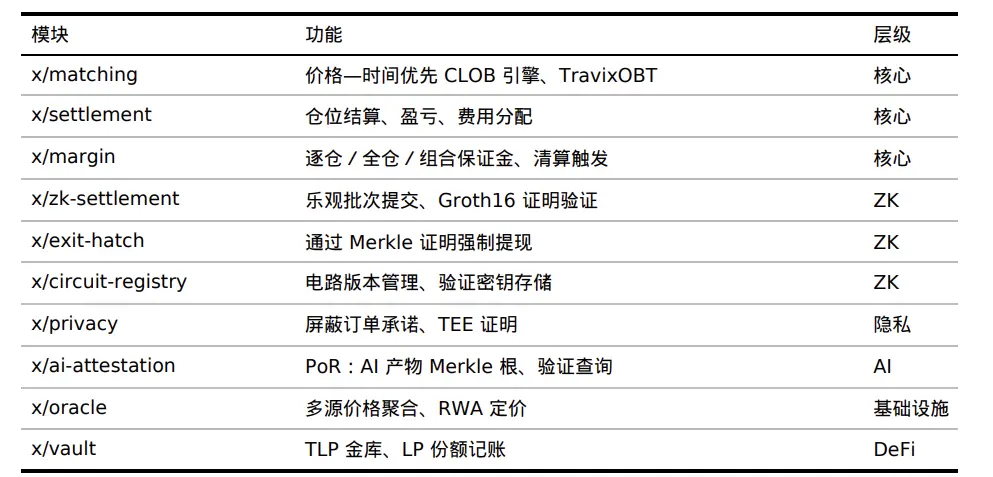
Table 1: TravixCore Module Architecture.
- State Tree and TravixOBT
TravixCore uses the Poseidon2 hash function to store the state in a Sparse Merkle Tree (SMT) and organizes it by subtrees of specific domains.
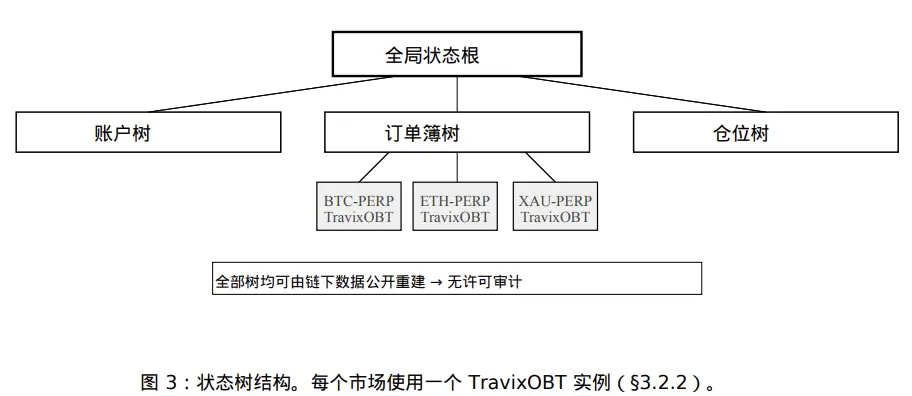
2.1. Account Tree
The account tree stores data for each user: asset balances, position metadata, sub-account mappings, API key nonce with disconnection protection timestamp, and public fund pool share information. Each leaf node contains sufficient data needed to generate exit proof for the escape channel.
2.2. TravixOBT: Margin-Aware Order Book Tree
The technical team proposed TravixOBT: a dedicated data structure that uses margin-aware aggregation of internal nodes to extend the prefix tree index. When the price field is P bits and the nonce field is O bits, the tree height H = P + O.
- ZK-Validium Verification Layer
3.1. Dual Finality Model
Definition (Dual Finality). Soft finality (T≈0): The sorter submits batches through MsgSubmitBatch → SUBMITTED. Trust assumption: Honest sorter. Hard finality (T≈2--10 minutes): STARK followed by Groth16's hybrid proof π is verified on-chain → CONFIRMED. Trust assumption: Reliability of Groth16 on BN254. If the proof is not submitted within ProofTimeout (24 hours), the escape channel is activated.
3.2. Multi-Layer Circuit Architecture
Under production latency targets, directly performing Groth16 proofs on billions of constraints is computationally infeasible. Therefore, the Travix prover adopts a hybrid pipeline of STARK followed by Groth16: block and segment-level internal proofs use FRI-based STARK (beneficial for proof, parallelizable, and requires no trusted setup), ultimately packaging the aggregated STARK proof into a constant size proof (about 200 bytes) for on-chain verification through Groth16/PLONK wrappers. This architecture is similar to deployed production systems like Polygon zkEVM and zkSync Era.
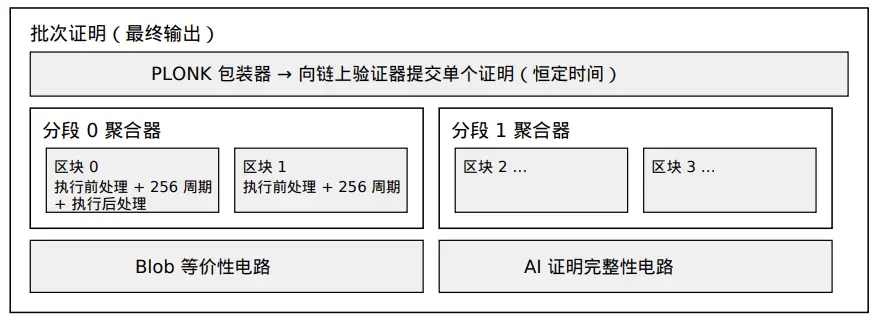
Figure 4: Multi-layer Proof Aggregation. Block proof aggregation into segments, segment aggregation into a single batch proof
Then wrapped by PLONK. Proof integrity circuit verifies PoR Merkle root. Execution preprocessing updates the global market state: when the block timestamp exceeds the funding fee interval, fund payments are applied; oracle data updates index and mark prices; market premiums are calculated; and mark prices are recalculated using boundary recalculation with EMA deviation limits.
The execution cycle processes one instruction per cycle. For new transactions, the circuit uses the API key stored in the account tree to verify signatures, checks the nonce to prevent replay, and validates witness data by verifying the Merkle path against the state root. Risk checks confirm sufficient margin using the MarginReq aggregate value in TravixOBT. The circuit then executes order insertion, pending transactions, cancellations, or liquidations based on the instruction type, updates the affected leaf node data, recalculates internal node aggregate values along the modification path, and derives a new state root.
3.3. Circuit Lifecycle Management
The x/circuit-registry module achieves smooth upgrades through a four-stage process: Registration (governance, about 7 days) → Parallel Operation (about 14 days) → Deprecation (about 7 days) → Retirement.
3.4. Matching Engine and Order Semantics
3.4.1. Deterministic Parallel Transaction Engine (PTE)
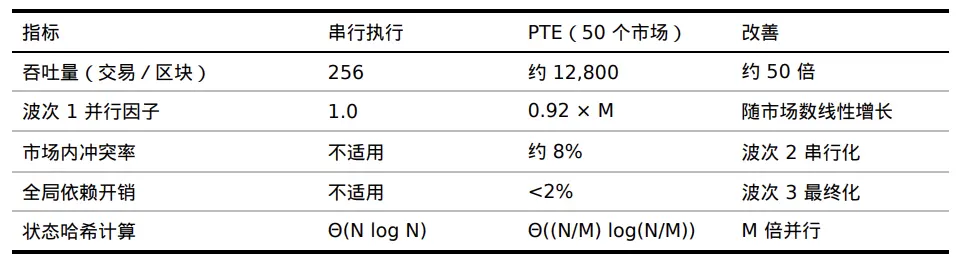
Sequential execution of transactions is the main bottleneck of on-chain transaction systems: for 10,000 transactions across 50 independent markets, even if 98% of the transaction states do not overlap, they are still processed serially. TravixCore introduces a deterministic parallel transaction engine (PTE) that extracts maximum parallelism from ordered transaction batches while maintaining bitwise consistent determinism—the property required for ZK verification.
3.4.2. Wave-Based Parallel Dispatch
Execution is divided into three wave phases, each with different parallel characteristics:
Wave 1: Non-conflicting state transitions (parallel phase). Transactions with non-overlapping state access ranges are executed simultaneously in isolated market Actors. Each market Actor is an independent execution context, possessing a single instance of TravixOBT for the market and its related state subtree. A batch containing M active markets can have up to M market Actors executing concurrently. Transactions for the same market within the same Actor are executed sequentially, maintaining the sorter’s ordering invariant.
Wave 2: Intra-market dependency transitions (serial phase). Transactions with state conflicts within the same market, such as buying BTC and then canceling the BTC order, are executed sequentially within their respective market Actors. The scheduler ensures that these transactions are dispatched only after the preceding transactions from Wave 1 have submitted their state increments.
Wave 3: Global state dependencies (finalization phase). Cross-market operations, including global risk checks, funding rate settlements, portfolio margin recalculations, and liquidation chain assessments, are executed after all local waves in the markets are completed. These operations read the aggregated states of multiple market Actors and may trigger liquidations, ADL, and other secondary transactions; the latter also adopts the same wave decomposition for parallel processing.
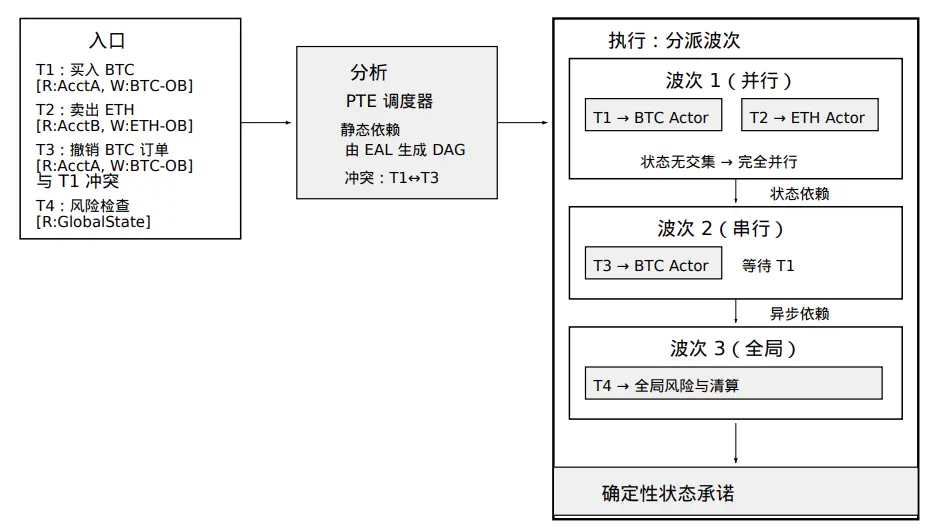
Figure 5: Deterministic PTE Processing Flow. Transactions marked with EAL analyze state conflicts, dividing them into waves that comply with dependency relationships, and then dispatching them to isolated market Actors. Conflicts between T1 and T3 (sharing BTC-OB write set) force them to execute serially in Wave 2, while T1 and T2 (different markets) can execute fully in parallel.
Table 4: PTE Performance Characteristics.
3.5. Liquidation System
3.5.1. Margin Model
The initial margin rate for each position IMR = 1/maxleverage, maintaining the margin rate MMR = IMR × maintenancefactor (usually 0.5). Account health is defined as:

Liquidation is triggered when Health < 0. Health calculation belongs to account tree operations: equity and unrealized profits and losses update with mark price changes, but the MarginReq aggregate value cached in TravixOBT remains stable, as they encode the initial margin under the entry price rather than the mark-to-market margin. This separation is crucial: mark price updates affect Health through the equity numerator (O(1) account-level updates), without needing to re-traverse the order book tree at O(N) cost.
In the combined margin model, related positions receive margin offsets at the account tree level rather than the order book tree level. For accounts holding P positions across different markets, the combined margin adjustment δportfolio is derived from the cross-asset correlation matrix Σ:

where sign_offset is positive for positions that offset each other (negatively correlated). This O(P²) calculation (typically P < 20) generates account-level margin offsets, reducing the effective maintenance requirements of Equation 13. The Θ(log N) property of TravixOBT remains unchanged: order book operations use static per-position margin aggregate values, while combined adjustments are calculated as an independent account-level process.
3.5.2. Progressive Liquidation
The liquidation engine operates as an asynchronous market Actor, executing a five-level cascade:
(1) Warning: Health < threshold1, notify the user;
(2) Order Cancellation: Cancel all unfilled orders to release margin;
(3) Partial Liquidation: Reduce the maximum position, quantity liqqty = min(|position|, margindeficit / markprice × safetymultiplier);
(4) TLP Floor: The treasury absorbs the remaining position at a discount;
(5) Insurance Fund: Covers the gap Δ = max(0, bankruptcyprice − fillprice) × size.
3.5.3. Automatic Deleveraging (ADL)
When the order book depth is insufficient for market price liquidation, the system ranks counterparties by ADL priority = profitratio × effectiveleverage in descending order. ADL executes at the bankruptcy price rather than the marked price, ensuring that losses are not socially distributed. The liquidated positions are matched with the counterparties with the highest priority.
3.5.4. Insurance Fund
The insurance fund comes from partial liquidation penalties and agreement income. It is responsible for covering losses when the liquidation transaction price is lower than the bankruptcy price. The fund balance can be transparently queried on-chain.
3.6. Privacy Protection Infrastructure
3.6.1. TEE+ZK Hybrid Trust Model
This security model progressively degrades under three fault modes and clearly distinguishes between correctness guarantees (relying solely on ZK) and privacy guarantees (relying on TEE):
(i) TEE is intact. Complete privacy (no parties, including the order sorter operator, can know the order parameters) and complete speed (matching is done in the enclave based on plaintext). ZK proof verifies the correctness of the matching and the commitment association. This is the operational mode of the design goal.
(ii) TEE is compromised (information leakage). Attackers exploiting TEE vulnerabilities can see the plaintext orders within the current batch window. This means a degradation of privacy but does not violate correctness: the ZK proof in stage 3 still verifies that all transactions follow price-time priority, quantity constraints, and margin sufficiency. Attackers gain an MEV-style informational advantage, allowing them to front-run or sandwich orders within the batch interval, but they cannot manipulate execution prices or steal funds. The privacy exposure window is constrained by the batch interval (usually 2-10 minutes): attackers observing orders within the observation window can at most gain an informational advantage equivalent to the delay in observing the order book at the batch granularity, similar to the latency advantage held by market makers in traditional finance who are located in the same place.
(iii) Both TEE and the prover are compromised. If both the TEE and the proof generation infrastructure are compromised simultaneously, the on-chain validators will reject invalid proofs (Groth16 reliability); the escape channel is activated after proof submission exceeds ProofTimeout. Users verify their balances based on the last valid state root using Merkle inclusion proofs.
The protocol adopts a defense-in-depth approach: during session establishment, it verifies enclave integrity through SGX remote attestation; hardware encrypts enclave memory; batch granularity privacy windows limit the impact range of individual vulnerabilities. We emphasize that the TEE assumption is the weakest part of the privacy model, as SGX has historically encountered multiple side-channel attacks; the protocol design ensures that TEE failure only degrades privacy and never compromises correctness.
- Travix AI Intelligent Agent Infrastructure
4.1. Native Design Philosophy of Intelligent Agents
Travix is designed as a dual-track exchange: humans interact through a GUI trading terminal; AI agents interact through the MCP protocol, structured skills (JSON Schema), and direct APIs. Both paths share a single unified liquidity pool to avoid fragmentation. The agent path provides over 100 machine-native skills for querying market status, submitting orders, executing algorithms (TWAP), and managing risks, all optimized for LLM function calls.
4.2. Decoupled Cognition and Execution Architecture
LLM inference requires 5-15 seconds, while the crypto market moves in milliseconds. Directly coupling AI cognition to order execution would introduce unacceptable delays: by the time LLM completes analysis, trading opportunities may have vanished. The CED architecture separates slow cognition from fast execution into two independent infrastructure layers, connected by an asynchronous compilation bridge to resolve this fundamental contradiction.
The cloud layer operates on a time scale of seconds to minutes, hosting the LLM inference engine, strategy generation pipeline, backtesting infrastructure, and Wasm compilation toolchain. When users request new strategies through natural language specifications or by cloning historical behaviors, the cloud layer executes multi-step reasoning: analyzing market structure, generating candidate strategy logic, backtesting across historical states, iterating parameter boundaries, and finally compiling the validated strategy into a deterministic Wasm module. This process may take 30-120 seconds but occurs only once, and the product can be executed for days or weeks.
The edge layer operates on a time scale of microseconds to milliseconds. The compiled Wasm module is deployed to edge nodes co-located with the sorter infrastructure, achieving less than 5 milliseconds of market-to-trade latency. Edge nodes subscribe to real-time market data (order book updates, transaction records, funding rate changes, Oracle Terminal force field vectors), injecting each market update as input parameters into the Wasm runtime. The Wasm module executes deterministically: given the same input, it produces the same output on any machine, which is a necessary property for PoR verification.
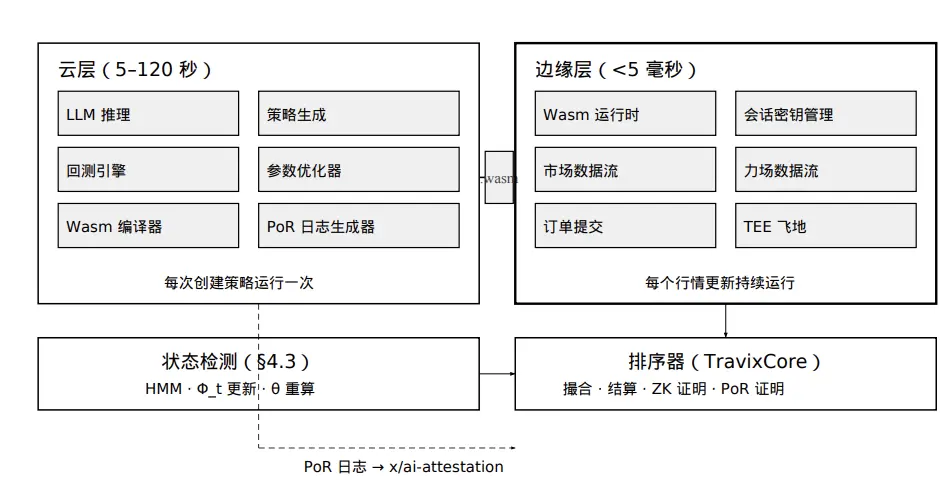
Figure 6: Decoupled Cognition and Execution (CED) Architecture. The cloud layer generates strategies on a time scale of seconds to minutes; the edge layer executes with less than 5 milliseconds of latency co-located with the sorter. The thick border indicates the trust boundary.
The chain verifies constraint parameters before executing any session key signed orders. Constraints are enforced within the ZK circuit: even if the edge node is compromised, it cannot exceed the leverage or position size limits set by the user. Keys can be revoked at any time through priority trades that bypass the regular queue; the system also implements a disconnection protection switch: if no heartbeat is received within a configurable timeout (default 60 seconds), all unfilled orders are canceled, and positions are reduced to a safe state as defined by governance.
Failover and Resilience. Each edge node maintains a heartbeat connection with the cloud layer. If the cloud layer is unreachable (LLM provider failure, network partition), the edge layer continues to execute the most recently deployed Wasm module using the last known state parameters, resulting in performance degradation but still operational. The determinism of Wasm ensures that even without state updates, execution remains predictable and auditable. After reconnection, the cloud layer pushes accumulated market state changes, and parameters are updated atomically.
- Oracle Terminal: Probability Event Trading Engine
5.1. Probability World Model
The core insight of Oracle Terminal is philosophical: event trading is not about trading prices but about trading the probabilities of future world states. Each prediction market contract is an Arrow-Debreu security: it pays $1 if and only if a specific state is realized. The contract price equals the risk-neutral probability of that state. When these probabilities change, while the corresponding asset prices have not yet responded, there exists informational arbitrage. Specific Example. Consider the Federal Reserve's interest rate decision. At 1:45 PM Eastern Standard Time, informed participants incorporate leaked dot plot expectations, causing the "Federal Reserve maintains interest rates" prediction contract to drop from 72% to 58% within 15 minutes.
Historical event studies show that this contract's probability decreased by 14 percentage points, corresponding to changes of approximately -0.8% for DXY, +1.2% for XAU, and +2.5% for BTC. However, at 1:50 PM Eastern Standard Time, BTC only rose by 0.3%, with the remaining 2.2% of implied increase not yet priced in. Oracle Terminal automatically detects this discrepancy: KL divergence is unexpectedly high (probability shifts from a relatively certain area); the transmission coefficient is statistically significant (historical calibration p < 0.01); the informational advantage ΔT is positive (the prediction market leads the asset by about 5 minutes). The system generates a long BTC signal, with confidence proportional to the magnitude of the unutilized probability differential.
5.2. Three-Layer Decision Architecture
Oracle Terminal processes information through a three-layer structure with deepening increments and decreasing speeds, with each layer supplementing the context that the previous layer could not provide. Inter-layer upgrades occur automatically: abnormal force field readings trigger LLM analysis, and high-impact events trigger complete group simulations.
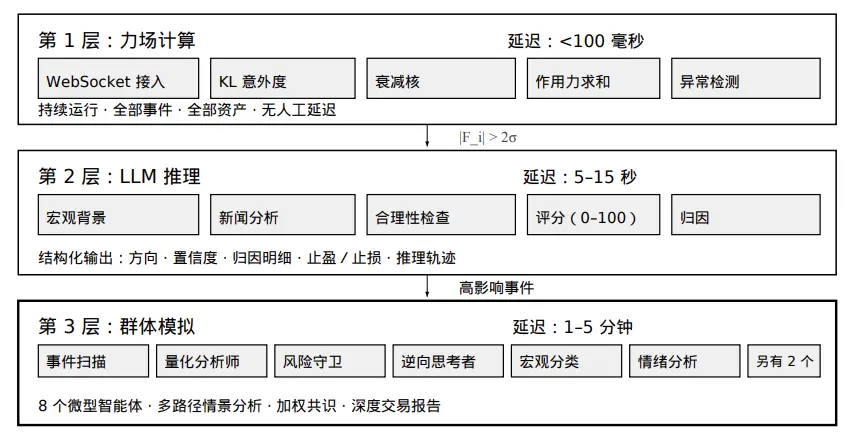
Figure 10: Three-Layer Decision Architecture. Each layer exchanges increased latency for deeper analysis. The system automatically upgrades based on the size of the anomaly and the importance of the event. The thick border indicates the deepest analysis layer.
Tron Commentary
The advantage of Travix lies in integrating cross-asset perpetual trading, AI strategy generation, and verifiable on-chain execution into a unified platform, improving capital efficiency through a unified account and portfolio margin, lowering the barrier to entry for quantitative trading through strategy backtesting, market state adaptation, and event signal analysis, and enhancing settlement credibility and the auditability of AI decisions through ZK verification, self-custody, and reasoning proofs.
The disadvantage is the complexity of the architecture, where the coordination of matching, proof generation, oracle, and AI execution increases development and operational difficulty; cross-asset trading relies on reliable price data and sufficient liquidity, while stock, forex, and commodity markets also involve challenges related to market closure pricing and compliance; additionally, reasoning proofs can only verify the integrity of decision records and cannot prove the correctness of AI analysis or the profitability of strategies, and privacy protection still relies on TEE security, whose performance, strategy robustness, and commercial viability require real-world validation.
II. Industry Data Analysis
1. Overall Market Performance
1.1. Spot BTC vs ETH Price Trends
BTC
ETH
III. Macroeconomic Data Review and Key Data Release Nodes for Next Week
Macroeconomic Data Review (November 16, 2026 - November 22, 2026)
This week, U.S. economic data showed characteristics of resilient consumption, weakening industrial production, marginal cooling in the labor market, and persistent inflationary pressures. Retail sales in October increased by 0.2% month-on-month, higher than the expected 0.1%, while core retail sales increased by 0.6%, indicating continued support for consumer spending; however, industrial output in October decreased by 0.4% month-on-month, significantly weaker than expected, and the November Philadelphia Fed manufacturing index fell to 6.3, reflecting weakened manufacturing momentum. In terms of employment, the number of initial jobless claims rose to 203,000 for the week ending November 14, and the number of continuing claims rose to 1.763 million, indicating some cooling in the labor market. The University of Michigan consumer confidence index for November was 51.5, slightly above expectations but still at a low level. Overall, there are no clear signs of recession in the U.S. economy, but growth divergence is intensifying, coupled with sticky inflation, which still poses significant constraints on the Federal Reserve's monetary policy.
Key Macroeconomic Data Release Nodes for Next Week (November 23 - November 29)
IV. Regulatory Policies
United States
- Regulatory rules for stablecoins enter the final administrative review stage (November 18).
The final rules for anti-money laundering and sanctions compliance for payment-type stablecoin issuers, developed by the U.S. Department of the Treasury's Financial Crimes Enforcement Network (FinCEN) and the Office of Foreign Assets Control (OFAC), were submitted for review to the Office of Information and Regulatory Affairs (OIRA) under the Office of Management and Budget on November 18. At the same time, the final rules developed by the Federal Deposit Insurance Corporation (FDIC) for stablecoin issuing institutions under its regulatory scope also entered the review process. This means that the implementation details of the GENIUS Act continue to advance, but the relevant rules cannot yet be considered officially published or effective.
- The division of regulatory authority over the digital asset market continues to advance (November 17 to 19).
The Senate Agriculture Committee held a nomination hearing related to the CFTC on November 17, and the Banking Committee held a nomination hearing related to the SEC on November 19. Agriculture Committee Chairman John Boozman reiterated that the CFTC should become the primary regulatory agency for the digital asset spot market. The relevant progress reflects the U.S. continuing to push for adjustments to the regulatory framework for the digital asset market, but new market structure legislation has not yet been completed this week.
Policy Impact: The U.S. regulatory focus is shifting from stablecoin legislation to the implementation of rules, market regulatory division, and compliance infrastructure development. In the short term, this is favorable for institutions with licenses, anti-money laundering systems, and compliance clearing capabilities, but there remains uncertainty regarding market structure legislation.
United Kingdom
- Officially formulate amendments to cryptocurrency asset regulatory regulations (November 16 to 19).
The UK House of Commons approved the relevant amendment regulations on November 16, and the Treasury officially formulated the Financial Services and Markets Act 2026 (Cryptocurrency) (Miscellaneous Amendments) Regulations (SI 2026/1219) on November 18, which came into effect on November 19.
The new regulations clearly adjust the boundaries of the regulatory system for cryptocurrency assets and electronic money. Among them, fiat-backed stablecoins and their supporting assets will no longer be treated according to the original electronic money definition starting from December 10, 2026; exemptions for eligible UK stablecoins, certain proprietary trading, market-making, and decentralized protocol technical services will apply from October 25, 2027.
Policy Impact: The UK is establishing a regulatory framework for cryptocurrency assets that is distinct from traditional electronic money systems, providing clearer legal classifications for stablecoin issuance, on-chain payments, and compliant market intermediaries. However, a complete cryptocurrency asset regulatory system still requires subsequent supporting rules to be implemented.
Hong Kong
- Announce the expansion of the virtual asset service license bill (November 20).
The Hong Kong government published the draft of the Virtual Asset Service Legislation (Amendment) Ordinance 2026 in the Gazette on November 20, intending to include virtual asset trading, consulting, asset management, and custody services within a more comprehensive licensing regulatory framework. Relevant business operators will be required to comply with corresponding licensing and regulatory requirements.
The bill is scheduled for its first reading on December 2 and is currently still in the legislative review stage, not yet a new licensing system that has been fully implemented this week.
- Promote tokenized deposit cross-border payment infrastructure (November 16).
The Hong Kong Monetary Authority announced continued collaboration with SWIFT to study connecting the Project Ensemble settlement infrastructure with the SWIFT ledger, exploring the use of multi-currency tokenized deposits to improve the efficiency and settlement experience of cross-border payments.
Policy Impact: Hong Kong is expanding the regulatory coverage of virtual asset intermediary services while promoting the construction of tokenized deposit and cross-border payment infrastructure, reflecting its policy direction of simultaneously developing a compliant virtual asset market and institutional-level on-chain financial services.
European Union
- The European Commission strengthens the enforcement of MiCA and cryptocurrency tax reporting systems (November 19).
On November 19, the European Commission initiated or advanced infringement procedures against several member states:
Spain, Czech Republic: Due to incomplete implementation of the DAC8 cryptocurrency tax information exchange directive, both countries received reasoned opinions from the European Commission and must take corrective measures within two months, or they may face lawsuits in the European Court.
Portugal: Due to insufficient implementation of MiCA-related requirements, further accountability was imposed by the European Commission.
Spain: Additionally, due to incomplete implementation of MiCA-related amendment requirements, a formal notification letter was received.
- Progress made in establishing a unified regulatory framework for the cryptocurrency market in the EU.
The draft minutes of the Economic and Financial Affairs Council meeting published on November 19 confirmed that member state finance ministers had previously reached a common position on capital market integration and regulatory reform proposals. The relevant proposals aim to bring some systemically important large cryptocurrency service providers under the more centralized regulatory scope of the European Securities and Markets Authority (ESMA), rather than transferring all service providers uniformly to ESMA regulation.
Policy Impact: EU regulation is shifting from MiCA rule-making to cross-member state enforcement, tax information sharing, and centralized regulation of large cryptocurrency institutions. In the future, exchanges, stablecoin issuers, and custodians operating cross-border will face stricter compliance consistency requirements.
Singapore
The central bank announces the completion of SGD 100 million tokenized note issuance and wholesale CBDC settlement experiment (November 19).
The Monetary Authority of Singapore (MAS) announced on November 19 that it successfully issued SGD 100 million of tokenized MAS notes with a four-week maturity on the Singapore Dollar Test Network on November 6 and completed the settlement using wholesale central bank digital currency. DBS Bank, HSBC, OCBC Bank, Standard Chartered Bank, and UOB participated in the issuance.
MAS plans to rename the network to SG Digital Ledger and expand the application of tokenized notes in collateral management and institutional financial markets by 2027.
Policy Impact: This development is not a new regulatory framework for cryptocurrency trading but an important advancement in Singapore's promotion of regulated financial asset tokenization, wholesale CBDC settlement, and the commercialization of on-chain financial infrastructure, helping to facilitate the integration of RWA with the traditional banking system.
Australia
Parliament passes anti-money laundering amendment bill aimed at strengthening cryptocurrency ATM regulation (November 16).
The Australian Parliament passed the Anti-Money Laundering and Counter-Terrorism Financing Amendment Bill 2026 on November 16, intending to grant the Australian Transaction Reports and Analysis Centre (AUSTRAC) the authority to restrict or prohibit high-risk service mechanisms, with cryptocurrency ATMs being one of the explicitly mentioned key application scenarios.
As of this week, the bill is still awaiting royal assent and cannot be considered fully effective.
Policy Impact: Australia is strengthening anti-money laundering regulation of cryptocurrency cash exchange channels, particularly focusing on the fraud, illegal fund transfer, and money laundering risks that ATMs may involve. The relevant measures will increase compliance pressure on high-risk cash pay-in and payout service providers.
Russia
Russia further improves regulated cryptocurrency trading channels (November 17 to 22).
The directive from the Central Bank of Russia regarding the range of cryptocurrencies that exchanges can accept for trading came into effect on November 17; another directive regarding organized cryptocurrency trading came into effect on November 22.
According to the relevant system, exchanges can conduct eligible cryptocurrency trading business after obtaining approval from the Central Bank of Russia for trading rules, but this does not mean that all cryptocurrency trading is unconditionally fully open.
Policy Impact: Russia is gradually establishing cryptocurrency trading channels approved and regulated by the central bank, with a policy direction closer to limited access, designated asset ranges, and controlled trading, rather than complete liberalization.
Canada
Strengthening regulation of cryptocurrency ATMs and cross-border virtual asset fraud (November 16 to 17).
Canadian securities regulators launched a joint law enforcement action against cross-border cryptocurrency asset fraud on November 16, enhancing cross-jurisdictional investigations into suspected illegal digital asset investment activities.
On November 17, the Canadian Senate began reviewing Bill S-8. This bill aims to classify the operation of cryptocurrency ATMs without a license as a criminal offense, further raising the entry threshold for cash and cryptocurrency asset exchange channels.
Policy Impact: Canadian regulation is strengthening its crackdown on cryptocurrency ATMs, unregistered operators, and cross-border investment fraud, but Bill S-8 is still in the legislative process, and the relevant criminal penalty provisions have not yet officially come into effect due to this week's review.
Brazil
Financial institutions' virtual asset risk management requirements make institutional progress (November 16).
The minutes of the meeting published by the National Monetary Council of Brazil on November 16 indicate that the agency had previously approved a resolution to amend the risk management rules for financial institutions, planning to include virtual assets, tokens, and virtual asset service activities into the institutions' risk management systems, involving existing resolutions No. 4557 and No. 4606.
It is important to note that the approval of the relevant resolution occurred on September 24, and the new progress this week is the public disclosure of the meeting minutes, while the official resolution text has not yet been published as of November 16.
Policy Impact: Brazil is incorporating virtual asset risk management into the prudential regulatory system of traditional financial institutions, helping to clarify the risk management responsibilities of banks and financial institutions when engaging in cryptocurrency-related business.
Kenya
Announces the application checklist for virtual asset service provider licenses (November 16).
The Capital Markets Authority of Kenya published the verification checklist and capital requirements needed for virtual asset service providers to apply for licenses, advancing the previously established regulatory system for virtual asset service providers.
As of the relevant disclosure, no virtual asset service provider has obtained an official license.
Policy Impact: Kenya's cryptocurrency regulation is shifting from legal framework construction to the actual application and admission review stage, but market participants still need to wait for the regulatory authority to complete formal authorization.
Turkey
The Financial Stability Board recommends establishing a dedicated stablecoin regulatory system (November 17).
In its peer review of Turkey, the Financial Stability Board (FSB) recommended that it establish a clearer stablecoin regulatory system to improve the management of financial stability risks related to cryptocurrency assets.
This recommendation is a policy suggestion from international regulatory bodies and does not represent new laws issued by Turkey this week.
Policy Impact: Turkey may further improve the issuance, reserve management, and related risk regulation of stablecoins in the future, but the specific system still depends on the subsequent actions of local regulatory authorities.
Colombia
Adjustments proposed for the normalization of digital asset taxation (November 18).
During the review of the government tax bill, a senator in the Colombian Congress proposed on November 18 to delete the relevant provisions for imposing a 5% tax on undeclared digital assets.
Currently, this proposal does not represent the final legislative outcome, and there remains uncertainty regarding the tax treatment of digital assets.
Policy Impact: Colombia's tax treatment of undeclared cryptocurrency assets is still in the policy negotiation stage, and the specific tax burden and reporting requirements will depend on the formally passed bill.
ChainCatcher reminds readers to view blockchain rationally, enhance risk awareness, and be cautious of various virtual token issuances and speculations. All content on this site is solely market information or related party opinions, and does not constitute any form of investment advice. If you find sensitive information in the content, please click , and we will handle it promptly.


Popular articles