The hundred billion IPO has concluded. How will Bitget and its RWA protocol Reality confront the U.S. stock market on-chain?
 Core Viewpoint


 Bitget attracted over 217 million USD in funding through two rounds of subscriptions opened by IPO Prime, with allocated shares delivered in rANT issued by Reality, and a 10.06% allocation rate in the VIP round.
Written by: Ma He, Foresight News
On the evening of November 18, Anthropic completed its IPO pricing at $83 per share, significantly higher than the previous guidance range of $70 to $78. The next day, the company officially listed on Nasdaq under the code ANT. Based on the base issuance scale, this fundraising amounted to approximately $81.3 billion, surpassing the $75 billion record set by SpaceX in June this year. On November 20, its underwriters fully exercised the overallotment option, combined with a concurrent private placement, bringing the total fundraising amount close to $120 billion.
The secondary market experienced significant fluctuations on its first day: ANT reached a high of $115.1 during the trading day, then fell back to close at $97.17, marking a first-day increase of 17.1%. The next day, affected by an overall pullback in the AI sector, ANT dropped 8.5%, hitting a low of $83.05 during the day, approaching the issue price, but ultimately remained above the issue price. As of November 24, pre-market trading in U.S. stocks showed signs of stabilization.
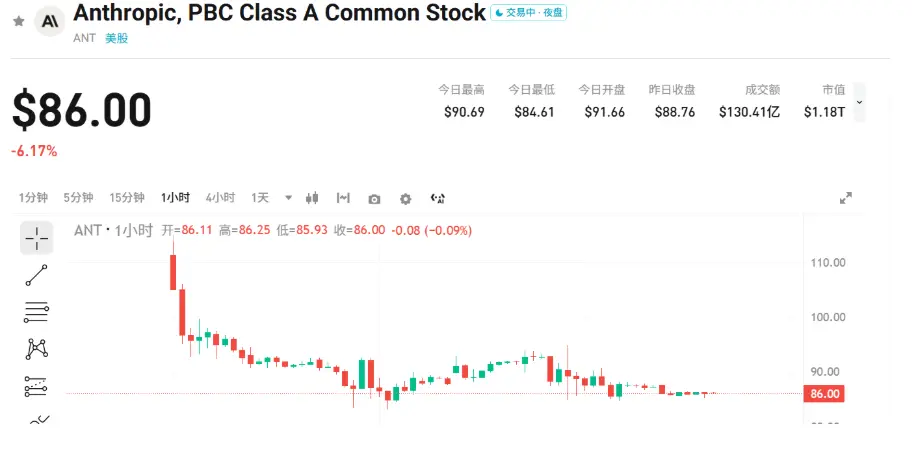
Multiple exchanges and token issuers launched related subscription products simultaneously before the listing of ANT, with some subscription channels reaching full capacity within hours. After the listing, the on-chain issuance pace of ANT almost synchronized with Nasdaq's opening, clearly indicating a strong demand from crypto funds for scarce primary shares of leading AI targets.
$217 Million Subscription, VIP Round Allocation Rate 10.06%
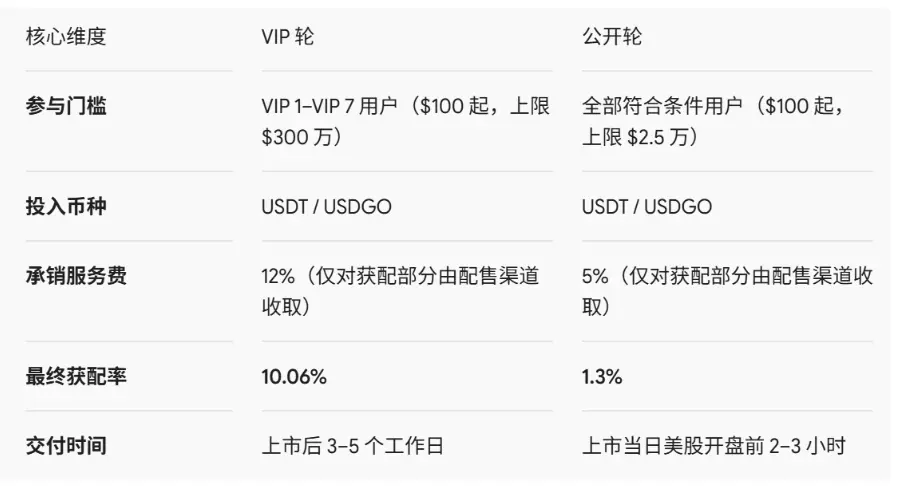
In this issuance, Bitget attracted over $217 million in funding and participation from 13,290 users through two rounds of subscriptions opened via IPO Prime. Ultimately, 153,774 tokenized shares were allocated, amounting to approximately $12.76 million at the issue price. The allocated portion was delivered in the form of rANT issued by its RWA protocol, Reality. The VIP round allocation rate was 10.06%, while the public round allocation rate was 1.3%.
For individual investors outside the U.S., IPO allocations have long been primarily aimed at institutions. Bitget participated in this issuance by connecting with a global network of funds and family offices, with a subscription threshold starting at $100, supporting fractional shares, and without the need to open additional overseas brokerage accounts.
The subscription scale of over $217 million reflects a high demand among exchange users for primary shares of leading AI companies, while Reality's goal is to convert this primary market allocation demand into standardized assets that can be verified and circulated on-chain.
Although branded as "tokenized Anthropic," the underlying structures of competing products in the market vary significantly. Currently, there are cash-settled Pre-IPO perpetual contracts, products that re-tokenize shares held through SPVs, and stock tokens with different reserve and custody arrangements.
To evaluate a product, at least three questions need to be answered: Can it be entered at the IPO issue price? Is the token backed by the stock itself? Where does the transaction price come from? These three questions determine whether the holder receives a simple price exposure or economic rights closer to the underlying securities.
Taking rANT as an example, it settles at the official issue price of $83, with underwriting service fees charged based on the round (5% for the public round, 12% for the VIP round). This fee is collected by the cooperating funds, brokers, or allocation channels based on the actual allocated portion and is included in the invested amount; unallocated funds incur no fees, and Bitget does not charge an additional platform subscription fee. In terms of delivery pace, public round shares are credited 2 to 3 hours before the U.S. stock market opens, allowing users to hold rANT before the first matching transaction of ANT; the VIP round is delivered within 3 to 5 business days after listing.
On the trading side, rANT opened for trading on Bitget about an hour after the Nasdaq opening auction for ANT. This is not Reality's first time achieving on-chain listing on the same day as the IPO—on June 12, the day SpaceX went public, rSPCX was also listed on Bitget simultaneously. The entire process from primary subscription, share delivery to secondary circulation was compressed to the listing day, allowing ordinary investors to truly enter the IPO pricing window rather than being forced to buy at high prices in the secondary market.
1:1 Full Custody, U.S. Stocks On-Chain 2.0
As Bitget's RWA protocol, Reality's compliance and issuance entity is BG El Salvador, S.A. de C.V., which holds a Category I Financial Services Provider (FSP) license in El Salvador.
On the asset side, each rANT corresponds 1:1 to a share of real Anthropic stock held in custody by Reality.
The underlying securities are independently isolated and held in custody by Alpaca Securities LLC, a FINRA-registered and SIPC-member broker, and are ultimately registered within the DTCC system. To ensure that the accounts match the actual holdings, Reality has commissioned The Network Firm, a licensed accounting firm specializing in digital assets, to regularly issue daily reserve verification reports starting from August 2026; at the same time, rToken adopts the standard ERC-20 architecture, and the on-chain circulating supply is available for public verification in the market.
In terms of underlying scalability, Reality has been deployed on Ethereum Layer 2 networks such as Arbitrum and Morph, covering over 1,000 tokenized stocks and ETFs; in October this year, the protocol further upgraded its split and merge stock mechanism to the ERC-8056 display multiplier standard and supports direct cash dividends in stablecoin form for eligible distributions.
It is important to clarify that holding rANT grants economic rights corresponding to the underlying stock, rather than legal shareholder status and voting rights; the product itself is not issued or endorsed by Anthropic. However, through the combination of "licensed isolated custody + daily CPA verification," Reality addresses the core issue of whether "the token is truly backed by real stock" on an auditable financial infrastructure, rather than remaining at a simple price mapping.
DMA Directly Connects to Nasdaq: Solving the Liquidity Challenge on IPO Day
On the first day of a new stock's listing, the lack of historical price anchors and continuous market data, along with the cold start phase of the market maker quoting system, often results in significant bid-ask spreads and decoupling risks.
Reality's rToken introduces a DMA (Direct Market Access) architecture: during regular trading hours (RTH) in U.S. stocks, user orders can be directly connected to Nasdaq liquidity through cooperating brokers, with tokens minted on demand according to real transactions.
This means that large orders can directly access the underlying traditional market depth, and the transaction scale is not limited by the displayed depth of the exchange's front-end market, with transaction prices closely anchored to Nasdaq's real-time price discovery.
rANT chose to open trading during regular U.S. stock hours to fully leverage the advantages of DMA penetrating underlying depth. Although the price formation logic may change outside regular hours, within the core trading window of U.S. stocks, rANT's pricing and acceptance capabilities are no longer solely reliant on the exchange's own market-making pool.
As more and more tech giants move on-chain, the market's focus on tokenized U.S. stocks is shifting from "can it be bought" to "what is being bought."
rANT integrates entry at the issue price, 1:1 full custody, and direct connection to Nasdaq liquidity into the same architecture, delivering what originally belonged to institutions' primary allocation shares through exchange channels to ordinary users.
Whether this path can become the industry paradigm for subsequent new stocks going on-chain remains to be seen through long-term practical tests of more targets—whether reserve custody remains transparent and verifiable, whether corporate actions such as dividends and stock splits can be accurately penetrated on-chain in the long term, and how to balance 24/7 on-chain continuous trading with underlying liquidity gaps during U.S. stock market closures after DMA resolves the depth anchoring during regular trading hours will be the next essential question for Reality and the entire tokenized U.S. stock sector.
However, it is certain that whoever can first successfully implement the closed loop of "primary allocation + full custody + direct liquidity connection" will hold the on-chain pricing power in the next wave of tech giant IPOs.
ChainCatcher reminds readers to view blockchain rationally, enhance risk awareness, and be cautious of various virtual token issuances and speculations. All content on this site is solely market information or related party opinions, and does not constitute any form of investment advice. If you find sensitive information in the content, please click , and we will handle it promptly.


Popular articles