BTC $78,061.53 -2.10%
ETH $2,237.51 -3.09%
BNB $716.76 -3.91%
XRP $1.25 -2.96%
SOL $97.28 -2.34%
TRX $0.3451 +4.43%
DOGE $0.0760 -2.18%
ADA $0.1923 -2.72%
BCH $285.10 +2.54%
LINK $11.00 -3.52%
HYPE $92.12 +17.29%
AAVE $124.07 -4.40%
SUI $0.8845 -2.05%
XLM $0.1651 -1.68%
ZEC $1,283.59 +3.74%
AAPL $350.56 +1.19%
AMZN $226.71 -10.35%
GOOGL $282.62 -3.61%
MSFT $525.33 -4.86%
META $618.71 +0.38%
NVDA $209.20 -2.10%
TSLA $397.34 -0.57%
SNDK $1,316.35 -2.59%
INTC $71.45 -22.49%
SPCX $140.96 -1.95%
MU $910.23 -4.45%
AMD $533.71 -4.68%

hai

All
Article
Flash

first_img On-chain lending company Birch Hill announces core team appointments

On-chain lending company Birch Hill announced on its official account the appointment of Jonathan Thomas as the head of curation. Brad Schlagel, Alex Cornwell, and Ian Plosker joined from the on-chain treasury platform Yearn, responsible for the on-chain lending strategy Birch Hill Absolute Value, while Traver Normandi joined from the on-chain lending risk management company Gauntlet, responsible for business development.According to Birch Hill's announcement, Schlagel previously led the development of Yearn v3 and is currently the portfolio manager and head of strategy architecture; Plosker is the portfolio manager and head of platform engineering; Cornwell was previously responsible for Yearn's business development and is now the head of capital formation. Thomas has worked with the Yearn team on strategies based on the Yearn v3 treasury standard and is now responsible for treasury curation. Normandi previously worked at Gauntlet in institutional business development.Birch Hill is a financial services company headquartered in New York that evaluates, builds, and distributes credit on public chains, and serves as the official curator for the lending protocol Morpho. The company announced on October 28 that it has completed a $4 million seed round of financing, led by Multicoin Capital, with participation from ParaFi Capital, Castle Island Ventures, and Nascent, bringing total funding to $6.5 million. The company stated in a follow-up post that it will further introduce tokenized credit securities oABS and Birch Hill Absolute Value.

first_img Blockchain Space Company Gattaca released the Ethereum consensus client Silver

The blockchain infrastructure company Gattaca announced the launch of the open-source Ethereum consensus client Silver. The company operates the Ethereum block builder Titan Builder and the relay Titan Relay. Gattaca stated that Silver was built from scratch, aiming to support shorter time slots and post-quantum security while maintaining decentralization, censorship resistance, privacy, and security. Currently, Silver is in the alpha stage, with audits and final testing yet to be completed.Gattaca claims that Silver's state transition function has a p99 latency of less than 10 milliseconds, approximately 10 times faster than other clients. During the mainnet window from October 17 to 20, 2026, Silver, Prysm, Lighthouse, and Grandine processed the same 20,300 canonical blocks. The median block processing latency for Silver was 6.5 milliseconds, with a p99 of 9.5 milliseconds, and the slowest block in the sample was 17.8 milliseconds; the second-lowest median was 33.5 milliseconds, and the second-lowest p99 was 91 milliseconds. All four clients operated as supernodes, subscribing to all 64 proof subnets and hosting all 128 data columns, with the executing client being ethrex v29.0.1.The above comparison used consensus processing metrics available for each client, excluding execution client processing time. Silver is based on Gattaca's Flux framework, using six threads bound to CPU cores for parallel processing, and comes with a low-latency peer-to-peer network, state hash library, formally verified BLS and KZG cryptographic libraries, and a node cluster for penalty protection. In another comparison, supernodes needed to verify about 32 times the proofs and about 16 times the KZG unit proofs relative to the default configuration, with block processing latency and resident memory still within a similar range.

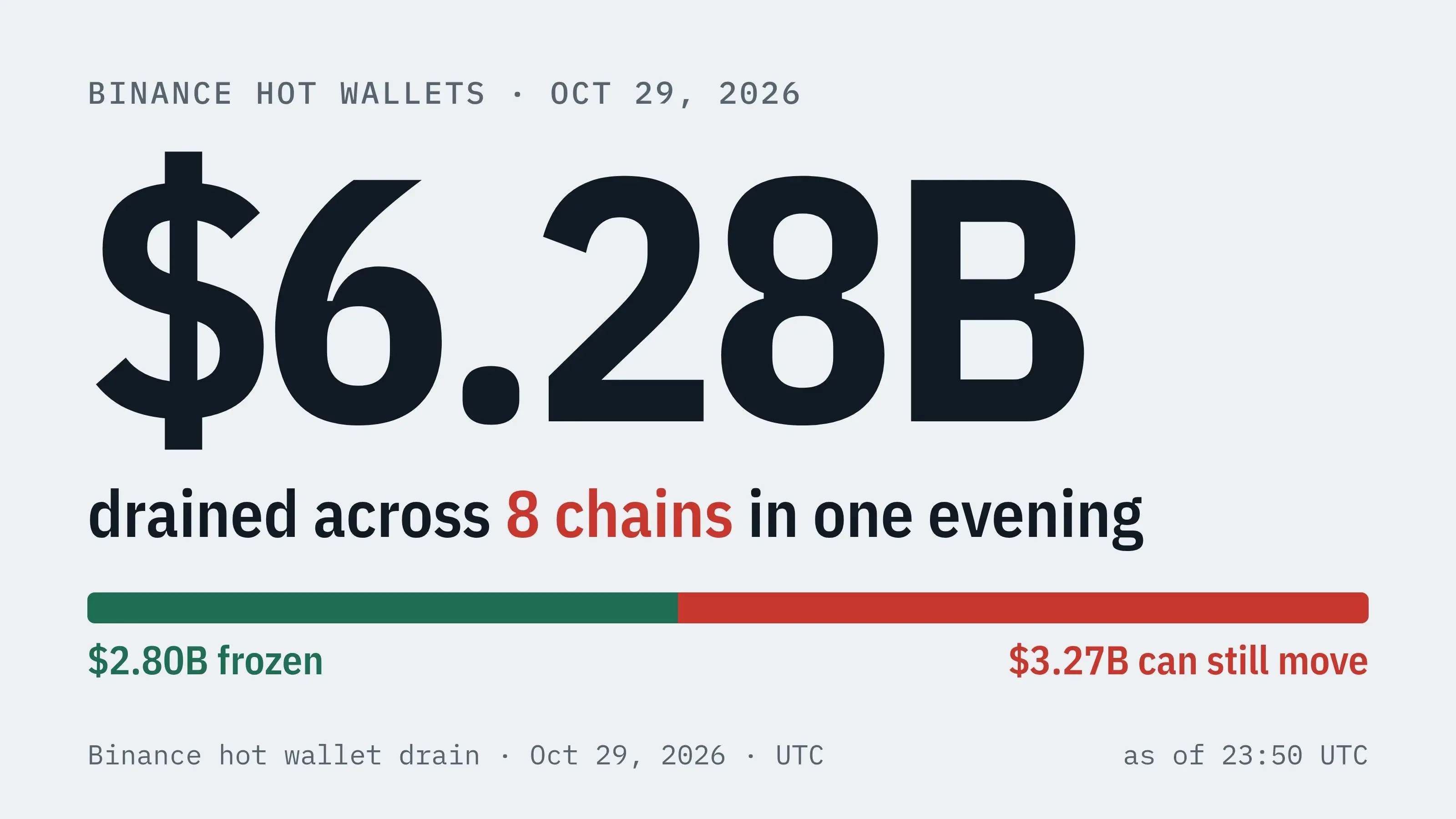
During the Binance hack, an on-chain arbitrage window appeared, with a single address profiting approximately 3.47 million USD

During the attack on Binance, arbitrage opportunities appeared on-chain. A community user reviewed that the attacker, in order to avoid Tether's freeze, exchanged a large amount of USDT for ETH through DEX, causing the price of ETH on Uniswap to rise to between $2560 and $2750, with some transactions exceeding $3000, while the ETH price obtained through Chainlink oracles on Aave remained between $2250 and $2290, resulting in a price difference of 15% to 30% between on-chain and oracle prices, lasting nearly an hour.Arbitrageurs took advantage of this price difference by depositing USDC/USDT as collateral on Aave, borrowing ETH at the oracle price, and then selling it at a high price on DEX. After the price difference narrowed, they bought back ETH to repay the loan. According to the user's statistics, within 6 hours after the incident, a total of 61 addresses borrowed ETH on the Aave mainnet (excluding hacker addresses), with the address that profited the most selling 12,289 ETH at an average price of about $2580, and then buying back 12,314 ETH at an average price of about $2297, making a profit of about $3.47 million. The top ten arbitrage addresses collectively made a profit of about $6.36 million.The user stated that the arbitrageurs exploited the price disconnection between centralized exchanges and DEX, and there was no vulnerability in the Aave contract itself. As DEX prices fell and Aave froze the mainnet V3 market, the arbitrage window gradually closed. The aforementioned profits are based on on-chain statistics and have not yet deducted Gas fees.

first_img 1kx Report: The share of blockchain revenue accounted for by listed companies has risen to 16%

The cryptocurrency investment firm 1kx released a report stating that publicly listed companies contributed 16% of the blockchain industry's revenue in 2026, more than doubling from 7% in 2022. The report compiled data from over 2,600 protocols and the financial reports of 104 publicly listed companies, with data up to the third quarter; revenue remains concentrated among a few enterprises, with the top six publicly listed companies accounting for about 50% to 60% of that group's revenue.1kx expects the total revenue of the blockchain industry to decline by 28% year-on-year in 2026 to approximately $100 billion, but the share of publicly listed companies continues to expand. Circle's listing in 2025 brought new trading listings, combined with revenue growth from existing companies, driving the share increase; the blockchain-related revenue of the top ten publicly listed companies in the study has doubled over the past three years. In the first half of 2026, Coinbase and Circle together generated approximately $3.3 billion in blockchain-related revenue, publicly listed Bitcoin mining companies around $2 billion, and traditional financial institutions such as JPMorgan, BlackRock, CME Group, Visa, and Robinhood collectively about $1.1 billion.The report also pointed out that revenue from broader economic activities in the third quarter surpassed blockchain infrastructure revenue for the first time, at approximately $5.3 billion and $5.1 billion, respectively. Categories such as tokenized assets, payments, and prediction markets grew by 58% year-on-year in the first half of 2026, with institutional adoption accounting for a total of 33% of the blockchain's total revenue in the third quarter, and an expected annual share of 30%. Data from RWA.xyz shows that the scale of tokenized real-world assets grew by about 51% over the past year, rising from $26.16 billion in October 2025 to $39.54 billion; tokenized stocks grew 471% during the same period to $3.77 billion.

first_img On-chain infrastructure company KR1 purchased 5,000 TAO and initiated Bittensor staking

On October 29, KR1 plc, a company listed on the main board of the London Stock Exchange that focuses on on-chain infrastructure, announced the launch of its technical infrastructure operations on the decentralized artificial intelligence network Bittensor. The company stated that it has recently acquired 5,000 network-native assets TAO and has initiated staking as part of its technical infrastructure strategy. Based on the reward rate observed on October 28, the company estimates that the annualized infrastructure income is approximately equivalent to 6.6% of the current value of the deployed TAO holdings.The announcement stated that Bittensor is a layer blockchain that supports subnets, covering services such as AI inference, computing power, training, and prediction, where independent suppliers compete for network rewards based on performance. KR1 supports the assessment of service provider performance through staking and receives a portion of the network rewards. There is no mandatory unbonding period for TAO unstaking, allowing the company to retrieve its holdings immediately after unstaking. Rewards can be retained to expand the scale of productive assets or can be liquidated for subsequent investments and operational costs. The company will also disclose its TAO holdings and related infrastructure income in monthly unaudited updates.Keld van Schreven, Managing Director and Co-Founder of KR1, stated: "As artificial intelligence enables more complex tasks to be performed by software, the demand for infrastructure related to supply-side intelligence is expected to grow significantly. Bittensor introduces open competition for the supply of AI services, and the company is focused on how its incentives are forming services that lead to continuous customer payments, as well as how to deploy TAO holdings to enhance the value and income potential of productive digital assets per share." KR1 claims to be the only publicly listed company on the main board of the London Stock Exchange that focuses on on-chain infrastructure, holding and operating productive digital assets on the relevant network.

Beijing investigates the first case of pyramid selling using blockchain and virtual currency, a technology company was fined and confiscated over 930,000 yuan

According to a report from the Beijing Daily client, the Market Supervision Administration of Haidian District, Beijing, investigated and handled the city's first illegal case of assisting pyramid schemes using blockchain and virtual currency technology, resulting in a technology company being fined and confiscated a total of over 930,000 yuan.The technology company involved is an outsourcing service provider for a certain public blockchain, offering support such as operations, market services, publicity and promotion, exchange docking, and maintenance. This public blockchain launched the "Atomic Plan" and "Hathaway Plan," which are centered around recruiting people for rebates, using the number of recruited individuals as the basis for rebates, and requiring participants to invest funds to obtain membership qualifications. Despite being aware of the pyramid scheme applications associated with this public blockchain, the involved company continued to provide technical operations, external publicity, and maintenance of virtual currency trading channels, facilitating the flow of funds and the spread of activities related to the pyramid scheme.Ultimately, the pyramid scheme activities of this public blockchain were investigated by public security authorities, the organizers were criminally detained, and the involved technology company was administratively punished with a total fine and confiscation of over 930,000 yuan for providing facilitative conditions.

first_img CFTC Chairman: Refrigerators can stake ETH and issue Memecoin

Michael Selig, the Chairman of the U.S. Commodity Futures Trading Commission, stated at the CFTC's inaugural Frontier Forum in Washington that imagining a refrigerator autonomously purchasing groceries with funds from staked ETH, or even issuing its own Memecoin, "is no longer science fiction." He believes that when AI agents can hold assets and execute trades autonomously, regulators must make adjustments.Selig pointed out that the CFTC's regulatory framework is built around executing specific financial functions concerning "identifiable market participants," but autonomous software is raising questions about how these rules apply. He proposed that if AI agents identify trading opportunities and execute trades for users, their developers may need to register, who is responsible when the agent goes out of control, how regulators know for whom the agent is trading, and whether a new type of "Know Your Agent" rule, referred to as KYA, is necessary.Selig also mentioned that AI could provide smaller traders and businesses with risk management capabilities that were previously only available to large institutions, but greater autonomy also brings new risks: agents may react unexpectedly to market conditions, agents using similar models may exhibit correlated trading behaviors, and the speed of autonomous trading could complicate market regulation and risk management. Animoca Brands Chairman Yat Siu recently expressed similar concerns to Cointelegraph; Coinbase launched Agentic Wallets in February, and Binance introduced AI Agent Skills in March, allowing agents to trade within user-defined parameters or provide spot order tools.
app_icon
ChainCatcher Building the Web3 world with innovations.