BTC $64,023.46 -0.11%
ETH $1,838.69 -1.77%
BNB $566.45 -1.50%
XRP $1.08 -0.07%
SOL $74.98 -0.65%
TRX $0.3227 -0.03%
DOGE $0.0725 -1.12%
ADA $0.1654 +2.22%
BCH $219.67 -1.26%
LINK $8.21 -2.00%
HYPE $60.15 -3.76%
AAVE $90.58 -1.90%
SUI $0.7383 -1.01%
XLM $0.1864 -1.51%
ZEC $547.41 +1.35%
BTC $64,023.46 -0.11%
ETH $1,838.69 -1.77%
BNB $566.45 -1.50%
XRP $1.08 -0.07%
SOL $74.98 -0.65%
TRX $0.3227 -0.03%
DOGE $0.0725 -1.12%
ADA $0.1654 +2.22%
BCH $219.67 -1.26%
LINK $8.21 -2.00%
HYPE $60.15 -3.76%
AAVE $90.58 -1.90%
SUI $0.7383 -1.01%
XLM $0.1864 -1.51%
ZEC $547.41 +1.35%

g7

All
Article
Flash

Stripe plans to acquire PayPal for $53 billion to build a stablecoin empire, and HSBC Orion has been selected to issue the world's first G7 digital sovereign bond

According to BBX data, the integration of traditional financial infrastructure and cryptocurrency settlement layers accelerated simultaneously in two distinctly different tracks yesterday, with the following core dynamics:PayPal Holdings, Inc. (NASDAQ: $PYPL) reported by CoinDesk today as the headline news, the world's largest independent payment technology company Stripe (privately held) has teamed up with private equity firm Advent International to propose an acquisition offer of approximately $53 billion to PayPal; PayPal is currently reluctant to engage actively, but the offer has sparked widespread discussion on Wall Street about the "largest payment merger in the world." Stripe acquired the stablecoin infrastructure company Bridge.xyz for $1.1 billion in 2024 (which has served cross-border stablecoin settlements for institutions such as Visa and Coinbase), while PayPal has its own stablecoin PYUSD (with a circulation size of about $700 million) and independent cryptocurrency trading capabilities, covering over 400 million active accounts. If the acquisition is completed, the combination of Stripe + PayPal will control the largest single payment network globally, while integrating Stripe's stablecoin settlement (Bridge.xyz) with PayPal's native stablecoin (PYUSD)------the combination will create the largest-scale "traditional payment + stablecoin" dual-track infrastructure to date, directly threatening Visa and Mastercard's positions in cross-border settlement scenarios and posing competitive pressure on Circle's USDC in retail payments.HSBC Holdings plc (NYSE: $HSBC) reported by CoinDesk today, the UK government plans to issue the world's first digital sovereign bond for G7 countries, with the issuance scheduled for early 2027; this bond will be issued and circulated on HSBC's blockchain bond platform Orion, operating within the Digital Securities Sandbox framework of the Bank of England (BoE) and the Financial Conduct Authority (FCA), aimed at testing the feasibility of reducing settlement time (transitioning from T+2 to T+0) and lowering back-office costs. HSBC Orion has completed multiple batches of tokenized gold, green bonds, and Hong Kong government bonds on-chain issuance from 2023 to 2025, and this UK sovereign bond is the first instance of G7 countries introducing blockchain settlement at the sovereign debt issuance level------this milestone will elevate the compliance of tokenized government bonds from "emerging market experiment" to "highest sovereign endorsement," signaling significant implications for institutional adoption of tokenized government bond products like BlackRock BUIDL and Securitize.

G7 central bank quantum technology working group releases first report: warns of long-term risks in the financial encryption system

According to a report by Crowdfund Insider, the first public report released by the G7 Central Bank Quantum Technology Working Group (QTWG) indicates that quantum computing technology could have a profound impact on the global financial system, particularly posing structural challenges in the fields of data encryption and cybersecurity. The working group was established in 2025, co-led by the Bank of France and the Bank of Canada, with members including the Federal Reserve, the European Central Bank, the Bank of England, the Bank of Japan, and major central banking institutions from Germany, Italy, and others.The report points out that although quantum computers capable of breaking encryption have not yet emerged, there is a general belief in the industry that the likelihood of their appearance within the next decade is increasing, which poses potential risks to existing financial infrastructure that relies on traditional encryption algorithms. One core risk is referred to as the "collect now, decrypt later" strategy, which involves the long-term storage of currently encrypted financial data, with the intention of decrypting it once quantum computing capabilities mature, potentially threatening the long-term data security of the financial system.The report recommends that financial institutions in various countries proactively compile a list of their reliance on encryption systems and gradually assess the feasibility of transitioning to post-quantum cryptography, while also strengthening inter-agency coordination to reduce systemic risk exposure. In terms of opportunities, quantum computing is expected to enhance the computational capabilities of financial institutions in areas such as risk modeling, portfolio optimization, macroeconomic forecasting, and stress testing, but its practical application still depends on technological maturity and scaling progress.Analysts believe that this report marks the beginning of G7 central banks systematically incorporating quantum technology into their financial stability assessment framework, which may drive long-term upgrades of global financial infrastructure at the encryption and computational architecture levels.

first_img Data: The cryptocurrency market is rising, with MAG7.ssi up over 6% and the PayFi sector rising 17.06%

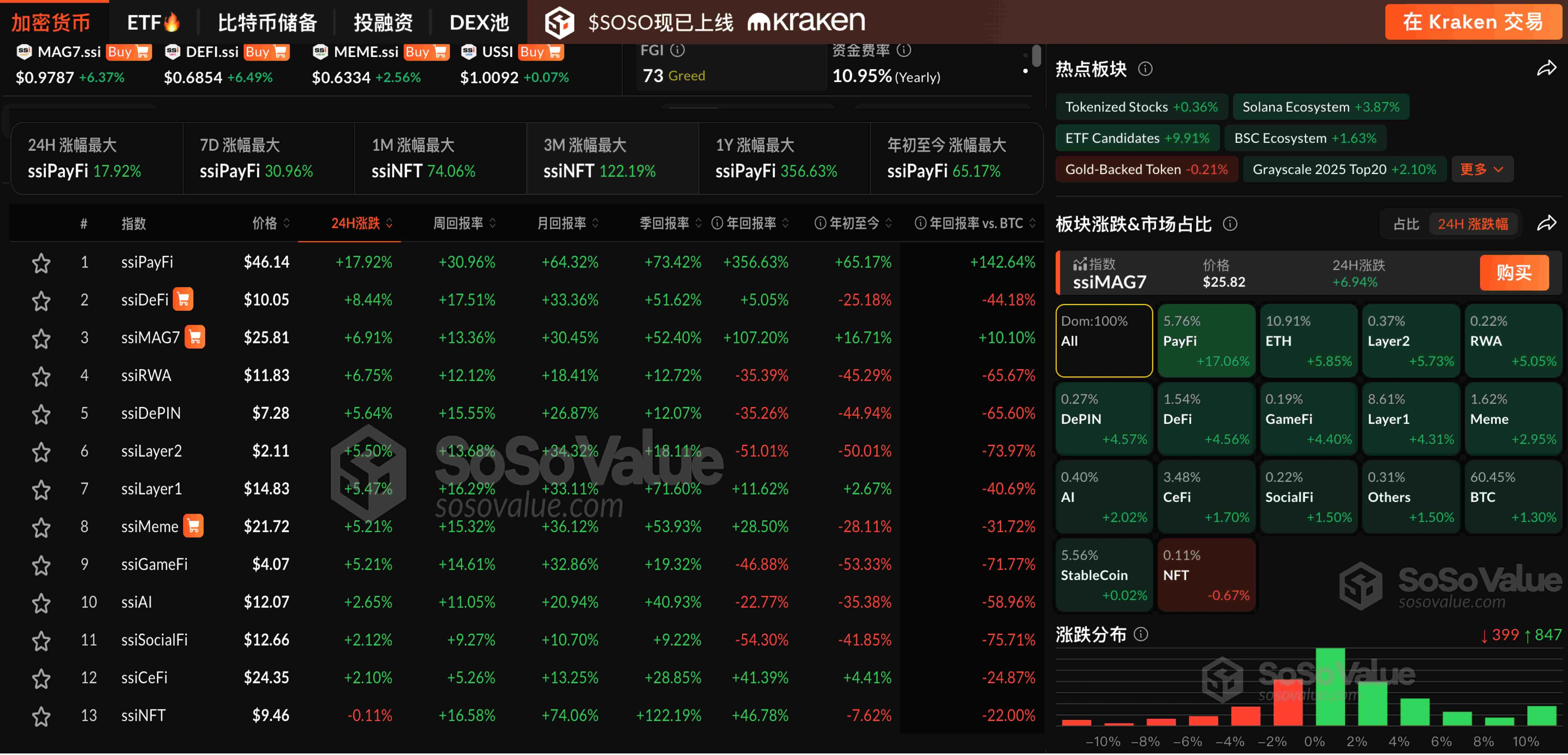
ChainCatcher news, according to SoSoValue data, three cryptocurrency bills have been passed by the House of Representatives, leading to an overall increase in the crypto market, with gains generally around 2% to 6%. Among them, the PayFi sector surged by 17.06% in 24 hours, driven by the positive news of the "Genius Bill" passing and the expectation that it will be signed by Trump on Friday. Within the sector, Stellar (XLM) and XRP rose by 11.42% and 18.15%, respectively. Additionally, ETH increased by 5.85%, breaking the $3500 mark.It is noteworthy that XRP and ETH's strong upward movement, as core components of MAG7.ssi, has propelled MAG7.ssi to continue rising, reaching a 24-hour increase of 6.37%, approaching the 0.98 USDT mark. Furthermore, DEFI.ssi rose by 6.49%, and MEME.ssi increased by 2.56%.In other sectors, the Layer2 sector rose by 5.73%, with Mantle (MNT) increasing by 11.86%; the DeFi sector rose by 4.56%, with Uniswap (UNI), Ondo Finance (ONDO), and Chainlink (LINK) increasing by 13.01%, 13.31%, and 13.69%, respectively; the Layer1 sector rose by 4.31%, with Cardano (ADA) and Hedera (HBAR) increasing by 14.24% and 24.44%, respectively; the Meme sector rose by 2.95%, with Fartcoin (FARTCOIN) and Dogecoin (DOGE) increasing by 9.53% and 9.86%, respectively; the CeFi sector rose by 1.70%.The cryptocurrency sector indices reflecting historical market trends show that the ssiPayFi, ssiDeFi, and ssiRWA indices increased by 17.92%, 8.44%, and 6.91% in 24 hours, respectively.
Data: The cryptocurrency market is rising, with MAG7.ssi up over 6% and the PayFi sector rising 17.06%
app_icon
ChainCatcher Building the Web3 world with innovations.