Wen $crvUSD? The Curve development team's GitHub may provide the answer

 Due to the immutable nature of smart contracts, the Curve development team is testing more extreme scenarios and features that may be needed in the future. In addition, recent work also includes gas optimization, user small liquidity extraction, and administrator profit extraction functions.
Original Title: 《Wen $crvUSD? CAN CURVE DEVS DO SOMETHING?》
Author: crv.mktcap.eth, Curve Market Cap
Compiled by: Biscuit, ChainCatcher
Wen $crvUSD? (When will crvUSD stablecoin be released?) This is the most frequently asked question in the Curve community recently.
In July 2022, Curve founder and CEO Michael Egorov stated that despite regulatory scrutiny, Curve is seeking to launch its own over-collateralized stablecoin. This seems to indicate that DeFi protocols are joining the race for stablecoin market share following the collapse of UST.
The crvUSD whitepaper was published last November, with the two most important pillars being LLAMMA and PegKeeper. LLAMMA stands for Lending Liquidation AMM algorithm. PegKeeper is used to maintain the dollar peg of crvUSD.
For a long time, Curve has been regarded as the DeFi protocol with the best liquidity for various stablecoins and derived collateral, which has almost given Curve pricing power over tokens like stETH. With the Shanghai upgrade approaching, if crvUSD is launched at this time, it will undoubtedly give Curve more advantages in the "Shanghai upgrade battle."
It has been 3 months since the release of the crvUSD whitepaper; what is the progress? crv.mktcap.eth interpreted the details and progress of the Curve development team deploying crvUSD on Github over the past month, and this article is a compilation of the main points by ChainCatcher.
Key Points:
Due to the immutable nature of smart contracts, the Curve development team is testing more extreme scenarios and features that may be needed in the future.
Gas optimization to save costs for users.
Admin features to optimize pool yields.
Even if you know nothing about coding, some images can confirm that Curve developers have been doing something.

For developers, we mainly refer to Curve's founder Mich, whose Github has been updated frequently. To gain insight into what has happened recently, we can quickly check which files have been modified over the past month.
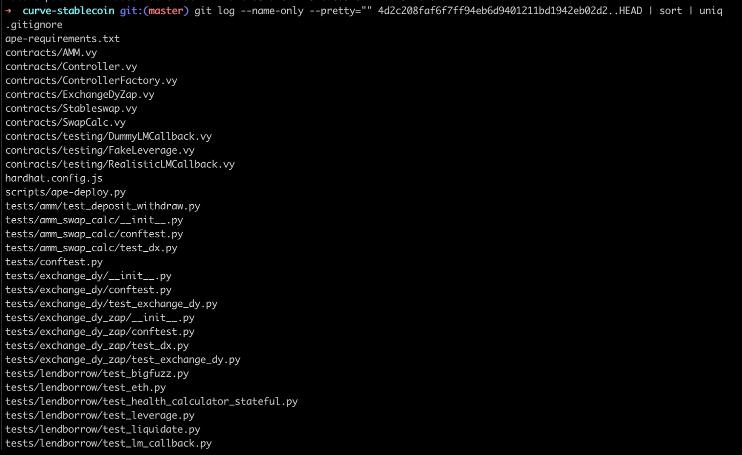
It is well known that crvUSD could have been launched last month, but it currently looks very different from before. Developers have added many additional tests to crvUSD. This is very important because crvUSD is an unknown territory in many ways. Auditors may miss some things, and more robust testing means that crvUSD will be safer at launch.
Most importantly, these tests are still discovering bugs. A history titled "bugfix" could be a significant issue.
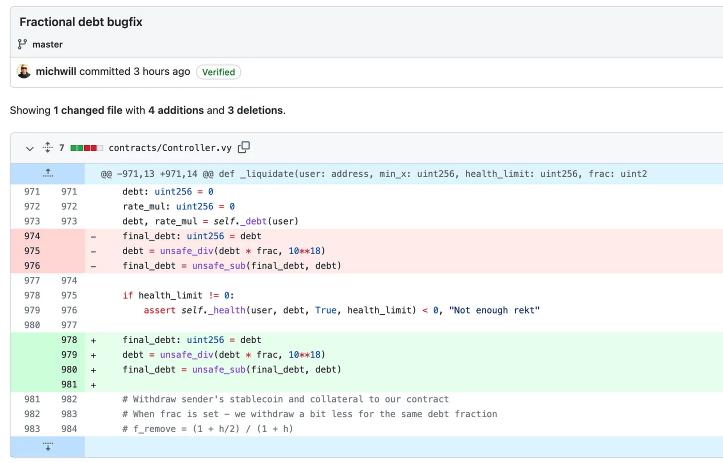
Compared to changes in unit tests, changes in the actual running smart contracts are more noteworthy. Since smart contracts are immutable, and Curve's smart contracts are even more immutable. Some protocols defraud users by using upgradeable proxy contracts. Proxy contracts allow one address to inherit the logic from any other address and can be changed at any time. Curve does not do this. This is great because it means no one can bully you.
On the other hand, this is also bad because it means developers cannot fix bugs or add new features after the fact. Developers need to spend a little more time thinking about extreme scenarios and need to foresee every future feature that may be needed before launching the official product.
No one can cover everything, but spending more time (by writing new tests) to study the contract before its launch can reveal the usefulness of new features.
For now, the crvUSD smart contract suite is more feature-rich and user-friendly than when it was launched a month ago. A few examples:
An early issue with Curve contracts was the lack of getdx() and getdy() functions, which are used to show how many tokens a user would receive for specific inputs. Because sometimes users want to know how many tokens they should provide to ensure a specific output.
The new logic provides a getdxdy() function with a useful toggle to determine whether it is used as getdx() or get_dy(). These changes can be confirmed in the curve-stablecoin-js repository.

The activity in this middleware repo is much less, indicating that it is in a more mature stage. In terms of the frontend, most of the functionality remains the same. The only change in the past five months has been modifications to support get_dxdy().
Another new feature added last month is the ability for users to withdraw small amounts of liquidity.

The liquidation feature is similar…

We can see from the smart contracts that the Curve development team is spending more time on Gas golfing to improve efficiency.
ChainCatcher Note: Gas Golfing refers to the challenge of developers writing the most gas-efficient code in a series of interactions between smart contracts.

Gas optimization is important because Curve contracts are complex. These complexities become more manageable because Curve is written in Vyper, which has a more efficient compiler than other smart contract languages. Even so, careful design can further save Gas.
We see this directly in Curve's v2 pools. Uniswap v3 shifts the responsibility of rebalancing liquidity to LPs, who must change positions as prices change, while Curve v2 pools do this automatically. In both cases, Uni v3 has LPs manually paying Gas when rebalancing positions, while Curve v2 merges the logic internally.
In fact, Curve developer Fiddy is rewriting TriCrypto from scratch to provide a gas-optimized version, which may be a theme for future developments. Therefore, the development team tends to optimize more Gas fees in the final design, which will save a little ETH in the long run (although burning more ETH may help reduce supply…)
Finally… every week, Curve's yield pools are able to produce tokens worth millions of dollars. Therefore, the development team has also added a new feature to enhance the admin's ability to manage these fee surpluses.

 Предупреждение о рисках
 Предупреждение о рисках



Популярные статьи