



A simple guide to understanding Polkadot

 From the perspective of paradigms, Polkadot still falls within the category of smart contract platforms. Where will it go under the Ethereum ecosystem? Will it surpass Ethereum? Or will it become an important complement to Ethereum? This depends on the evolution of developers, the community, and the public chain itself.
This article was published on October 23rd in Blue Fox Notes, authored by Blue Fox.
Public chains are a trillion-dollar track. New public chains always claim to be the next generation of new technology. However, the comprehensive factors ultimately determine whether a public chain can go far. First is the temperament of the founding team. Having leading, practical technology along with idealism is an important part of project sustainability; such teams will not stop building due to market fluctuations. Second is the community. Support from token holders and developers is essential; only a true ecosystem can enhance the value of the public chain, increase its market capitalization, and make it safer, thus leading to a positive cycle.
Public chains are not only the most attractive track in the crypto field but also the most challenging area to succeed. Aside from Ethereum, which other public chains have opportunities? This is a focal point of great interest for developers and investors. Polkadot is one of the most watched public chains outside of Ethereum. There are many introductions to Polkadot, and Blue Fox Notes has mentioned it several times before. This article mainly provides a simple introduction to Polkadot to help beginners understand Polkadot, with more foundational articles to be published later.
1. What is Polkadot
Polkadot is a public chain, but it is a special public chain composed of multiple chains, allowing for the existence of multiple chains. Why not just one chain? It attempts to solve issues of scalability, speed, and cost, allowing for more personalized blockchains, enabling interoperability and upgrades between chains, and allowing for self-governance of chains.

(Source: Polkadot.network)
Polkadot not only supports token transfers but also facilitates data transmission between different chains. Its ultimate goal is to become a cross-chain network protocol, making cross-chain registration and cross-chain computation possible.
2. Polkadot's Architecture and Scalability
Currently, Bitcoin's TPS is about 7, while Ethereum's is around 15, leading to a very poor transaction experience, with slow speeds and high costs, especially evident during previous mining peaks. To address this, Ethereum is gradually exploring Layer 2 solutions, particularly the Rollup series, and Ethereum's sharding is also on the way, although it will take a long time. The following diagram shows Vitalik's outlook on Ethereum's scalability, moving from 15 TPS to 100,000 TPS.
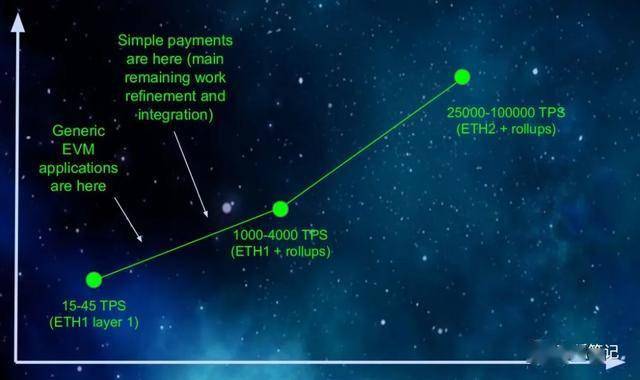
(Source: Vitalik Buterin)
Polkadot, on the other hand, follows the path of heterogeneous sharded blockchains. The so-called heterogeneous refers to the "union" of different blockchains. In contrast, Ethereum's sharding is homogeneous, all being part of the Ethereum blockchain.
In Polkadot, there is a central chain that connects all blockchains, known as the "Relay Chain." The chains connected to the "Relay Chain" are called parachains.
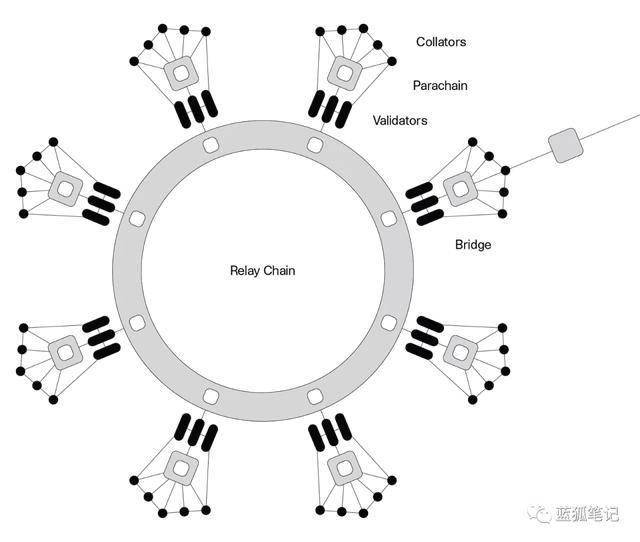
(Source: Polkadot.network)
This Relay Chain + Parachain architecture is the reason Polkadot can achieve scalability; multiple chains can process transactions in parallel without queuing on a single path. Thus, compared to the current Ethereum, Polkadot can offer higher throughput, faster speeds, and lower costs.
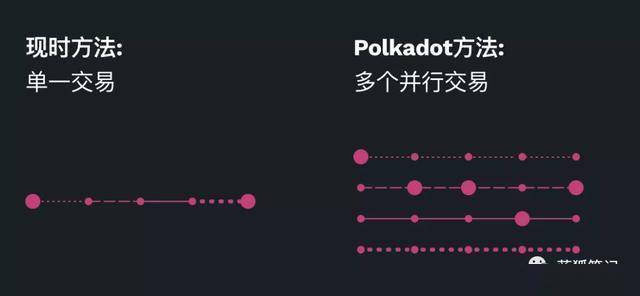
(Source: Polkadot.network)
In Polkadot's future plans, it is even possible to add Relay Chains on top of the Relay Chain, attempting to achieve a chain within a chain for greater scalability. Additionally, the parachains on Polkadot differ from those on Cosmos in that they share security, which is also a significant reason why developers are attracted to build parachains on Polkadot. For blockchains, building security from scratch is a challenging task.
3. Security of Polkadot Parachains
The security of a blockchain stems from the reliability of its consensus. This is also why consensus mechanisms have always been one of the most important components of blockchains. When the state on the chain changes, all nodes need to reach a consensus, and the mechanism for achieving consensus is key to whether the blockchain can ensure security.
Polkadot uses a PoS mechanism that combines BABE and GRANDPA. In traditional PoW mechanisms, people gain the right to record transactions through proof of work, while in PoS mechanisms, participants need to stake tokens, with stakers also being validators and stakeholders. They need to verify the state transition proofs of parachains and produce relay blocks based on the validity of these proofs.
BABE (Blind Assignment for Blockchain Extension) is a block production mechanism that operates between validating nodes, determining the generator of new blocks. To some extent, BABE can be compared to Ouroboros Praos, although there are significant differences in chain selection rules and slot time adjustments. BABE allocates block production slots to validators based on the amount of staked tokens and Polkadot's random cycle.
GRANDPA (GHOST-based Recursive ANcestor Deriving Prefix Agreement) is Polkadot's "finality tool," serving the Relay Chain. As long as 2/3 of the nodes are honest and can handle 1/5 Byzantine nodes in an asynchronous setting, it can operate normally in a partially synchronous network. GRANDPA reaches consensus on the chain (as opposed to on blocks), which is beneficial for achieving finality more quickly, even in the face of long-term network partitions or other network failures.
Validators maintain the security of the Relay Chain by staking DOT tokens; they verify proofs from Collators and reach consensus with other validators. To prevent collusion among validators, they are randomly selected based on the number of DOT tokens they have staked. If they accurately report the state changes of the assigned parachains, they will receive DOT rewards; if they are dishonest (as checked by other nodes), their staked tokens will be reduced.
In Polkadot, there is a role called Fisherman. They can also report these dishonest validators, and Fishermen can also be Collators or Validators. Validators do not publish all transactions to Polkadot's Relay Chain; they only publish state transition proofs. Therefore, the Relay Chain is not aware of the actual transactions on the parachains, but they can verify whether the current state is valid. Additionally, validators change randomly and are not fixed to a specific parachain; they are part of the Relay Chain, not a parachain.
(Source: Polkadot.network)
Polkadot also has roles such as Nominator and Collator, which are important participants in the Relay Chain. Nominators do not directly become validators but can participate in validation by selecting validators to earn DOT rewards. Of course, if the selected validators are penalized, they will also be reduced. Collators collect user transactions on parachains and provide state transition proofs to validators to maintain the parachains. Collators maintain full nodes for the Relay Chain and full nodes for specific parachains.
4. Interoperability of Polkadot Parachains
Currently, the likelihood of a single chain dominating is low. Polkadot's cross-chain design is predicated on a future world of multi-chain coexistence. Different blockchains are independent, with different designs that cannot communicate directly. There are interoperability issues between heterogeneous chains. For example, people cannot trade ETH or ERC20 tokens on the Bitcoin chain, and BTC cannot be traded directly on Ethereum or participate directly in DeFi on Ethereum. Currently, to participate in Ethereum's DeFi activities, Bitcoin needs to be wrapped first (e.g., wBTC).
Polkadot's parachains are interconnected, allowing for interoperability. The starting point of Polkadot's parachain design is that Polkadot views blockchains as personalized, with different chains focusing on specific areas. Ultimately, each chain serves different needs. For instance, some focus on trading, some on lending, some on asset management, and some on gaming, etc. When these parachains focus on different areas, they may perform better.
To facilitate developers in building parachains, Polkadot provides a blockchain-building framework called Substrate, which supports developers in launching and running custom blockchains in a short time. Substrate also allows developers to build blockchains in a way similar to assembling Lego blocks based on their needs. Blockchains built through Substrate can not only achieve interoperability with other parachains on Polkadot but also connect with other blockchains (such as Ethereum) through token bridges.
5. Upgrades and Governance of Polkadot
Upgrades and governance of blockchains have always been a significant issue. This is related to the decentralized nature of blockchains. When upgrades cannot be effectively resolved through governance, hard forks become a common phenomenon in blockchains. To iterate, project developers and node operators need to do a lot of work.
However, parachains on Polkadot do not have to worry about hard fork issues. Polkadot addresses this problem through a governance system and at the code level. Polkadot's code is updated according to its voting system, and this code is also part of the blockchain itself. The core code of the Polkadot network is updated similarly to deploying smart contracts, thus enabling iterative updates without the need for hard forks, and nodes do not need to perform additional operations.
Of course, this also means that holders of the Polkadot token DOT are crucial, as it is the DOT holders who determine the future direction of Polkadot.
In Polkadot's governance, there are active participants including DOT holders, the council, and the technical committee. When the number of votes for a proposal meets specific voting criteria, the proposal is approved.
Proposals are generally made by ordinary token holders or the council and are ultimately decided by the votes of DOT token holders. In proposals made by ordinary holders, users can initiate a proposal by depositing the minimum required amount of tokens within a certain period. If others agree with the proposal, they will deposit the same amount of DOT to support it. The proposal supported by the most DOT tokens is selected as a proposal for the entire vote. For council proposals, when all council members agree, it becomes a proposal for the entire vote, adopting an adaptive quorum mechanism; the fewer the staked votes, the smaller the number required for approval. If a proposal is agreed upon by a majority of council members, it can also become a proposal for the entire vote, but the threshold is higher, requiring a majority vote to pass.
(Source: Polkadot.network)
The council plays an important role in Polkadot's governance, which differs from the purely community governance in DeFi. The council consists of 13 to 24 members and has some relatively special rights: to conduct full votes and emergency votes; to cancel controversial or malicious full votes; to elect the technical committee; and they have greater weight in full votes.
6. Polkadot's Token Economic Mechanism
DOT is the native token of the Polkadot network, just as ETH is the native token of Ethereum, with its smallest unit being Planck, similar to Wei on Ethereum.
The main uses of DOT are:
*DOT serves network governance
Holding DOT provides the opportunity to vote on proposals and participate in decisions such as determining network fees, adding or removing parachains, etc.
*DOT serves network security
DOT also supports the consensus mechanism that underpins the Polkadot network. To reach consensus, participants need to stake DOT tokens. This is the most important role of DOT, as it ensures the security of the Polkadot network.
*DOT serves parachains
To become a parachain on the Polkadot network, a certain amount of DOT must be bonded for a period of time. During the bonding period, DOT will be continuously locked. This means that if the Polkadot ecosystem is favored by developers, DOT will become sought after to compete for limited positions.
From the above mechanisms, it can be seen that the token mechanism of DOT is deeply tied to the Polkadot network, with profound connections to its governance, security, and utility. If the Polkadot ecosystem develops, there will be significant demand for DOT in terms of governance, security, and utility. In other words, the value of DOT itself is highly correlated with the development of the Polkadot ecosystem.
Some public chains may develop well, but their tokens do not necessarily capture value proportional to their ecosystem development. From this perspective, the token design mechanism of DOT is beneficial for capturing its future value.
7. Polkadot's Path as a Public Chain
From a paradigm perspective, Polkadot still falls within the realm of smart contract platforms. Where will it go under the Ethereum ecosystem? Will it surpass Ethereum? Or will it become an important complement to Ethereum?
This depends on the evolution of developers, the community, and the public chain itself. Will Ethereum's Layer 2 and sharding play important roles in the future? How will Layer 2s and shards achieve interoperability? Will Ethereum's scalability path be smooth? Is Polkadot's cross-chain model a better path, capable of winning developers' favor? Do other public chains, like Solana, have a chance to gain a foothold?
There are no clear answers to these questions, but one thing is certain: public chains are the most important infrastructure in the crypto field, and the future evolution of public chains will directly determine the development direction of the entire crypto domain.
 Risk warning Risk warning