What opportunities will the new wave of Web3 bring to young people?
 What opportunities do young people have in the wave of Web3?
Source: Wanxiang Blockchain
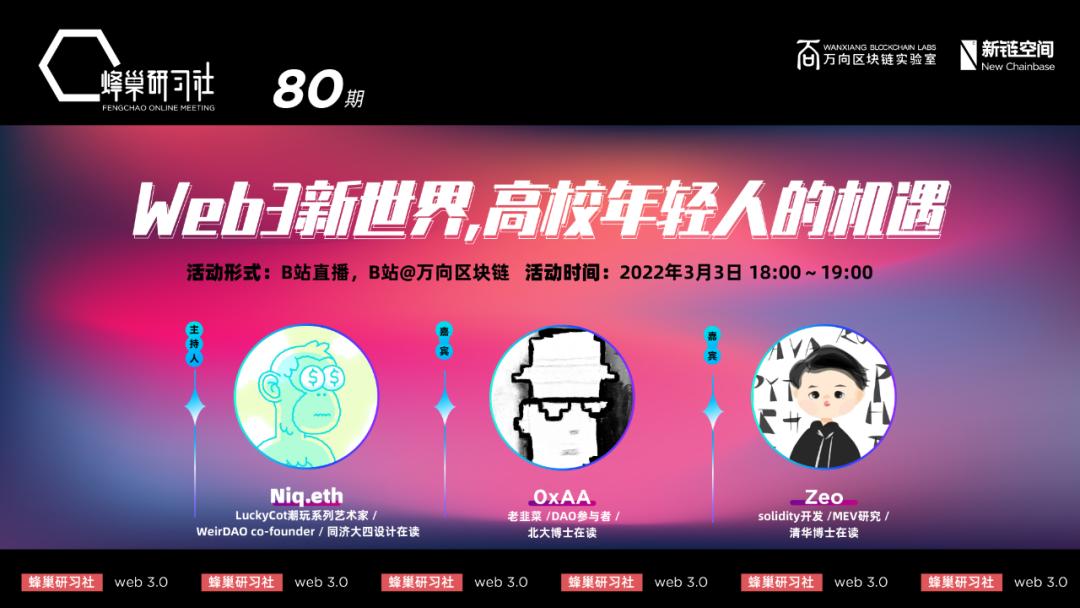
The 80th session of the Wanxiang Blockchain Hive Study Society's online public course invited LuckyCot's trendy toy series artist/WeirDao co-founder/Tongji University industrial design student Niq.eth, DAO participant/Peking University doctoral student OxAA, and Solidity developer/MEV researcher/Tsinghua University doctoral student Zeo. They shared their experiences and insights on the opportunities available to young people as Web3 develops.
The following text has been organized based on shorthand notes, with minor edits that do not affect the original meaning. The views expressed are solely those of the guests and do not represent the position of Wanxiang Blockchain.
Niq.eth (Host):
Good evening, friends in the Wanxiang Blockchain Bilibili live stream! I am honored to be invited as the host for tonight's Hive Study Society Web3 university special, and I am very happy to chat with two guests about topics related to young people in universities and Web3. The two guests are from Tsinghua and Peking University, and I am from Tongji. Let’s start with a brief self-introduction from both of you.
0xAA:
Hello everyone! I am OxAA, a participant in DAO and a doctoral student at Peking University. I am very glad to chat with my old friend Zeo and my new friend Niq about the opportunities for young people in the Web3 era.
Zeo:
I am Zeo, currently a doctoral student in computer science at Tsinghua University, focusing on the technical side, doing some Solidity development work, and my research direction is related to MEV on-chain data analysis. I am very happy to learn alongside the experts.
Niq.eth (Host):
I am Niq, a senior student at Tongji University, studying in the School of Design and Creative Studies, majoring in industrial design. I also have another identity as a crypto artist, creating my own series of art pieces since February last year, which means I have been in the space for almost a year now.
I have experienced many interesting things, such as when I wrote "All in NFT" on my graduation destination form, which made the news, and then I lost a very rare Doodle, which also made the news. At the same time, I am one of the co-founders of the artist organization WeirDAO, and I am involved in DAO-related activities. Another co-founder, Sleepy, recently released "Little Ghost," which also gained some attention. That’s my introduction.
The next question: everyone has briefly introduced their schools, majors, and fields. As young people participating in the Web3 world, could you share your understanding of Web3 as university students and why you are interested in Web3 and blockchain?
0xAA:
When Ethereum first came out, I heard that Vitalik was amazing, creating a decentralized computer at the age of 17. At that time, Ethereum didn’t have many applications, and I thought it was a scam and warned others not to fall for it. But later, as it developed better and better, I started to wonder if it could really achieve something.
I didn’t pay much attention until the pandemic hit, and I got bored, so I took out my Ethereum to look at it and began to understand blockchain technology and Web3 technology, learning Solidity.
I feel it has a lot of application scenarios because it is decentralized. Everyone has the idea of pursuing decentralization.
Niq.eth (Host):
So your understanding of Web3 is decentralization; can we understand it this way?
0xAA:
Yes, there are some very new and interesting things. The technology itself is new, and the field is also new, with not many people involved. You can play 24/7, so people all over the world are engaged, which is very interesting.
Niq.eth (Host):
So you see it as a "new battlefield for investment," can we understand it this way?
0xAA:
Yes, a new battlefield for investment, and now it’s a new battlefield for construction.
Niq.eth (Host):
What about you, Zeo?
Zeo:
I lean more towards the technical side. We look at this from a data perspective. Personally, I believe that from the user's point of view, it is about more self-control over personal data. For example, now there are a billion people using WeChat, and it’s obvious that one app cannot satisfy a billion people. At that point, you cannot say that you want to use a customized version of WeChat because commercial behavior will prohibit it.
But blockchain is different because as long as I connect to the on-chain data, I can operate on it. The first benefit is that the previous internet considered user stickiness as the moat of the product. The moat product itself is good, but from the user's perspective, it is not good. If a better chat app appears, we cannot migrate because our social relationships are all on WeChat, which is a loss for users, as they are being held hostage by their own data.
I believe that the accessibility brought by the openness of blockchain data allows for rapid innovation in applications, and the cost of user migration is very low. My on-chain data is also on-chain, so I can enjoy better innovation. Of course, for entrepreneurial teams, it becomes more competitive because they have to constantly respond to new challenges and cannot enjoy the moat brought by user data.
Niq.eth (Host):
Perhaps you need to consider not how to monopolize but how to innovate.
Zeo:
Yes, you must ensure user experience, which allows many small entrepreneurial teams to survive because it is unlikely that one or two products can meet all users' different needs.
Niq.eth (Host):
I saw a saying last year that I found very reasonable, saying that Web2 is like a city with many fortresses, while Web3 is like the "Peach Blossom Spring" where "paths are interwoven, and chickens and dogs can be heard." You just mentioned data; now these big companies and tech giants seem to be monopolizing the data gold mine generated during user interactions. Blockchain can release value through open-source technology and decentralized storage, not being monopolized by a single company.
Zeo:
Yes, because the data is on-chain and not privately owned by a company.
Niq.eth (Host):
I personally feel this is a difference in interaction. In Web2, when you see those interactions, you might think about how the platform is taking advantage of you, which ads you have to watch, and feel like you are being exploited. But in Web3, participation feels constructive; you might think about what problems the product has and whether you should provide feedback on Discord. It’s very interesting; there is a significant difference in the sense of value participation between Web2 and Web3.
Zeo:
Yes.
Niq.eth (Host):
My understanding of Web3 is just that; it is also related to data. However, I would like to share why I am interested in Web3.
First, I think it may be related to culture and people. I am a subculture enthusiast and enjoy watching subculture memes on Bilibili. I feel that Web3 is naturally close to subcultural groups from an artistic and cultural perspective.
Initially, Satoshi Nakamoto's Cryptopunks were also a subculture, a subculture organization created by cryptographers. These subcultures being accepted by Web3 is also why decentralization is needed; every niche culture and aesthetic can find its supporters and resonate with users in the Crypto community, which resonates strongly with artists.
Including several artists I know, their creations are inherently niche, generative art, or some very scary and strange art. However, in Web3, they form some very interesting cultural groups, being accepted and encouraged, even supported financially. Many things that are not included in the mainstream can find a place in Crypto, which is a cultural aspect.
On the other hand, I feel that people in Web3 are very real; this is reflected through culture. Many people think that the memes in Web3 are really toxic, but from an artist's perspective, I find these phenomena very interesting. They are fascinating anthropological phenomena that generate interesting cultures; those who like them will love them, and those who don’t will dislike them.
Overall, people in Web3 are very real, perhaps because everyone is on-chain, and your interactions are recorded. Especially now with NFTs, it’s easy to check which NFTs you own by looking up your address; your interaction records are all transparent.
At the same time, this circle is more welcoming to young people. These memes and cultures are more likely to be played with by young people, especially NFTs, which continuously generate various cultural elements. The speed of cultural mutation is very fast, and during the dissemination process, many things that younger, internet-native generations will know emerge.
For me, this year is definitely a life-changing year because I have met many Web3 people, whether they are artists, collectors, or speculators. These people, whether happy or sad, are very interesting. The impact and changes they have brought to me are more than the sum of my first 20 years of life; it’s all very interesting, and that’s a significant attraction for me.
Next question, let’s return to our identity as university students. After all, when participating in the Web3 industry chain, people do not particularly emphasize their student identity; everyone is relatively equal.
But back in real life, as university students, what do you think students can do in terms of research topics related to blockchain technology?
I can start with my own experience. Our college is unlikely to have much related to blockchain, but there may be some research on the metaverse, related to metaverse design and metaverse art. However, if you say there are really practical things, there aren’t; they are all very theoretical. I am curious about what research Tsinghua and Peking University have in technology.
Zeo:
There are some courses in technology at school. I am in the computer science department, and the professors will teach. But if you want to do in-depth research, there are many differences. A good entry point is contract development, which is on-chain. Relatively speaking, interacting with blockchain as a ledger is simpler. Now, the Web3 js and Web3 Python libraries are quite complete. I think everyone can start by learning contract calls or doing some on-chain data analysis to understand how blockchain technology works.
Generally speaking, at the graduate, master’s, and doctoral levels, people will do some research on underlying public chains, such as exploring consensus algorithms, looking at the design architecture of the underlying EVM, and those focusing on cryptography will do research related to zero-knowledge proofs. Those focusing on contracts will study contract security and vulnerability traces. There are many technical topics related to this.
In the blockchain world, everyone is in a low-trust environment, so technology plays a role in performance assurance, and the importance of technology is very strong. Therefore, there is a lot of attention on technological innovation and development, providing a lot of space for technology-related topics.
0xAA:
The good thing about the school is that the clubs are quite good. Peking University has a blockchain club, and Tsinghua also has a blockchain club. Clubs are small groups where everyone is classmates and often sees each other on campus, so the learning group atmosphere is great for exchanging technology and information, which are very important in this field.
I am responsible for the technical department at Peking University, and we usually study development tutorials every week. There is a Dapp Learning program that teaches you how to create these DApps, so there will be a technical sharing session every week, and each semester we also participate in a hackathon. Last year, we participated in the Wanxiang Blockchain hackathon and also joined Tsinghua in the Dfinity hackathon. Hackathons are quite fun, and you can also receive some monetary rewards, which motivates everyone to continue learning this stuff.
Niq.eth (Host):
Zeo, do you have any experiences to share about blockchain associations in domestic universities? I didn’t participate because I heard that blockchain associations seem to be all about technology, and people like us who focus on design and art might not fit in. I’d like to hear what you have to say about this area in China.
Zeo:
In terms of domestic clubs, Tsinghua started relatively early. The association was established by seniors in 2017, and last year we merged with international blockchain associations. I was the head last semester, and we just had a new election this semester. What we do is mainly focused on how to help new students who want to understand blockchain enter the blockchain industry. After joining, everyone can share resources, information, and participate in projects and opportunities together, which are all good opportunities.
For example, we organize courses and activities, inviting guests to share at the school. The atmosphere is not overly technical; it’s not that everyone in the association is focused on technology. Overall, blockchain is very open. As you just mentioned, those studying design or art, and even various other majors like environmental materials and physics, all want to understand this very interesting new world.
Many students are willing to step in to see what is happening. The association serves as the first step for them to enter, and whether they want to step into the industry with their second foot depends on their experiences and feelings during their time in the association.
We encourage everyone to be a builder, to truly understand the value and ecology behind a project, and to think about what kind of contributions and value they can make in the industry in the long term. I think this is what university students need more, and it’s what will help them survive in this industry in the long run.
Niq.eth (Host):
Could you introduce the blockchain-related clubs at Peking University, A?
0xAA:
The technical part is in the technical department, where the cryptography club shares some cryptography knowledge, and other developers learn Solidity and front-end development. If you are studying design, it’s actually easy to integrate; you can design some NFTs, and regardless of the product, front-end design is necessary, including UI design, so designers can easily fit in.
Peking University is also trying to do some industry research and project research, and people from various directions can come in to play around and understand the latest developments and projects in blockchain.
Niq.eth (Host):
Do you think associations in schools will evolve into DAO forms in the future?
0xAA:
Zeo wrote an article on the public account discussing associations and DAOs.
Zeo:
It’s a summary, really, because during the process, we found that associations and DAOs are very similar. One aspect is liquidity; this is inevitable. Everyone will advance in grades and consider graduation and work, so it’s impossible to stay in the association permanently.
On the other hand, it’s unrealistic for an association to handle everything from start to finish. There are many resources and many things that need to be collaborated on externally, including some activities and courses they want to do internally.
Various aspects require dynamic participation from students. Furthermore, everyone is relatively like-minded, and they can gain motivation from doing these things together. This aligns very well with DAOs, both in form and spirit.
Niq.eth (Host):
It seems possible; it would be quite interesting if various associations in schools turned into DAOs. Let’s continue with the student topic. Now many students choose to learn about Web3 or join Web3 associations. Many people want to understand this industry, and now everyone is saying Web2 is too competitive. Many wonder if there are relatively more opportunities in Web3.
For those wanting to understand opportunities in the Web3 industry, do you have any suggestions for university students entering Web3? Whether technical or non-technical, there are many differences between Web3 and the Web2 that most people are familiar with, and many find it hard to accept. What suggestions do you have for them on how to get started?
0xAA:
Yes, the threshold is relatively high now. But if you understand technology, it’s easy to get started because Solidity isn’t very difficult, and the front-end is basically similar to the Web2 front-end tech stack. If you are technical and want to switch careers, it’s easy. For others wanting to transition to being artists, it’s also easy; you can design some NFTs and work on some projects. For the rest, the threshold might be higher. Another suggestion is to learn English well; this is very important.
Niq.eth (Host):
Zeo, do you have any observations?
Zeo:
I feel that university students entering the industry have fewer burdens. If you are already working at a big internet company, it’s hard to jump out and try something in Web3 because if it fails, it’s difficult to return to that system to continue competing. Most of my friends who are in the industry participate part-time. For students, during their time in school, they don’t need to consider opportunity costs too much; the cost of trial and error is low, and they can try to enter the industry and observe deeply.
Initially, everyone tends to choose internships, participating in more mature tracks to make selections. I’ve noticed many people doing investment research internships because they want to understand the various ways to play in the industry, the ecosystems, and the projects involved. So many choose to explore through investment because that way, they can see a lot.
Moreover, the technical threshold isn’t high, but there are high requirements for energy, learning ability, and rapid growth. For the technical side, I suggest trying to participate in hackathons because many ecosystems want to attract developers. In the blockchain industry, technology is still a very important aspect.
If you have a technical background and can learn contract development or various technologies, you can participate in hackathons to see the judges’ feedback and understand the needs in this area.
Many people are trying to do both sides, and associations often organize many hackathon events. If anyone is interested, they can get in touch with a lot through this. Indeed, the industry supports and encourages students to actively participate in hackathons.
Niq.eth (Host):
Overall, it seems that having a technical background is a good way to enter Web3. There is a high demand for technology in Web3 projects. You can also be a mod; if you do well as a mod, there will be significant opportunities.
As A mentioned earlier, if you understand design, you can help with front-end work or create NFTs. NFTs have project parties that need help. My situation is a bit special; I am currently working as a personal artist, releasing my own works.
I personally feel this is somewhat like self-media; you might be operating your own work account, which is quite similar to Web2 illustrators or other artists. You are managing your fans and growing your brand. To summarize, that’s about it. If there are students listening in front of the screen, I hope this can be useful to you.
Finally, there’s a question related to employment. I’d like to hear you both share your future employment directions. Returning to yourselves, what are your employment directions? Freelancing, investing, working for a company, or directly working in a DAO? What are your thoughts on your future employment directions?
0xAA:
I still have two years until graduation, so it’s a bit early to think about what to do after graduation. But I think the next two years of research will still be fun. In the future, I might spend half my time doing research and half my time looking for a project or working in a DAO.
Zeo:
I will definitely lean towards technical work because I am also doing research-related things. I enjoy working in entrepreneurial and DAO formats. Some projects have tried this approach, but when you actually do it, you find that if you really use a DAO, it still heavily relies on the reliability of the core team.
Because relationships are indeed weak, and everyone is remote and online, how do you ensure efficiency and output? Changing the format doesn’t truly solve all the management problems faced by traditional companies; it just means new forms will bring new management issues.
In short, to truly enter the industry and produce results, you still have to compete with other friends. It’s no longer like a few years ago in the blockchain industry, where anything new seemed reliable and could gain recognition. Now it has become competitive, and a large number of teams are working hard on these matters. You can clearly see that the recent on-chain applications and various apps have very good user experiences, and the technical barriers will continue to rise.
If you choose to participate or choose to work in some DAOs, I think the team is very important. I personally enjoy doing research, so I prefer to find a team where I can leverage my abilities in this area.
Niq.eth (Host):
Research, right?
Zeo:
Yes, relatively speaking, many people can help you solve other issues, allowing you to focus on research, which is great.
Niq.eth (Host):
I feel similar to you. I personally don’t want to return to traditional company structures. Initially, there was a perception that working in a company or having a natural labor contract might provide stable salaries and career planning, with the company directly planning your path, allowing you to level up in a fixed career route. For most people, this might be a better choice.
But I personally don’t want to compete in such places. I felt this way during my internship; I realized I am not very suited for office work. I am not very focused and enjoy various explorations. It seems that working online in the blockchain space might suit me better.
I envision working in a DAO in the future, where I can have more freedom in time allocation; I can wake up at 10 or 12 if I want. It’s somewhat like freelancing, except that your work is organized within a DAO. I will continue to manage my artist account and earn money from my works.
Currently, my thoughts are like this. After graduation, I don’t want to work anywhere; I prefer to do my own things. This is really great; it feels like you are working for yourself, and you don’t feel like your value is being exploited by a company or anything like that. This experience is fantastic.
But whether it’s a 996 situation really needs a question mark. To do a good job, you will definitely be busy during that time, possibly even busier than a 996 situation; it’s hard to say.
Zeo:
You are your own shareholder.
Niq.eth (Host):
Yes, you are your own shareholder, and you want to get the maximum benefit. We have roughly discussed employment directions. To summarize briefly, we are all inclined to go all in on Web3. We can only see if there are suitable opportunities in Web2, and if not, Web3 is also quite good.
What do you think about the value that blockchain brings to society, whether in Chinese society or human society?
Zeo:
This question is indeed very broad. I tend to discuss some of its value from a CS background. Now everyone has recognized the value of cloud computing. In the past few years, whether to engage in cloud computing was still a topic worth debating.
But now everyone recognizes the value of cloud computing for society, allowing some companies to confidently hand over hardware resources to professional companies to solve. This is particularly true in the field of computing, where there are people specifically running hardware, and you just run software on top of that.
Blockchain takes it a step further; it has already solved the account system for you. It’s no longer a hardware issue; hardware is a special case of cloud computing. Someone has taken care of the hardware for us, so I don’t need to worry about the collapse of decentralized applications. If it collapses, it will be a total network collapse.
On the other hand, it even takes care of user accounts for me. Imagine if we want to create a payment system; we can only connect to Alipay or WeChat Pay, which requires us to pay them a fee and consider the security of user accounts and passwords. But in blockchain, these things are already handled by on-chain elements.
We only need to interact on top of that and consider the business layer. This greatly promotes everyone’s productivity and the rapid iteration of entrepreneurial innovation; it’s an upgraded version of cloud computing.
Niq.eth (Host):
It saves a lot of manpower and resources, allowing a focus on innovation.
Zeo:
Yes, we don’t need to deal with those infrastructures anymore; there are dedicated chains to handle that.
Niq.eth (Host):
I understand; this is indeed an interesting point. From my perspective, I can discuss it from the angle of cultural artists, as I don’t have a deep understanding of technology.
It can be said that it is almost certain that the art history of these two years is closely related to Ethereum. This is now repeatedly mentioned, including the increasing number of overseas art papers researching NFT-related topics, including last year’s emergence of Beeple and other top on-chain artists. They use digital art carriers, including some avatar projects, which may not necessarily be called art.
But they are also visual carriers, and the blockchain ideology and Web3 ideas are constantly breaking into the mainstream through these avatars and these strange visual art carriers, capturing the hearts of some outsiders.
From the results, it represents a comprehensive ideological transformation and paradigm shift from economics to cultural arts, which is really interesting. You can see that many well-known celebrities overseas are no longer flaunting luxury cars and mansions but are starting to show off strange images, like a funny monkey.
You can deeply feel that the paradigm shift is happening in overseas internet culture, prompting more people to think about where value lies, whether it’s cultural value or internet value, which may encourage more people to ponder this issue. Just promoting this kind of thinking already has enough historical significance.
I am willing to share the trends for designers in the Web3 field in 2022. I feel that earlier, Web2 designers were more like doing things at the bottom of Maslow's pyramid, ensuring system security, ensuring interactions don’t go wrong, designing buttons, deciding where to place them, and how the interaction process works. Web2 designers were focused on ensuring the underlying system.
Now in the Web3 era, there are more community needs. Designers need to pay attention to aspects of spirit, destiny, and cultural dissemination. Especially in NFT communities, there are many needs for cultural design, organizational design, and community design. You may even need to create a certain culture or meme through some design thinking. There are many opportunities for designers in this area; this is the development trend for designers in blockchain.
This is just a visual trend for now. In the future, music NFTs may become one of the trends. I believe music still needs to be combined with video and images, possibly needing to be disseminated through short videos, just like TikTok and Douyin. This may bring more value to music in Web3. Currently, Web3 lacks music, so many people are exploring and looking forward to the development of this area.
Most people are discussing music copyright issues, but there hasn’t been much focus on music dissemination. In Web3, dissemination is a very important matter; seeing it makes it more valuable. We can look forward to the development of music in this regard.
 Risk warning
 Risk warning