Bitcoin's dominance has reached a three-year high, with its market share at 55%

 The market share of Bitcoin refers to the proportion of Bitcoin's market capitalization in the entire cryptocurrency market. It is one of the important indicators for investors to analyze the development trends of the cryptocurrency market and predict future movements. According to data from CoinMarketCap, Bitcoin's market dominance has risen to 55.25%, reaching a new high since April 2021.
Source: CoinWorld Original
Author: Web3 Scent Observation
Bitcoin's market share refers to the proportion of Bitcoin's market capitalization in the entire cryptocurrency market, and it is one of the important indicators for investors to analyze the development trends of the cryptocurrency market and predict future movements. Market capitalization refers to the total value of an asset, calculated based on market price and circulation.
According to data from CoinWorld, Bitcoin's market dominance has surged to 55.25%, reaching a new high since April 2021. Recently, due to the price of Bitcoin and Ethereum retreating from their peaks, while other altcoins suffered significant losses, this has conversely boosted Bitcoin's dominance. At the end of May this year, Bitcoin's market share was still below 50%. This growth has also been primarily driven by the approval of spot ETFs.

Chart source: CoinWorld
It is noteworthy that Bitcoin's market share is nearly three times that of Ethereum (ETH), which is the second-largest cryptocurrency by market capitalization, with a market share of about 18.25%.

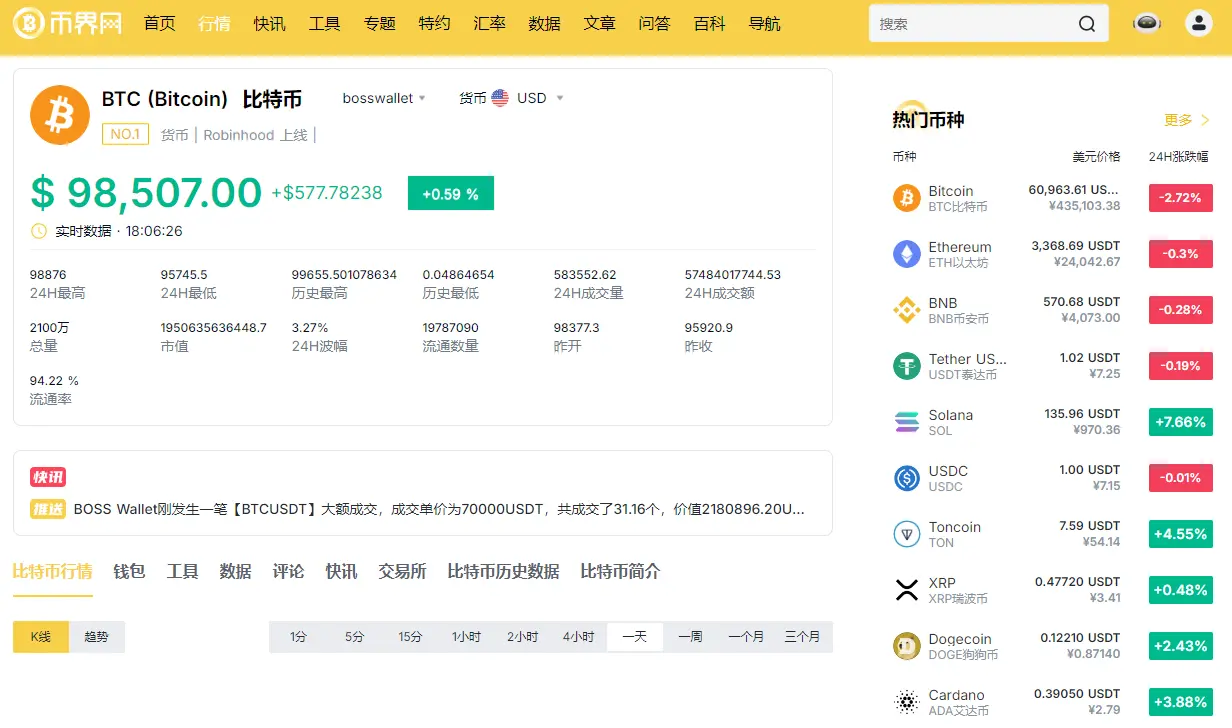
According to CoinMarketCap data, on June 20, the total market capitalization of cryptocurrencies worldwide was $2.4 trillion, with Bitcoin's total market capitalization at $1.3 trillion, and the current price of BTC is $65,470.
Over the past year, Bitcoin's market share has remained between 44% and 53%, showing little change. However, since last summer, the wave of spot ETF approvals has enhanced Bitcoin's position relative to other cryptocurrencies. This week, Bitcoin's market share surged again, reaching a new high since April 2021. It is worth noting that the bull market in 2021 significantly boosted the market capitalization of other crypto assets.
Recently, due to the Federal Reserve only expecting one rate cut in 2024, Bitcoin has fallen by 5.3% in the past week. In contrast, many small-cap tokens such as FLOKI, STRK, IMX, and FIL have dropped by double digits in the past seven days. Nevertheless, Bitcoin is viewed as a lower-risk asset due to its higher regulatory acceptance and institutional adoption, and it is increasingly regarded as a safe-haven asset.

Bitcoin has performed better in response to declines in risk assets. Although all cryptocurrencies are generally classified as risk assets, Bitcoin may be considered less risky than many of its peers, as they have not received the same level of regulatory approval and institutional adoption. Typically, during market downturns, Bitcoin's safe-haven properties as the leading cryptocurrency are stronger.
Looking back at history, during the past few cycles of bear-to-bull transitions, Bitcoin's market capitalization share generally increased. First, Bitcoin's "vampire effect" led to its relative resilience while altcoins performed poorly, marking the first phase. Then, Bitcoin rose, followed by altcoins also rising or performing strongly, marking the second phase. Whether the current bull market will follow this pattern remains to be seen.
Although Bitcoin's market share has recently declined, its advantages as the leading cryptocurrency and its safe-haven properties remain significant amid market volatility. In the future, as market conditions change, Bitcoin is still expected to maintain an important position in the cryptocurrency market.
However, with the market rebound, Bitcoin's dominance may gradually decline.
 Risk warning
 Risk warning