Why do you always lose? The 10 psychological biases you need to overcome

 Only when conducting an objective analysis of market sentiment should the behavior of the public be considered.
Source: KoroushAK X Account
Author: Koroush AK
Compilation: Deep Tide TechFlow
Your biggest trading mistakes are not technical but psychological errors, and these biases have destroyed countless traders.
Avoid the following points at all costs:
1. Anchoring Bias
- Traders focus on a specific price (anchor), which may affect their decisions.
- If Trader A enters cryptocurrency when BTC is priced at $52,000, then $61,000 BTC seems expensive.
- If Trader B enters cryptocurrency when BTC is priced at $71,000, then $61,000 BTC seems cheap.

2. Recency Bias
This is the tendency to remember and give more importance to the most recent information.
Traders may carry information from recent trades into the next trade, which can lead to overconfidence and losses.

3. Loss Aversion
Traders feel losses more intensely than gains.
The pain of losing $100 may be greater than the pleasure of gaining $100.
This bias may lead traders to prematurely abandon profits because they fear these gains will turn into losses.

4. Endowment Effect
When traders hold an asset, they often overestimate its value.
This emotional attachment makes it difficult for them to sell at a loss, or even to sell at a fair price, as they rely more on their expectations than on the actual market conditions to judge the future price of the asset.

5. Herd Mentality
There are risks in either blindly following the crowd or deliberately doing the opposite.
Stick to your trading plan and avoid acting impulsively due to the behavior of the masses.
Only consider the behavior of the crowd when conducting an objective market sentiment analysis.

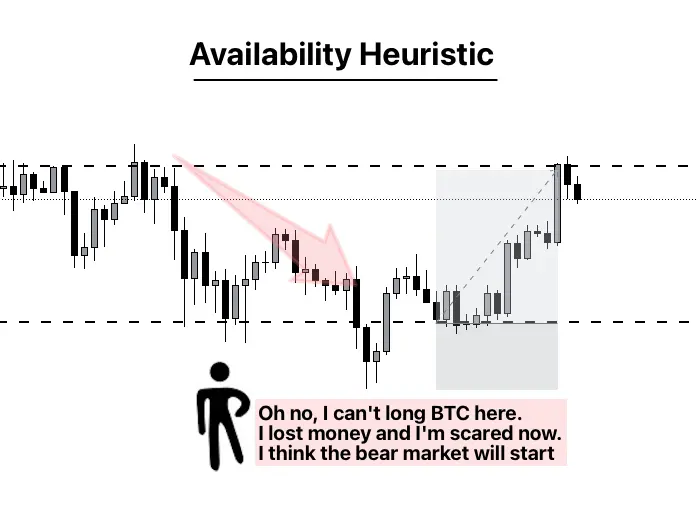
6. Availability Heuristic
Traders often give too much weight to the most emotionally intense or recently occurred information.
For example, even if market conditions have changed, a recent market crash may make traders overly cautious.
7. Survivorship Bias
Systematically overestimating the probability of success.
What we often see are success stories, while failure stories tend to be forgotten.

8. Framing Effect
The way information is presented can influence decisions.
Traders' emotions and confidence can affect their risk assessment.
Positive emotions may lead to underestimating risks, while negative emotions may lead to overestimating risks.

9. Confirmation Bias
Traders tend to seek data that supports their beliefs.
If you are bullish on an asset, you will look for all information that supports a bullish outlook while ignoring bearish data.

10. Captain Hindsight
In hindsight, everything seems obvious.
After an event occurs, traders often feel they had already foreseen the outcome.
This bias can lead to overconfidence in future predictions and unrealistic expectations about their trading abilities.

 Risk warning Risk warning



Popular articles