TRON Industry Weekly Report: Positive news realized, mainstream coins continue to adjust, RWA infrastructure Centrifuge may become the sector leader
 Core Viewpoint
 This week, the cryptocurrency market showed a lackluster performance against the backdrop of a 25 basis point rate cut by the Federal Reserve. Major coins like Bitcoin and Ethereum lacked sustained buying interest, and market risk appetite was insufficient. Capital flows exhibited structural differentiation, primarily concentrated in Bitcoin ETFs, while trading volumes for altcoins shrank. The article analyzes three potential projects that received significant funding: PublicAI, OVERTAKE, and Centrifuge, which represent the three cutting-edge tracks of AI training data, game trading, and RWA tokenization, respectively.
I. Outlook
1. Macroeconomic Summary and Future Predictions
Last week, the Federal Reserve lowered the federal funds rate by 25 basis points to 4.00%--4.25%, as expected, marking the first rate cut since December last year. The statement emphasized that this is a "risk management rate cut," primarily addressing the ongoing weakness in the labor market. Market reactions were moderate, with slight upward fluctuations in the stock market, while bonds and gold remained attractive.
Looking ahead, the Federal Reserve has entered a rate-cutting cycle but remains cautious, expecting 1--2 moderate rate cuts within the year, depending on the subsequent performance of inflation and employment. Overall, risk assets are still supported by liquidity in the short term, but increased volatility is inevitable after the positive news is priced in.
2. Market Changes and Warnings in the Crypto Industry
Last week, despite the Federal Reserve's announcement of a moderate 25 basis point rate cut bringing liquidity benefits, the cryptocurrency market remained weak overall. Bitcoin briefly rose to about $116,000--$117,000 but lacked sustained buying interest, showing clear signs of a pullback; mainstream coins like Ethereum performed even more sluggishly, indicating insufficient market risk appetite compared to the resilience of U.S. stocks. On the funding side, although ETFs saw net inflows, they were more concentrated in Bitcoin, while trading volume and funding heat for altcoins shrank, reflecting structural differentiation in the market.
Overall, while the crypto market still has liquidity support in the short term, it is significantly weaker compared to other risk assets. If Bitcoin breaks key support levels, the pressure for a pullback may be rapidly amplified.
3. Industry and Sector Hotspots
Raising $12 million, PublicAI, backed by well-known institutions like Solana & Near, is innovating the AI ecosystem by providing high-quality, human-generated AI training data while allowing individuals worldwide to monetize their expertise; raising $7 million, led by the Sui Foundation, OVERTAKE is a peer-to-peer trading market based on the Sui blockchain that enables the free circulation of game assets through a trusted trading infrastructure, supporting secure, fast, and decentralized trading of digital game assets via smart contract escrow.
II. Market Hotspot Sectors and Potential Projects of the Week
1. Overview of Potential Projects
1.1. Analysis of PublicAI, which raised $12 million with participation from well-known institutions like Solana & Near, building a decentralized intelligence layer
Introduction
PublicAI is innovating the AI ecosystem by providing high-quality, human-generated AI training data while allowing individuals worldwide to monetize their expertise. With a decentralized global network of verified contributors, the platform ensures unprecedented data quality through rigorous skill verification and staking penalty mechanisms.
As AI drives job displacement, PublicAI offers everyone a way to continue participating and benefiting from the AI economy. Human-in-the-loop (HITL) is not only crucial in AI training but also indispensable during the reasoning phase (when AI makes real-world decisions). As AI replaces conventional jobs, humans must transition to higher-value roles alongside it. PublicAI is building a decentralized human reasoning layer that enables real-time validation, review, and guidance of AI outputs.
Architecture Overview
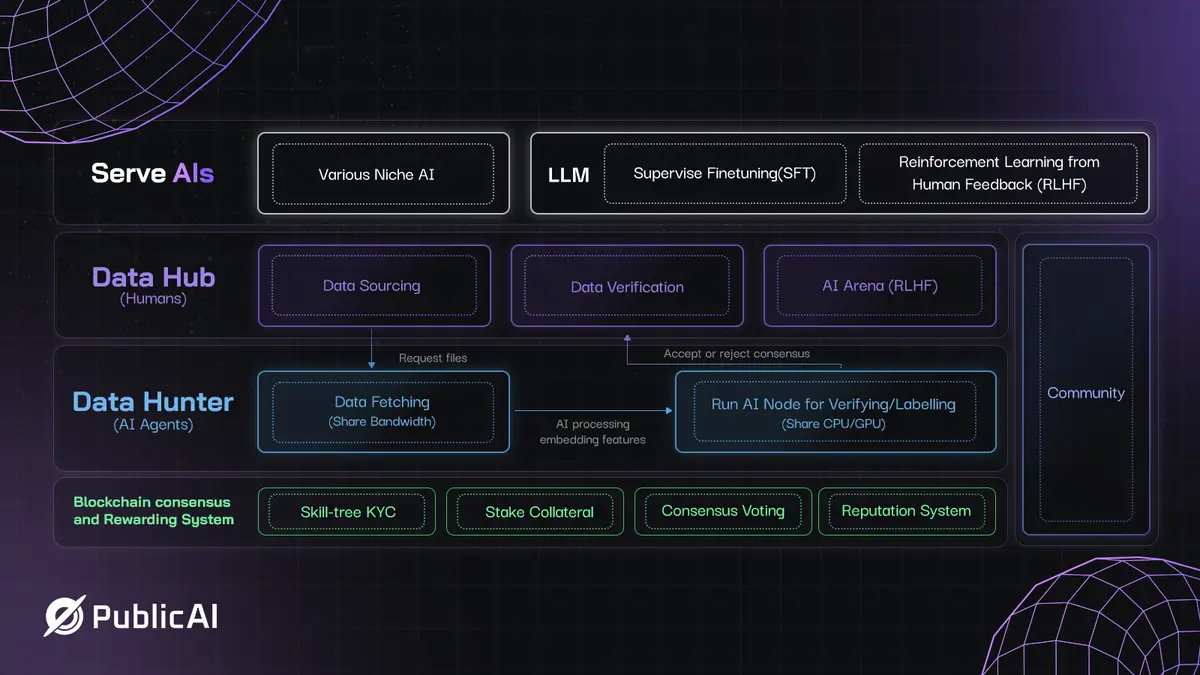
PublicAI Three-Layer Architecture
1. DataHub (Layer One)
Positioning:
DataHub is the main platform for data activities and quality verification, where uploaders and voters collaborate to ensure high-quality data needed for AI training.
Core Functions:
Hosts data collection activities, allowing uploaders to submit datasets based on task instructions.
Supports voters in assessing the quality of uploaded data to ensure it meets activity requirements.
Maintains data quality and integrity through a voting-based consensus mechanism.
Key Features:
Uploaders can earn USDT rewards and $PUBLIC airdrop points by participating in activities and submitting high-quality data.
Voters help filter quality data by voting on whether uploaded data meets activity instructions.
Contributors and voters receive corresponding rewards based on their participation and alignment with consensus (e.g., "hit consensus" or "deviate from consensus").
2. Data Hunter (Layer Two)
Positioning:
Data Hunter focuses on enabling node operators to support AI Agents, enhancing data processing capabilities and community engagement.
Core Functions:
Node operators can run AI Agents through the Data Hunter plugin, contributing computing power resources for DataHub's data quality checks.
Encourages community participation, such as completing tasks: using AI to reply to popular X (formerly Twitter) posts (views >1k).
Key Features:
Node operators:
Provide computing resources to enhance AI Agent efficiency and accelerate DataHub's data verification process.
Use the "AI Reply" feature to interact with popular X posts, generating valuable AI feedback data.
Earn $PUBLIC airdrop points by running nodes and participating in AI-driven interactions.
3. Blockchain and Smart Contracts (Layer Three)
Positioning:
The blockchain layer ensures security, transparency, and fairness in data contribution and reward management.
Core Functions:
Manages tasks through smart contracts, such as voting consensus, uploader rewards, and node operator incentives.
Tracks and guarantees all activities, ensuring data source traceability and immutability.
Provides decentralized governance, allowing community members to influence platform development.
Key Features:
Consensus Mechanism: Implements Byzantine Fault Tolerance (BFT) algorithms to verify data quality through decentralized voting.
Incentives and Penalties: Loyal contributors receive rewards, while malicious actions are penalized through on-chain automatic mechanisms.
Transparency: Ensures all data lifecycle activities are publicly transparent and immutable.
Tron’s Commentary
PublicAI's advantage lies in its use of a decentralized network that incorporates globally verified contributors into the ecosystem, ensuring data quality through skill verification + staking penalty mechanisms, and allowing individuals to monetize their expertise in the AI economy, extending not only to training but also to the reasoning phase of human-in-the-loop (HITL), providing real-time supervision and correction for AI decisions.
Its disadvantage is its high dependence on large-scale community participation and incentive mechanisms, high operational complexity, and ongoing challenges in data review efficiency, node incentive sustainability, and compatibility with traditional AI enterprise data standards.
1.2. Interpretation of OVERTAKE, which raised $7 million led by the Sui Foundation, enabling free circulation of game assets ------ a trusted trading infrastructure based on Sui
Introduction
OVERTAKE is a peer-to-peer trading market based on the Sui blockchain, supporting secure, fast, and decentralized trading of digital game assets such as items, in-game currency, accounts, and collectibles through smart contract escrow. It integrates AI-driven smart search, automated buying strategies, and seamless cross-market listings to enhance liquidity, trading speed, and user trust.
Architecture Analysis
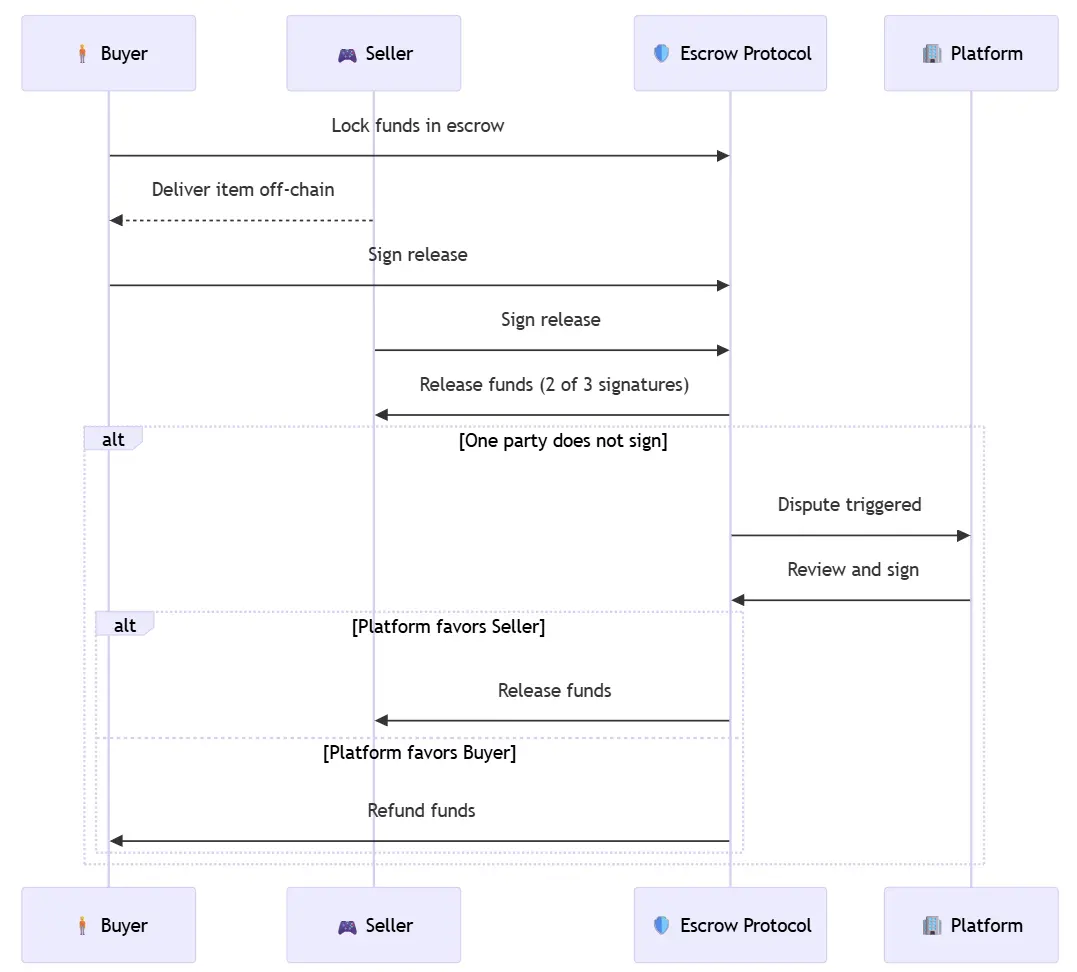
1. On-Chain Escrow System
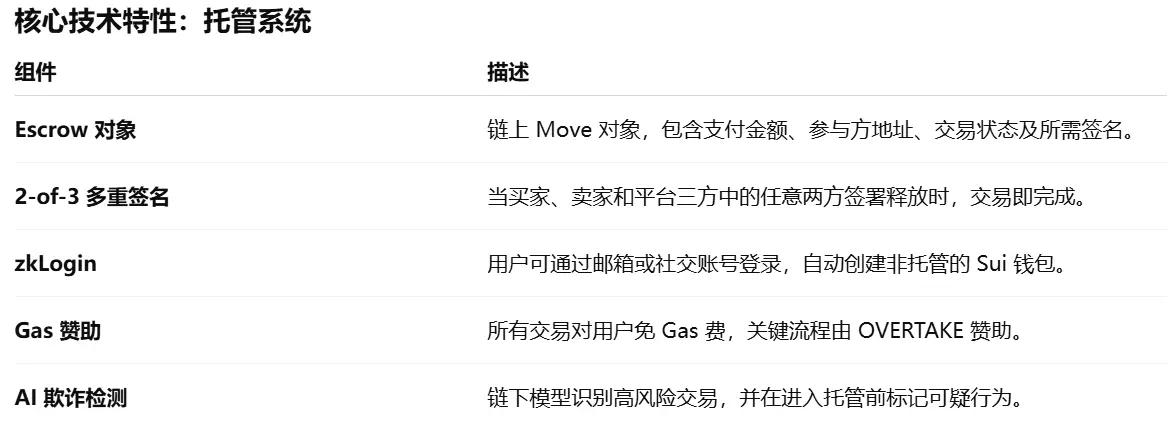
At this stage, the platform replaces Web2-style trading models with a smart contract escrow system, establishing programmable trust between users. This system supports secure peer-to-peer trading of game accounts and items, coordinating on-chain logic with off-chain delivery to ensure transaction safety and reliability.
We utilize Sui's object-centric model and programmable transaction blocks to implement a decentralized escrow mechanism. The system employs a 2-of-3 multi-signature logic, allowing the platform to intervene and mediate disputes without directly holding assets.
2. In-Game Asset Verification and Trading Integration
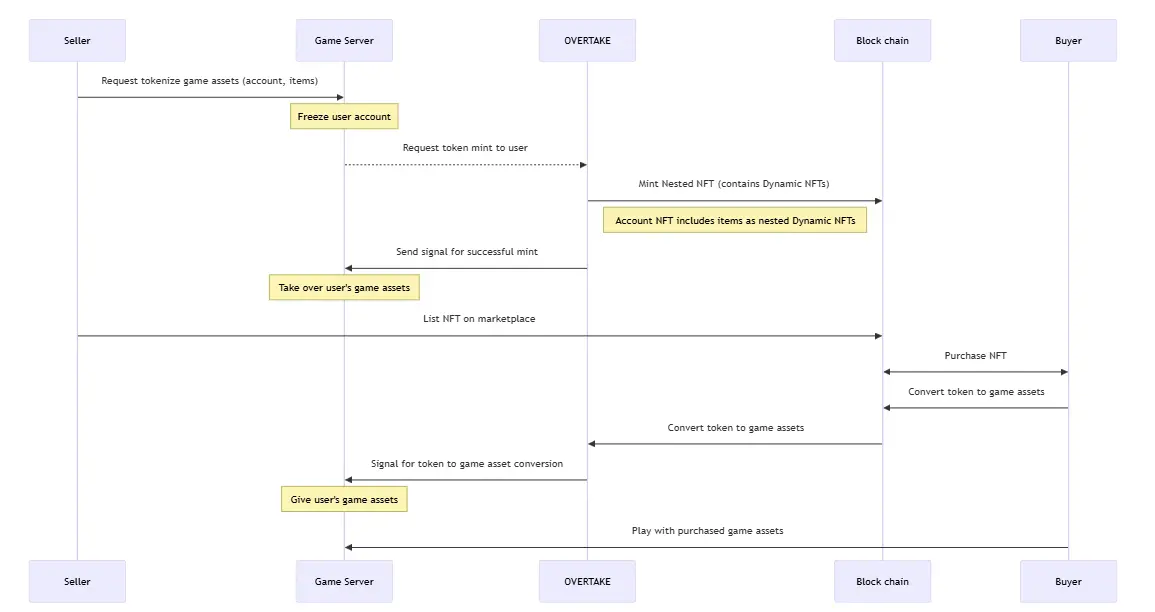
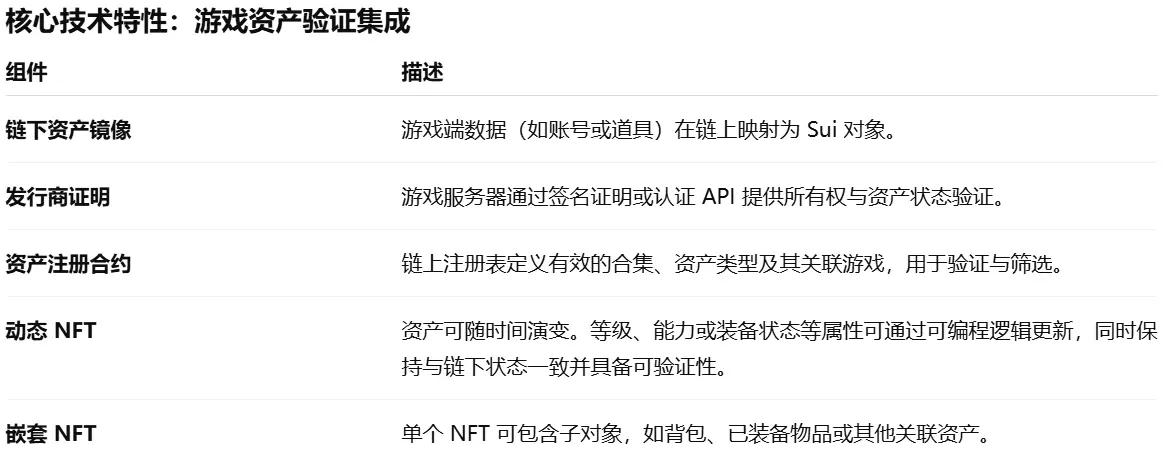
In the second phase, OVERTAKE's goal goes beyond basic peer-to-peer trading, directly connecting with game publishers to enable verified in-game asset trading, such as accounts, in-game currency, or high-value items.
These assets are no longer just tokens on the chain but correspond one-to-one with real items in the game, verified by server data and subject to the rules of the game environment.
In this model, the escrow mechanism is no longer necessary. Players do not need to rely on coordination or dispute mediation between users, as the authenticity and ownership of assets are verified at the source—by the game publisher. This allows players to trade with greater confidence, ensuring that the assets they buy and sell are legitimate, real, usable, and fully functional.
This phase is based on practical experience:
During the launch of Somnis: Rumble Rush, OVERTAKE closely collaborated with developer MetaEdition to build a Web3 trading market that connects both the Immutable blockchain and the game backend.
Through this deployment, OVERTAKE has proven its capabilities:
Managing real-time tokenized assets;
Verifying asset ownership from off-chain databases;
Supporting instant trading in real-time gaming environments.
Looking ahead on the Sui blockchain, OVERTAKE will further expand:
Utilizing Sui's support for nested and dynamic NFTs, it will create asset structures capable of representing complex states (e.g., an account with a backpack or a weapon with upgrade history) while achieving dynamic updates over time with full verifiability.
3. Embedded Infrastructure
In the final phase, OVERTAKE will evolve into "invisible infrastructure."
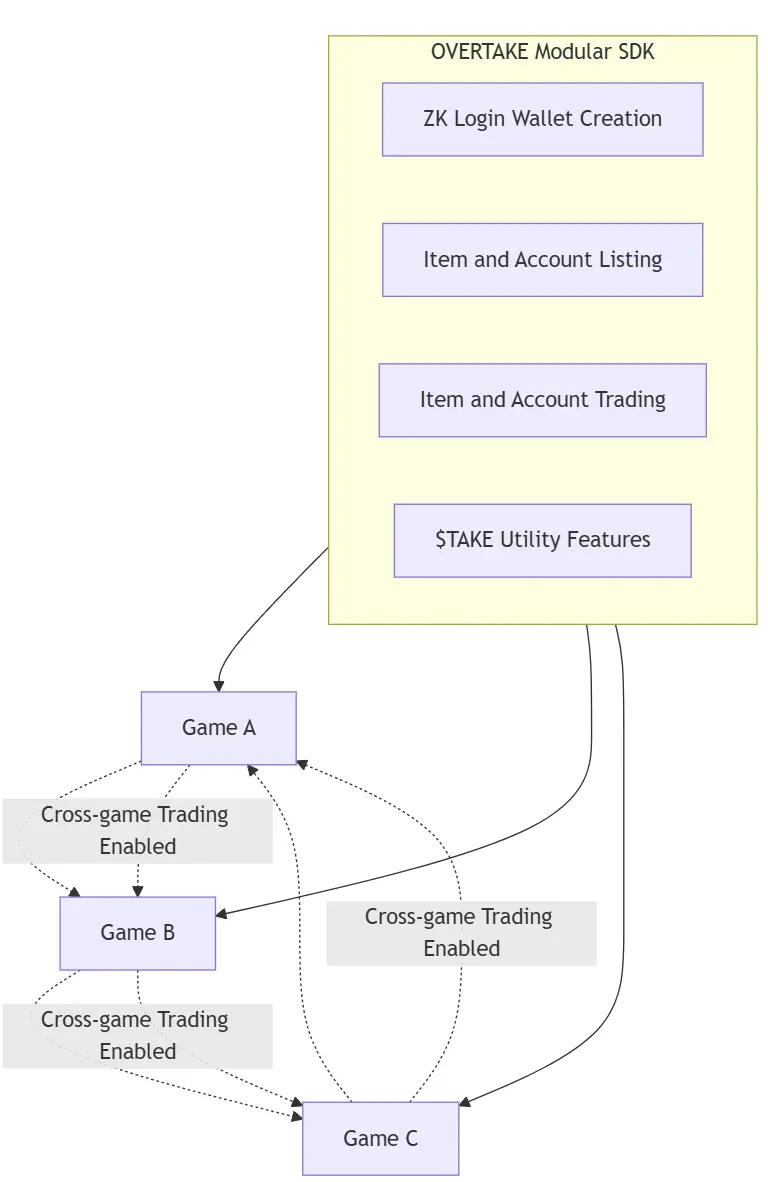
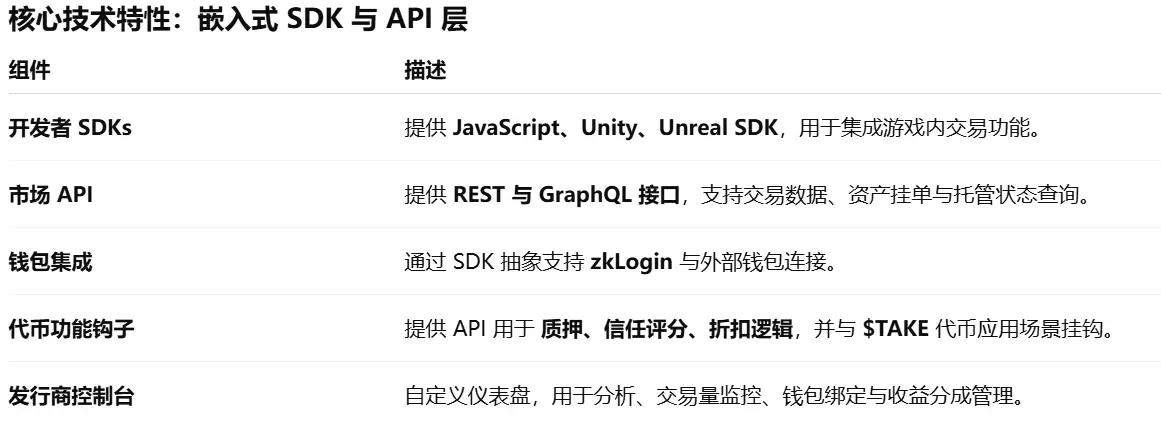
It will no longer exist as an independent trading market but will allow developers to directly embed trading functionalities into their games through modular APIs and SDKs.
This includes a complete set of tools:
Asset listing and purchasing
Wallet creation
Escrow logic
Staking mechanisms
Use cases for the $TAKE token
All functionalities can be conveniently accessed through client libraries and management consoles.
Tron’s Commentary
OVERTAKE's advantage lies in its phased evolutionary design: from on-chain escrow systems to in-game asset verification and finally to embedded infrastructure, gradually addressing the three major pain points of transaction security, asset authenticity, and developer integration; leveraging Sui's dynamic and nested NFTs, as well as AI-driven anti-fraud and smart search, the platform can enhance liquidity, speed, and user trust.
Its disadvantage is its high dependence on cooperation with game publishers, needing to overcome traditional manufacturers' resistance to integration; at the same time, the multi-layered technical architecture brings implementation complexity, and the costs of early market education and user migration are also relatively high.
2. Detailed Explanation of Key Projects of the Week
2.1. Detailed Analysis of Centrifuge, which raised over $50 million led by Republic, dedicated to RWA tokenization and decentralized financing infrastructure
Introduction
Centrifuge is a pioneering platform for tokenizing real-world assets (RWA). Through Centrifuge, investors can access a diversified asset portfolio, enhance transparency, and gain deeper insights into their investment portfolios. Asset managers can tokenize their funds, simplifying the connection process with necessary service providers and investors, thereby reducing fund operating costs and unlocking new sources of capital.
Centrifuge also provides infrastructure and ecosystems to support the tokenization, management, and investment of real-world assets, helping to build a complete and diversified RWA investment portfolio.
Architecture Analysis
1. The Centrifuge DAO
At the governance core of Centrifuge is the community-driven Centrifuge DAO. CFG token holders play a key role, collectively deciding the protocol's development direction through on-chain and off-chain voting, and managing the use of the Centrifuge treasury. Meanwhile, some authorized working groups are responsible for guiding specific areas of the DAO and protocol.
Management Process
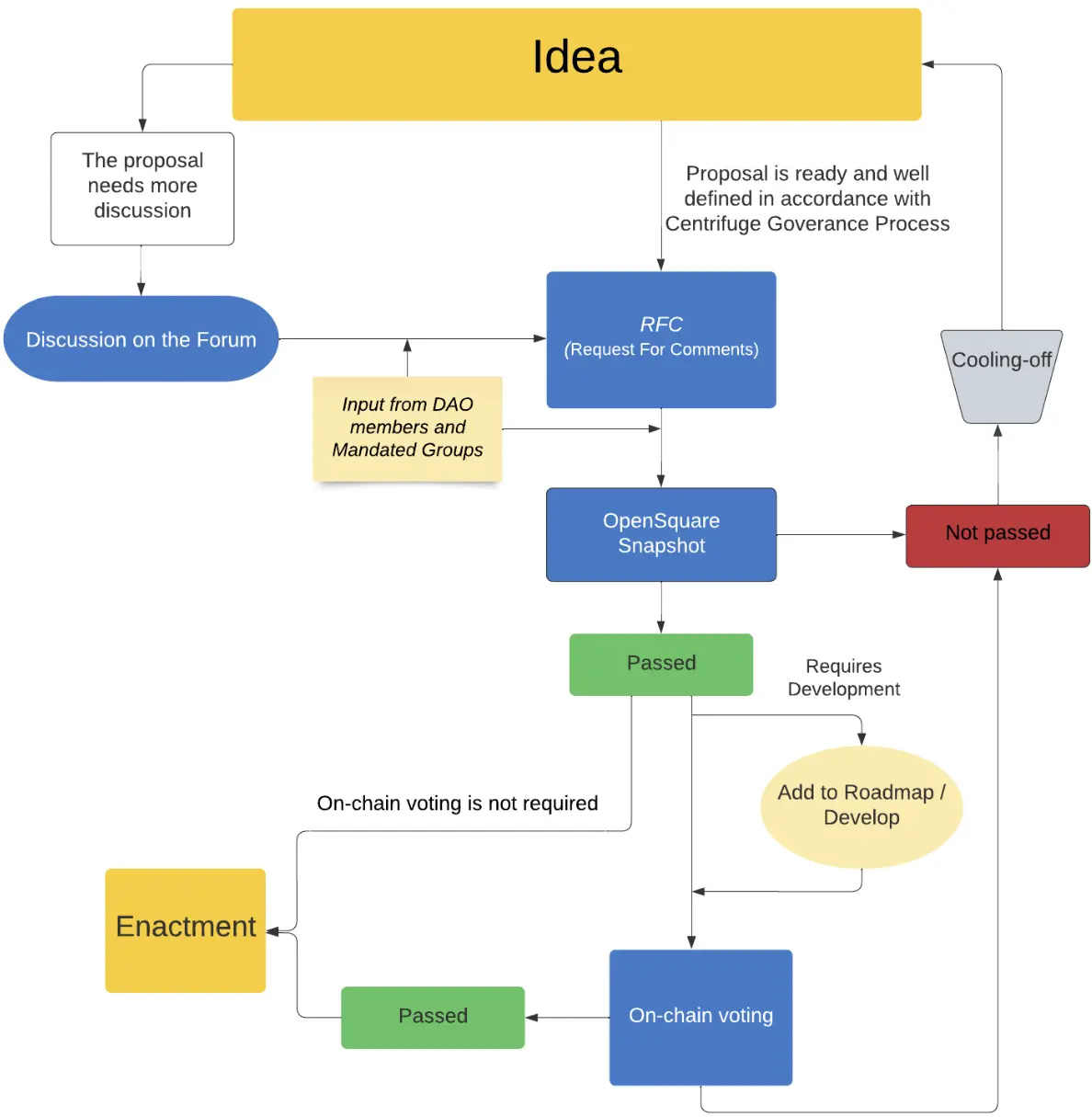
The Centrifuge protocol is governed by CFG token holders, and all proposals must go through a governance process. The overall process can be divided into two parts: off-chain governance and on-chain governance.
Offchain Governance
This is the first part of the governance process, occurring in community forums (in the form of "Request for Comments RFC") and on the OpenSquare platform.
Purpose: To gather community opinions and support before submitting proposals on-chain.
Note: Not all proposals need to be submitted on-chain to be approved; some can be passed through community off-chain consensus.
Onchain Governance
This is the part of the governance process that occurs on the blockchain.
First, proposals are created on-chain (can be initiated by the public or committees).
Subsequently, a public referendum is usually initiated, allowing all token holders to vote in favor (Aye) or against (Nay).
Different types of proposals may have different governance processes, but all must start from a forum post. All Centrifuge proposals (CP) must also be submitted to the Centrifuge Proposal Repository (Proposals Repository) (Github).
Proposal Repository
All proposals must be submitted to the proposal repository on Github for record-keeping.
Proposal discussions (RFC phase) occur in the forum, and if there are any modifications to the proposal, they must be updated via PR during the RFC phase before entering snapshot voting or on-chain voting.
This ensures that proposals cannot be tampered with during or after the voting period.
A proposal is only considered valid and final once it has been submitted to the proposal repository and merged.
After submission, the system automatically generates a PR number (XXX), which serves as the proposal's index and is written into the title of the forum post (prefixed with CPXXX). The forum post must include a link to the proposal on Github.
If spelling errors or minor issues are found in the final version of the proposal, corrections can be made. However, such changes must be handled by the Governance Coordination Group (GCG) and announced in the forum; if the community believes the modification changes the original intent of the proposal, they can raise objections.
Request For Comments (RFC)
Creating an RFC is the next step:
Published in the forum to gather community feedback, questions, and assess support for the proposal.
If community feedback requires modifications to the proposal, it should be completed at this stage.
Different proposals may require different discussion times; RFCs must run for at least 7 days, with a recommendation of no less than 14 days. The specific duration is determined by the proposer.
RFC posts must contain the content required by the template (such as title, proposal content, etc.) and be published in the Centrifuge Proposals section of the forum. As the proposal progresses, the original post must be continuously updated with the latest information at the end of the main post.
Onchain Proposal
The next step, if necessary, is to create an on-chain proposal.
On-chain proposals can be initiated in the following ways:
Democracy Proposal / Treasury Proposal: Any token holder can create.
Council Motion: Initiated only by the council.
Once the on-chain proposal submission is complete, the forum post must be updated with the following information:
Subsequent governance process description
Corresponding council motion/democracy proposal/treasury proposal link (Subsquare platform)Proposal pre-image hash
If the council motion/democracy proposal passes, the forum post must be updated again to include the referendum link (on Subsquare) for community members to follow the proposal's progress.
Cooling-off Period
The cooling-off period refers to the time a proposal must wait before being resubmitted.
- If a proposal fails (whether through off-chain voting or on-chain voting), it must wait for a 15-day cooling-off period (calculated from the end of voting) before a new RFC can be resubmitted.
The significance of the cooling-off period is to:
Provide sufficient time to absorb community feedback;
Make necessary modifications to the proposal based on opinions;
Then resubmit the RFC, entering a new round of governance processes.
2. Centrifuge Protocol
Centrifuge V3 is an open, decentralized on-chain asset management protocol. Built on immutable smart contracts, it allows for the permissionless deployment of customizable tokenized products.
The protocol supports a wide range of application scenarios: from permissioned funds to on-chain loans, enabling rapid and secure deployment. Its support for ERC-4626 and ERC-7540 Vault standards allows tokenized assets to seamlessly integrate into the DeFi ecosystem.
Through the protocol layer's chain abstraction design, tokenized issuers can obtain liquidity across any network and manage it uniformly on a Hub chain of their choice.
a. Centrifuge's Hub-and-Spoke Solution
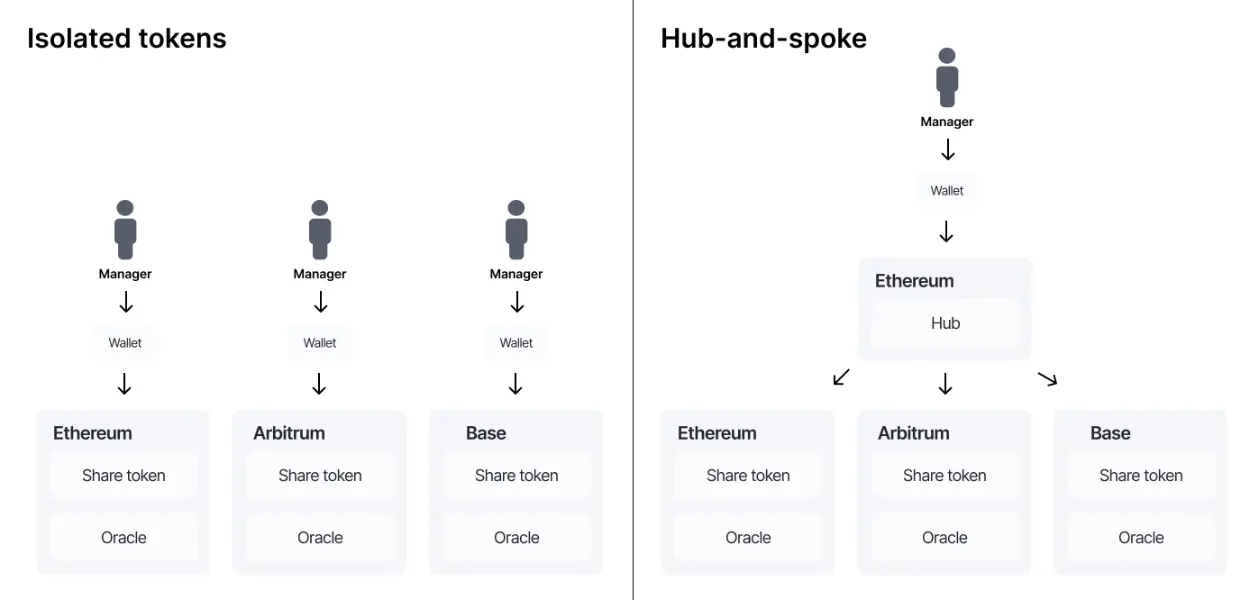
Centrifuge V3 addresses the challenges of multi-chain asset management through a hub-and-spoke architecture.
Each pool selects a Hub chain as its authoritative "real source" and control layer.
On this Hub chain, the pool's core state, vaults, and overall accounting records are managed uniformly.
Spoke chains are where token deployment and liquidity acquisition occur, such as Ethereum, Base, Arbitrum, and other supported networks.
Scalable Cross-Chain Interoperability
To achieve this, Centrifuge has built a powerful messaging system between Hub and Spoke chains, capable of handling large-scale cross-chain activities with minimal overhead while maintaining the highest security.
Multi-message Proof
To enhance the security of cross-chain communication, the protocol integrates multiple interoperability service providers.
Each message is accompanied by multiple independent proofs that can be verified by different providers.
This reduces the impact of a single interoperability provider's failure or attack on the system's security.
Automatic Batching of Messages
The protocol automatically batches multiple messages into a single payload and proof.
This reduces the total number of messages that need to be relayed, significantly lowering gas costs.
Batching is executed automatically by the protocol, requiring no additional configuration from pool deployers.
Automatic Gas Subsidies
The protocol provides an automatic gas subsidy mechanism for pool users:
Gas payments can be subsidized or reimbursed by pool managers.
Users do not need to hold native gas tokens on each Spoke chain.
Centrifuge will automatically relay gas tokens across chains to fund transactions.
These designs alleviate the burden on users to manage gas in multi-chain interactions, ensuring a seamless experience even when cross-chain operations involve vaults.
Built-in Retries and Repayments
Cross-chain message execution may fail for various reasons. To reduce operational burdens, the protocol implements:
Built-in repayment mechanisms: to replenish gas funds for messages with insufficient funds.
Automatic retry logic: to attempt failed messages again.
This ensures that cross-chain operations can be reliably executed without manual intervention from pool managers or end users.
b. Vaults
The Centrifuge protocol adopts a tokenized vault standard to implement investment and share token redemptions.
Vault Types
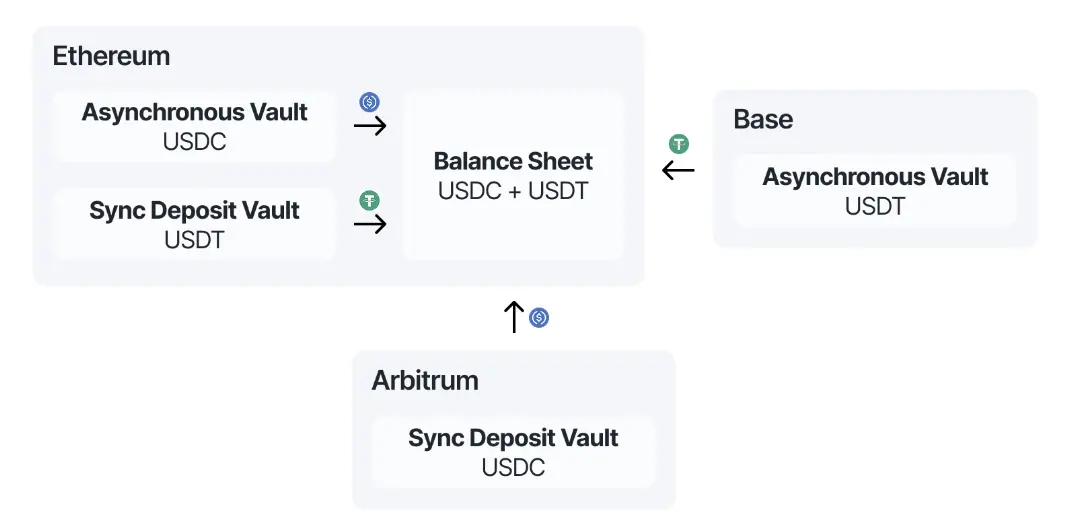
The protocol supports two types of vault models: asynchronous and synchronous.
1. Asynchronous Vaults
Fully request-based mode, following the ERC-7540 standard.
Deposit and redemption operations are completed through asynchronous processes.
All requests are managed and processed uniformly by the Centrifuge Hub.
2. Synchronous Deposit Vaults
Uses a hybrid model, combining ERC-4626 and ERC-7540.
Deposits: Executed instantly according to ERC-4626 behavior, allowing users to immediately receive share tokens.
Redemptions: Managed through Hub queuing and withdrawal requests according to the asynchronous process of ERC-7540.
3. Pooled Vaults
Supports multiple investment assets corresponding to a single share token through the ERC-7575 standard.
The liquidity of all vaults is aggregated into a single balance sheet, efficiently allocated to various assets by the protocol.
c. Modularity
The Centrifuge protocol is designed as a modular and extensible system to support complex financial products.
This architecture allows developers to access different components independently or in combination, enabling:
Permissioned tokenization
Cross-chain deployment
Custom pricing logic
Diverse collateral management
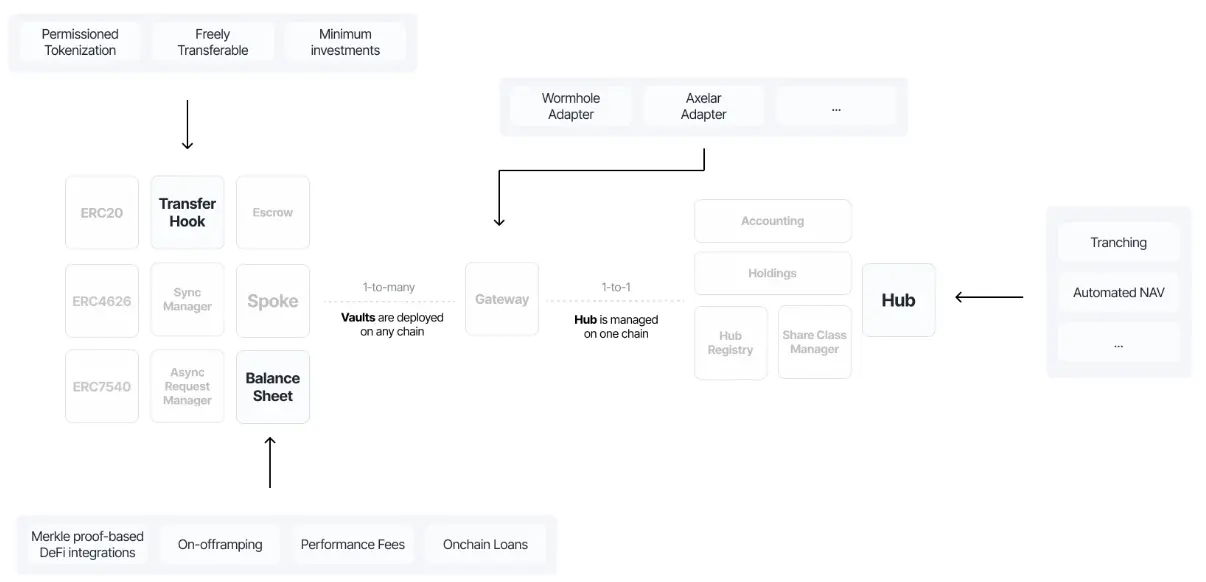
The following are the core smart contract components of the protocol and their extensibility points:
1. Transfer Hooks
Customizable restrictions and checks logic directly embedded in ERC20 token transfer logic.
Used as plug-and-play extensions for:
Permissioned tokenization: ensuring compliance and access control.
Freely circulating tokenization: for decentralized RWA (deRWA) token access to DeFi.
Minimum investment thresholds: limiting the minimum amount of investment.
Through the hook mechanism, regulatory and operational controls are achieved without modifying core token logic.
2. Hub Managers
The Hub is the core smart contract responsible for managing:
Net Asset Value (NAV) calculations
Investor share class logic
Fund-level operational mechanisms
Developers can define custom logic through Hub Managers, such as:
Automated NAV and token pricing
Tranche structures and waterfall distributions
Customized share class management
Request processing logic
This module provides fine-grained control over fund structures and investor dynamics, enabling fully customizable on-chain fund operations.
3. Balance Sheet Managers
Enables the protocol to support and manage any form of collateral:
Tokenized real-world assets (RWA)
Stablecoins
Native crypto tokens
Other DeFi protocol assets
Functions include:
On-chain/off-chain asset channels
Integration with DeFi protocols
Performance tracking and management fees
Integration with on-chain loans
This module positions Centrifuge as a bridge connecting traditional finance and DeFi, supporting various asset forms through modular asset management.
4. Adapters
The interoperability layer of the protocol connects Centrifuge pools to any blockchain, enabling cross-chain vault deployment and communication.
Supported adapters include:
Wormhole adapter
Axelar adapter
Adapters route cross-chain messages through Gateway contracts, maintaining a "one-to-many" relationship: a single Hub chain can simultaneously manage multiple vaults on different chains.
Tron’s Commentary
Centrifuge's advantage lies in its pioneering position in the tokenization of real-world assets (RWA), possessing a complete modular architecture (Transfer Hooks, Hub Managers, Balance Sheet Managers, Adapters), supporting various vault standards (ERC-4626, 7540, 7575), and achieving efficient asset management and liquidity expansion through Hub-and-Spoke cross-chain design, making it compatible with TradFi and DeFi while providing flexible infrastructure for institutions and developers.
Its disadvantage is that the ecosystem is still in its early development stage, with limited scale for real asset on-chain, high complexity in cross-chain communication and compliance execution, and a significant reliance on market education, liquidity cultivation, and deep cooperation with traditional financial institutions.
III. Industry Data Analysis
1. Overall Market Performance
1.1. Spot BTC vs ETH Price Trends
BTC
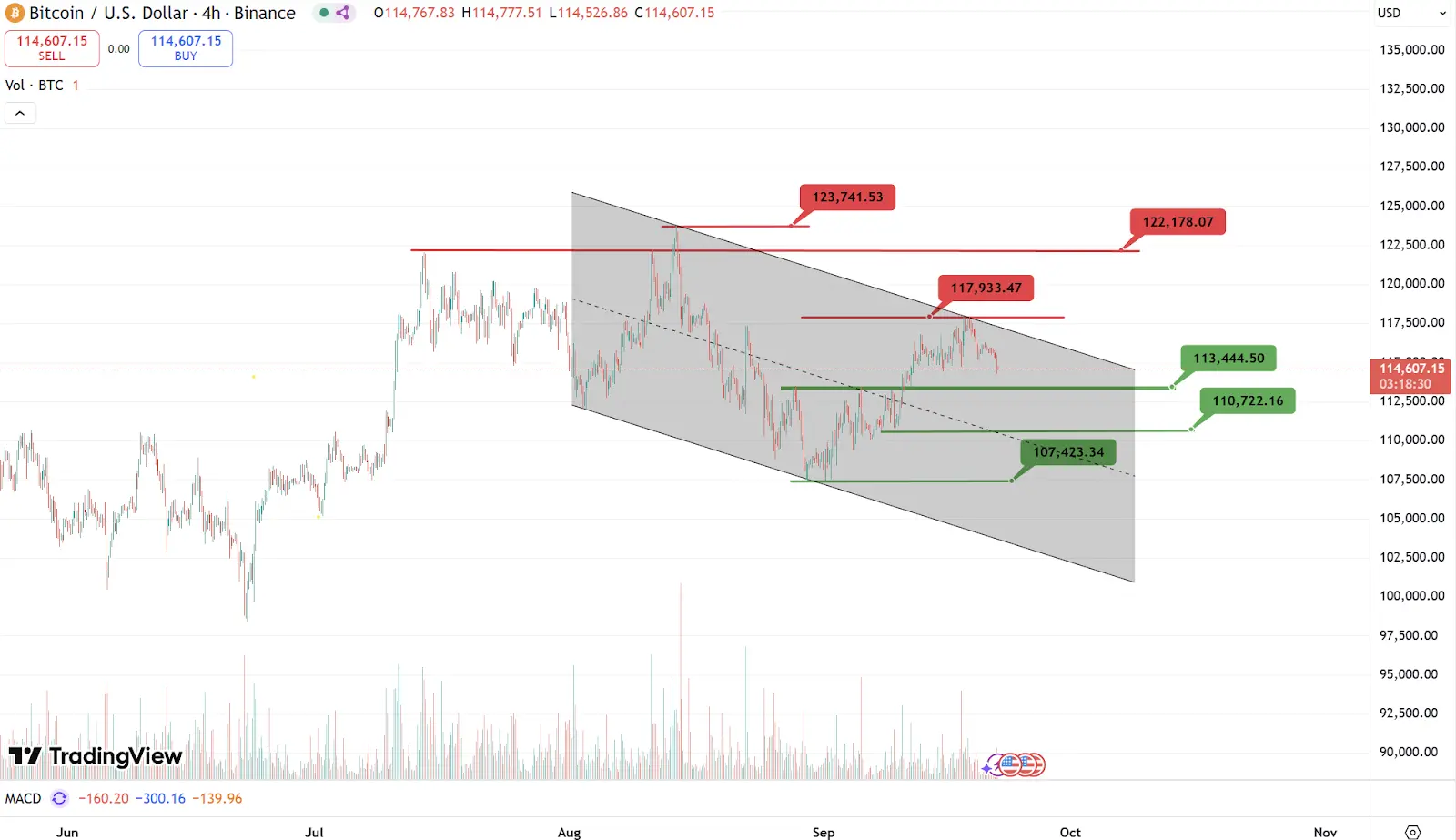
Analysis
Key resistance this week: $117,900, $122,100, $123,700
Key support this week: $113,400, $110,700, $107,400
ETH
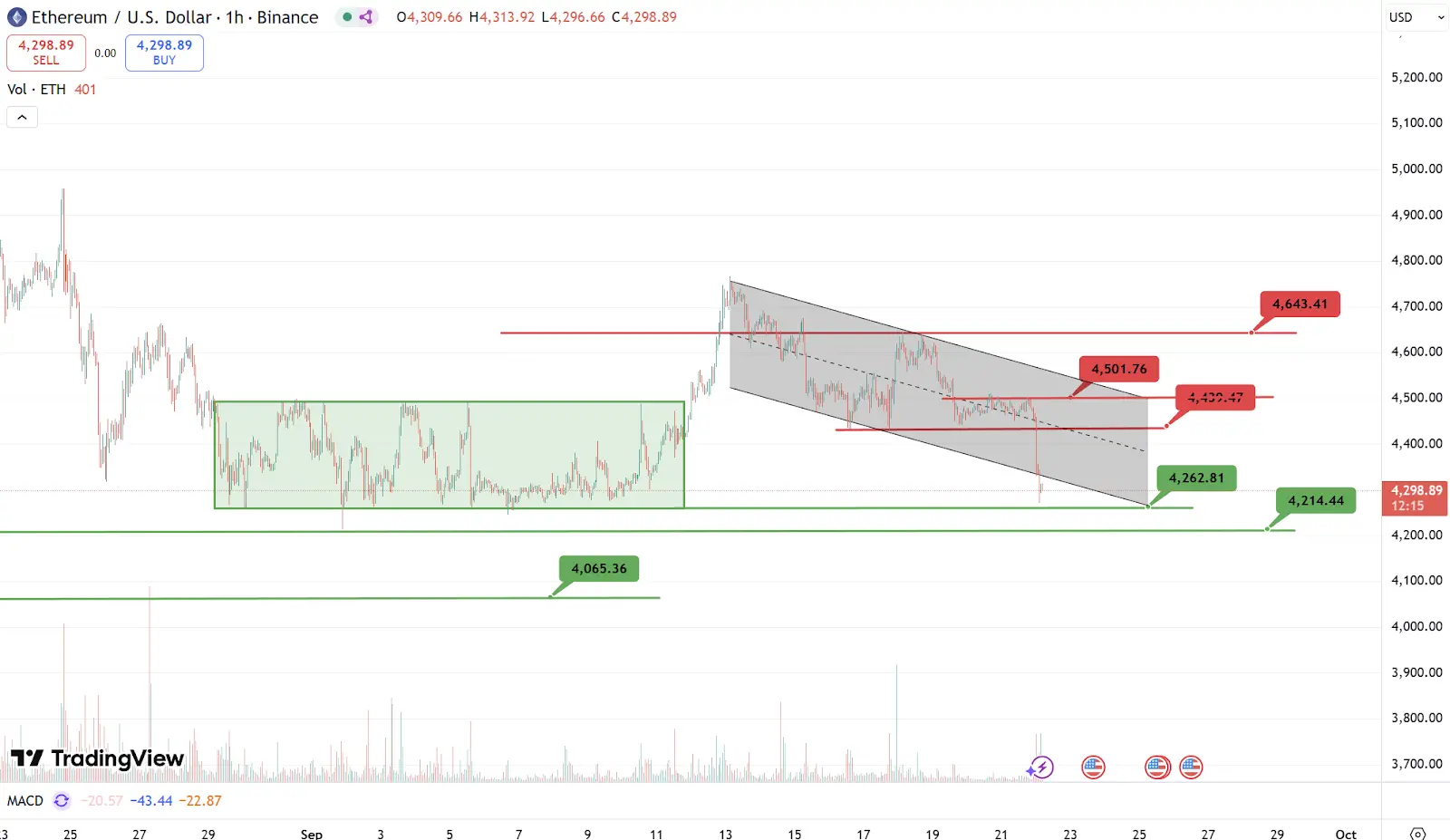
Analysis
Key resistance this week: $4,440, $4,500, $4,640
Key support this week: $4,260, $4,210, $4,060
2. Public Chain Data
2.1. BTC Layer 2 Summary
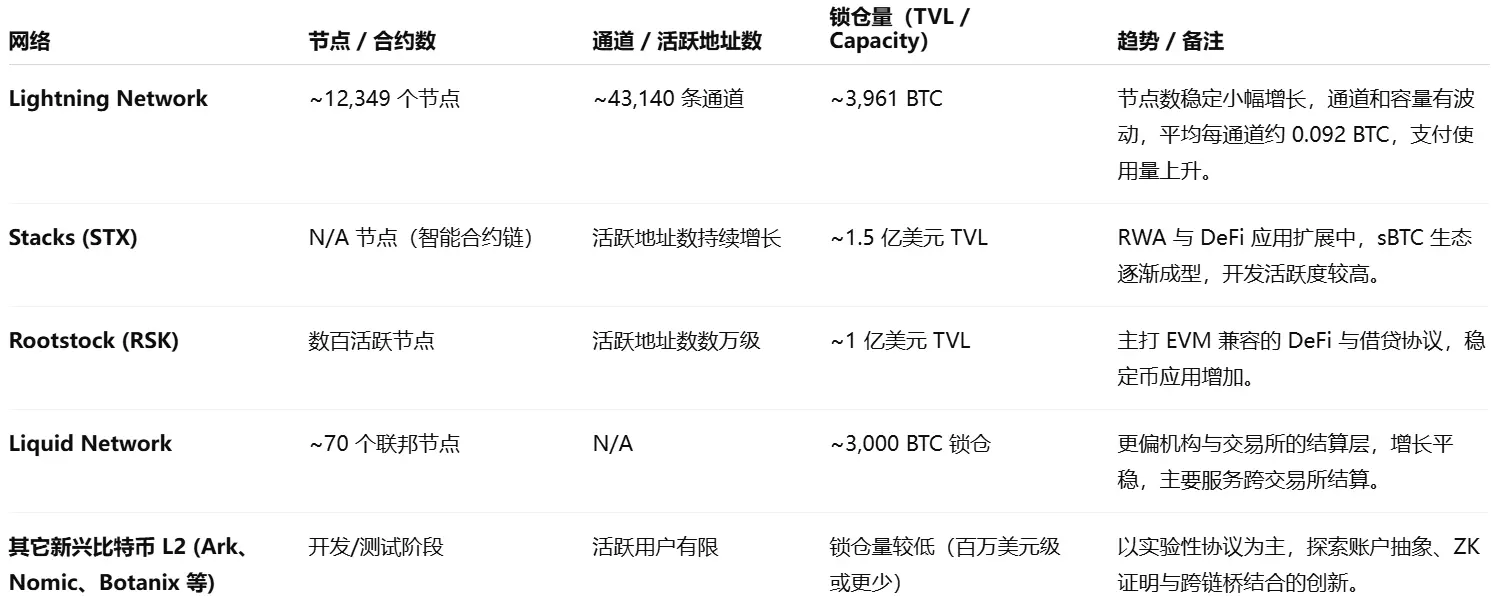
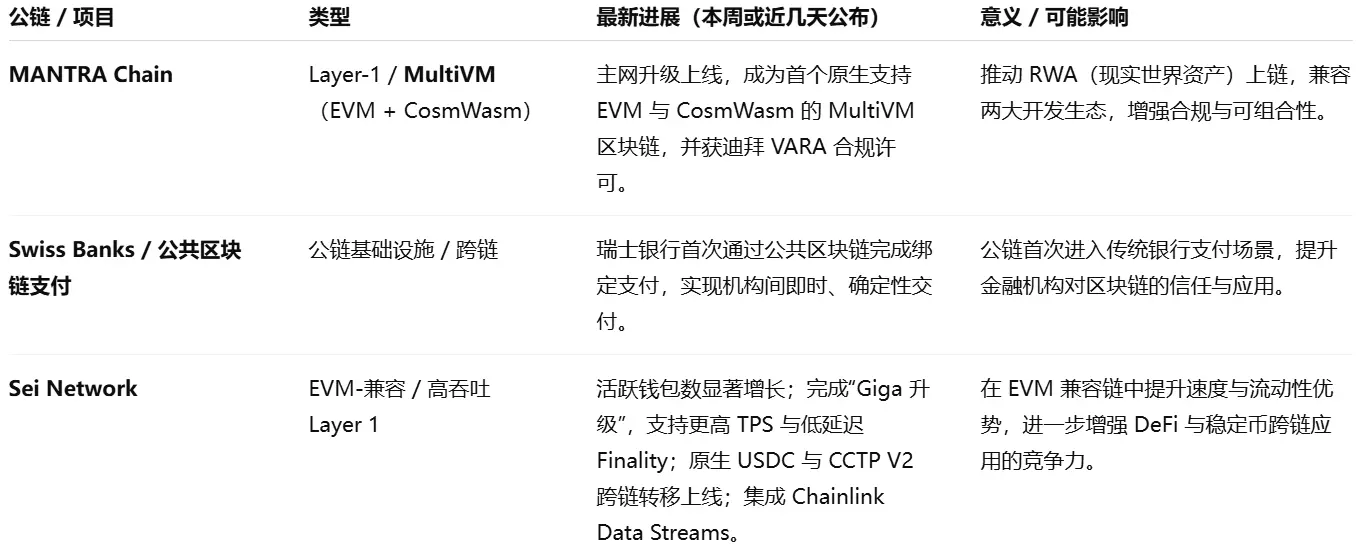
2.2. EVM & non-EVM Layer 1 Summary
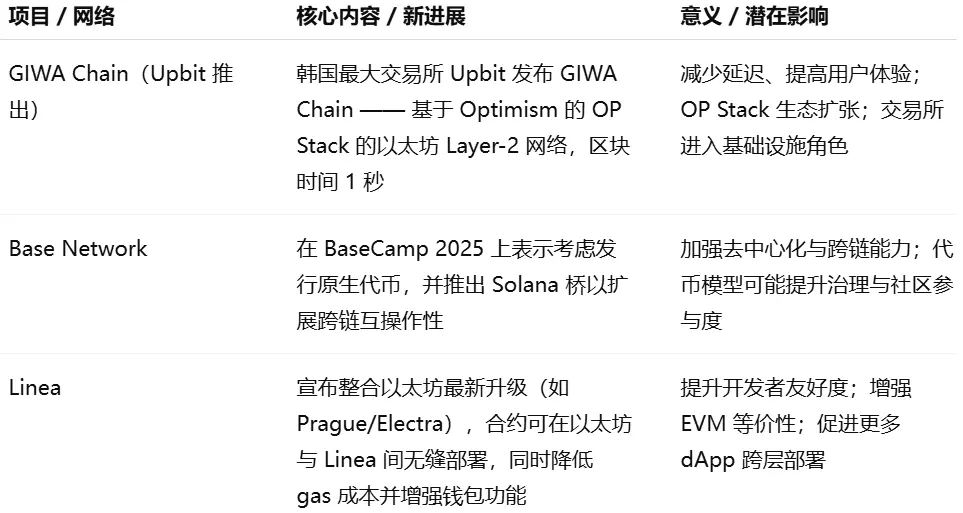
2.3. EVM Layer 2 Summary
IV. Macroeconomic Data Review and Key Data Release Points for Next Week
Last week, August retail sales recorded a month-on-month increase of 0.1%, far below the market expectation of 0.3%, indicating a slowdown in consumer momentum, reflecting that the high-interest-rate environment and weakening labor market have begun to suppress household spending. Meanwhile, the Federal Reserve lowered the upper limit of the federal funds rate to 4.25% on September 18, marking the first rate cut since December last year.
This week (September 22-26), important macroeconomic data points include:
September 24: U.S. EIA crude oil inventories for the week ending September 19
September 25: U.S. initial jobless claims for the week ending September 20
September 26: U.S. August core PCE price index year-on-year; U.S. September Michigan University consumer sentiment index final value
V. Regulatory Policies
United States
The SEC has approved a universal listing standard for cryptocurrency spot ETFs, eliminating the need for case-by-case approvals, which may accelerate the launch of more crypto asset ETFs and promote the integration of mainstream finance and crypto.
United Kingdom
The FCA has expedited the registration approval process for crypto companies, increasing efficiency by more than three times and granting exemptions for certain compliance obligations, seeking a balance between consumer protection and encouraging innovation.
India
The government has mandated that all exchanges, custodians, and intermediaries must undergo mandatory cybersecurity audits to enhance industry safety standards and user protection, but this also increases the operational burden on businesses.
Bahrain
New regulations related to stablecoins and Bitcoin have been introduced, providing a clear legal framework for crypto activities, consolidating its position as a digital financial hub in the Middle East and attracting businesses to establish operations.
 Risk warning Risk warning


Popular articles