Morning Report | Cryptocurrency market stabilizes and rebounds; last week, global listed companies net bought $40.88 million in BTC

 Overview of Important Market Events on September 29
Organized by: Zhou, ChainCatcher
Important News:
- The open interest of options linked to BlackRock's IBIT surpasses Deribit, now approaching $38 billion
- Williams: Weak labor market prompts my support for rate cuts, with the estimated real neutral rate at 0.75%
- Data: Last week, global listed companies net bought $40.88 million in BTC, with Strategy increasing its holdings by 196 bitcoins, while Metaplanet did not purchase any bitcoins last week
- The total market value of stablecoins on the Solana chain reaches $13.8 billion, setting a new historical high
- Data: Aster's fees exceeded $25 million in the past 24 hours, ranking first among perpetual DEXs
- QCP: The crypto market stabilizes and rebounds, BTC needs to break $115K to confirm upward movement
What important events happened in the past 24 hours?
Data: BTC total network contract positions increased by 6.41% in 24h
According to ChainCatcher, data from Coinglass shows that the total contract positions for BTC across the network increased by 6.41% in the past 24 hours, with the current total position at $82.903 billion. Among them, Binance's position is $14.382 billion, OKX's position is $4.286 billion, and Bybit's position is $9.833 billion.
According to ChainCatcher, Williams from the Federal Reserve stated on Monday that initial signs of weakness in the labor market prompted him to support rate cuts at the recent Federal Reserve meeting. He believes "it makes sense to slightly lower rates" and that "moderately easing some tightening measures" will help boost the job market and exert some downward pressure on still high inflation levels. Additionally, his model estimates the real neutral rate at 0.75%, but he emphasized that policy is data-driven.
According to ChainCatcher, the open interest value of options linked to BlackRock's iShares Bitcoin Trust (IBIT), listed on Nasdaq, has approached $38 billion, surpassing Deribit's open interest value of $32 billion. This means that IBIT has surpassed Coinbase's Deribit platform in terms of the largest trading volume of Bitcoin options.
Deribit, established in 2016, has dominated the Bitcoin options market for years, while IBIT options opened last November and have been listed for less than a year.
According to ChainCatcher, the newly developed contract exchange Flying Tulip by Andre Cronje has raised $200 million at a $1 billion valuation, with participation from Brevan Howard Digital, CoinFund, DWF Labs, FalconX, Hypersphere, Lemniscap, Nascent, Republic Digital, Selini, Sigil Fund, Susquehanna Crypto, Tioga Capital, and Virtuals Protocol. It is reported that Flying Tulip is currently planning to publicly issue its FT token.
Citibank introduces blockchain technology into cross-border payment services
According to ChainCatcher, Citibank announced that it will integrate its blockchain platform Citi Token Services with the US dollar clearing system to provide real-time cross-border payment services for institutional clients in the US and UK, available 24/7.
According to ChainCatcher, crypto journalist Eleanor Terrett posted on platform X that the SEC has requested LTC, XRP, SOL, ADA, and DOGE ETF issuers to withdraw 19 b-4 applications, as the new general listing standards have been approved, replacing the 19 b-4 applications. The withdrawal of applications may begin as early as this week.
Data: Ethereum network gas fees rise to 15 gwei
According to ChainCatcher, possibly influenced by the "Falcon Finance airdrop event," Ethereum network gas fees have risen to 15 gwei.
According to ChainCatcher, based on SoSoValue data, as of September 29, 2025, Eastern Time, last week, global listed companies (excluding mining companies) had a total net purchase of $40.88 million in Bitcoin.
Strategy (formerly MicroStrategy) invested $22.1 million last week, increasing its holdings by 196 bitcoins at a price of $113,048, bringing its total holdings to 640,031 bitcoins.
The Japanese listed company Metaplanet paused its Bitcoin purchases last week.
Additionally, three other companies made new Bitcoin purchases last week.
Mitsubishi UFJ: If the non-farm payroll report is weak, the dollar may further decline
According to ChainCatcher, Mitsubishi UFJ analyst Lee Hardman pointed out in a report that if the US non-farm payroll report released on Friday shows continued weakness in job growth for September, the dollar may further decline. He stated that another poor non-farm payroll data would support market expectations for the Federal Reserve to cut rates again in October.
According to ChainCatcher, Federal Reserve Governor Waller stated that stablecoins should be included in regulatory protection and increase payment options.
According to ChainCatcher, SolanaFloor posted on platform X that the total market value of stablecoins on the Solana chain has increased to $13.8 billion, setting a new historical high.
QCP: The crypto market stabilizes and rebounds, BTC needs to break $115K to confirm upward movement
According to ChainCatcher, QCP's briefing indicates that the crypto market has begun to stabilize after a significant pullback last week, with Bitcoin and Ethereum rebounding to levels of $112,000 and $4,100, respectively. Despite large-scale redemptions of ETFs, the market has shown strong resilience.
Optimism in the perpetual contract market has reignited, with leveraged long positions returning to the market, and the open interest of perpetual contracts has risen from $42.8 billion to $43.6 billion, with BTC perpetual contract funding rates remaining positive. Analysts point out that while market conditions support the upcoming "Uptober" trend, Bitcoin still needs to break $115,000 to confirm a new upward trend. The options market shows that traders are gradually rebuilding confidence, with bearish skew returning to normal levels.
Data: Short-term Bitcoin holders are experiencing losses, and the market may enter a reset phase
According to ChainCatcher, Glassnode released data on social media indicating that the NUPL (Net Unrealized Profit and Loss) metric for short-term Bitcoin holders has entered the loss zone, suggesting that recent buyers are under pressure. Historically, surrender events among short-term holders often mark the market's entry into a reset phase, typically laying the groundwork for a new round of asset accumulation.
According to ChainCatcher, Matrixport released a chart today stating, "Our Greed and Fear Index is close to a range low. Historically, this level often corresponds to a tradable bottom. Ideally, moving averages should trend upward steadily, indicating a smoother and more manageable rebound. However, the current market shows that Bitcoin's movements are more technical. The current price hovers at the lower end of the range, providing some tactical basis for long positions, but traders still need to pay attention to Bitcoin's retest of key long-term moving averages."
Data: Aster's fees exceeded $25 million in the past 24 hours, ranking first among perpetual DEXs
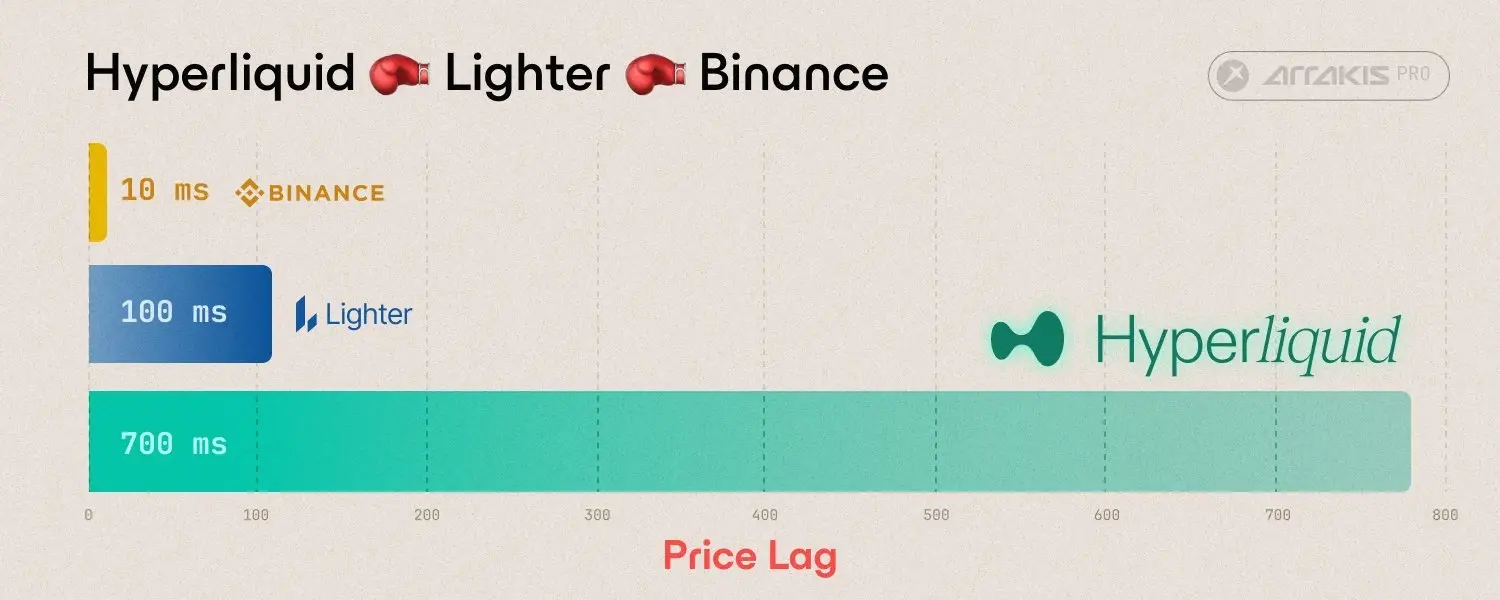
According to ChainCatcher, as reported by The Block, the decentralized perpetual contract exchange Aster currently ranks first in fee revenue on DefiLlama, surpassing Hyperliquid and other perpetual decentralized exchanges (DEXs).
According to DefiLlama's data, Aster recorded over $25 million in fee revenue in the past 24 hours, leading other protocols. Its competitor Hyperliquid generated $3.17 million in fees in the past day, ranking fifth. The data also shows that Aster's spot trading volume in the past day was $199.96 million, ranking 13th among decentralized perpetual contract exchanges. In terms of trading volume, Hyperliquid surpassed Aster with $477.3 million. Aster also did not appear on the daily revenue leaderboard of the data aggregation platform.
According to ChainCatcher, Binance co-founder Zhao Changpeng expressed his insights on the one-year anniversary of his release on platform X, stating, "A year ago, I was released and finally left the US. A year later, I see the American people choosing a president who supports cryptocurrency, influencing policies around the world, seeing BNB reach its historical peak, seeing BTC reach its historical high, seeing ETH reach its historical high, witnessing the return of utility tokens, and seeing an increase in on-chain trading volume."
According to ChainCatcher, Aster CEO Leonard stated in an interview with Mable (@Mable_Jiang), the founder of the social protocol Trends:
"I initially worked as a technician at an investment bank in Hong Kong, mainly dealing with high-frequency trading. After five years, I started trying to start my own business. The narrative at that time was 'Internet+', and my first startup was a P2P lending project. Later, the project failed along with the entire sector, but I learned a lot from it.
I first entered the crypto space by participating in the Ethereum ICO. After making money, I thought I was a genius, but then I lost everything in the next three trades. However, I became interested in blockchain technology and developed a lending platform project under IBM Blockchain's Hyperledger ecosystem. Clearly, we chose the wrong ecosystem and should have made our mark on Ethereum. After that, I also worked on NFT and token solutions for a gaming platform, but it was too ahead of its time and also ended in failure."
Data: Last week, cryptocurrency exchanges saw an outflow of 7,865.74 bitcoins
According to ChainCatcher, in the past week, major cryptocurrency exchanges saw a total outflow of 7,865.74 bitcoins, with Coinbase Pro seeing an outflow of 8,928.34 bitcoins, Binance seeing an outflow of 5,298.6 bitcoins, and Bitfinex seeing an inflow of 5,346.46 bitcoins.
Meme Popularity Rankings
According to the meme token tracking and analysis platform GMGN, as of September 30, 08:45,
The top five popular tokens on ETH in the past 24 hours are: sUSDe, FF, APEX, USDe, LINK

The top five popular tokens on Solana in the past 24 hours are: MetaMask, FF, ASTER, ASTER, FF

The top five popular tokens on Base in the past 24 hours are: EURC, wstETH, HOPELESS, Polyfactual, ZORA

What are some interesting articles to read in the past 24 hours?
Understanding Canton Network: A public blockchain with institutional-level privacy and compliance
Canton was born at the turning point of institutional on-chain and RWA tokenization acceleration. The complete openness and decentralization of public chains long misaligned with the privacy, compliance, and governance needs of financial institutions. Canton achieves selective transparency at the sub-transaction level and rights-obligations workflows through "public permissioned + Daml," combined with the "network of networks" architecture of Participant/CSP/vCSP, retaining real-time settlement and atomic composability while making it easier to reduce capital occupation under Basel standards, allowing institutions to protect privacy while complying with regulations.
Notably, Canton Network's developer Digital Asset announced in June the completion of a $135 million strategic financing round, led by DRW Venture Capital and Tradeweb Markets, with participation from well-known companies in traditional finance and crypto, including BNP Paribas, Circle Ventures, Citadel Securities, DTCC, Virtu Financial, and Paxos; currently, the tokenized assets on Canton exceed $60 trillion, larger than the GDP of most countries. The network also processes over $280 billion in US Treasury repurchase transactions daily. Additionally, its token, Canton Coin, has no VC/foundation reserves, is fully distributed based on contributions, and incentivizes early super validators through a balanced mechanism of fee destruction + reward minting.
Powell is about to step down; who will be the next "money printer"?
In May 2026, Federal Reserve Chairman Powell's term will officially end. However, the Trump administration's layout has already begun—Trump and Treasury Secretary Basant are trying to gain substantial control over monetary policy by mastering key voting rights on the Federal Reserve Board (FRB) before the first half of 2026. Currently, the Trump camp has secured three seats by replacing Adriana Kugler with Stephen Miran, and Governor Lisa Cook is under pressure to resign due to allegations of mortgage fraud, just one seat away from controlling the majority of the seven-member board.
From the proposal of the "shadow chairman" concept to the quiet layout of board seats, this power struggle over control of the Federal Reserve is reshaping the future landscape of cryptocurrency. According to the two prediction platforms Polymarket and Kalshi, multiple candidates open to cryptocurrency are competing for this key position, and market expectations for the next Federal Reserve chair have shown significant divergence: Kevin Hassett, Kevin Warsh, and Christopher Waller are the top three candidates, with odds significantly ahead; other candidates like Bowman and Basant have odds ≤1%; notably, Musk also appears on Polymarket's odds list, currently ranked last.
Circle President Heath Tarbert recently told the Financial Times that the company is exploring mechanisms to roll back transactions in cases of fraud and hacking while still maintaining settlement finality. He stated, "We are thinking… about whether it is possible to have transaction reversibility, but at the same time, we also want to maintain settlement finality."
In simple terms, if you are scammed or hacked, theoretically, you could get your money back.
This reversible transaction mechanism will not be directly implemented on the Arc blockchain that Circle is developing but will be achieved by adding a "reverse payment" layer on top, similar to how credit card refunds work. Arc is an enterprise-grade blockchain designed by Circle for financial institutions, expected to be fully launched by the end of 2025.
Animoca Brands Research Report: The New Era of Exchanges, How to Go Mainstream?
Centralized exchanges (CEX) have played a key role in the development of the crypto industry. They provide the core infrastructure for trading and discovering cryptocurrencies, serving as the foundation of the entire crypto space. As the earliest participants with clear business models, CEXs have rapidly evolved into large institutions, employing hundreds of employees. Their efforts to expand user bases have greatly promoted the popularization of cryptocurrencies among the public.
The form of crypto exchanges has undergone multiple stages of evolution. Initially, it was merely an electronic upgrade of over-the-counter (OTC) trading. With the boom of Web3 projects and altcoins, exchanges seized the surge in trading demand and transformed into professional-grade platforms. They then added features such as lending and hedging to meet the needs of professional traders.
However, the growth of CEXs now faces challenges and opportunities. On one hand, the native crypto user base is nearing saturation, leading to a slowdown in user acquisition in recent years. At the same time, innovations in decentralized trading are diverting users, such as meme coin issuance platforms and advanced DEXs like Hyperliquid, which offer experiences close to CEXs but with greater transparency. This forces exchanges to integrate self-custody wallets and DEX trading to retain native users.
 Risk warning
 Risk warning