TACO? Uptober? The epic price drop on 10.11 is back, where's my money?

📩 Written by: 4E Labs |@4E_Global
TL;DR
In the early hours of October 11, Beijing time, Trump suddenly announced a 100% tariff on Chinese goods, triggering the largest liquidation in crypto market history --- --- $19.3 billion evaporated, with 1.6 million traders liquidated. BTC plummeted from $125,000 to $102,000, ETH crashed to $3,500, and altcoins were halved. The core reason was the decoupling of staked assets like USDe, WBETH, and bnSOL, combined with a Binance system failure and liquidity vacuum, creating a death spiral. 48 hours later, the market saw a V-shaped rebound, with BTC returning to $115,000 and ETH surpassing $4,100 --- --- but for the retail investors who had been liquidated, while the prices recovered, their money did not. This is the harsh reality of the crypto market: leverage is a double-edged sword, and systemic risk is always present.
#TrumpTariffs #CryptoCrash #usde #wbeth #bnsol
1. "TACO"? Trump's Tariff Trick is Back
The trigger for this crash was a Truth Social post by Trump. At 4:50 AM Beijing time on October 11, just before the U.S. stock market closed and on the eve of the weekend with the lowest liquidity, Trump suddenly announced: Starting November 1, a 100% additional tariff will be imposed on Chinese goods, along with key software export controls.
Panic selling began, leading to the largest liquidation in crypto market history. After the crypto market crash on October 11, at 00:43 AM Beijing time on October 13, Donald J Trump posted again: "Don't worry about China!" (Of course, this may also be based on the easing of statements from the Chinese Foreign Ministry, so it is necessary and crucial for investors to observe China's subsequent attitude.)
This is not the first time Trump has played this trick. The crypto community has named this tactic: "TACO" strategy --- --- Trump Always Chickens Out, as Trump's tariff threats are always "loud but little action," and the 125% tariff in April was also resolved through negotiations.
Both of Trump's actions occurred after the U.S. stock market closed on Friday and before it opened on Monday. Therefore, as a 24/7 trading market, the crypto market directly bore the brunt. The reason is that the market fears that Trump's tariffs will trigger another tariff war with China, leading to continued inflation in the U.S., and the Federal Reserve will reassess interest rate cuts.
2. October 11 Crash: Epic Liquidation Hits
Crash Timeline (Beijing Time)
- October 11, 4:50 AM: Trump posts the first threatening tweet, and the market begins to decline.
- 5:20 AM: BTC falls below $120,000, altcoins start to plummet, and leveraged long positions begin to be liquidated.
- 5:43 AM: USDe decouples to $0.65 on Binance, triggering a chain liquidation.
- 5:20--5:56 AM: In 36 minutes, the market experiences the most intense selling and liquidation. WBETH crashes from $3,800 to $430, and bnSOL drops from $200 to $34.90. For investors in the Asian time zone, this was the most brutal "wake-up liquidation" moment.
- October 13, 00:43 AM: Donald J Trump posts again: "Don't worry about China!" indicating that the tariff war may ease, and market prices rebound.

Liquidation Data is Shocking
- Total Liquidation Amount: $19.3 billion
- Affected Traders: 1.6 million
- Long Liquidation: $16.8 billion (88%)
- BTC Liquidation: $5.34 billion
- ETH Liquidation: $4.39 billion
- Hyperliquid Losses: $1.23 billion, with over 1,000 wallets completely wiped out, and 205 accounts losing over $1 million each.
This is the largest single-day liquidation event in crypto history, 12 times larger than the FTX collapse.
3. System Level: The "Doomsday Loop" of Liquidation
wBETH (which should have been nearly equivalent to ETH, around $3,800) plummeted to $430 --- --- an 89% discount. This was not due to the devaluation of staked ETH, but because of a lack of buyers on the spot order book.
This is the dividing line between traditional financial theory and crypto reality. Traditional markets have circuit breakers, last market makers, and coordinated halts; while the crypto market only has algorithms blindly executing rules.
The cycle process is as follows:
The following will roughly analyze the more specific contributing factors to this crash: the circular lending + decoupling of staked assets + system failure on the Binance platform.
The Circular Lending Trap of USDe
USDe is a synthetic stablecoin launched by Ethena, with a market cap of about $4.7 billion. Many users use it for circular lending to earn a 12% yield:
- Use $100,000 worth of WBETH/bnSOL as collateral to borrow USDT.
- Use USDT to buy USDe, enjoying a 12% annualized return.
- Continue to use USDe as collateral to borrow more USDT.
- Repeat the process to maximize returns.
However, when the prices of ETH and SOL plummeted, users panic-sold USDe to exchange for USDT to repay their debts. The USDe/USDT trading pair lacked depth, causing USDe to drop from $0.9999 all the way down to $0.68, triggering more liquidations.
The Oracle Disaster of WBETH/bnSOL
Key Issue: The marked prices of WBETH and bnSOL rely on a single internal spot order book on Binance, rather than multi-source oracles or redemption values. In a liquidity vacuum, thin order books are easily manipulated.
⬇️ Algorithmic Flaws in WBETH/BNSOL Marked Prices
- BNSOL marked price = 30% BNSOL/USDT order book price + 70% (BNSOL/SOL exchange rate × SOL price)
- WBETH marked price = 20% WBETH/USDT order book price + 80% (WBETH/ETH exchange rate × ETH price)
(Reference calculation: https://x.com/0x_Todd/status/1977004670590894144)
In a liquidity vacuum, these order book depths are extremely shallow (only about 2,000 ETH/SOL daily), making them easy to manipulate. When a large amount of liquidation surged in, WBETH was smashed down to $430 (with a marked price of $711 at its lowest), and bnSOL was smashed down to $34.90 (with a marked price of $48 at its lowest), triggering more forced liquidations.
Actual Decoupling Data:

This is a typical "oracle disaster" --- --- a $60M sell-off triggered a $19.3B value evaporation, magnifying the impact by about 230 times due to marked price flaws. Binance promised to adjust the marked price algorithm for WBETH and bnSOL to 100% anchor to ETH and SOL prices on October 14.
Binance System Outage: Adding Insult to Injury
During the most critical 30 minutes, users reported the following issues on Binance:
- Unable to place orders, transfer failures lasting about 20 minutes
- Stop-loss orders collectively failed
- Financial products could not be redeemed in time (queue delays of 1 hour)
- API trading and lending modules delayed
Binance co-founder He Yi acknowledged the issues and announced a $280 million compensation plan, the largest compensation in Binance's history.
However, many retail investors questioned: Why does it always crash at critical moments? Why does liquidity suddenly disappear? How can a large-cap coin like DOGE drop 60% in an instant?
4. October 13 Rebound: Recovery, But What About Retail Investors?
Market Quickly Recovers
On October 12, signs of de-escalation appeared: China did not immediately retaliate, Vice President Vance hinted at possible dialogue, and Trump tweeted: "Don't worry about China, everything will be fine!"
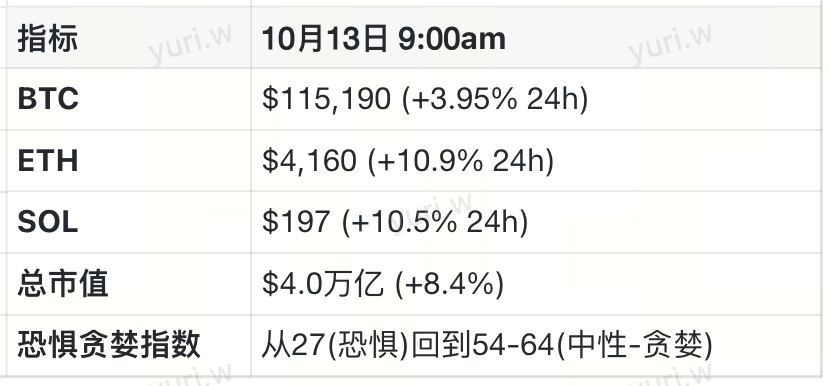
ETH led the rebound, possibly benefiting from 30% of the supply being staked and locked. Altcoins like Bittensor (+28%) and Cronos (+11%) also rebounded strongly.
Capital Flow: BTC ETF saw a net inflow of $197-$441 million from October 12-13, with institutional investors taking advantage of the dip to accumulate.
Where Did Retail Investors' Money Go?
"The price is back, but where's my money?" ------The harsh truth is: liquidated positions will never come back.
Assuming you have $100,000 in WBETH, borrowing $78,000 at a 78% collateralization rate:
- When WBETH drops to $85,714, you will be liquidated (91% collateralization rate).
- After deducting the loan of $78,000 and a 2% liquidation fee of $1,560,
- You can only get back $6,154.
Assuming that during the few seconds of liquidation execution, the collateral continues to drop to $80,000 or even lower, the protocol may sell at a price lower than $85,714, and after repaying the loan and fees, your remaining amount may approach zero;
(Calculation source: https://x.com/Phyrex_Ni/status/1977187660814074296)
The circular explosion effect: a 15% drop → liquidation selling → amplified depth difference → 80% crash → more liquidations, with users' borrowing rates dropping from 78% all the way below 20%.
Who Profited from This Crisis? Who Was Really Hurt?
Not everyone lost money. Some data shows:
- A mysterious whale: Shorted $752 million in BTC and $353 million in ETH on Hyperliquid before the crash, profiting $190-$200 million.
- Arbitrageurs: Bought low when USDe, WBETH, and bnSOL decoupled, selling high on-chain.
The injured retail investors:
- Highly leveraged retail investors: Completely wiped out, losing everything.
- Circular lending players: The decoupling of USDe caused them to be liquidated instantly.
- Asian users liquidated while sleeping: Woke up to find everything was already set in stone.
In contrast, spot holders experienced panic but had their assets intact and are now profitable.
5. Technical Lessons and Risk Warnings
1. Circular Lending Risks
The circular lending model of USDe, WBETH, and bnSOL
Although USDe peaked at about $4.7B in issuance on Binance, accounting for less than 2% of Binance's total assets, the concentration is extremely high (mainly in high-leverage positions and staking pools), and circular amplification leads to single-point vulnerabilities.
The broader issue is that any circular lending in a CEX environment carries similar risks, as liquidation selling directly impacts market prices rather than orderly redemptions.
Leverage is the devil
This liquidation once again proves that using high leverage in the crypto market is gambling. A 78% collateralization rate sounds safe, but in extreme market conditions, a 15% drop can lead to liquidation.
Recommended Strategies:
- Never exceed a 50% collateralization rate.
- Spot trading is king; use leverage cautiously.
- Leave enough margin; do not go all-in.
2. Exchange System Risks
Exposed Issues:
- API/order book instability under extreme pressure.
- Market makers forced to withdraw liquidity.
- Lack of alternative routing and fault tolerance mechanisms.
- Single exchange internal order book as the pricing source.
In contrast: DeFi protocols (like Hyperliquid) perform robustly under the same pressure
- Use multi-source oracles.
- Transparent on-chain liquidation mechanisms.
- Automation without human intervention.
3. Political Risks and Timing
The perfect storm of weekend + Asian time zone + U.S. stock market closure:
- The worst moment for liquidity.
- Most users asleep.
- Extremely short response time window (36 minutes avalanche).
Limitations of the TACO strategy:
- Relies on political interpretation, which is highly subjective.
- If Trump truly implements hardline policies, the market may decline again.
- Cannot be used for risk control, only as a reference for sentiment judgment.
4. Uptober? Or Cracktober?
Uptober (October rise) is a slang term in the crypto community, referring to October's typically strong performance:
- Historical average increase: 20-22%
- Success rate: 80-90% (10 positive returns in the past 12 years)
October was supposed to be "Uptober," but it turned into the largest liquidation month in history. This serves as a reminder: the crypto market has no certainty, only probabilities and risk management.
Independent crypto researcher @0xNing0x adjusted strategies in his review, abandoning the bet on BTC breaking $130,000 in Q4, and turning to privacy sectors and structural opportunities. He said: "Learn from the past without regret, know that the future can be pursued." This may be the best attitude.
6. Conclusion
The October 11 crypto market crash was the result of a combination of technical system failures and political catalysts, rather than simple market panic or fundamental breakdowns. Key elements include:
- Trigger: Trump's 100% tariff threat as an external catalyst.
- Amplification: USDe circular lending, WBETH/BNSOL marked price flaws, and unified account high leverage.
- Cascade: Exchange system pressure, market maker liquidity withdrawal, and chain liquidations.
A silver lining:
- Binance initiated a $283 million compensation within 24 hours.
- On October 14, marked price algorithm improvements were implemented (100% anchored to underlying assets).
- DeFi protocols withstood stress tests, demonstrating resilience.
- BTC quickly recovered after only a 15% drop, maintaining a healthy bull market structure.
Ongoing Risks:
- If the trade war escalates, it could trigger a deeper correction.
- If similar technical vulnerabilities are not thoroughly fixed, future collapses could be larger.
- The high-leverage culture may be temporarily hurt, but "once the scars heal, the pain is forgotten."
The price has returned, but your money may not. This is the harsh truth of leverage and systemic risk.
Please be sure to manage risks!
 Risk warning Risk warning



Popular articles