Vitalik supports, why Brevis's zkVM breakthrough excites Ethereum so much?

 Helping Ethereum upgrade from "bicycle" to "car"?
Author: momo, ChainCatcher
Vitalik Buterin expressed his support for Brevis. He stated on the X platform: "I am glad to see Brevis's Pico Prism officially entering the ZK-EVM verification field, marking an important step forward in ZK-EVM verification speed and diversity." The official account of the Ethereum Foundation also retweeted and endorsed this.
What breakthroughs has Brevis's Pico Prism achieved? Why are Vitalik and Ethereum so excited?
What breakthroughs has Pico Prism achieved?
Brevis is a company focused on zero-knowledge proof (ZK) infrastructure, announcing the completion of a $7.5 million seed round financing in November 2024, led by YZi Labs and Polychain, with participation from IOSG Ventures, Nomad Capital, Bankless Ventures, and HashKey Capital.
Brevis recently released Pico Prism, which is the distributed multi-GPU version of its open-source zkVM (zero-knowledge virtual machine) Pico. According to Brevis, this is the most advanced zkVM for real-time proof on Ethereum, and the various performance metrics achieved mark an important step toward 100x scalability for Ethereum.
Specifically, it achieves the following breakthroughs:
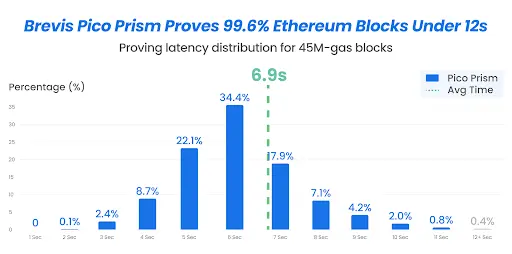
Ultra-high verification coverage: Pico Prism can efficiently verify Ethereum mainnet blocks, with 99.6% of blocks generating proofs within 12 seconds, and 96.8% of blocks completing "real-time" proofs within 10 seconds (close to Ethereum's block production speed). For example, a block with 45M gas takes an average of 6.9 seconds to verify, while a block with 36M gas only takes 6 seconds. This means the verification speed is almost synchronized with Ethereum's block production speed (about 12 seconds/block).
More cost-effective and efficient hardware: Pico Prism can run on 64 consumer-grade RTX 5090 GPUs (total cost about $128,000), which is half the hardware cost compared to other solutions (like SP1 requiring 160 RTX 4090 GPUs at a cost of $256,000), while achieving 3.4 times the performance. This lowers the verification cost, allowing ordinary people to participate.
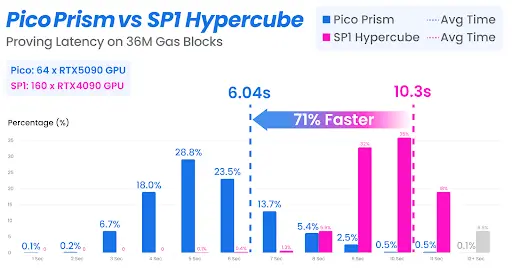
Architectural innovation and flexible scalability: Pico Prism employs a "glue-and-coprocessor" design, making the system modular and highly scalable, allowing for flexible adjustments to the verification process based on demand. It breaks down the complex proof process into smaller tasks (such as simulation and recursion) that are executed in parallel by multiple machines and GPUs, balancing speed and stability. The code is fully open-source, allowing anyone to test and reproduce the results.
What does this mean for Ethereum?
The breakthroughs of Pico Prism offer the potential for the Ethereum network to solve a significant problem: currently, each node must repeatedly compute all transactions, leading to slow network speeds. With zero-knowledge proofs, only one node needs to generate the proof, while other nodes can verify it in milliseconds, greatly enhancing efficiency.
Crypto KOL Blue Fox (@lanhubiji) likened Pico Prism to installing an accelerator for Ethereum L1, meaning Ethereum L1 will become faster, cheaper, and more efficient, capable of handling more complex implementations without sacrificing decentralization and security. If previous Ethereum was like an old-fashioned bicycle, with Brevis's Pico Prism technology, Ethereum has upgraded to a car.
Blue Fox stated that this acceleration effect could unlock more scenarios, such as real-time AI-driven DeFi lending, on-chain gaming, and anonymous voting.
In addition to acceleration and scenario unlocking, Pico Prism also promotes a fairer and more decentralized Ethereum. It allows ordinary users to participate in verification: currently, running an Ethereum node requires high-cost servers, while Pico Prism only needs consumer-grade GPUs (costing about $128,000), with the potential to verify transactions using even lower-cost devices in the future. This allows more people to join the network and reduces centralization risks.
The Ethereum Foundation hopes that ZK technology can cover 99% of transactions, complete proofs within 10 seconds, and require hardware costing less than $100,000. Pico Prism nearly achieves these goals. In summary, Pico Prism transforms zero-knowledge proofs from "laboratory toys" into "practical tools," potentially enabling Ethereum to truly become faster, cheaper, and fairer.
What opportunities do ordinary users have to participate?
Brevis's current main points activity is the Brevis Proving Grounds, which is divided into two phases.
Phase 1: Basic Training (October 13 - November 2, already live): Focuses on social tasks, where daily check-ins can earn additional Sparks. Task link: https://proving-grounds.brevis.network
Phase 2: Field Ops (starting November 3): Expected to involve on-chain tasks (such as trading and liquidity provision), with details to be announced soon. Accumulating Phase 1 points in advance can amplify Phase 2 rewards.
 Risk warning Risk warning