The cryptocurrency VC is almost gone
 Core Viewpoint

 "Weightlessness" in a Bull Market: Crypto VCs Face Survival Crisis
Written by|Ada, Deep Tide TechFlow
In April 2025, the well-known crypto VC ABCDE, founded by Du Jun, announced the cessation of new project investments and second-phase fundraising.
This once-active investment institution has shifted its focus to post-investment management and exit arrangements for existing projects, becoming a microcosm of the current state of crypto VCs.
In 2024, we reported on a wave of "rights protection" among crypto VCs. At that time, a group of senior partners shed the halo of "VC" and turned to project parties or the secondary market, simply because of one statement: "Being a VC doesn't make money."
A year has passed, and the bull market has indeed arrived.
Bitcoin has consistently stabilized above $100,000, Ethereum has returned to $4,000, and there are occasional sounds of wealth in the secondary market. However, when the lens turns to the primary market, crypto VCs are finding it even more difficult than in the last cycle.
They haven't made money, but they have taken on a lot of blame.
They are being suppressed by exchanges, market makers, and project parties in the ecological chain;
Their investment logic has been completely shattered after the narrative collapsed;
They can't raise funds and are even questioned about their "role being less than that of KOLs."
Where do crypto VCs go from here?
What’s Happening with Crypto VCs?
In the previous cycle, crypto VCs were accustomed to making quick bets. They chased narrative trends, willing to pour money into projects that didn't even have products or complete teams, as long as the story was enticing enough to get LPs and the secondary market to pay up.
That was an era where "telling a story was more important than making a product," but entering 2024-2025, this logic suddenly failed.
So, what has happened to the once-active Asian crypto VCs today?
Data from RootData shows that compared to 2024, the number of times Asian crypto VCs have made moves in the primary market has plummeted sharply in 2025.
Taking the three major crypto VCs that were most active in the last cycle as examples, SevenX Ventures' last publicly disclosed investment was in December 2024, Foresight Ventures saw its number of deals drop from 54 to 5, and HashKey Capital's investment count fell from 51 to 18.
In the Top 10 active investment institutions of 2024, OKX Ventures ranked first with 72 deals, but this number has drastically reduced to 12 in 2025.
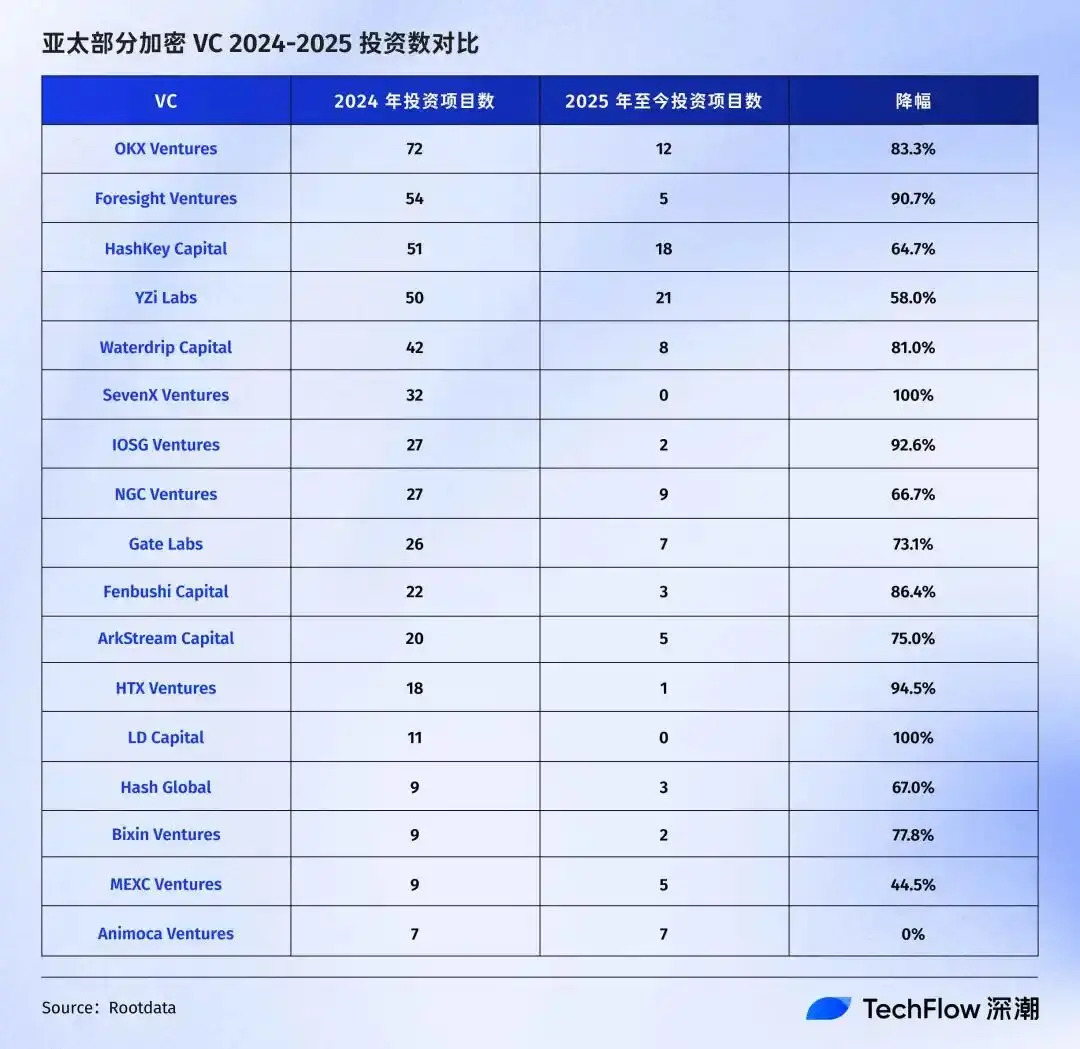
According to Jack, a partner at a crypto VC, the current crypto VCs are severely polarized. Small and medium-sized VCs are particularly struggling, with many being forced to pivot.
He provided his observations:
Between 2023 and 2025, about 5-7% of crypto VCs have turned to marketing/KOL agency businesses;
About 8-10% of crypto VCs have transformed into incubation/post-investment driven institutions, with post-investment team sizes expanding by 30-50%;
The majority of institutions are responding by: shifting to the secondary market, extending fund cycles, reducing management costs, or even pursuing compliant exit paths like ETFs/DAT/PIPE.
In other words: VCs have become service providers, or simply turned into "big players among the retail investors."
Former crypto VC investor Yinghao bluntly stated: "Currently, institutions that purely focus on primary investments are almost committing suicide."
LD Capital has pivoted to the secondary market, with founder Yi Lihua becoming the "milk king chess player" of ETH, maintaining a presence.
Additionally, some crypto VCs are being "forced" to enter AI investments.
As early as March, Jocy, founding partner of IOSG, posted on social media that another project in his portfolio had pivoted to AI. As more and more crypto investors found themselves with an unexpected number of AI entrepreneurs in their portfolios, they had to vote with their feet.
For example, Bixin Ventures has significantly reduced its investments in the crypto industry, choosing to invest in emerging companies in the AI sector, such as IntelliGen AI, which focuses on AI healthcare.
Pivoting is still a form of active self-rescue, while some institutions have directly announced a halt to investments. The well-known crypto VC ABCDE, founded by Du Jun, announced in April 2025 that it would stop new project investments and second-phase fundraising, focusing instead on post-investment management and exit arrangements for existing projects.
"ABCDE is relatively honest, openly stating they are done, but there are many more crypto VCs that are keeping it a secret," commented a VC practitioner interviewed.
With the drastic reduction in the number of deals, the underlying paradigm of the crypto primary market is changing. According to Jack, it is shifting from "liquidity-driven narrative speculation" to "cash flow and compliance-driven infrastructure development."
In recent years, the investment logic of crypto VCs has heavily relied on narratives. However, the financing data for 2024-2025 shows a clear shift: according to Pitchbook data, global crypto/blockchain VC total financing in Q2 2025 was only $1.97 billion, a 59% quarter-over-quarter decline, marking the lowest point since 2020; at the same time, late-stage financing accounted for over 50%, indicating that investors are more focused on mature projects with real revenue and verifiable cash flow.
"The difficulty of financing narrative-driven early projects has increased, while projects that can generate revenue and profits (such as exchanges, stablecoin issuers, RWA protocols) are more likely to attract capital," said Daxian, a partner at Waterdrop Capital.
Moreover, the "listing effect" of leading exchanges has also diminished significantly in this round. In the past, simply getting listed on a mainstream exchange could bring valuation liquidity. However, since 2025, although the number of listings on Binance has increased, the effect on secondary valuation premiums has weakened. According to CoinGecko data, the average decline of new coins in the first 30 days post-TGE in the first half of the year exceeded 42%. At the same time, investment exits have also seen new paths, such as compliant ETFs/tokenized funds (DAT), or structured secondary liquidity projects like protocol buybacks and ecological funds.
"This transformation does not mean that 'speculation has disappeared,' but rather that the window for speculation has shortened, with Beta returns giving way to Alpha selection," Jack stated.
The VC Predicament
The current predicament of crypto VCs can be summed up in one phrase: not making money.
Crypto analyst KK admitted that the primary issue is that crypto VCs are currently in a backward position within the crypto ecosystem. A project's lock-up period for VCs is 1-3 years, but due to the rapid changes in narratives in the crypto industry, by the time the lock-up ends, the narrative-driven projects may have already passed their peak, with token prices plummeting, even approaching zero. Some projects have even declared death before they could even get listed.
Additionally, many crypto VCs acquired too many overvalued projects in the last cycle, and now, with the logic being debunked, actual revenue and other data cannot support those high valuations.
"At that time, many VCs bought into some overseas projects at high valuations, partly believing that higher valuations were more stable, and partly because investing alongside well-known overseas investment institutions would enhance their brand reputation. But now it seems that many have incurred losses," KK said.
Most importantly, crypto VCs lack bargaining power. "Essentially, they can only provide money," Yinghao stated.
One interviewee even bluntly said: "In this market, the money from VCs is less valuable than that of a Twitter KOL."
What do projects need the most?
Not just money, but "liquidity resources."
Market makers can create depth in the secondary market, the listing on exchanges directly determines whether project parties can exit liquidity, and KOLs can help project parties sell tokens faster for cashing out… These liquidity participants often take the cheapest chips first and then resell them to VCs at multiples of the valuation. The result is: crypto VCs spend the most money but get the worst prices.
Thus, an absurd phenomenon has emerged: crypto VCs have become the group with the least bargaining power in the crypto market, inferior to exchanges, market makers, and even KOLs.
The "capital kings" of the primary market have instead become the "end of the ecological chain" in the crypto industry.
Fundraising Dilemma
If "not making money" is the survival dilemma for VCs, then "not being able to raise funds" is a matter of life and death.
According to PitchBook data, the total global crypto VC financing in Q2 2025 was only $1.97 billion, a 59% quarter-over-quarter decline, starkly contrasting with the over $10 billion peak in a single quarter in 2021.
Why are many traditional LPs no longer injecting capital? Besides the lack of returns from projects they invested in during the last cycle, having suffered losses, there is also the fact that "there are simpler ways to make money in the crypto space," Daxian stated, "such as buying mainstream coins, DeFi mining, options arbitrage, etc., with average returns exceeding 30%. This makes it very difficult to persuade LPs to invest in VCs, which require years to exit, and are likely to incur losses."
On the other hand, the funders are also changing.
Jack observed that traditional dollar LPs are shrinking, replaced by Middle Eastern sovereign funds like Mubadala and QIA, as well as Asian family offices, especially in Singapore and Hong Kong, where many family offices are allocating crypto secondary and early equity through FO and multi-strategy funds.
However, these emerging LPs are more selective:
They want to see real cash flow and are no longer willing to pay for PPTs; they require compliant custody, auditing, and fund licenses to avoid regulatory scrutiny; they prefer hybrid funds that bind secondary and primary investments, allowing for short-term realization of some profits…
The harsh reality is that money is increasingly concentrated in a few top players.
"Unless there is extremely strong vertical differentiation or key resources, it is more difficult for small and medium funds to attract LPs," Jack said.
The fundraising difficulty is particularly fatal for native crypto VCs. On one hand, they need to continuously raise funds externally, while on the other hand, they lack industry synergy resources to empower them. For VCs with backgrounds in exchanges or market makers, or those using their own funds, they not only have money but also industry resources, giving them greater confidence to acquire cheap chips. However, native crypto VCs must navigate this life-and-death challenge.
To put it more bluntly: in this market, LPs do not lack investment opportunities; they lack certainty, and native crypto VCs cannot provide that.
Where to Break Through?
Although the current state of the primary market is dire, players still in this market believe this is merely a period of growing pains. Once the reshuffle is over, only those who remain at the table will be qualified to reap the fruits of success.
They remain optimistic about the future.
"The current transformation is nurturing new opportunities," Daxian said, "for example, stablecoins. Some predict that the issuance of stablecoins will exceed $3 trillion in the future, and around this $3 trillion in settlement, clearing, and compliance services, a new batch of targets will inevitably emerge. This is an opportunity for crypto VCs to lay out in advance."
The more macro narrative is equally enticing. According to the Citi GPS 2024 report, the scale of tokenized assets is expected to reach $10-16 trillion by 2030. Whether it is on-chain settlement platforms or the issuance side of real-world assets (RWA), they provide entry points for VCs.
"And in every cycle, new opportunities arise around new assets, whether it is trading platforms, financial derivatives, or innovative DeFi projects, all injecting vitality into the market," Yinghao stated.
However, if crypto VCs want to survive in this game, they must completely reshape their roles.
They can step out of the identity of pure financial investors, providing market making, compliance, liquidity support, and even directly entering project operations. This model resembles "investment banking" rather than traditional VC.
Alternatively, they can create structured funds, using financial engineering methods like DAT, PIPE, SPAC, etc., to design diverse exit paths for LPs, transforming "uncertain narratives" into "predictable cash flows."
They must also establish genuine research and data capabilities, focusing on quantifiable metrics such as on-chain revenue, user retention, and protocol fees, rather than continuing to bet on the next "empty narrative."
These directions may be the last chips for crypto VCs.
However, the irony of history is that those who can truly survive are often those who endure in the most challenging environments. The "weightless era" of crypto VCs may be nurturing the birth of the next star.
After all, only players who still stand on the ruins are qualified to welcome the next bull market.
 Risk warning Risk warning




Popular articles