Same Order, 26x Slippage Difference: A Live Liquidity Test of Commodity Futures During March's Extreme Market Conditions
 The extreme market fluctuations in gold and crude oil have a difference in slippage of up to 26 times. A practical test of commodity contracts across multiple platforms reveals that MEXC leads the way with the lowest slippage and the strongest liquidity performance under pressure.
On March 23, geopolitical risks intensified, causing Gold, Silver, and Crude Oil to swing violently in a single day. For the exact same 100,000 USDT Gold market order placed across different platforms that day, slippage ranged from a low of 0.29 USDT to a high of 7.68 USDT — a 26x difference.
Every trader knows the brutal truth: the more extreme the market, the higher the hidden trading costs. Order books that look similar in normal conditions get instantly exposed in moments like these, who has depth, who holds their spread, and who can't absorb slippage all become immediately apparent.
This article uses two core datasets — an extreme market stress test and a normal baseline — to reveal which platforms' liquidity actually holds up when the market gets truly challenging.
Data notes: Each platform's highest-volume commodity pair in Q1 was selected for comparison. Gold and Silver cover 7 major platforms; Crude Oil covers only BingX, Hyperliquid, and MEXC. All figures can be independently verified via each platform's order book.
1. Evaluation Criteria
This test uses four metrics:
Bid-Ask Spread (bp): The gap between a platform's ask and bid price. A smaller gap means lower trading costs. However, since different platforms display prices at different decimal precisions, raw spread figures are not directly comparable across platforms and are provided only for reference.
Depth-to-Spread Ratio: Level-1 order book volume / spread. This measures how much order book depth you get per unit of spread cost — the higher the value, the better the liquidity value. This is a corrected view of the spread and is the core comparison dimension in this article.
0.5% and 1% Depth: Total pending orders within 0.5% and 1% of the mid-price, which determines the execution cost of large orders. The degree to which these figures contract during extreme market conditions also reflects a platform's liquidity resilience.
100K USDT Market Order Slippage: The comprehensive reflection of actual execution cost, comprising two components: the initial half-spread (paid on entry) and the market impact cost (determined by order book depth). This is the final verification that combines spread and depth into one figure.
2. Platform Performance During Extreme Market Conditions
2.1 Gold Futures
Gold was the most competitive instrument in this comparison, with 7 platforms compared head-to-head.
Spread and Depth-to-Spread Ratio
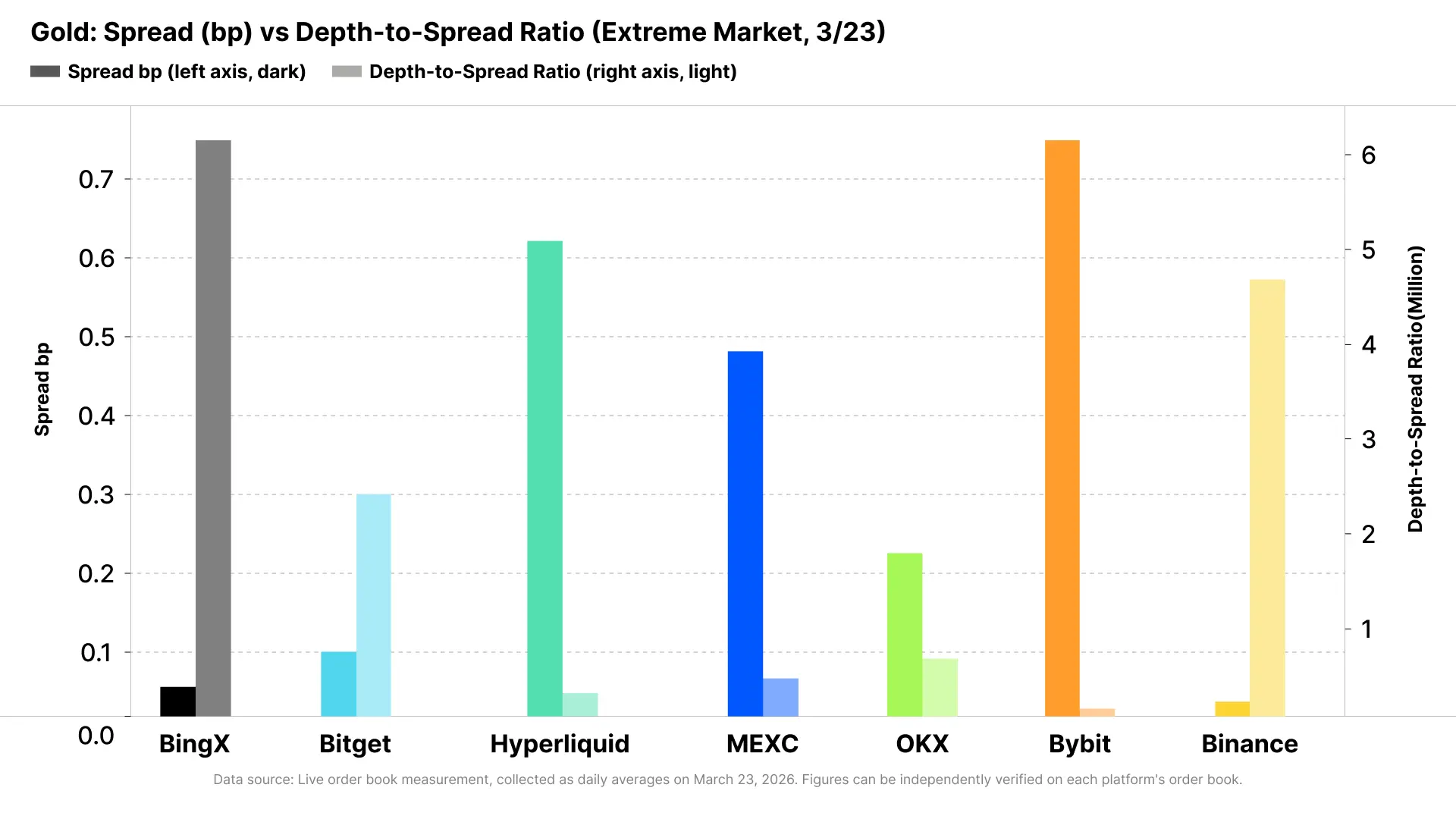
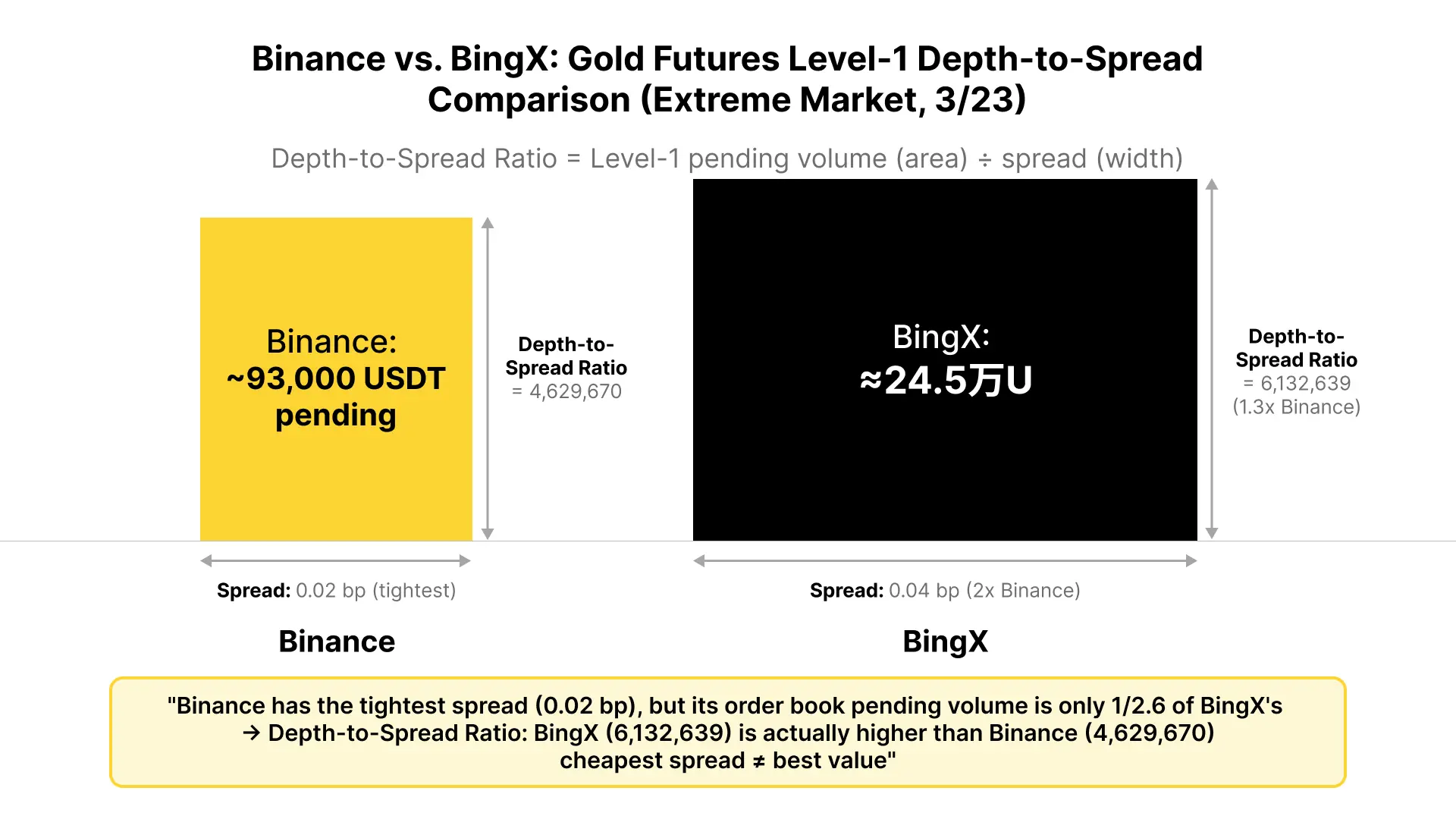
Since spreads are not directly comparable due to pricing precision differences, we focus on the Depth-to-Spread ratio. On this metric, BingX ranks first overall, even surpassing Binance, which has the tightest spread. Binance's spread is cheaper, but BingX's order book is thicker; on a combined basis, BingX's liquidity value is actually higher.
0.5% and 1% Depth
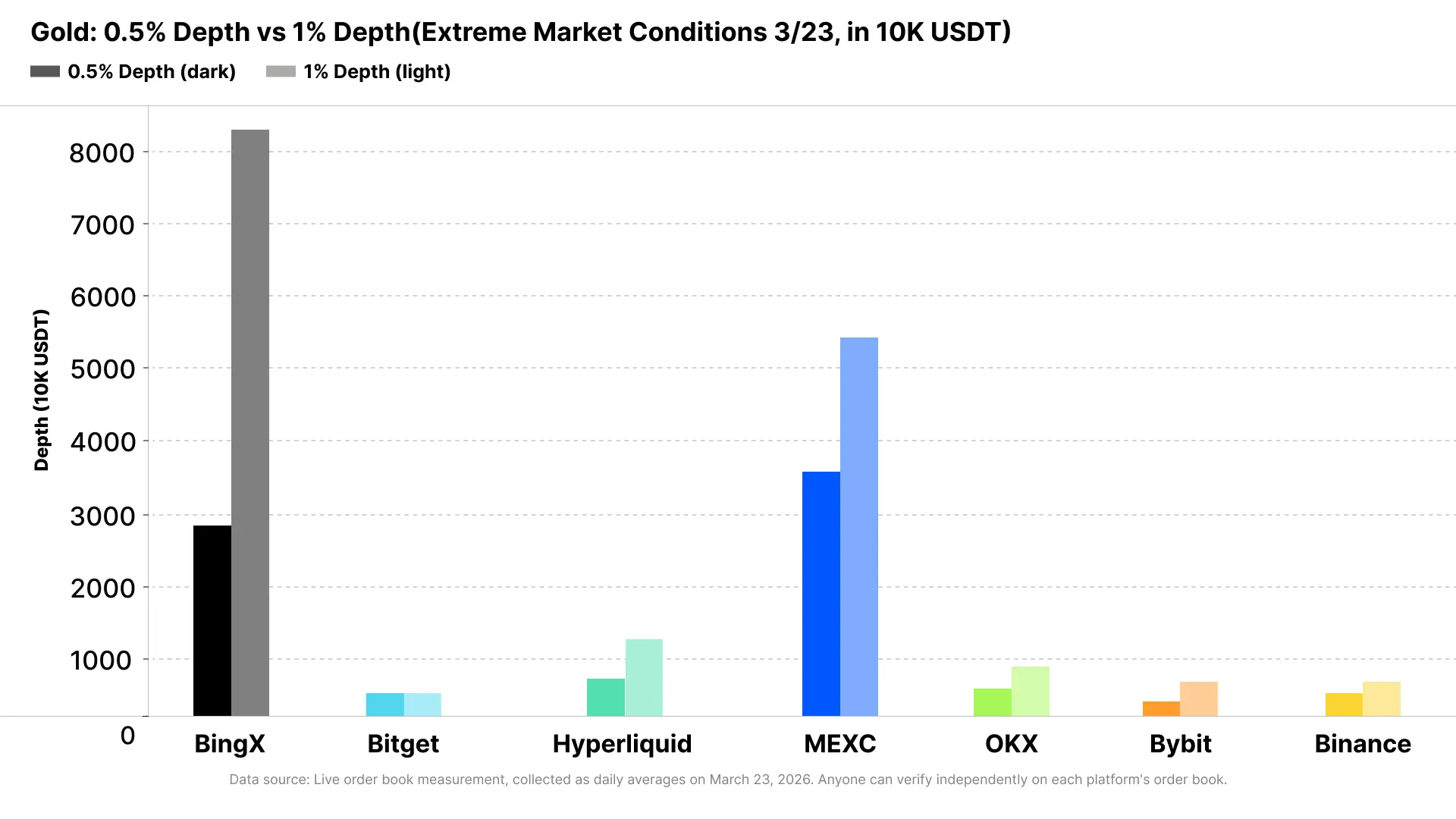
The 0.5% depth reflects capacity under normal conditions, while the 1% depth is closer to the liquidity floor during extreme volatility. Together, they reveal a platform's true performance under pressure.
MEXC ranks first in 0.5% depth, leading BingX by ~24% and outpacing OKX by 6.7x. However, at the 1% depth level, BingX overtakes to claim first place and MEXC drops to second, indicating BingX's depth distribution extends further out, giving it stronger capacity during large swings. Starting from third-place Hyperliquid, there is a clear cliff drop in the data. Moreover, some platforms' 0.5% and 1% depth figures are only in the hundreds (three digits), indicating relatively higher risk for large order execution.
Slippage
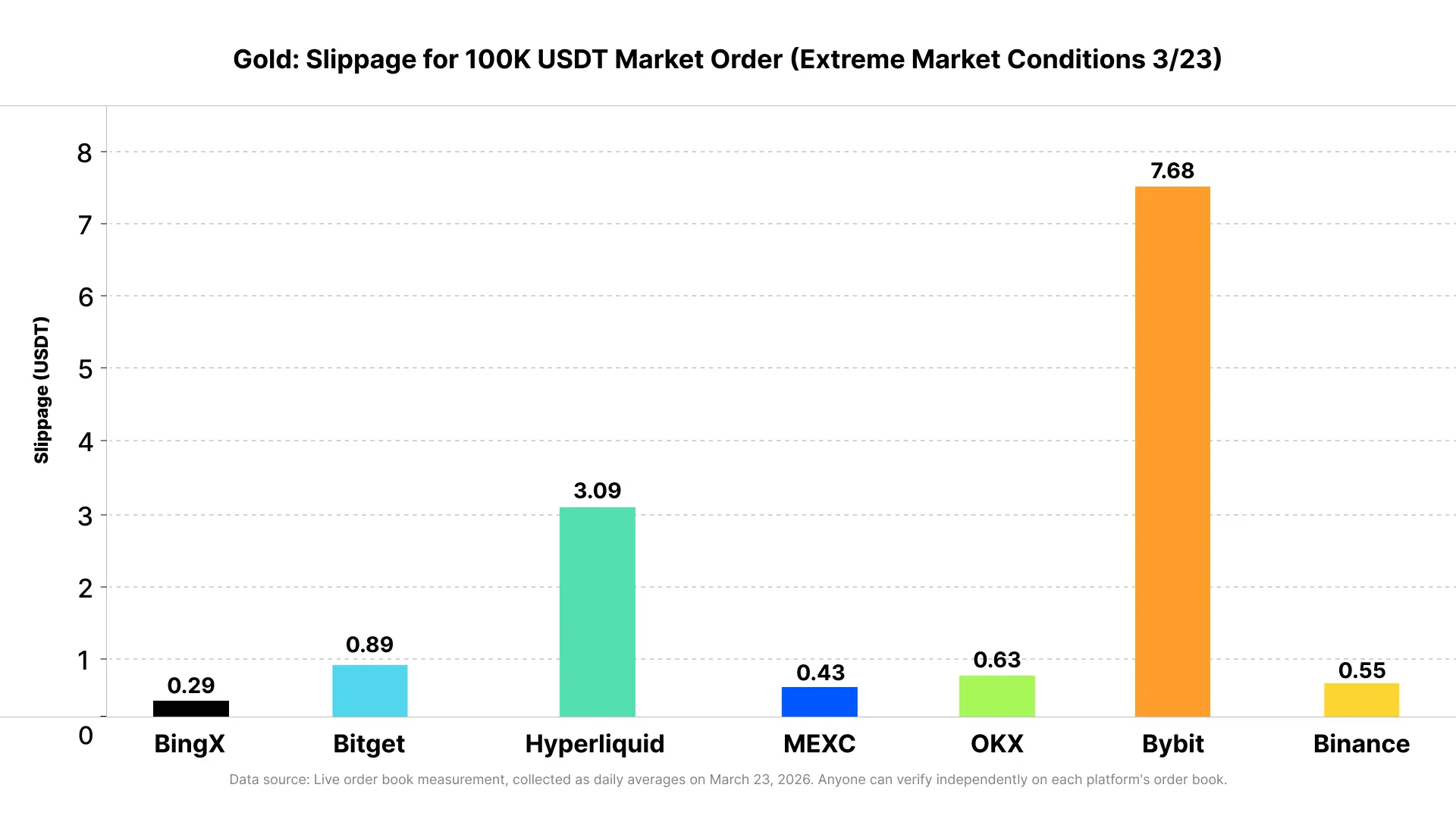
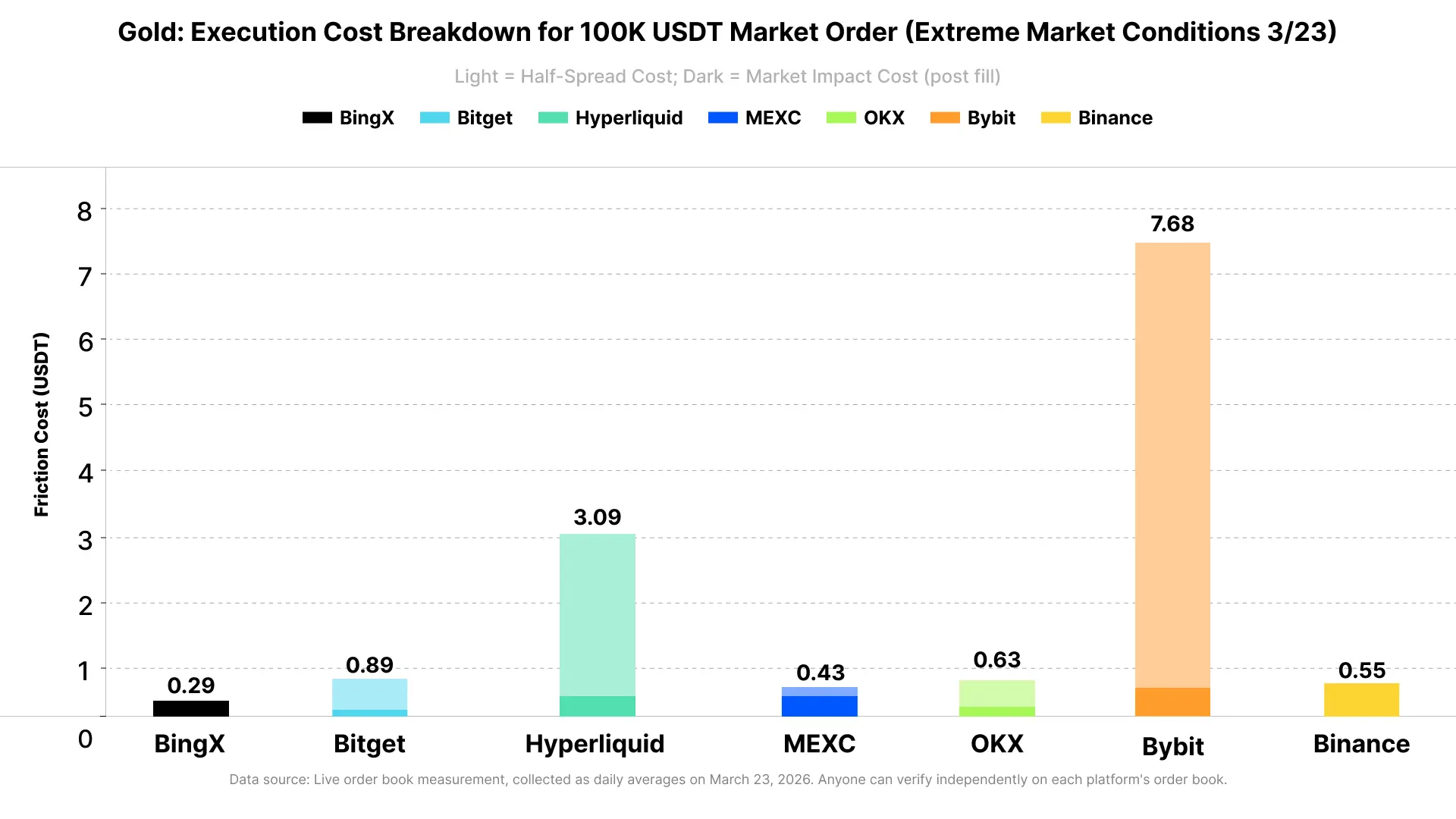
The execution cost breakdown: the lighter portion represents the initial half-spread; the darker portion represents the market impact cost after order fill. Their sum equals the slippage figure in the table above.
For the same 100K USDT Gold Futures market order, BingX incurred only 0.29 USDT in slippage, while Bybit incurred 7.68 USDT — roughly 26x the difference. Notably, Hyperliquid's slippage was far above OKX, Binance, and other platforms, which is consistent with its lower depth readings, confirming that its Gold Futures liquidity was clearly weak in this test. MEXC ranked second on slippage, consistent with its 0.5% depth advantage.
Gold Futures are highly competitive but sharply differentiated. BingX and MEXC led on both depth and execution cost — the best overall liquidity options. Binance has the tightest spread but thin depth, making it suitable for small orders. Moreover, some platforms have higher slippage and thin depth, resulting in significantly higher trading costs for large orders.
2.2 Silver Futures
Silver is more volatile than Gold, and order book differentiation is more pronounced.
Spread and Depth-to-Spread Ratio
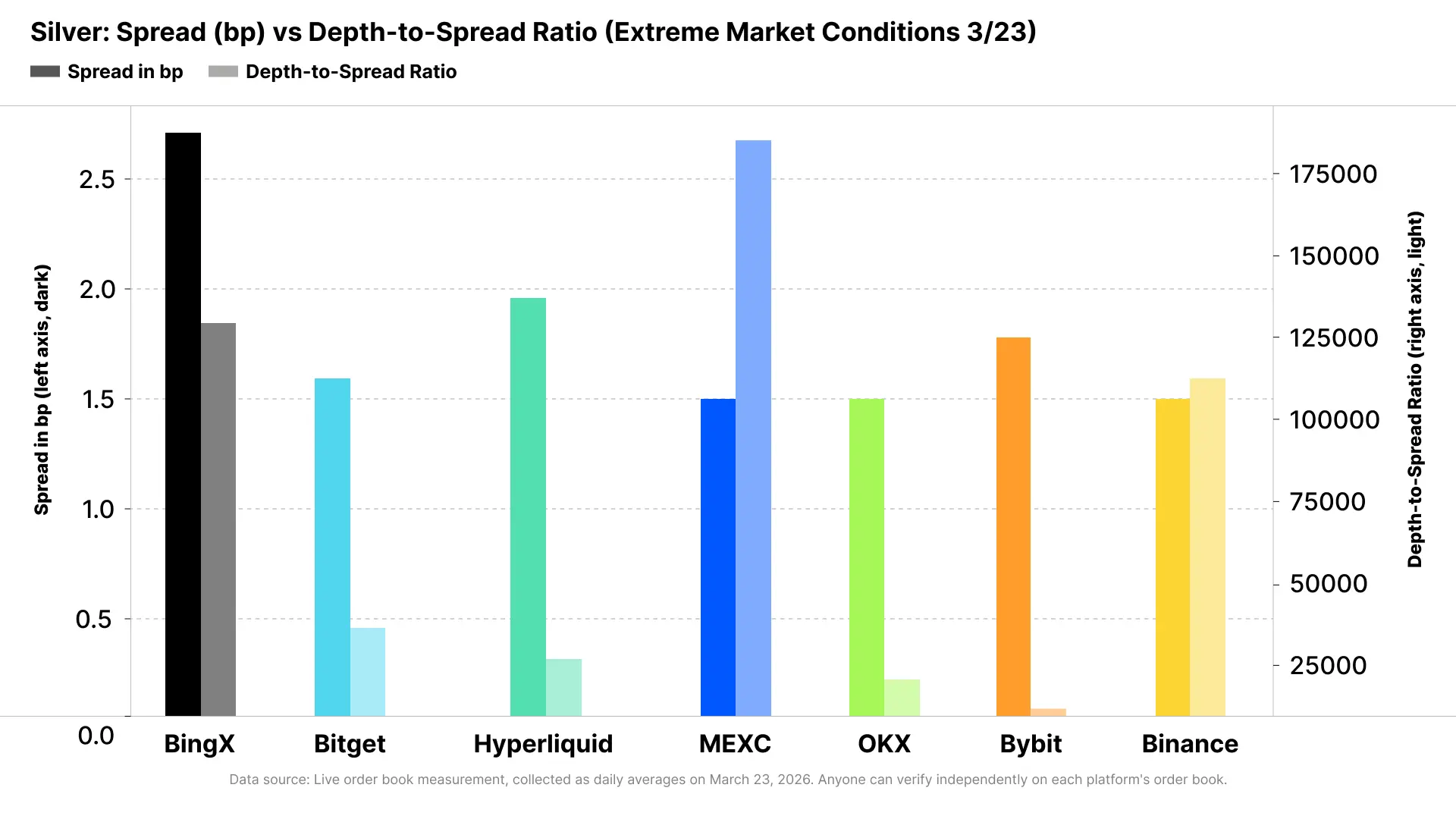
MEXC and Binance share the same spread of 1.50 bp, but MEXC's depth-to-spread ratio is 1.7x Binance's and 67x Bybit's. Notably, OKX's Gold depth-to-spread ratio was 645,288, but in Silver it dropped to just 9,747, shrinking to 1/66 of its Gold figure. Some platforms concentrate their liquidity resources heavily in Gold; when switching to Silver, their capacity drops sharply.
0.5% and 1% Depth
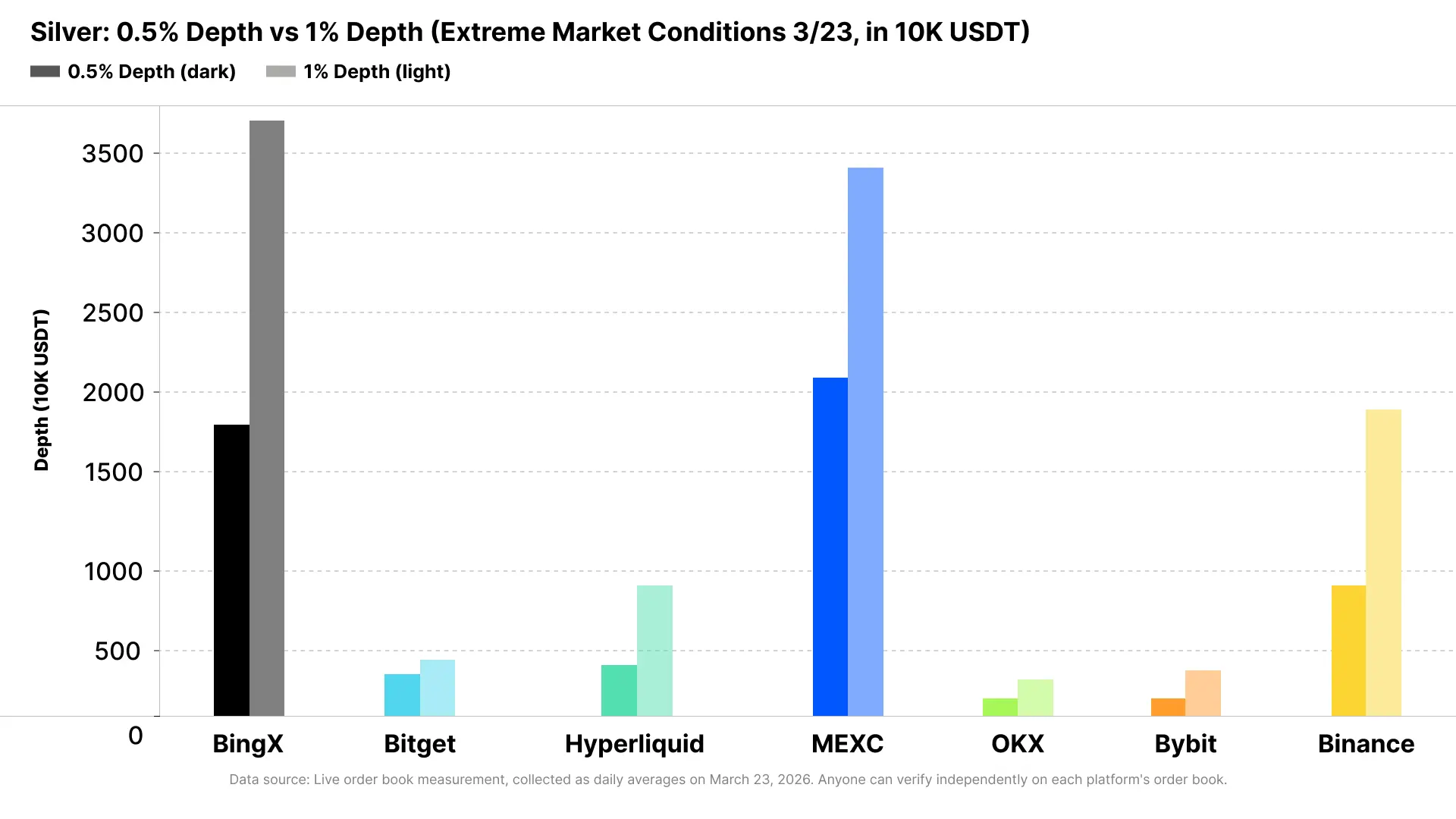 MEXC (21.7M USDT) and BingX (17.39M USDT) again form a clear tier-one group, with a noticeable gap over the rest. The same pattern as Gold holds: MEXC leads in 0.5% depth, BingX edges ahead slightly at 1% depth, with depth distribution extending further out. Similar to Gold, some platforms' 0.5% and 1% depth figures are only in the hundreds (three digits), reflecting clearly insufficient liquidity in extreme volatility scenarios.
Slippage
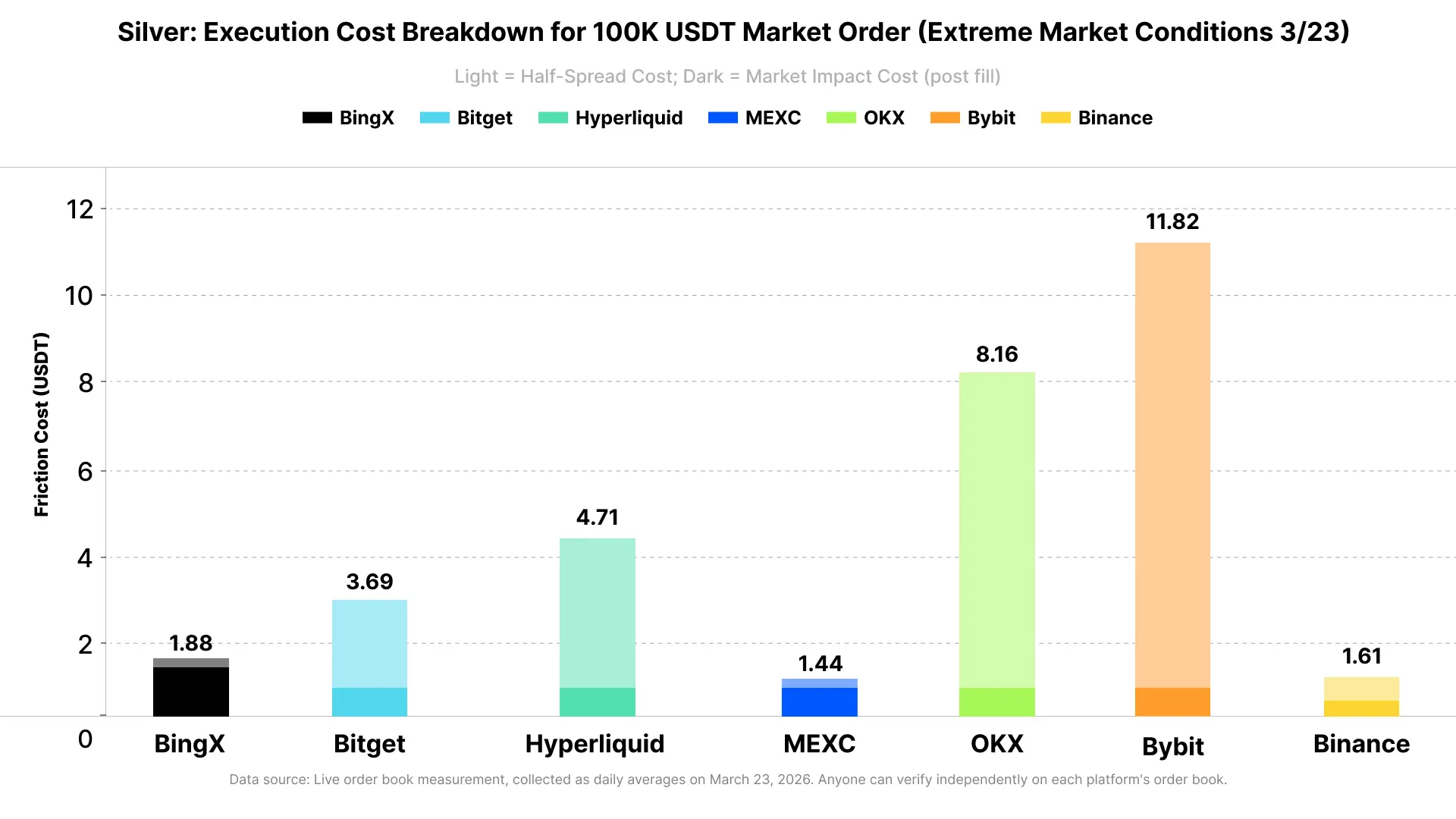
The execution cost breakdown: the lighter portion represents the initial half-spread; the darker portion represents the market impact cost after order fill. Their sum equals the slippage figure in the table above.
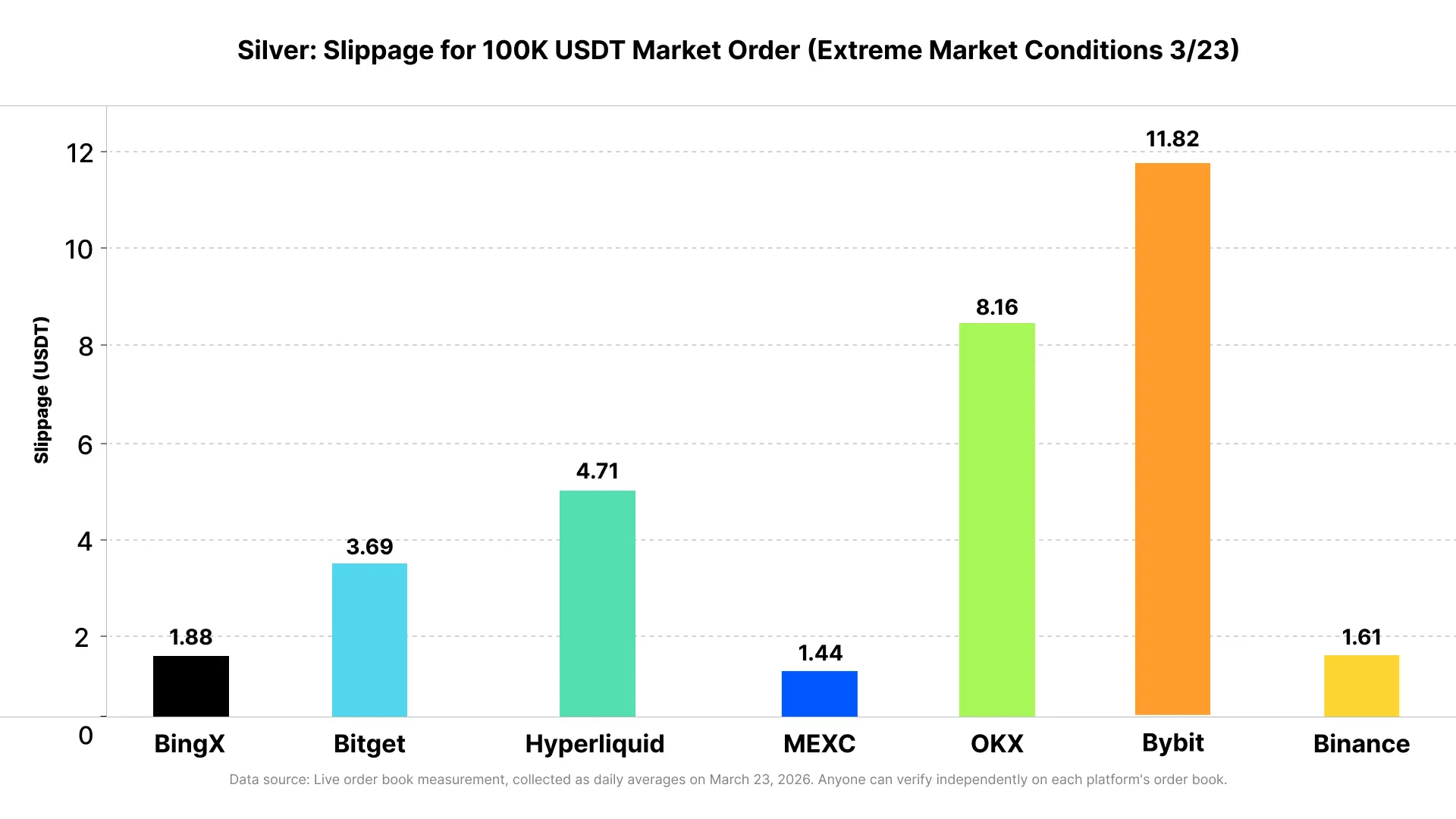
Silver's slippage differentiation is even more extreme than Gold's, with a head-to-tail spread exceeding 8x. MEXC is the lowest in the group, with Binance close behind, and a small gap between them. Starting from Bitget, there is a clear jump upward, with lower-ranked platforms falling far behind — executing the same Silver trade on the highest-slippage platform costs more than 8x that of the top-ranked platform.
The Silver Futures liquidity landscape is more concentrated than Gold. MEXC ranked first across three dimensions, depth-to-spread ratio, 0.5% depth, and slippage — and second in 1% depth, making it the most balanced overall performer in this Silver test. BingX is in the same tier as MEXC on depth, and even edges it slightly on 1% depth. Some platforms warrant caution — their Gold performance may be decent, but actual Silver execution costs should not be estimated based on their Gold performance.
2.3 Crude Oil Futures
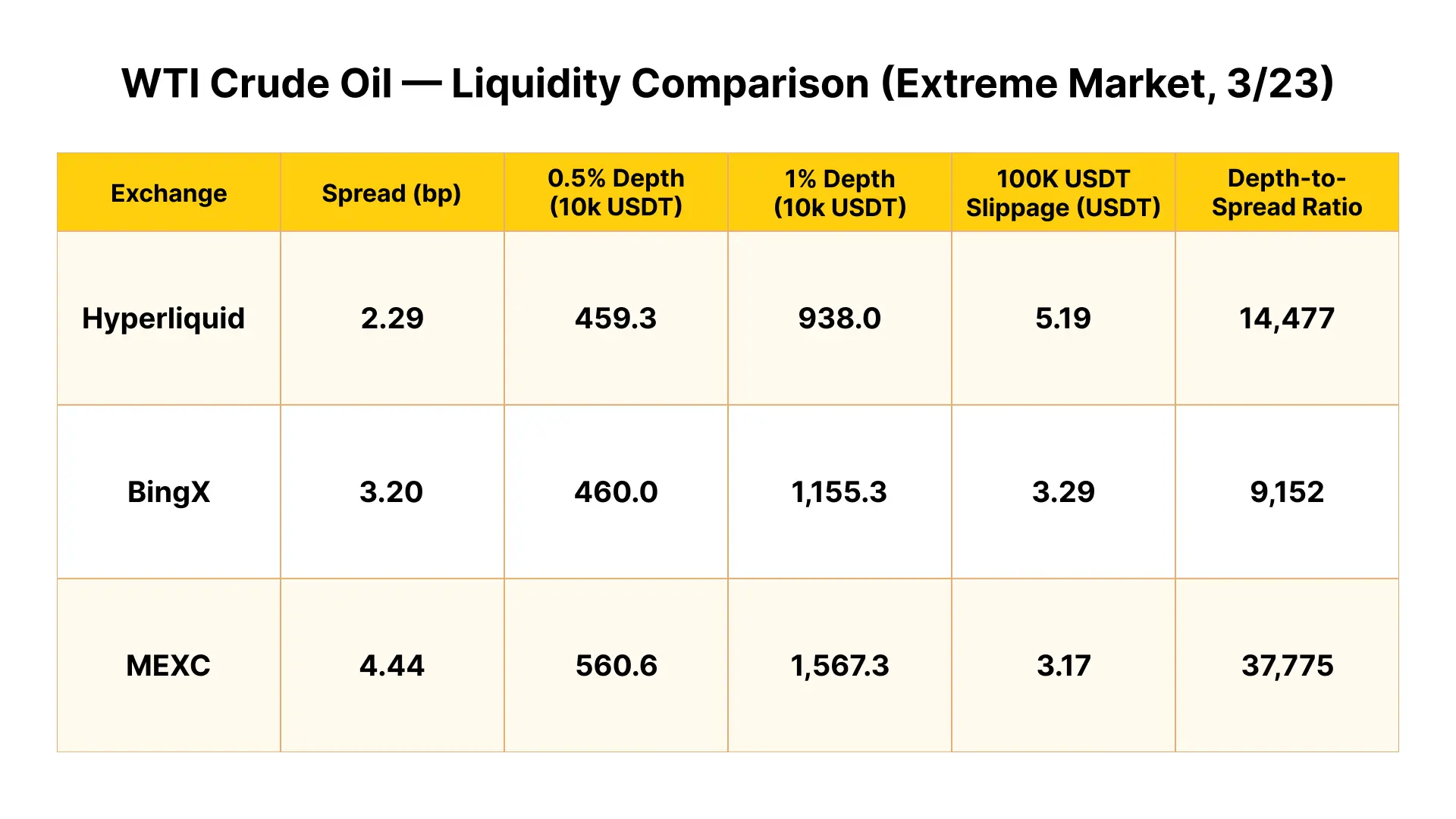
The Crude Oil Futures competitive landscape is still maturing. Currently only BingX, Hyperliquid, and MEXC have fully listed products, so this comparison covers only these three platforms.
WTI Crude Oil — Liquidity Comparison (Extreme Market, 3/23)
Brent Crude Oil — Liquidity Comparison (Extreme Market, 3/23)
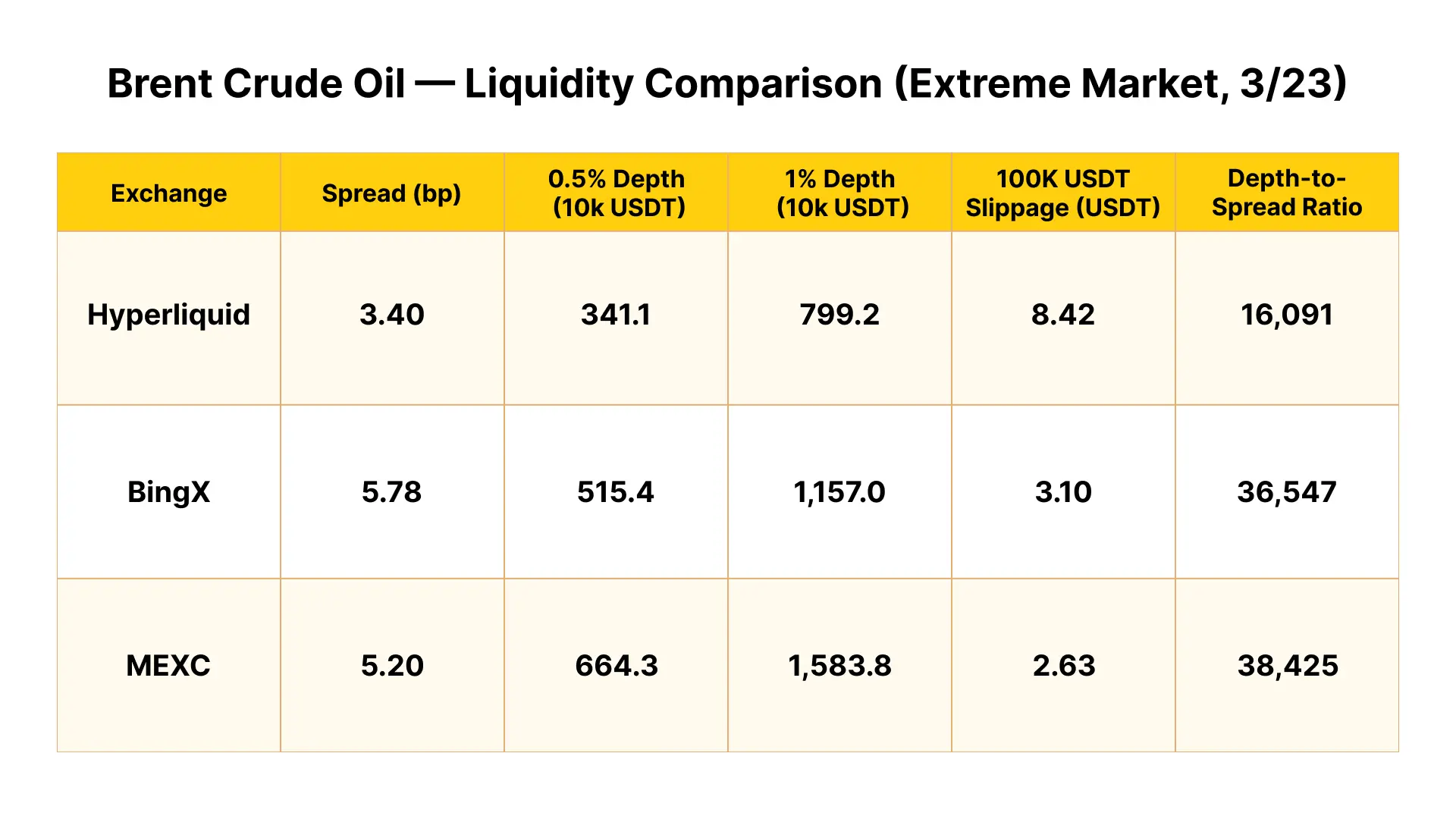
Hyperliquid has the tightest spread in both instruments, but this advantage is completely neutralized at market order execution. In WTI, MEXC's depth-to-spread ratio is 2.6x Hyperliquid's, and actual slippage is also lower. In Brent, the gap is even more pronounced — MEXC's slippage is just 1/3 of Hyperliquid's. Hyperliquid's spread is tight, but its order book is thin; the apparent savings on the quoted cost are more than consumed at execution.
Crude Oil Futures are currently a two-platform race between MEXC and BingX. MEXC leads on depth-to-spread ratio, 1% depth, and slippage; BingX is close behind. Hyperliquid has the tightest spread but insufficient order book depth to support large order execution, making its actual trading costs the highest of the three.
3. Stress Test: Whose Liquidity Held During Extreme Conditions
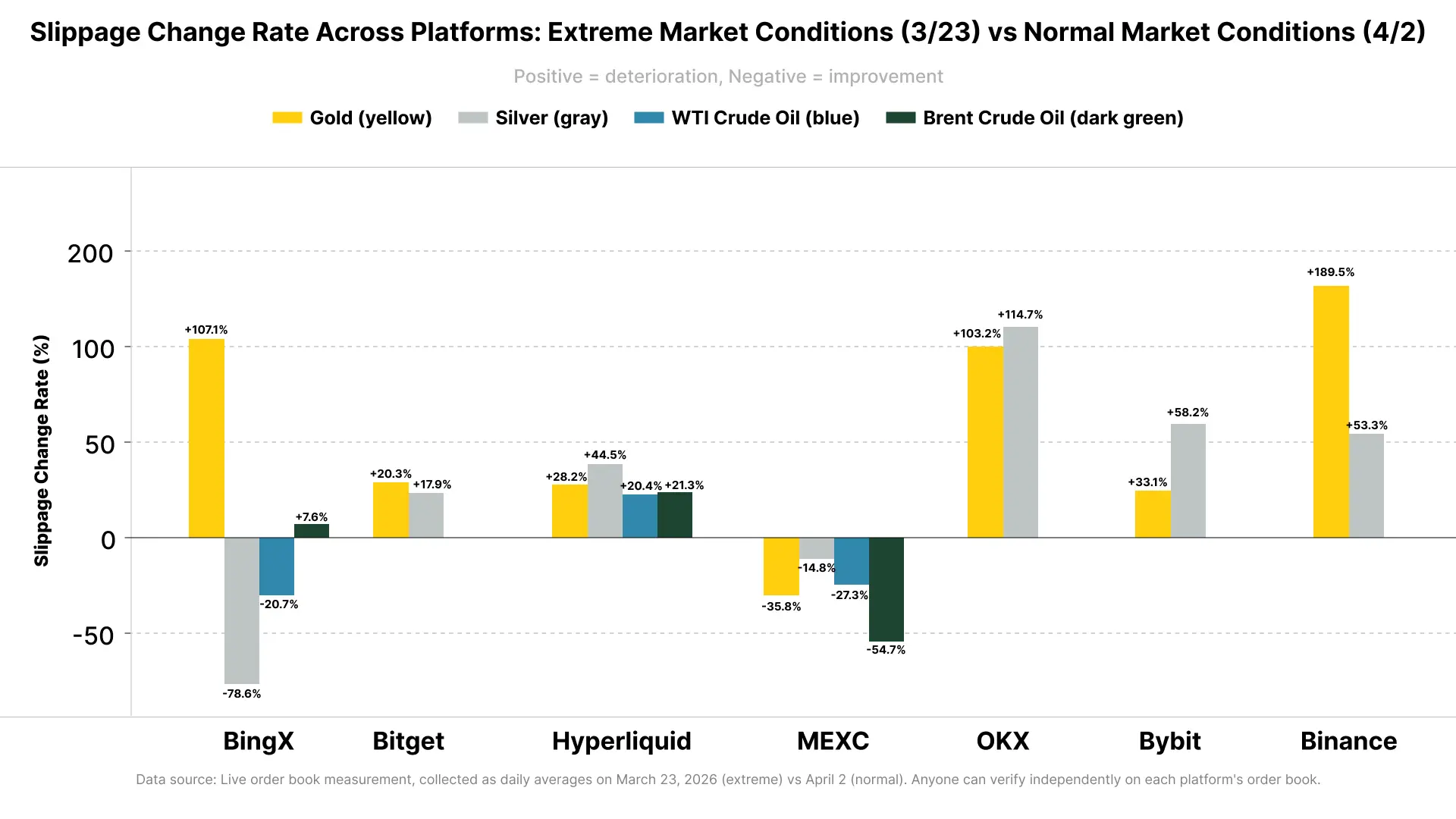
It is a general rule that market makers raise their risk premiums in extreme markets, causing slippage to deteriorate, but one exception emerged in this test.
Comparing March 23 (extreme) against April 2 (normal), all six other platforms saw slippage widen to varying degrees, ranging from +17% to +190%. MEXC was the only platform in the group whose slippage improved across all four instruments: Gold improved 35.8%, and Brent Crude Oil improved the most at 54.7%.
Slippage Change by Platform — Extreme (3/23) vs. Normal (4/2)
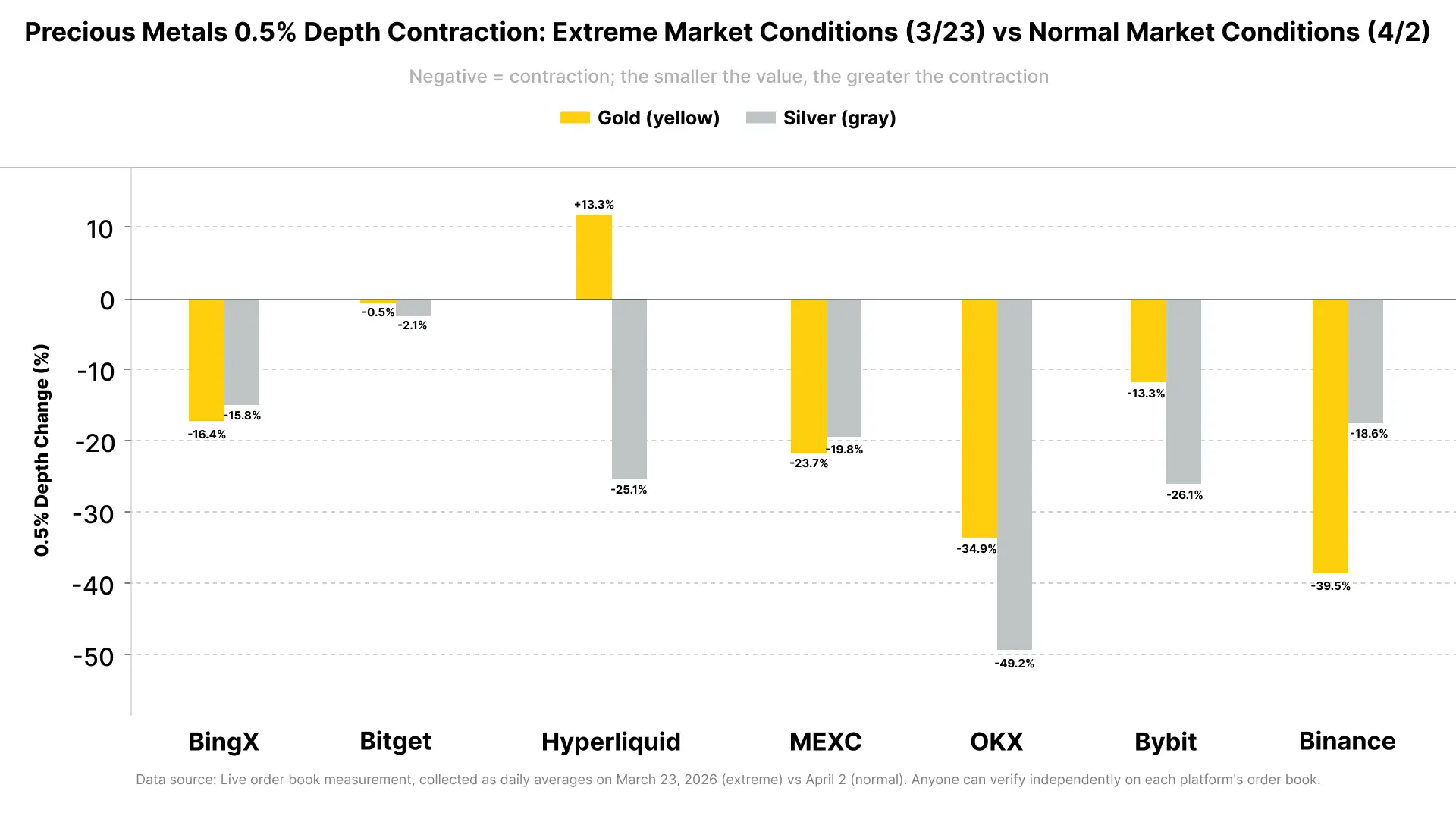
Depth contraction in extreme markets is a universal phenomenon — the difference is in degree. MEXC's Gold 0.5% depth contracted 23.7%, and Silver contracted 19.8%, both at the lower-to-middle end of the group. Bitget's contraction appears smallest, but given its extremely thin baseline depth (Gold 0.5% depth: only 2.12M USDT; Silver: only 2.60M USDT), there simply wasn't much left to contract, a smaller contraction percentage does not mean greater resilience.
0.5% Depth Contraction — Extreme (3/23) vs. Normal (4/2)
Even more telling is the stability of the depth-to-spread ratio. The degree to which this metric decays under extreme conditions directly reflects how resilient a platform's liquidity value is under pressure. MEXC's Gold depth-to-spread ratio contracted only 10.7%, and Silver contracted only 8.5%. By contrast, the platform with the largest contraction in this group saw drops of 44.9% on Gold and 63.6% on Silver — when pressure arrived, some platforms' liquidity foundations were nearly halved.
Level-1 Depth-to-Spread Ratio Contraction — Extreme (3/23) vs. Normal (4/2)
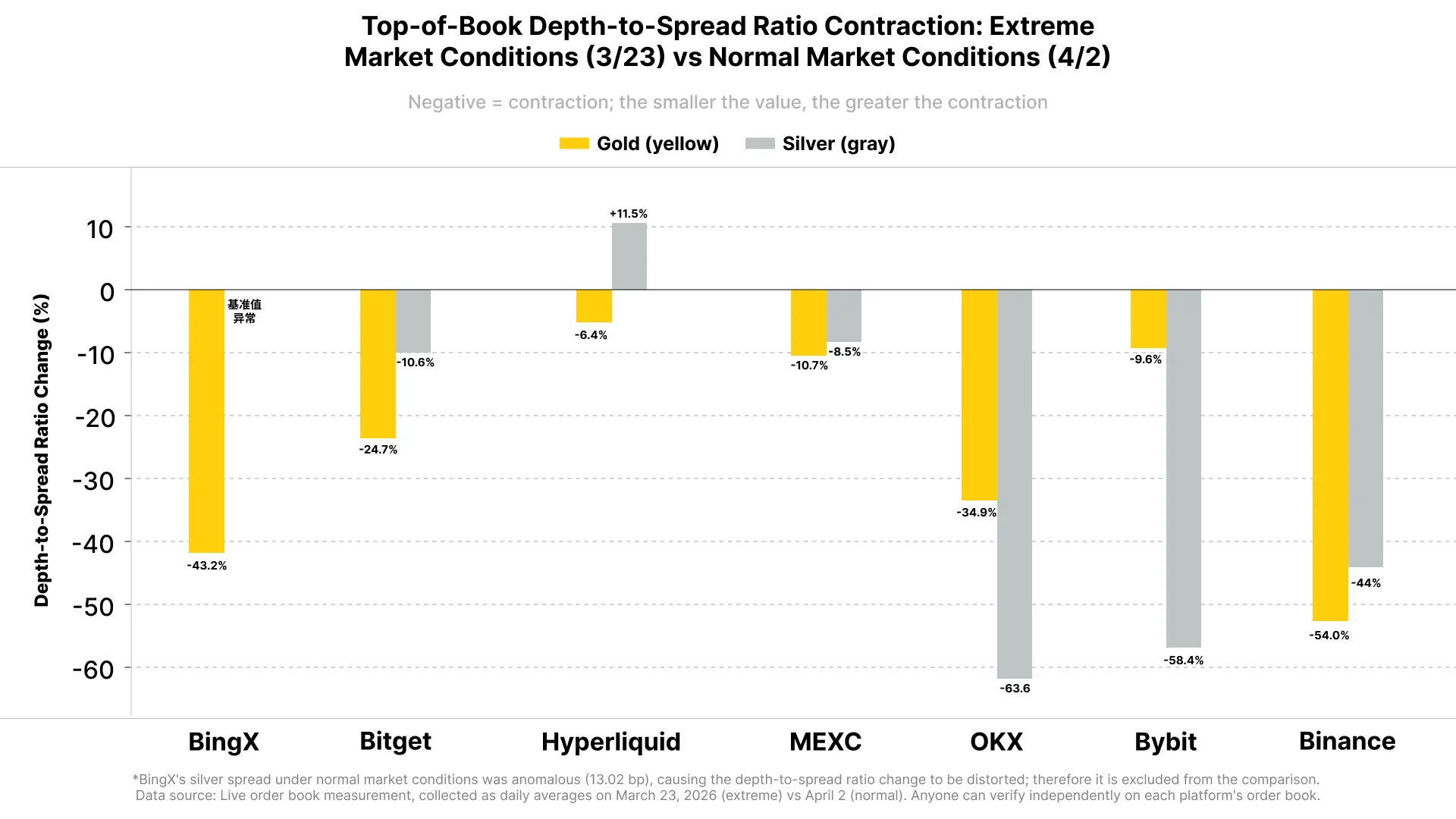
This test showed that most platforms experienced significant liquidity deterioration in extreme conditions, while MEXC's liquidity foundation did not collapse. Whether measured by slippage improvement or depth-to-spread ratio stability, MEXC's performance under stress conditions remained highly consistent with its normal-market behavior.
4. The Underlying Logic Behind MEXC's Liquidity Lead
MEXC's lead in precious metals and Crude Oil Futures liquidity is not coincidental, it results from a positive feedback loop formed by fees, market-making ecosystem, and risk controls working together.
4.1. 0-Fee Flywheel
MEXC's Futures trading fees can reach as low as 0%, placing it among the lowest of any mainstream centralized exchange. The effect is self-reinforcing: ultra-low fees draw in high-frequency and quantitative traders, whose large volumes of limit orders deepen the order book and compress spreads. Regular users benefit from better fills and lower slippage, and as execution quality improves, more users follow. The result is a flywheel that builds on itself.
In 2026, this strategy has been extended to RWA Futures, encompassing new asset classes such as precious metals and Crude Oil.
4.2. Professional Market Makers as the Foundation
In 2025, MEXC entered a strategic partnership with Da Vinci Trading, a veteran proprietary trading firm based in Amsterdam. Professional market makers like this maintain continuous two-sided depth quotes, use algorithms to compress spreads in real time, and deploy sufficient capital to effectively absorb sudden large-order impacts.
4.3. Risk Control Engine: Preventing Cascading Liquidations
During extreme market conditions, many platforms trigger "cascading liquidations", forced liquidation orders hit the order book and trigger chain reactions, instantly draining liquidity. MEXC uses a three-layer defense system:
-
Tiered Liquidation: Only partially liquidates positions by risk level, splitting large orders into multiple smaller orders to be absorbed gradually, reducing instantaneous market impact.
-
Insurance Fund + ADL Tiering: Deficits are covered first by the insurance fund; ADL (auto-deleveraging) is used only as a last resort, ensuring profitable traders are not forcibly reduced without cause.
-
Multi-Asset Cross-Margin: Supports multiple asset types pooled into a unified margin pool; when a single asset declines, funds are automatically reallocated, reducing unnecessary liquidation triggers.
The core principle of all three mechanisms is the same: handle liquidations in a tiered, staged, and buffered manner, minimizing the destructive impact of extreme market conditions on order book depth.
5. Conclusion
The extreme market conditions of 2026 will not be isolated events — geopolitical tensions are pushing commodities into a high-volatility cycle.
This stress test showed that most platforms' slippage widened by 17%–190% in extreme conditions.For traders, it is worth incorporating spread, depth, and slippage into routine platform evaluation, because extreme market conditions can arrive at any time — and liquidity is one of the certainties traders can lock in for themselves in an age of uncertainty.
 Risk warning