What does gold hitting 5000 dollars mean for Bitcoin?
 Core Viewpoint

 DeFi researcher Fishmarketacad analyzes that the recent strong surge of gold breaking through 4200 USD is not coincidental, but driven by four structural factors. These factors, particularly the global trend of "de-dollarization," will continue to support gold prices and are expected to drive them to a target of 5000 USD in the future.
Original Title: Why gold is going to $5k
Original Author: Fishmarketacad, DeFi Researcher
Original Translation: Deep Tide TechFlow
Seeing the attention CT has on gold today, I have been following gold for a while, so I decided to share some quick thoughts (which may be wrong).
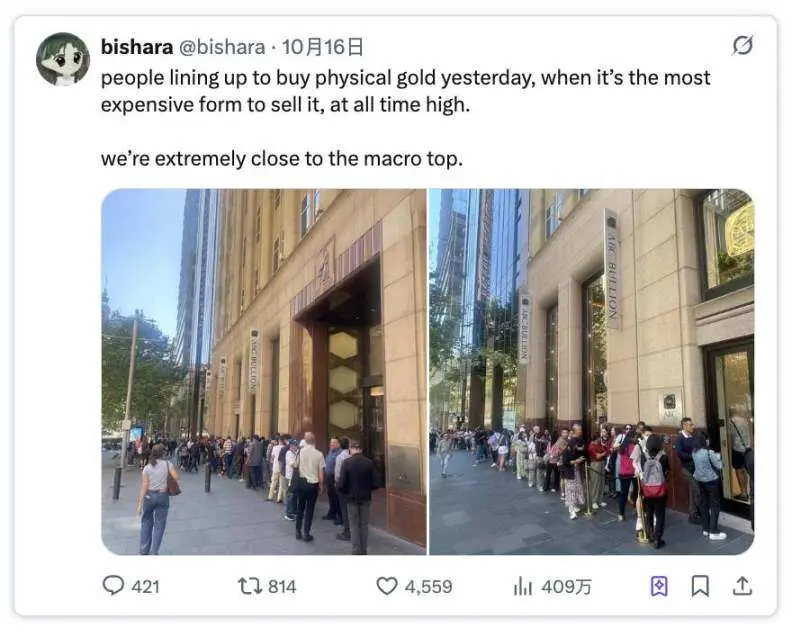
Why does gold only go up and not down?
Since the indefinite quantitative easing (QE infinity) and fiat currency devaluation in 2020, I have been paying attention to precious metals as a way to store value independent of the market.
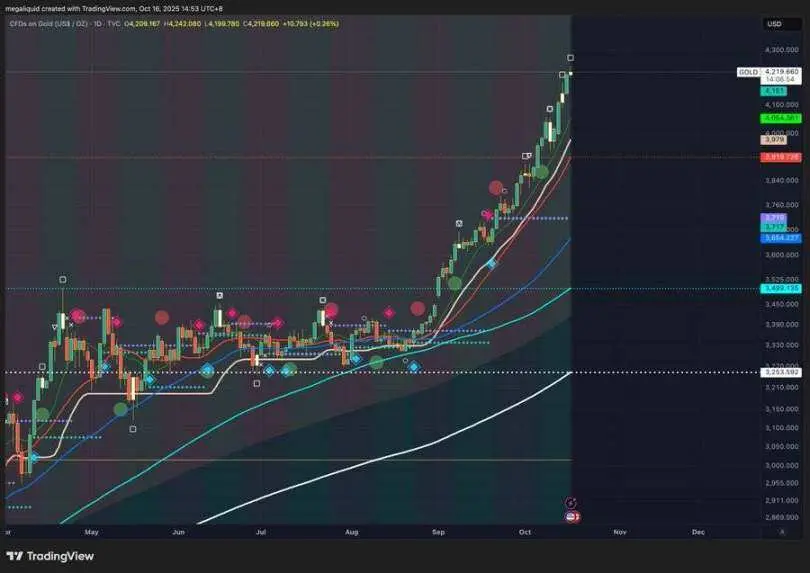
The price of gold has surpassed $4,200, rising 25% in less than two months. Let's explore the reasons behind this phenomenon:
1. De-dollarization / Central banks buying gold
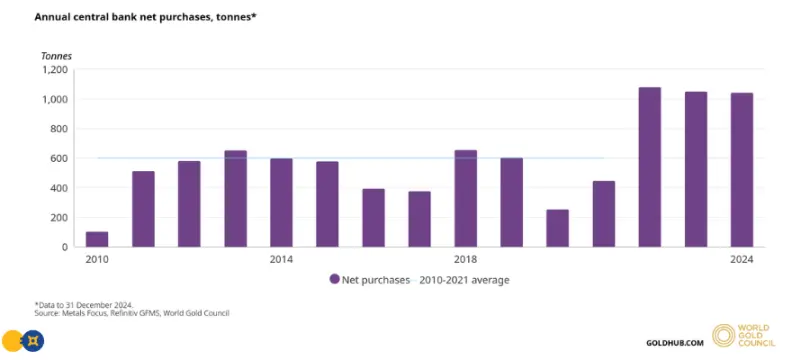
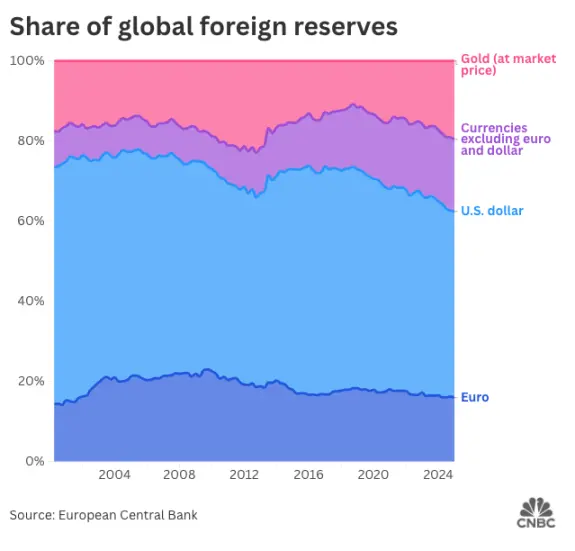
Central banks, especially China, are buying gold like crazy. As far as I know, they are expected to purchase over 1,000 tons of gold for the fourth consecutive year, and surveys show they plan to continue buying.
Why? The U.S. national debt is expected to reach $37.5 trillion this year, with interest alone exceeding $1 trillion (tax revenue is about $4-5 trillion). There are only two ways to deal with such a massive debt: default or devalue, and the U.S. never needs to default because they can devalue the debt by printing more money.
2. Stablecoins as a tool for socializing debt
The U.S. devalues its debt through monetary inflation, essentially printing more money to reduce the value of each dollar, thereby shrinking the actual value of the debt. This situation has persisted for decades, and you should be familiar with it.
The new twist is that if the U.S. shifts this portion of debt into the crypto space, such as stablecoins, it could become very interesting, as cryptocurrencies are more accessible to the world.
Stablecoins are increasingly backed by loans. Stablecoins pegged to the dollar, like USDT and USDC, are currently primarily backed by U.S. Treasury bonds. What started as a pure 1:1 tool has gradually evolved to be over 90% backed by U.S. Treasury bonds.
Thus, whenever people from other countries hold stablecoins, they are indirectly purchasing U.S. debt. This globalizes the U.S. "inflation tax." The higher the adoption rate of U.S. stablecoins globally— we know this number will reach trillions of dollars— the more the U.S. can export its debt and share its "losses" with the world outside the U.S.
If this is indeed part of the plan, then it circles back to the previously mentioned demand for de-dollarization, making gold a very important safe alternative for storing value.
3. Physical gold shortage
Another important point is that this gold rally is not just driven by a lack of physical gold or derivatives. If you are familiar with the potential short squeeze in perpetual markets when open interest (OI) exceeds token liquidity, this is a similar concept.
In 2025, COMEX gold futures typically have hundreds of thousands of open contracts (each representing 100 troy ounces), while the total amount of physical gold available for delivery is only a small fraction of that.
This means that at any time, the demand for physical gold far exceeds the deliverable amount. This is also why gold delivery times have extended from a few days to several weeks. This indicates a real demand for physical gold (similar to spot demand), which usually does not come from short-term investors, thus forming a structural price bottom.
4. Overall uncertainty
Gold once again confirms its status as a safe haven in uncertain times. Current factors such as U.S.-China competition, trade war concerns, domestic turmoil in the U.S., Federal Reserve rate cuts, the U.S. economy relying on AI infrastructure support, and economic uncertainty have led to a global flight from the dollar and investment in gold.
In my view, the main scenario where gold would decline is when there is no need for a safe haven. The following conditions would need to be met, but they are unlikely to happen in the short term:
· High employment rate: Poor outlook for the U.S. economy
· Capital flowing into risk assets: Stocks are not cheap (though they are not cheap now)
· Political stability: The U.S. needs to be friendly to China
· Rising interest rates, i.e., increased cost of capital: The current situation is completely opposite
Due to Trump's unpredictability, these conditions could change rapidly (or at least the relevant market perceptions), so caution is warranted.
What does this mean for BTC?
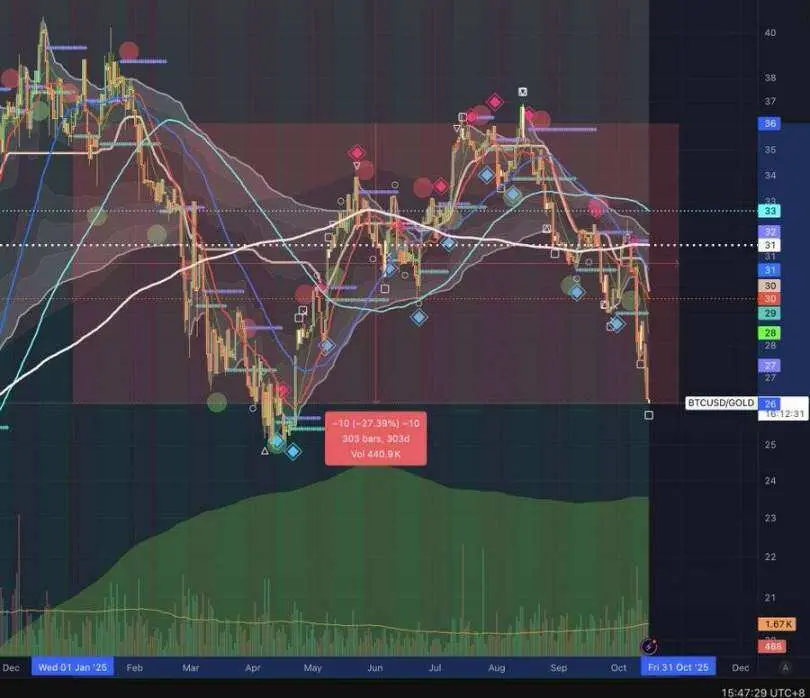
Believe it or not, Bitcoin has fallen over 25% against gold so far this year.
I still believe Bitcoin is not yet ready to become "digital gold." Although it shares similarities with gold in many ways, it is gradually getting closer to gold each year (except for the unresolved quantum computing issue).
However, if you try to buy gold, you will find that the premium on physical gold is very high, making it more suitable for buying and holding long-term, which is not very exciting. Therefore, I think retail investors might choose to buy Bitcoin instead of gold, but retail purchasing power is relatively low compared to central banks.
Bitcoin is now highly correlated with U.S. politics, which hinders other central banks' willingness to buy Bitcoin for de-dollarization. As far as I know, U.S. miners now account for about 38% of Bitcoin's hash power, while U.S. entities (ETFs, listed companies, trusts, and the government) control about 15% of Bitcoin's total supply and may continue to grow.
So, I don't know what will happen to Bitcoin relative to gold, but I think in the short term (until the end of this year), Bitcoin will continue to weaken against gold.
What am I doing?
Please do not follow my actions; this is not investment advice.
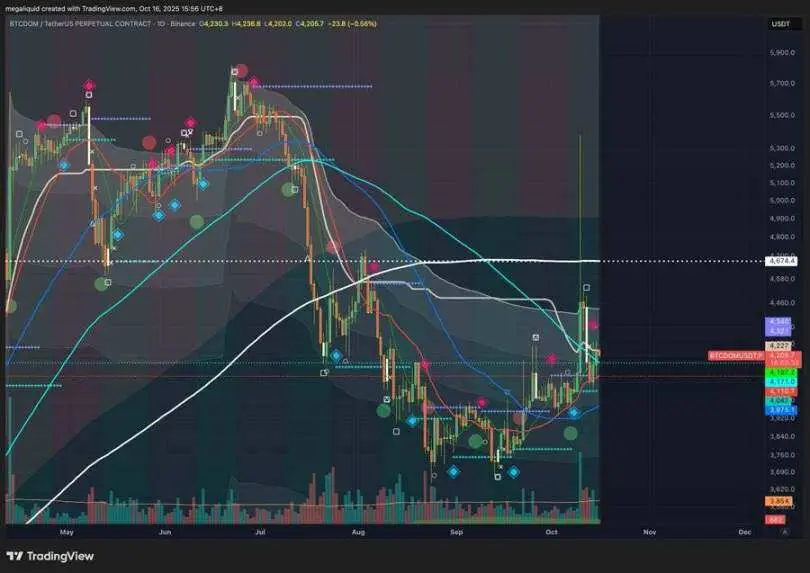
Long Bitcoin dominance (BTC DOM): I believe de-dollarization has a greater impact on Bitcoin compared to other altcoins. With the recent "Black Friday" crash, it is clear that Bitcoin is the only asset with real order book liquidity and buying pressure, and Bitcoin dominance currently appears to be on an upward trend. If I see altcoins performing well, I may stop this trade, but usually this happens after Bitcoin hits a new all-time high, which should further boost Bitcoin dominance.
Long gold: This basically means buying paper gold, selling put options, or buying call options. However, the principle of "not your keys, not your coins" applies here as well. I might just be holding a worthless piece of paper, but I have no objections to that for now.
Final thoughts
In short, I believe that due to the structural changes mentioned above, gold remains a good choice, but I would not be surprised if there is a 20-30% pullback in the short term, which could present a good long-term buying opportunity, provided the uncertainties mentioned above do not dissipate.
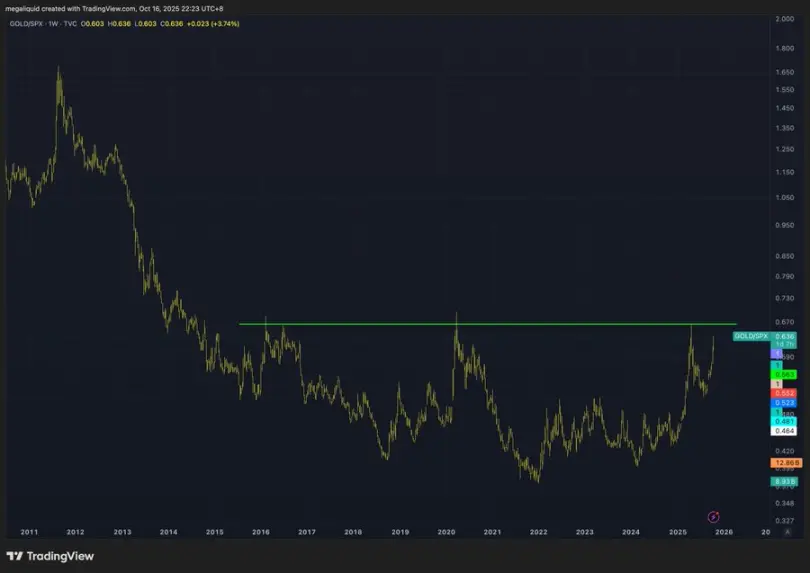
Additionally, gold is about to reach its resistance point relative to the S&P 500 index (SPX) and is approaching a market capitalization of $30 trillion, so these two factors could be potential local tops, and you might need to wait before entering a FOMO state.
Finally, this is another perspective I have on gold. As a quick conclusion, I believe gold still has room to rise:
· Gold rises if the U.S. economy or global stability is uncertain
· Gold rises if the U.S. economy or global stability becomes more unstable
· Gold falls if the U.S. economy or global stability becomes more stable
Original link ```
 Risk warning Risk warning