Exclusive Interview with Bitget CEO Gracy: Printing "Misunderstanding" on Cultural Creative Bags, Responding to the World with Humor
 Core Viewpoint
 From personal opinions, company strategy to family, Gracy has comprehensively shared Bitget's strategic evolution and business logic for the first time.
Author: Shenchao TechFlow
She is jokingly referred to as "very good at pretending," yet she boldly printed this teasing phrase on a cultural and creative bag and brought it to the industry conference.
As the leader of the world's top cryptocurrency exchange Bitget, Gracy has led this massive ship of 2,000 people from "pursuing quantity" to "pursuing quality" in her two years as CEO.
From deepening the Chinese market to global expansion, from being the first to launch the UEX strategy to embrace traditional assets, to going all-in on AI to welcome the silicon-based life era, Bitget is rapidly reshaping the trading ecosystem at an astonishing pace.
During the Web3 Carnival, we had an in-depth conversation with Gracy, where she comprehensively shared Bitget's strategic evolution and business logic for the first time, covering personal opinions, company strategy, and family. She also shared her transformation from Managing Director to CEO. In this uncertain period, let's see how this female leader navigates a "larger stage" with "a calmness in a corner." After shedding the halo of CEO, she reveals her softness and resilience as a single mother.
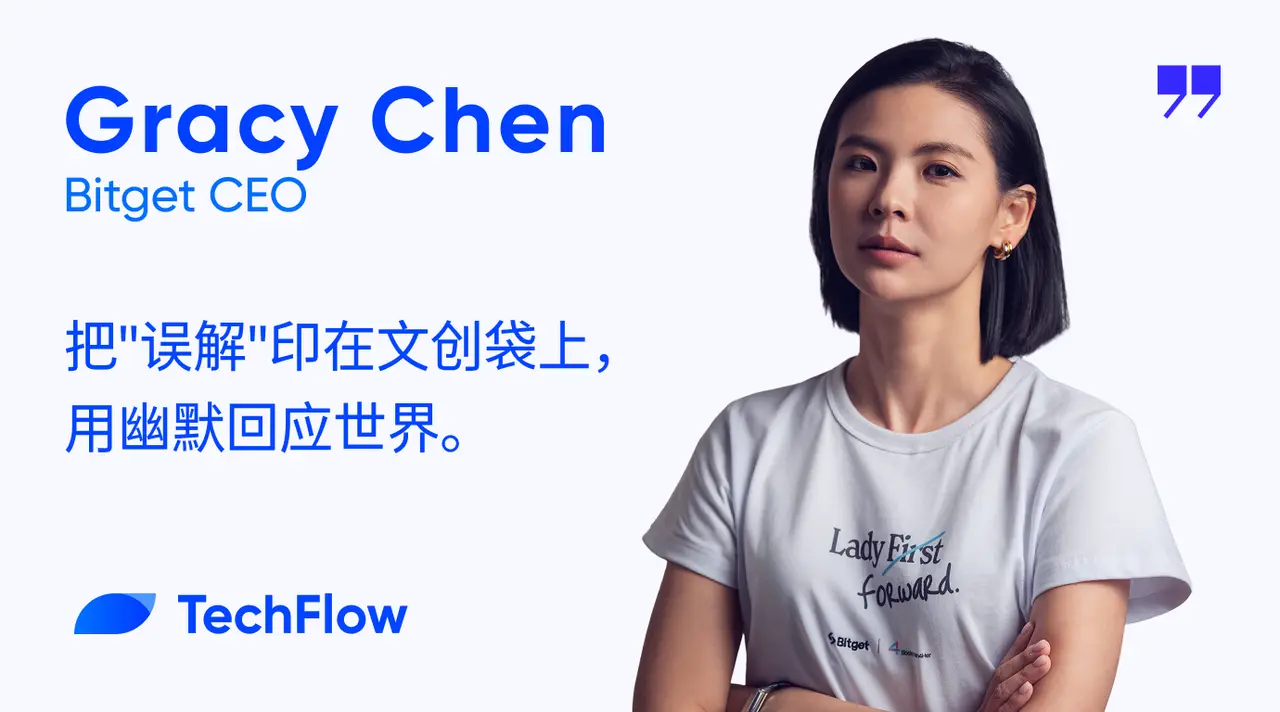
Facing criticism head-on, printing "misunderstanding" on the cultural and creative bag
Q1: You often appear in the Chinese market. In your opinion, which regions is Bitget currently most focused on, and how does the Chinese market differ from other regional markets?
Gracy:
The regions Bitget focuses on are the most active areas in the entire cryptocurrency industry.
The user base and trading volume of the Chinese-speaking region account for 25% to 1/3 of the global market share, with the U.S. market being similar. The European English-speaking (EUEN) market is large but fragmented, with differences in languages and cultures among countries, and the characteristics of Eastern and Western European markets are also vastly different. In the field of contract trading, some East Asian countries perform outstandingly; however, if we look at the spot market, the core regions mentioned earlier are the main markets, while emerging regions in Latin America, Southeast Asia, and Europe are new business growth points.
Bitget has been deeply involved in the industry for over seven years, serving over 100 countries globally, and possesses a global operational vision. Most core team members are of Chinese descent, and I personally grew up in the Chinese-speaking region, where Chinese is my mother tongue. Many team members come from traditional finance and Web2 tech industries, so our emphasis on the Chinese market is unquestionable. The Chinese-speaking market is our most familiar business area and one of the mainstream markets globally.
Q2: I see many posts about your travels and personal growth on Xiaohongshu. How do you balance travel and your work as CEO? What is your favorite travel destination and why?
Gracy:
I enjoy discussing such topics; it shouldn't always be about work.
New Zealand was my travel destination during last year's National Day holiday. Christmas, National Day, Labor Day, and Spring Festival are major holidays when many team members choose to take time off. During last year's National Day, I was invited to participate in a local innovation and entrepreneurship competition in New Zealand and gave a speech, while also interacting with several local friends, including a friend from my time at MIT who is now a member of the New Zealand Parliament. She even accompanied me on a tour of the New Zealand Parliament. I am accustomed to deep cross-border travel, usually staying for five to six days, and during my trip to New Zealand, I stayed for about seven or eight days, which felt very immersive and enjoyable.
Travel is important to me and our company. Although everyone is very competitive, and we are even known for being competitive, jokingly referred to as the Huawei of the crypto world, I want to clarify that this title does not mean we work excessively long hours; it reflects a "Work hard and play hard" spirit. For example, we do not require everyone to clock in at the office every day, even though we have offices in many parts of the world. We value results more, so as long as the results are achieved, you have flexibility.
Our team also needs to take vacations, but we care about ensuring that work continues even when people are on leave. Therefore, I usually plan my travels around these holidays. This year, during Labor Day, I happened to go to Miami to attend Consensus because we have some matters to handle in the U.S.
If it's purely for travel, I might prefer exotic places like Morocco and Turkey. However, for a more relaxing type of vacation, I really enjoy Italy. There are still places on my list that I haven't visited, such as Tanzania to see the animal migration, and I also look forward to more adventurous trips to the North and South Poles.
Q3: On Xiaohongshu, you have addressed negative reviews directly. What do you think are the most misunderstood evaluations of you? What is the truth?
Gracy:
Recently, we had a bag that became quite popular, right? At this year's conference, since we didn't have a booth, the marketing team suggested, "We don't have a booth, so let's create a mobile booth." They asked if I minded using my photo to make a standout bag. I immediately said it was fine. I remember there was a slogan that said, "I am socially anxious, but this bag is very socially confident." So I think there is a misunderstanding; people really believe I am very socially confident, but I am not socially anxious; I have recently started to enjoy spending time alone.
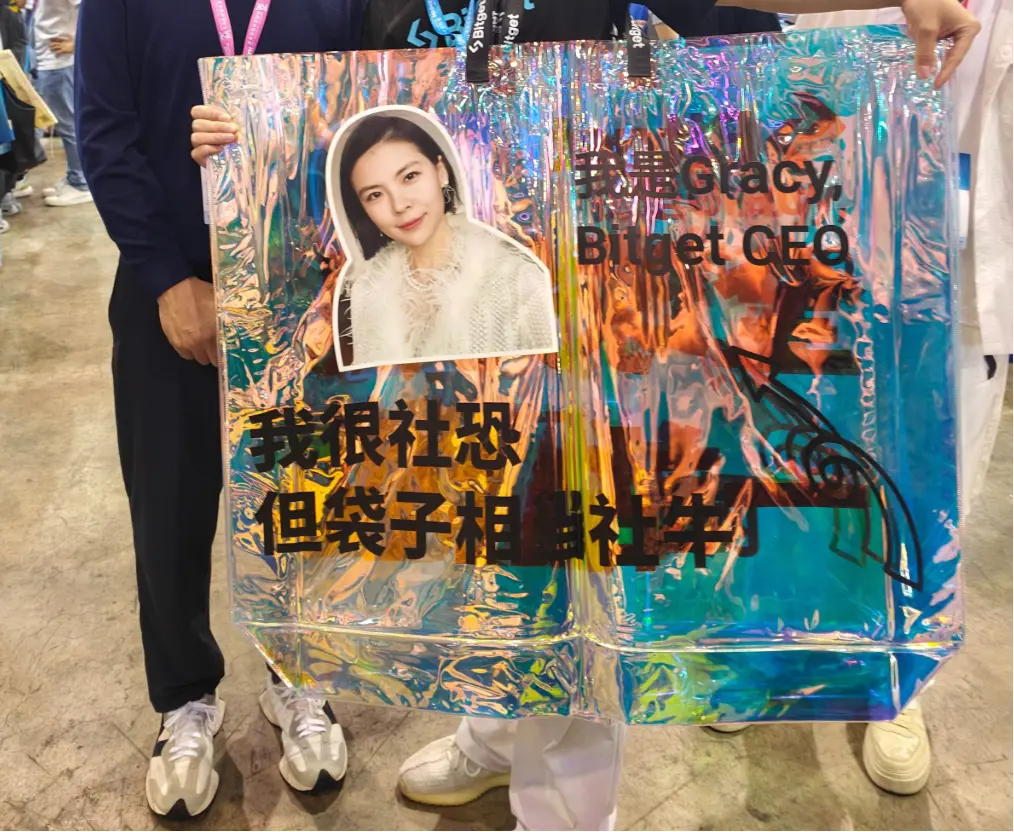
I think deep down, I am an E person, but because of this job, I have become more I. I believe the second misunderstanding is also presented on that bag, which says, "I am very good at pretending," so we printed all the misunderstandings directly on this bag. This is my way of responding, and I feel that since this industry is very competitive, attracting everyone's attention is a good thing in my view. So when people say, "Even negative attention is attention."
On the other hand, in today's era, people are quite tolerant. For example, people are tolerant of female CEOs, or female leaders who can be strong, have sharp opinions, and also have their personal lives. At the same time, I think people are also tolerant of brands that can use unconventional methods for communication and marketing.
However, there was a controversial incident where Bitget Wallet used a very eye-catching kissing photo from Dubai for a card. Our Wallet team obtained consent from both individuals, but it was sent out without my approval, and when I saw it, I felt it was a bit too much. Many netizens criticized it, so it was taken offline.
What I want to say is that from the company's perspective, we are open to innovation. I believe that in the process of such innovation, similar situations will arise, and we need to grasp the right balance. I think we must encourage this kind of innovation; if we cannot tolerate even minor mistakes, then no one will dare to innovate, and the core communicative power and creativity of the brand may manifest in these aspects.
Breaking the deadlock and reshaping: UEX strategy, RWA wave, and the new trading paradigm of the silicon-based life era
Q4: Bitget was the first to actively launch stocks, IPOs, and precious metals-related assets. I heard that some exchange users already account for a significant portion of stock trading volume. Can you share how user behavior and holding structures have changed after Bitget launched traditional assets? From a data perspective, how much do you think Bitget's UEX plan has achieved?
Gracy:
UEX is our long-term strategy, and gathering various assets is just the first step. From the data, we have already seen some changes; for example, in Q1 of this year, the non-crypto trading volume on our platform approached 40%. At the same time, we found that the user acceptance of non-crypto assets in the UEX sector has significant regional characteristics.
Taking U.S. stock tokens as an example, in regions with asset controls, foreign exchange restrictions, and high difficulty in opening U.S. stock accounts, users have a higher acceptance of our products. First, we do not engage in business with sanctioned countries; for example, we do not earn money from countries like Iran, no matter how much they offer. However, looking back a bit, there are indeed many regions where opening a U.S. account is quite difficult. We see that these users, when making global asset allocations, find us a logical choice because they previously had no other channels. We are not a dispensable existence but a necessity, so these regions exhibit such characteristics and show higher acceptance.
Secondly, over half of Bitget's users come from Asia. In January and February of this year, geopolitical conflicts caused significant fluctuations in precious metals and oil prices, and trading volumes surged, with gold trading volume on our platform nearing that of Bitcoin on some days.
Since launching the UEX strategy in September last year, we completed a large number of U.S. stock asset launches in Q4. In January of this year, we completed the layout of commodities like gold and oil through CFDs, as well as foreign exchange assets. However, users have an adaptation period for new products, and sudden events like geopolitical conflicts serve as catalysts for increased user acceptance. For instance, when gold prices significantly corrected, user trading activity also increased, and combined with leverage factors, the market experienced certain levels of liquidation, which is a normal phenomenon in high-volatility markets.
Looking at the UEX strategy now, I believe we have only completed the first stage. My definition of the first stage is to cover these assets relatively comprehensively. In the next stage, we need to continuously optimize the products we have launched.
For example, U.S. stock tokens are currently seen as quite mainstream in the RWA world. However, there are many others like Ondo and xStocks that have been around for nearly a year. Although we launched ours in September and October last year, we still encounter many issues. For instance, one major issue for users is whether dividends are paid. The design of the mechanism for whether dividends are paid is not easily perceptible, but in reality, dividends are paid; they just cannot be directly credited to your account. Instead, they are purchased through an underlying SPV, which is then reflected in the price. So you will receive the economic rights to the dividends, but you won't see the actual dividend payment. Because of this mechanism, the price of the underlying SPV, for example, this tokenized product, let's say Meta, hypothetically priced at $500, after a dividend is paid, it might become $510, but the underlying Meta is still $500, so users will feel that the price difference is growing, leading to discomfort. These issues are very difficult to detect.
If you don't engage in this, if you are not a trader, you might not think of this issue, and it is something we need to continuously optimize in the second stage. For instance, can we explore ways to communicate dividends better or how to help users perceive them more effectively? Additionally, extending trading hours like 24/7 or 24/5 sounds appealing, but how do we optimize liquidity during weekends when the U.S. stock market is closed? There are many such issues that we encounter when dealing with traditional assets.
Q5: I noticed that Bitget recently launched IPO Prime, which I understand is a key step in extending the UEX strategy from the secondary market to the primary market. What is the logic behind your choice to collaborate with Republic and launch preSPAX? Compared to other exchanges' on-chain models and reservation and derivatives models, what advantages do you see in Bitget's "compliant SPV + structured subscription" design?
Gracy:
I wrote an article sharing some stories behind our collaboration with Republic. I have known the two co-CEOs of Republic Crypto for many years, and there's a little anecdote: I was in the same group with their co-CEO Andrew at a closed-door meeting organized by Dragonfly, where we completed many tasks together and even won a championship. That was a very interesting experience and strengthened my personal relationship with Republic and Andrew.
We planned to launch the Pre IPO product last year because I knew they had a deep layout in this area, so I asked our team to talk to Republic. However, we couldn't just make a decision because Gracy and Andrew have a good personal relationship; it had to be based on facts. In fact, the team conducted extensive market research, and ultimately, we chose Republic because they have a wealth of licenses, including many in the U.S. and Europe. They have also issued U.S. stock pre-IPO tokens with some other exchanges and encountered some pitfalls, which could inform our product design and help avoid risks, such as wording issues. For example, when promoting, we refer to it as a debt instrument rather than equity. We do have a third-party SPV holding those equities, but we will have some compliance-related risk controls in our external communications.
We chose Republic primarily for their licensing, their existing experience, and their transparent mechanisms.
Republic's Pre-IPO product is somewhat more challenging than regular U.S. stock products because a company's IPO timing and pricing are not entirely predictable. For instance, with SpaceX, when will it go public? Elon Musk decides when it will go public. We have been designing this product since last year, but in February and March of this year, an event occurred where SpaceX merged with xAI and acquired Grok, leading to a situation where the SPV's partners discussing selling old shares suddenly stopped selling, or all prices changed, requiring renegotiation. There are many such details that you only realize when you actually work on the product; there are indeed quite a few pitfalls. We are also offering this to users at our cost price, so we are not looking to profit from this product but rather to provide benefits to users.
Many users ask why our valuation is $1.5 trillion, while Reuters estimates the post-IPO valuation at $2 trillion. Some on-chain platforms are already trading above a $2 trillion valuation, so users wonder why Bitget is so cheap. Are there risks associated with not having a 1:1 mapping? I want to explain that this is because we required our third-party SPV to acquire and confirm a valuation in the market six months ago. So the low valuation you receive is due to a time lag; this is the valuation we obtained six months ago, and now we are presenting it to you at this price point, so you are actually getting a bargain, rather than the underlying not being mapped. For us, 1:1 mapping is the most critical point when we create all RWA products. From the mechanism design of the Pre-IPO product, we will also ensure that after the IPO occurs, the price of the "pre-sale" tokens will align 1:1 with the asset's stock tokens.
Q6: You mentioned in an interview that "the four-year cycle still exists, but it has now been 'smoothed out' by Wall Street capital represented by ETFs and DAT." The global market is reassessing macro risks at a faster pace. What do you think the impact on exchanges is in this context, and what strategic shifts are there?
Gracy:
Of course, we have made significant strategic adjustments. Why do we have the UEX concept? Because we found that pure crypto no longer meets our users' needs or our own development cycle. There are some very definite trends in the market that we have observed and need to capture.
For example, the growth of stablecoins. Stablecoins are rapidly attracting more traditional funds, even family offices and endowment funds, especially for cross-border payments. The other day, a friend of mine, who has no connection to us, runs many stores in Yiwu, told me he has a lot of USDT. I asked why he has so much USDT, and he said everyone in Yiwu uses USDT because it's the best asset for cross-border transfers.
There are many similar scenarios, and I am certain that people will have more stablecoins in hand, and the proportion of stablecoins compared to fiat currencies will also increase. Therefore, we hope to capture the incremental trading of stablecoins because Bitget primarily focuses on trading. Bitget Wallet or some of our other sister companies may have more payment scenarios, but we believe that as stablecoins are used more for payments, they will also be used more for trading. So this is the first opportunity we want to capture, using U for trading.
The second opportunity is the RWA mentioned earlier. U.S. stock tokens currently account for 0.1% compared to U.S. stocks. This figure is at least 0.5% - 1% for RWA in money market funds and private credit products. I believe the tokenization process for U.S. stocks will accelerate significantly with the involvement of the NYSE and NASDAQ, potentially reaching a singularity, as we have discovered in our discussions with them that they are deeply exploring the direct issuance of a token with new companies going public. Although it is still based on existing platforms like ATS, the progress in tokenization is rapid because they have already submitted applications to the SEC; it just depends on when the SEC approves them.
We also hope to collaborate with them on some channels, but overall, RWA is growing. Gold can be tokenized, oil can be tokenized, and as mentioned, U.S. stocks can be tokenized, even Pre-IPO; many financial assets can be tokenized.
However, we also have a sense of boundaries. For instance, RWA in real estate is a hot topic, but as a global exchange, the RWA of Hong Kong properties compared to Dubai properties is too non-standard, and it is subject to local regulations and recognition, with many diverse rules. It is not typically the type of asset users want to trade. We will provide RWA that are more standardized financial assets.
So on this issue, we have basically decided not to engage in RWA for items like art and real estate, but we are very supportive of relatively standardized financial assets.
Q7: Bitget has been quite high-profile in AI, both in terms of internal employee usage and the launch of GetAgent. Why are you so optimistic about AI, and are you concerned about an AI bubble? Bitget currently has around 2,200 employees. If everyone fully utilizes AI, in what areas do you think the company will see qualitative changes?
Gracy:
Regarding bubbles, I think there is a bubble in AI assets, such as certain U.S. stocks, which are currently priced very high, especially some long-tail stocks. I think Nvidia is fine, but it is indeed expensive, and some long-tail AI stocks do have bubbles. However, I believe there is no bubble in the use of AI.
First of all, at least from our company's perspective, I was just chatting with one of our VIP managers about how many scenarios are currently using AI. I shared how I use AI.
I have tried many AI tools, such as Nano Banana, to create images with my son, which is more of a lifestyle application. I have been using AI for images and videos since the early days, like when Midjourney first came out; I was using AI to create images two or three years ago. Recently, I have been quite fascinated by Manus, eagerly awaiting my 8,000 credits to refresh each month. One interesting aspect in my world is that, for example, we are currently working on U.S. business, which I am personally leading. I feed a lot of content to my AI agent, who is a dedicated U.S. strategy officer in Manus, while avoiding information leaks. I provide it with content that I think is suitable for AI, and I tell it what meetings I have and what topics we need to discuss. I also want to find certain people, and I need to send a quick message to them on LinkedIn. I let AI handle all these tasks, and when I need to do something quickly, I have the agent research existing studies to tell me how we can collaborate.
I have also built a knowledge base for it, so it knows who Bitget is, who Gracy is, and understands my position and goals. Therefore, when it generates content for me, it does so very quickly without needing to repeat tasks. I even have an agent in Manus that teaches me how to date, which is quite fun.
I discussed with the AI lead, Bill, that our company had about 22 scenarios using AI at the end of last year, and it should be more now. In those 22 scenarios, AI is already being effectively utilized.
Returning to our core business scenarios, what have we done with AI? For example, in some basic scenarios, customer service, translation, and knowledge base establishment are all areas where AI has performed well. In compliance scenarios, such as KYT (know your transaction), AI is also used for detection. We believe that in the future, trading between AIs may surpass trading between humans. Therefore, we have developed many trading tools. This year's crayfish trend is quite popular, and we quickly launched GetClaw, which not only provides information but can also help you execute orders directly. For instance, you can tell your GetClaw what to do via Telegram, and it can give you advice on trading and what to pay attention to. All these tasks can be handled by AI.
I want to share a very important concept: we believe that in the future world, starting with Bitget, I have told the entire company that I think the future will be a collaboration between carbon-based life and silicon-based life. This trend is irreversible; you must embrace it, or you will be eliminated. Essentially, you are not being eliminated by the company, but by the era. Therefore, we advocate for everyone to use AI, and I believe that in this process, those who do not use AI will be eliminated, but more importantly, those who use AI effectively will see their efficiency multiply by 5 to 10 times.
Talking about role models, the first 35 years of riding the waves and the calmness in a corner
Q8: Last year, you should have just turned 35. If you had to summarize the first 35 years of your life in three words, what would they be? Compared to when you first became CEO of Bitget in 2024, what changes have you observed in Bitget, and what personal changes have you experienced?
Gracy:
The changes in Bitget from 2024 to now, the first thing that comes to mind is: our emphasis and definition of users have changed. In 2024, the TON ecosystem was very popular, and we had a close collaboration with TON, gaining many users. However, a significant adjustment we made in 2024 was to shift from purely adding user numbers, which was indeed the KPI for the team at that time, such as the requirements for the coin listing team to add KYC users and FTTS (First Time Trader) users. I think one adjustment I made was that instead of just looking at new users, we need to focus more on the value of each user, LTV (Long Term Value), and our VIP users and institutional users. So the company's KPI shifted from pursuing Quantity to pursuing Quality, which I think is a very important transformation.
The second change relates to the direction we discussed earlier. Since 2024, we have been responding to and observing changes in the era, with RWA and TradFi entering the market more. In January 2024, when the Bitcoin ETF was approved, and BlackRock issued the first Bitcoin ETF, you began to notice that many mainstream market institutions started paying attention to Bitcoin. After Bitcoin reached $100,000 last year, many of my wealthy friends and family offices came to ask me if they should allocate 5% of their assets to Bitcoin. When it hit $100,000, I actually advised many against it. If you look at my Twitter, I advised many against it, and although many criticized me at the time, in hindsight, advising against it at $100,000 was a good choice. I told them there is still a bull-bear cycle, especially not to use leverage, particularly at $100,000. I advised many friends like this. But this indicates that cryptocurrency is no longer a small circle; you must embrace regulation, compliance, and institutions to welcome these large amounts of capital. So this has also led to strategic adjustments in our company's development, which became more apparent last year.
As for my personal changes, I mentioned earlier that because this job is so E, I have become a bit more I. I have tested my MBTI, and I am an ENTJ, but my E and I have indeed moved closer to the middle. I used to be very E, but now I am too E, as my work requires a lot of external engagement, so I have become a bit more I.
The second important growth is a strong focus on business. I used to come from marketing, and when I was Managing Director before 2024, I was more like a CMO. However, as CEO, I need to consider many aspects, such as how to build a better team and how to manage a company of 2,000 people. Aligning everyone’s hearts on this matter is quite challenging, especially in hiring and utilizing talent. For example, in our current U.S. business, there are many details. I think if you had talked to me before 2024 about the mechanism design of IPO Prime or Ondo, I might not have been able to explain it clearly, and of course, those things didn't exist back then, but similar matters, I might not have focused too much on the business details.
The keywords for my first 35 years would be: the first keyword is "always moving towards a larger stage." Perhaps when I was at Chengdu No. 7 High School, I told myself that I was already in the best high school in Sichuan Province, and I had to go to the best university in Asia, so I went to the National University of Singapore. After going to Singapore, I thought I had to go to the best university in the world, so I later went to MIT. There has indeed been a continuous growth trajectory, and of course, in my career, I have transitioned from starting in Web2 to becoming CEO of Bitget and growing the company larger, which brings a lot of fulfillment.
The second keyword would be "calmness in a corner." I have become a bit more I, and sometimes I really enjoy the moments spent with my child.
The third keyword would be that I am not so pretentious anymore. As mentioned earlier, I used to be pretentious, but now I really enjoy watching stand-up comedy, and I even perform it. I have posted about stand-up comedy on Xiaohongshu, where I talk about it. I think making jokes about many things, including my comments on negative reviews, is because I no longer care so much about these matters, so I bring them up and even joke about them.
So it’s all about having fun; life itself is a one-way journey, and making it enjoyable is very important.
Q9: You often express concern for your son in many posts. If you were to find a role model for your son, who do you think it would be and why?
Gracy:
Sometimes I find that my son learns things from me at any time and place. So if you ask me who the most relevant person is right now, I would say I might be that role model.
When he was six months old, I noticed an interesting action of his. He took a sip of water from his bottle, finished it, and then said "hey." I thought, where did that "hey" come from? Our nanny said, "Have you noticed that sometimes when you finish something, you are also happy like that?" I realized that even at six months, he was constantly learning my actions. Especially since I am now a single mother, there is no husband or father figure in my world; my son's father last saw him in 2022. Therefore, my influence on him, along with my parents helping me raise him, creates a very small circle of family influence on him.
But I also hope that one day I will no longer be able to be his role model, and he will surpass me and find his next ideal role model.
Q10: Who is a historical figure you admire the most? What qualities do you find attractive in him/her?
Gracy:
I have several role models, to be honest. For instance, in building Bitget, I really admire JP Morgan. I am also reading his biography, and we have encouraged many executives in the company to read it together because he lived during a transformative financial era from the 19th century to the early 20th century. During the Gilded Age, many events occurred, especially in the U.S., where rapid industrialization was taking place, and the financial structure was undergoing a major reshuffle, even before the Great Depression. How did he respond to such a transformative financial era? We can relate to this because crypto is currently reshaping traditional finance, and we have the opportunity to build a billion-dollar company at this historical juncture, which I find very mission-driven, so I appreciate this perspective of JP Morgan.
From an investment perspective, I admire Duan Yongping and Li Lu, who are deeply influenced by Buffett's value investing. When I applied to business school, I seriously considered Columbia University because its value investing program is excellent, and there are many opportunities to learn from these masters on Wall Street.
As for life role models, if I had to choose, it might be Yang Lan, who was a role model for me when I was younger because I found her to be a very intellectual sister. When I was a teenager, I read her book "Facing the Sea," and I liked it very much. I also worked at Yang Lan's Sunshine Media Studio during my internship and met her, where I did quite a bit of work. Many of my role models, I have had the chance to meet and learn from. However, I have never met JP Morgan, so he is truly a historical figure.
 Risk warning