The private key of 15 billion dollars in Bitcoin was accidentally cracked by the United States
 Core Viewpoint

 Is my on-chain wallet still my wallet?
Author: BUBBLE
In October 2025, the U.S. District Court for the Eastern District of New York disclosed an unprecedented case of cryptocurrency asset seizure, where the U.S. government confiscated 127,271 bitcoins, valued at approximately $15 billion at market prices.
Cobo co-founder Shen Yu stated that law enforcement agencies did not obtain the private keys through brute force cracking or hacking but exploited a randomness vulnerability. Some forums also claimed that law enforcement directly seized the mnemonic phrases or private key files from servers and hardware wallets controlled by Chen Zhi and his family from the Prince Group, but the specific facts have not yet been publicly reported.
These hardware wallets were subsequently transferred to a multi-signature cold storage managed by the U.S. Marshals Service (USMS) under the U.S. Department of the Treasury. The transfer of 9,757 BTC signed by the USMS to the official custody address on October 15, 2025, originated from this seizure. The U.S. Department of Justice described Lubian as part of the money laundering network of the Cambodian Prince Group, emphasizing that the criminal organization attempted to launder scam funds using "new coins" mined from pools.
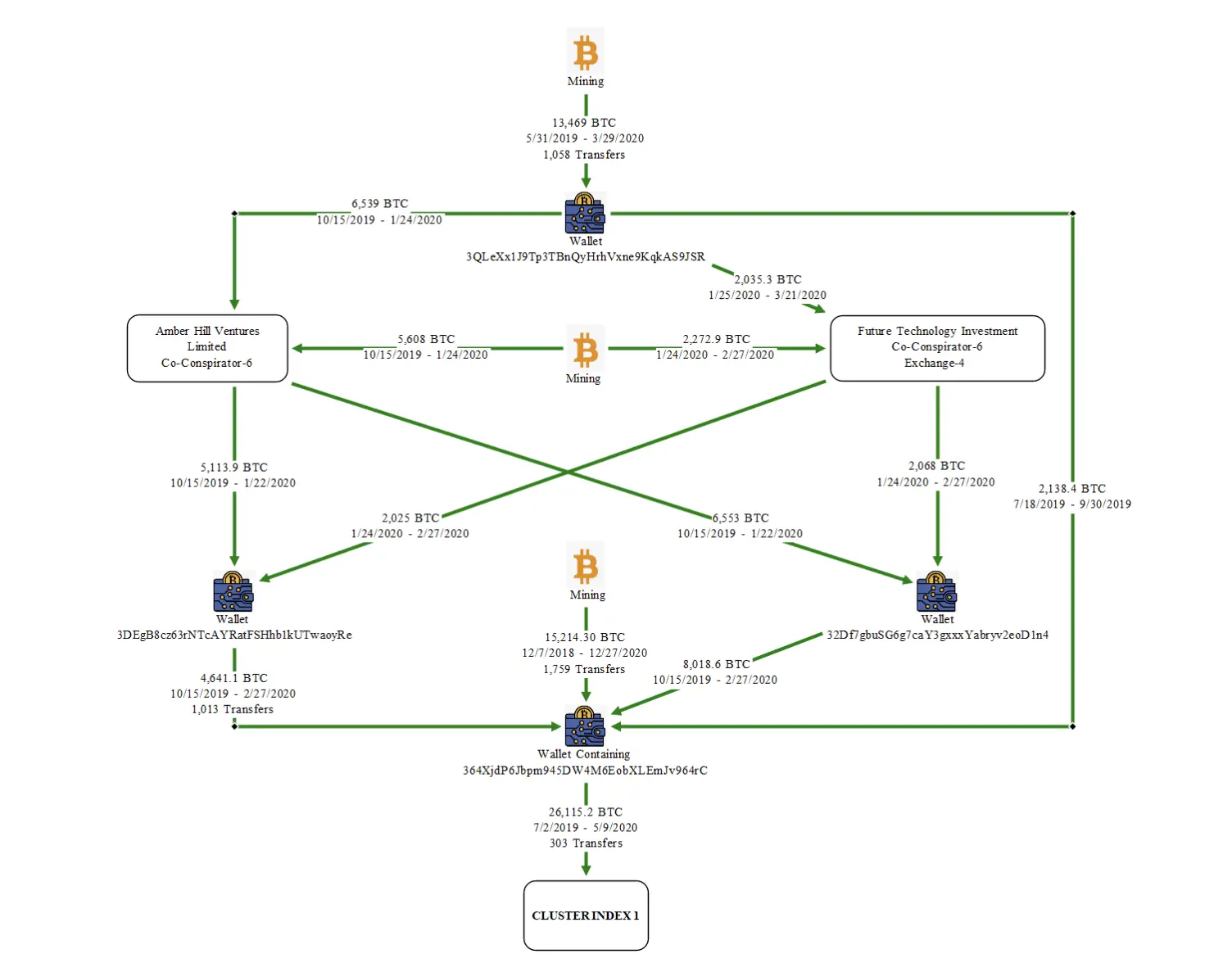
Some community members tracked on-chain data and determined that this batch of bitcoins was the one stolen from the Lubin mining pool due to a vulnerability at the end of 2020. The Lubin mining pool suddenly appeared in 2020 without any team background information or disclosed operational model, yet its hash rate quickly ranked among the top 10 mining pools in the world, once accounting for nearly 6% of the global hash rate.
The report mentioned that Chen Zhi boasted to others in the Prince Group that "profits are considerable because there are no costs," but it is still unclear whether this was established by Chen Zhi or controlled later. However, this case has brought the dormant whale back to the surface, prompting a reevaluation of the wallet private key security disaster that lurked around 2020.
During subsequent investigations, researchers found that the first two words of the mnemonic from the damaged key generation process were "Milk Sad," which later became known as the Milk Sad incident.
Hidden Dangers of Weak Randomness
Everything originated from the Mersenne Twister MT19937-32, a pseudo-random number generator.
Bitcoin private keys should consist of 256 bits of random numbers, theoretically allowing for 2^256 combinations. To generate an identical sequence, all 256 "coin tosses" must perfectly match, which cannot be said to have a probability of 0, but it is very close. Wallet security does not come from luck but from this vast space of possibilities.
However, tools like the Lubian mining pool used the Mersenne Twister MT19937-32 random number generator, which is not a truly fair "coin toss machine," but rather like a jammed device that always selects numbers within a limited and regular range.
Once hackers grasped this pattern, they could quickly enumerate all possible weak private keys through brute force, thereby unlocking the corresponding Bitcoin wallets.
Due to some wallet or mining pool users' misunderstandings about security, between 2019 and 2020, many Bitcoin wallets generated using this "weak random algorithm" accumulated astonishing wealth, with a large amount of funds flowing into this fragile area.
According to statistics from the Milk Sad team, the number of bitcoins held by these weak key wallets exceeded 53,500 at one point between 2019 and 2020.
The sources of funds included whale-level concentrated transfers; in April 2019, four weak wallets received about 24,999 bitcoins in a short period. There were also daily mining rewards, with certain addresses receiving over 14,000 miner rewards marked as "lubian.com" within a year. Currently, it is found that there are a total of 220,000 such wallets, and the holders clearly did not realize the risks in the private key generation process, continuously pouring assets into them to this day.
Large-Scale Withdrawal at the End of 2020
The long-standing security vulnerability erupted at the end of 2020. On December 28, 2020, abnormal transactions appeared on-chain, with a large number of wallets in the Lubian weak key range being drained within hours, with approximately 136,951 bitcoins transferred out in one go, valued at about $3.7 billion at the time's price of around $26,000 per bitcoin.
The transaction fee was fixed at 75,000 sats, remaining consistent regardless of the amount, indicating that the operator was well-versed in the Bitcoin network. Some of the funds subsequently flowed back to the Lubian mining pool for future mining rewards, suggesting that not all transferred assets fell into the hands of hackers. However, for the victims, the losses were a reality.
Even more bizarrely, some on-chain transactions carried messages such as "To the white hat saving our assets, please contact 1228btc@gmail.com." Since the weak private key addresses had already been exposed, anyone could send transactions with messages to these addresses, and this information did not necessarily come from actual victims.
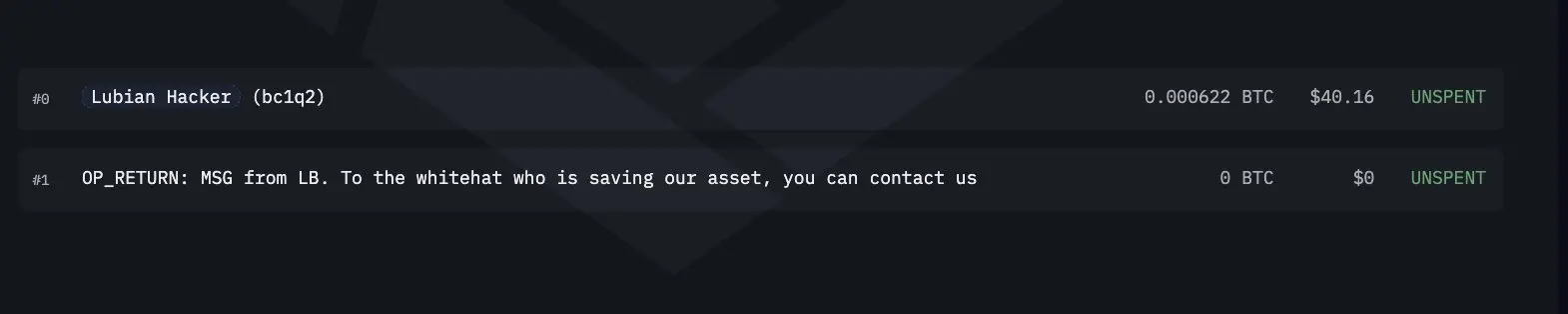
It remains unclear whether this was a hacker's mockery or a victim's plea for help. The fatal issue was that this massive transfer was not immediately regarded as theft.
Researchers from Milk Sad later admitted in their analysis that at the time, Bitcoin prices were soaring, and mining pool revenues had stopped. They were uncertain whether it was the work of hackers or if the Lubian management sold at a high point and reorganized wallets. They pointed out, "If the theft occurred in 2020, it would have been earlier than the confirmed timeline of the Mersenne Twister weak key attack, but we cannot rule out this possibility."
Due to this uncertainty, the fund withdrawal at the end of 2020 did not trigger industry alarms, and the massive bitcoins remained dormant on-chain for years, becoming an unresolved mystery.
Thus, it was not just Lubian that was affected, but also the old version of Trust Wallet. On November 17, 2022, the security research team Ledger Donjon first disclosed the random number vulnerability in Trust Wallet to Binance. The team responded quickly, pushing a fix to GitHub the next day and notifying affected users in succession.
However, it was not until April 22, 2023, that Trust Wallet officially disclosed the vulnerability details and compensation measures. During this period, hackers had launched several attacks exploiting the vulnerability, including stealing about 50 bitcoins on January 11, 2023.
Delayed Alarm
Meanwhile, the vulnerability was brewing in another project.
The bx seed command of Libbitcoin Explorer version 3.x used the MT19937 pseudo-random number algorithm combined with 32-bit system time as a seed, generating a key space of only 2^32 combinations.
Hackers quickly began exploratory attacks, and from May 2023, multiple small thefts appeared on-chain. On July 12, the attacks peaked, with a large number of wallets generated by bx being emptied. On July 21, Milk Sad researchers found the root of the problem while helping users investigate losses; it was indeed the weak randomness of bx seed that allowed private keys to be brute-forced. They promptly reported this to the Libbitcoin team.
However, since this command was regarded as a testing tool by the official team, initial communication was not smooth. The team ultimately bypassed the project party and publicly disclosed the vulnerability on August 8, applying for a CVE number.
It was only due to this discovery in 2023 that the Milk Sad team began to reverse-engineer historical data. They were astonished to find that the weak key range that accumulated massive funds between 2019 and 2020 was linked to Lubian and that the massive transfer mentioned earlier occurred on December 28, 2020.
At that time, about 136,951 bitcoins resided in these weak wallets, and the large-scale outflow that day was worth approximately $3.7 billion, with the last known movement being a wallet consolidation in July 2024.
In other words, the suspicious aspects of the Lubian incident only emerged after the weak randomness vulnerability was exposed. The missed alarm window was long gone, and the whereabouts of the bitcoins at that time had also vanished without a trace. Five years later, it was only when the U.S. Department of Justice (DOJ) and British authorities jointly prosecuted the Prince Group and Chen Zhi that things began to take shape.
For us, the phrase "Not your Wallet, Not Your Money" can only take effect under the premise of randomness.
 Risk warning
 Risk warning




Popular articles