What other projects can be focused on besides炒 Meme?
 Core Viewpoint

 x402 ecological comprehensive sorting, protocols, infrastructure, and applications.
Author: Viee, Core Contributor of Biteye
To understand x402, we need to start with a "legacy feature" that has been shelved for nearly thirty years.
As early as 1997, the HTTP protocol reserved status code 402, representing "Payment Required." However, it has been unused due to a lack of viable payment methods.
Today, with the maturity of crypto-native stablecoins, L2 reducing payment costs, and the rise of AI Agents bringing real micro-payment demands, Coinbase has launched the x402 protocol using this "long-dormant button": allowing anyone or AI to access paid content without needing to register an account or redirect to another page, enabling on-chain payments.
What seems like a simple "automatic payment" is actually a whole ecosystem being rebuilt. From protocol standards to infrastructure, and then to upper-layer applications, x402 has the potential to reconstruct the payment logic of the internet.
This article will delve into this emerging x402 ecosystem to see what protocols, chains, infrastructures, and applications can truly operate beyond just memes.
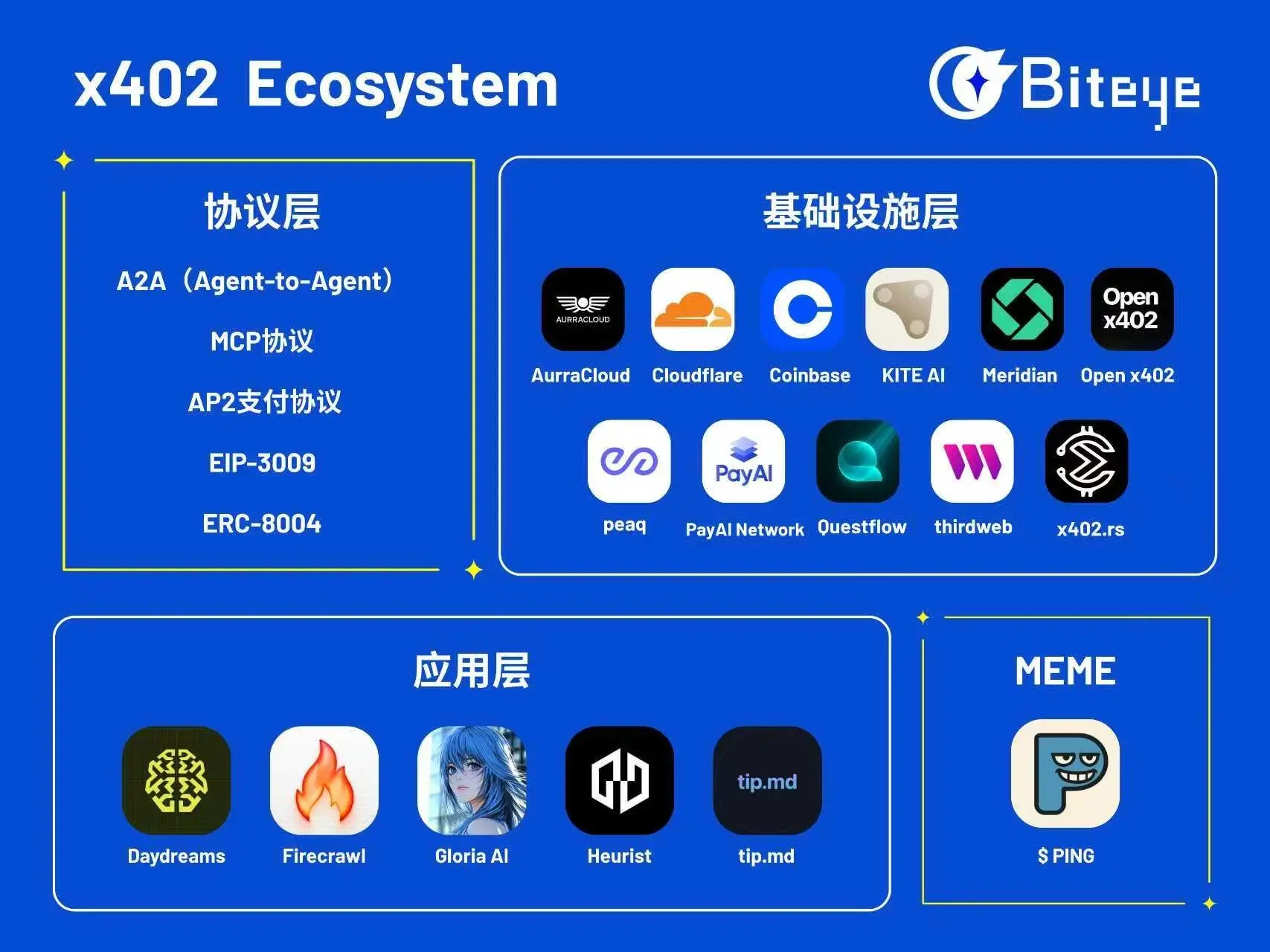
1. Protocol Layer: Enabling Payment Capabilities for AI Agents
The protocol layer of x402 is not a single standard but a modular combination that addresses three key issues: how AI Agents communicate, how they make payments, and how they establish identity and trust.
At its core is the x402 protocol itself, designed based on the HTTP 402 status code, allowing AIs to automatically receive payment requests when accessing paid content or APIs, and to complete on-chain transfers using stablecoins like USDC, all without registration or redirection.
To facilitate collaboration between AIs, Google proposed the A2A (Agent-to-Agent) protocol to standardize communication and task handover between agents. Anthropic also launched the MCP protocol, providing access tools and context data interfaces for AIs. Based on MCP, Google further released the AP2 Payment Protocol, enabling AI Agents to call services on demand and complete automatic payments, while being compatible with traditional payments and x402.
The key to implementing these protocols is Ethereum's EIP-3009 extension. It allows users to authorize token transfers via signatures without paying Gas fees, solving the payment challenge of "AI wallets lacking ETH." Complementing this is the ongoing ERC-8004, which establishes an on-chain identity and reputation system for AI Agents, recording execution records and trust scores to help service providers assess the reliability of agents.
In summary, the x402 protocol layer is gradually building a "language + currency + trust" system for AI services, enabling AI Agents to complete transactions, collaborations, and payments without human involvement, which is the first step for the entire ecosystem to function.
2. Infrastructure Layer: Making Payment Requests Operate
The x402 protocol defines the solution, but what truly makes it operational is a complete set of infrastructure responsible for verifying requests, completing payments, coordinating services, and linking AIs to the blockchain.
First is Cloudflare (@Cloudflare). As a global cloud platform, it co-founded the x402 Foundation with Coinbase and integrated the protocol into its CDN nodes and development tools. Cloudflare not only provides a global distribution network but also supports a delayed payment mechanism of "use resources first, pay later," helping AI Agents smoothly access content and complete settlements.
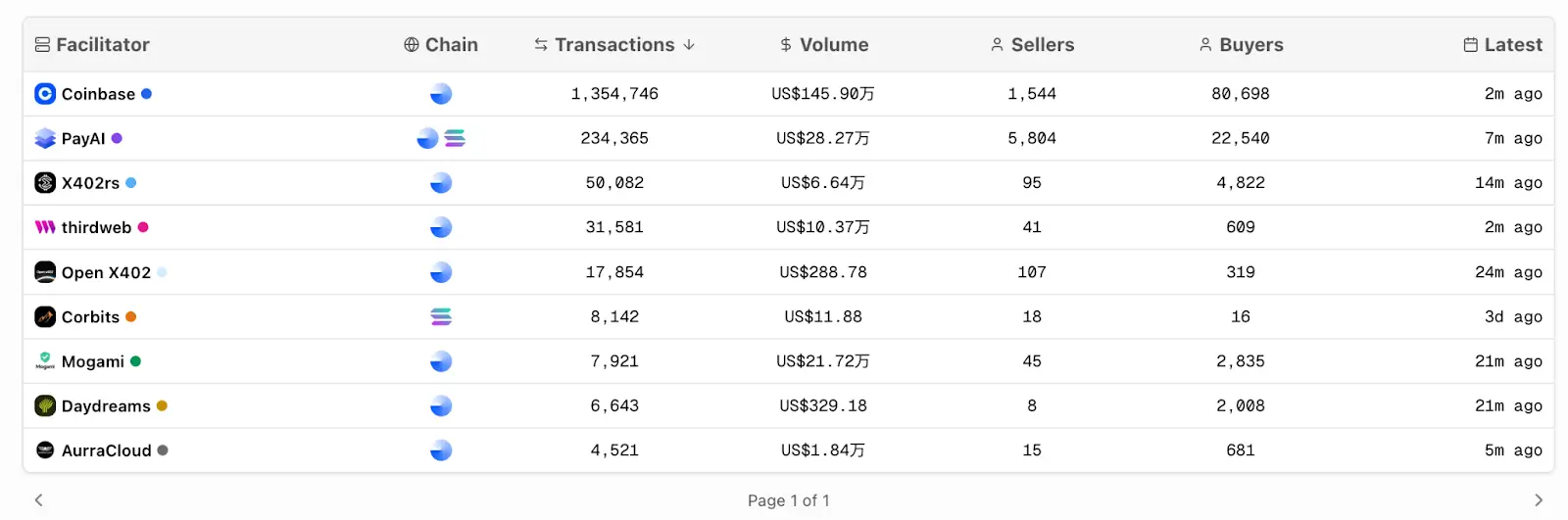
Next is the x402 Facilitator, a payment aggregator (including multiple projects) responsible for helping AI agents complete a series of on-chain processes such as "payment on behalf, settlement, broadcasting." Users or AIs only need to initiate an HTTP 402 request, and the Facilitator will pay Gas, package transactions, and complete on-chain broadcasting. The settlement process uses the EIP-3009 standard, allowing for one-time authorization of USDC deductions, simplifying on-chain interactions significantly without requiring AI to hold tokens or manually sign.
From the data in the chart below, Coinbase (@coinbase) remains the largest Facilitator, processing over 1.35 million transactions, covering 80,000 buyers; PayAI (@PayAINetwork) ranks second, active on chains like Solana and Base, with a cumulative transaction volume of $280,000, and even surpassing Coinbase in user numbers. Other projects like X402rs, Thirdweb (@thirdweb), and Open X402 (@openx402) are also competing for market share.
Source: https://www.x402scan.com/facilitators
Beyond the Facilitator, there has also emerged a "native settlement blockchain" specifically built for x402. A representative project is Kite AI (@GoKiteAI), one of the first Layer 1 blockchains to fully embed x402 payment primitives at the base layer, supported by institutions like Coinbase Ventures and PayPal Ventures. It does not directly handle payment verification (not a Facilitator) but provides an execution and settlement environment for x402 transactions, allowing agents to automatically initiate, receive, and reconcile on-chain payments through standardized authorization commands.
On the execution level, besides the native chain designed for AI payments, Peaq (@peaq) in the DePIN field is also playing a key role. Peaq is a public chain focused on the machine economy, natively supporting the x402 protocol, enabling automatic payments and settlements between devices and agents.
The representative project of the x402 collaboration layer is Questflow (@questflow), where developers can publish agent tasks, set prices, and complete on-chain settlements directly through x402, having already partnered with Virtuals, Gate, and others.
Additionally, AurraCloud (@AurraCloud) and Meridian (@mrdn_finance) provide multi-chain settlement and custody services for the x402 protocol.
In summary, the x402 infrastructure layer is being built around three core issues: how to send requests, how to securely receive payments, and how to quickly land on different chains, which determines whether the entire payment system can truly operate.
3. Application Layer: What Are the Real Applications Using x402?
With the x402 protocol and infrastructure in place, we need to see if the application layer is active, and currently, there are very few projects that have landed.
- Daydreams (@daydreamsagents): Building an LLM inference platform with x402 payments.
- Heurist Deep Research (@heurist_ai): A Web3-native AI research platform where users pay in USDC per query, automatically generating multi-page research reports.
- Gloria AI (@itsgloria_ai): Implementing pay-per-use news through x402.
- Snack Money API: A micro-payment interface for X, Farcaster, etc., focusing on small payments and tips around identity and social interactions.
- tip.md (@tipdotmd): Enabling AI assistants to directly help users complete crypto tips in chat interfaces, with USDC tips going through the complete payment process via MCP + x402.
- Firecrawl (@firecrawl_dev): A web scraping and cleaning API that converts websites into LLM-compatible data, charging per call through x402.
Overall, the application layer of x402 is still exploring, with functional platforms just starting out and not yet forming a scale effect. It remains to be seen who can first create truly usable, payable, and reusable products.
4. Meme: Price and Popularity Fluctuations
As the popularity of x402-related concepts rises, the market has quickly seen a batch of "narrative-surfing" native meme projects, the most representative being PING, issued on the Base chain. On the day of its launch, its market value quickly surpassed ten million dollars.
In addition to PING, tokens like "PENG" and "x402" have also emerged in the community. These meme tokens currently do not constitute the core of the protocol but can provide attention, popularity, and early liquidity.
5. What Challenges Does x402 Face from Protocol to Implementation?
Despite the eye-catching concept of x402, there are still many practical issues to overcome for it to truly land.
First, there is a lack of truly usable products. Most projects are still in the testnet or proof-of-concept stage, and the user experience is currently rough.
Second, the technology stack is complex, and integration costs are high. x402 involves a new set of protocols, integrating payment, signature transfers, agent communication, and other modules, which poses a high barrier for developers.
Third, there are compliance risks. While promoting "no accounts, no redirect payments" for efficiency, it bypasses the KYC/AML requirements of traditional payment systems, potentially raising regulatory concerns in certain regions.
Fourth, network effects have yet to form. The core of a payment protocol lies in ecological collaboration, but currently, there are not many services and platforms integrated with x402, and the ecosystem has not yet formed a self-circulation.
In summary, x402 is still some distance away from "widespread use," with multiple barriers to overcome from technology to real-world implementation.
6. Participation Opportunities
From a participation perspective, the long-term opportunities of x402 lie more in the layout of infrastructure and key platforms.
First is the foundational chain and infrastructure. x402 relies on Ethereum ecosystem standards like EIP-3009 and ERC-8004, with Base being the primary landing chain, having a strong stablecoin closed loop and a developer-friendly environment, likely to incubate leading products first. Solana also has advantages in high-frequency payments, suitable for Agent micro-transaction scenarios.
Second is the native settlement blockchain Kite AI, as well as payment aggregators and service platforms like PayAI, Meridian, and AurraCloud, which are responsible for verifying payments, bearing Gas costs, and connecting APIs. Once a universal entry point is formed, the value will rapidly amplify.
As for the token side, it's best to be cautious. Currently, x402-related tokens are small in size and highly volatile, with many meme coins still in the narrative-driven stage. Projects that genuinely possess payment landing or platform usage value are more worthy of attention.
7. KOL Perspective
In the current market with diverging voices, the views of many frontline builders and KOLs on the x402 ecosystem are also worth noting.
Haotian @tmel0211 pointed out that the current x402 craze is largely driven by meme speculation; however, the real "main course"—the technical landing and ecosystem formation—has yet to begin. Only through market selection will quality projects emerge. He believes that treating x402 as a short-term speculation misreads the logic and rhythm of the entire track.
Laobai @Wuhuoqiu, from a historical perspective, noted that micro-payments are not a new concept. From early Bitcoin and the Lightning Network to Nano, IOTA, and BSV, the crypto space has attempted to promote small transaction applications multiple times but has always struggled to land on a large scale. The difference with x402 is that it has found the true "subject" that needs micro-payments: AI Agents, rather than human users.
Danny @agintender further elevated the perspective, pointing out that the greater potential behind x402 is the payment infrastructure for the "machine economy." From on-chain knowledge collaboration and API economy to AI-driven DAO governance, all these M2M (machine-to-machine) transaction demands inherently require a frictionless, account-free, and automatically executable payment layer.
Lanhu Biji @lanhubiji, from an architectural standpoint, believes that the Facilitator, as a key link in payment verification and execution, is becoming one of the most critical infrastructures in the track. Projects like PayAI, Coinbase, and Pieverse have already formed a clear competitive landscape.
Finally, Zhixiong Pan @nake13 raised a long-term perspective question: Can Agents truly "hold tokens and make payments"? This involves key mechanisms such as private key custody and permission management.
In summary, while the popularity of x402 may fluctuate, in the eyes of long-termists, it has just entered a true construction phase.
 Risk warning Risk warning



Popular articles