TRON Industry Weekly Report: US stocks pull back, funds flow into the crypto market, BTC hits $80,000, detailed explanation of building institutional-level sustainable returns and on-chain credit infrastructure Cap

 A detailed explanation of building institutional-level sustainable revenue and on-chain credit infrastructure Cap & on-chain revenue infrastructure layer aimed at institutional funds.
I. Outlook
1. Macroeconomic Summary and Future Predictions
Macroeconomic summary from August 16 to August 23, 2026: The main theme globally this week is "resurgence of inflation pressure + high long-term interest rates + growth differentiation." In the U.S., the minutes from the July FOMC meeting were released on August 19, indicating that "multiple" officials believe that if inflation does not continue to decline, interest rate hikes will still be necessary in the future, with the current federal funds rate maintained at 3.50%--3.75%. Meanwhile, the number of initial jobless claims fell to 206,000 for the week ending August 15, indicating that layoffs remain low, but the U.S. real estate market continues to face pressure, with single-family housing starts declining by 9.9% month-on-month in July and total housing starts down by 12.4%. As a result, the market has repriced the possibility of "high rates lasting longer," with the 10-year U.S. Treasury yield briefly returning to around 4.7% and the 30-year yield approaching 5.25%. Major U.S. stock indices generally closed lower for the week; the fiscal deficit and long-term U.S. Treasury supply pressures further amplified yield volatility. Meanwhile, the situation in the Middle East continues to drive up energy costs, with Brent crude oil rising back above $90 per barrel, reinforcing global imported inflation risks.
Predictions for the upcoming week (August 24 to August 30): Market focus will be on the Jackson Hole Global Central Bank Annual Meeting, signals from Federal Reserve Chairman Kevin Warsh, as well as U.S. PCE, revised Q2 GDP, and durable goods orders. The market has already re-priced the possibility of about one 25bp rate hike before the end of the year, so if Warsh continues to emphasize inflation stickiness, fiscal expansion, and energy price risks, long-term U.S. Treasury yields may remain high, providing temporary support for the dollar, while high-valuation growth stocks and risk assets still face valuation compression pressure; conversely, if core PCE shows a significant cooling and Warsh's statements are neutral, long-term rates are expected to decline, leading to a rebound in risk assets.
2. Market Changes and Warnings in the Crypto Industry
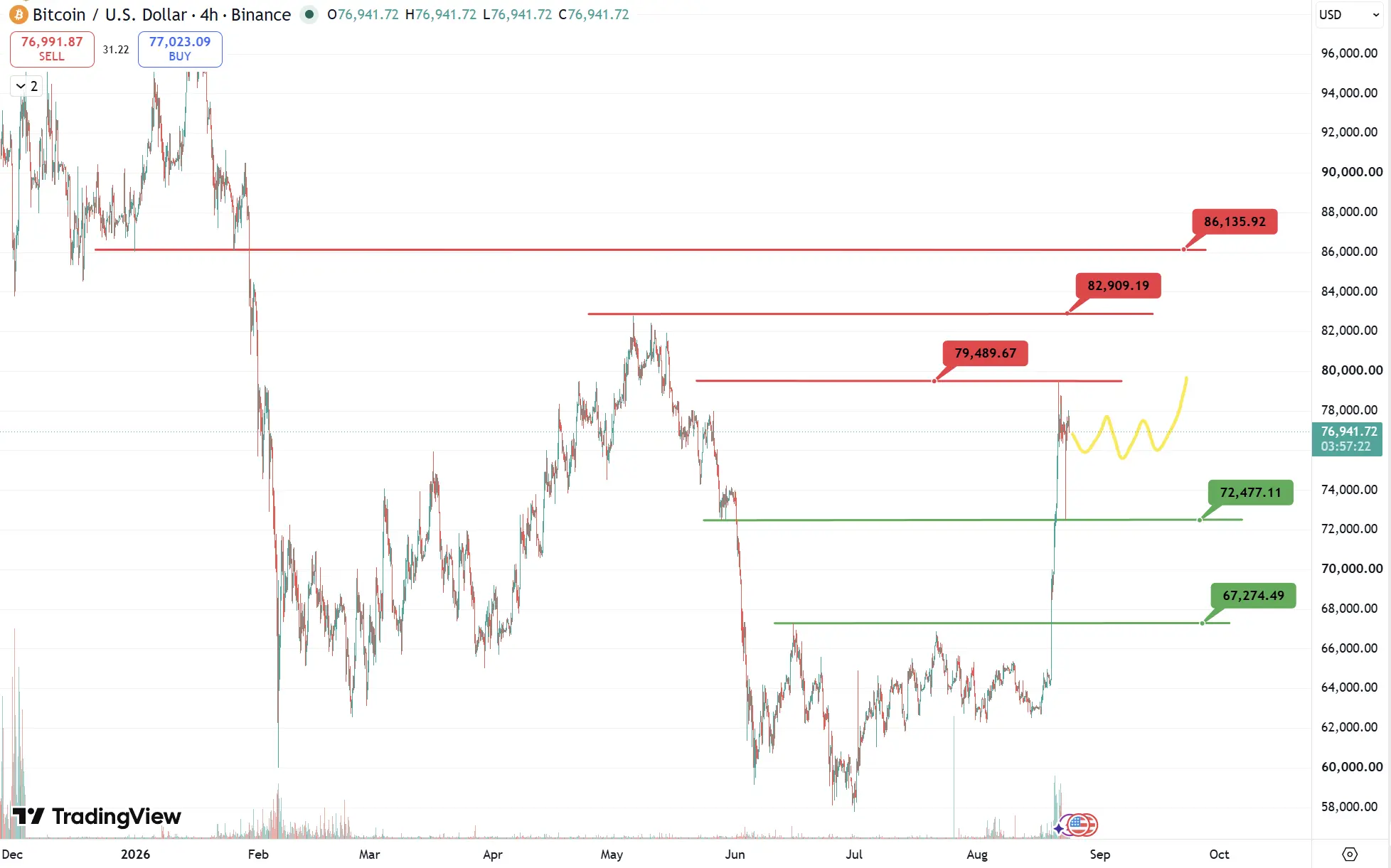
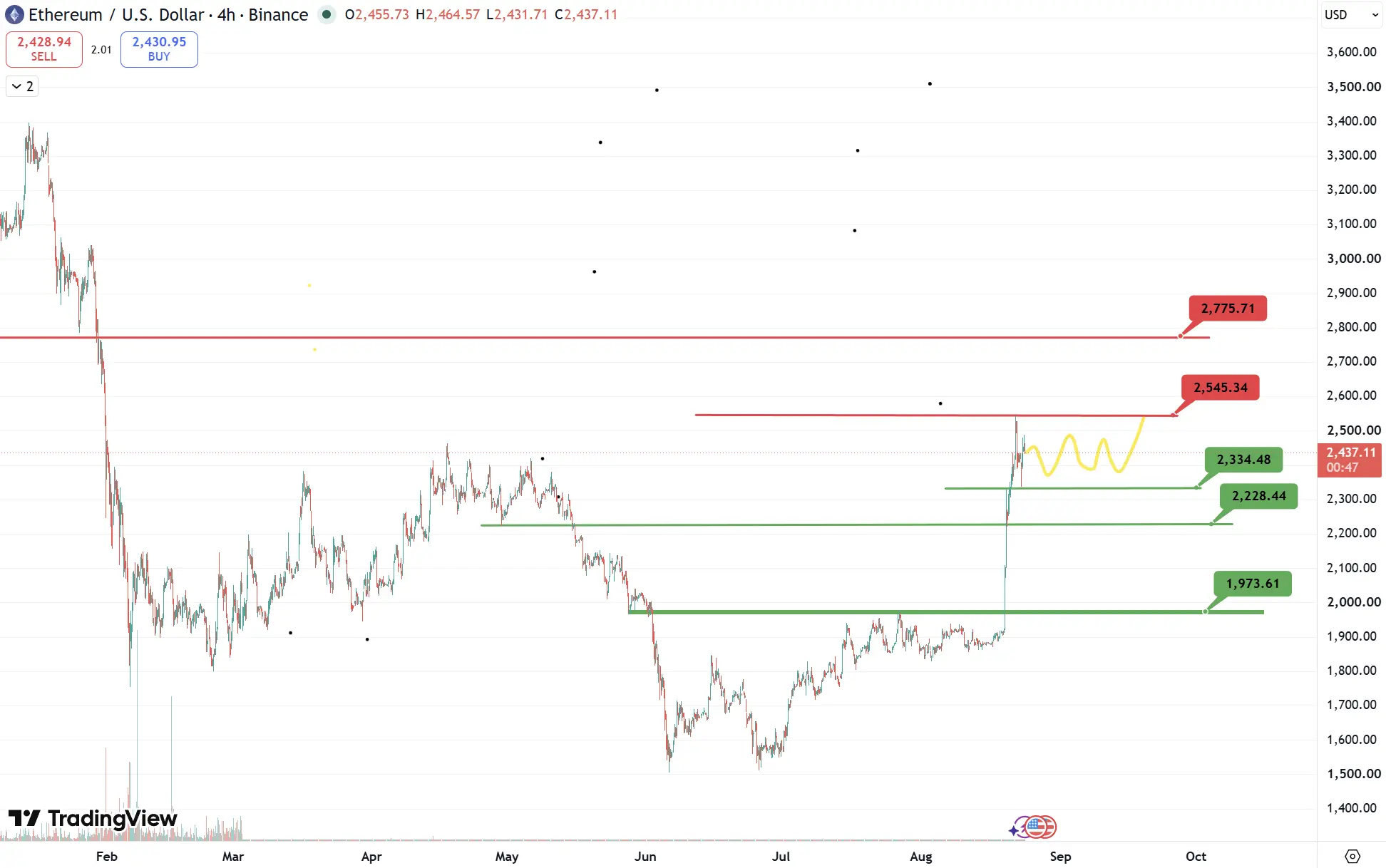
Market changes from August 16 to August 23, 2026: The crypto market saw a significant recovery in risk appetite this week, with BTC rising rapidly from about $62,819 on August 16, peaking at around $79,306 during intraday trading on August 21, and retreating to about $76,000---$76,300 by August 23, a cumulative increase of about 21%; ETH rose from about $1,876 to around $2,390, with a weekly increase of about 27%, peaking at about $2,544 on August 21, overall outperforming BTC. This round of increase was driven by three main factors: first, the U.S. Treasury announced an expansion of its long-term Treasury buyback program, leading to a weaker dollar and market expectations for improved liquidity; second, the U.S. crypto regulatory environment has clearly warmed up, including the CLARITY Act regaining policy momentum and the SEC proposing new rules for crypto asset issuance; third, institutional funds have flowed back in, with a cumulative net inflow of about $1.6 billion into U.S. spot BTC ETFs from August 17 to 20, with about $606 million on August 20 alone. Funds then spread from BTC to high-beta assets, with ETH, XRP, and others showing significant catch-up gains, with XRP's weekly increase reaching about 40%; however, BTC and ETH saw intraday pullbacks of about 1%---4% on August 22 and 23, indicating that short-term profit-taking has begun after the rapid rise.
Warnings and predictions for the upcoming week (August 24 to August 30): The market's short-term trend has shifted from weak fluctuations to a bullish bias, but it has entered a high-volatility verification phase, with core variables being the U.S. PCE, core PCE, and revised Q2 GDP on August 26, as well as Chairman Kevin Warsh's speech at Jackson Hole on August 28; if PCE is below or in line with expectations and Warsh signals a dovish stance, BTC is likely to retest $79,000---$80,000, and an effective breakthrough may further open up an upward space to $82,000---$85,000, while ETH will focus on whether it can break through $2,500---$2,550 again, with a breakthrough potentially leading the market to continue spreading to ETH and mainstream altcoins. However, BTC has rapidly risen from about $63,000 to nearly $80,000 in just a few days, indicating clear short-term overheating; therefore, if PCE is high or Warsh continues to emphasize inflation risks, BTC will first focus on support around $73,000, and further support is at $69,000---$70,000; ETH will focus on $2,200---$2,250, and a drop below this level may lead to a retest of around $2,000. Thus, the next week is more likely to present a "high-level fluctuation + macro data determining the second direction," and it is not advisable to simply extrapolate this week's approximately 22% BTC increase as a new round of one-sided bull market.
3. Industry and Sector Hotspots
From August 16 to 23, the overall financing scale in the primary market is not particularly high; what is truly noteworthy is the direction of funds—AI Agent (NeoSoul), privacy infrastructure (Beldex), DeFi credit and lending infrastructure (Twyne, Concrete), and AI × DePIN (Botanika) constitute the main financing tracks this week. Among them, NeoSoul's $11 million Series A is the largest single transaction in publicly disclosed early-stage financing this week, with AI Agent and on-chain autonomous economy continuing to be the most noteworthy emerging directions in the primary market.
II. Market Hotspot Tracks and Potential Projects of the Week
1. Overview of Potential Projects
1.1. Analysis of Total Financing of $15.4 million, with participation from Franklin Templeton, Triton Capital, GSR, Flow Traders, etc.—building institutional-level sustainable income and on-chain credit infrastructure Cap with stablecoins as the entry point.
Introduction
Cap is an on-chain credit lending platform built on Ethereum, supported by a financial guarantee mechanism. Each loan is over-collateralized through escrowed collateral to ensure the safety of lenders' funds.
The core of the platform relies on an "Underwriters market": these underwriters independently decide whether to issue loans and provide credit guarantees for each loan, while needing to invest their own funds as risk backing.
In return, underwriters can earn "underwriting income" from the loan interest spread. For lenders, they receive secure income backed by underwriter capital, with all risk coverage rules transparently executed and automatically enforced through smart contracts.
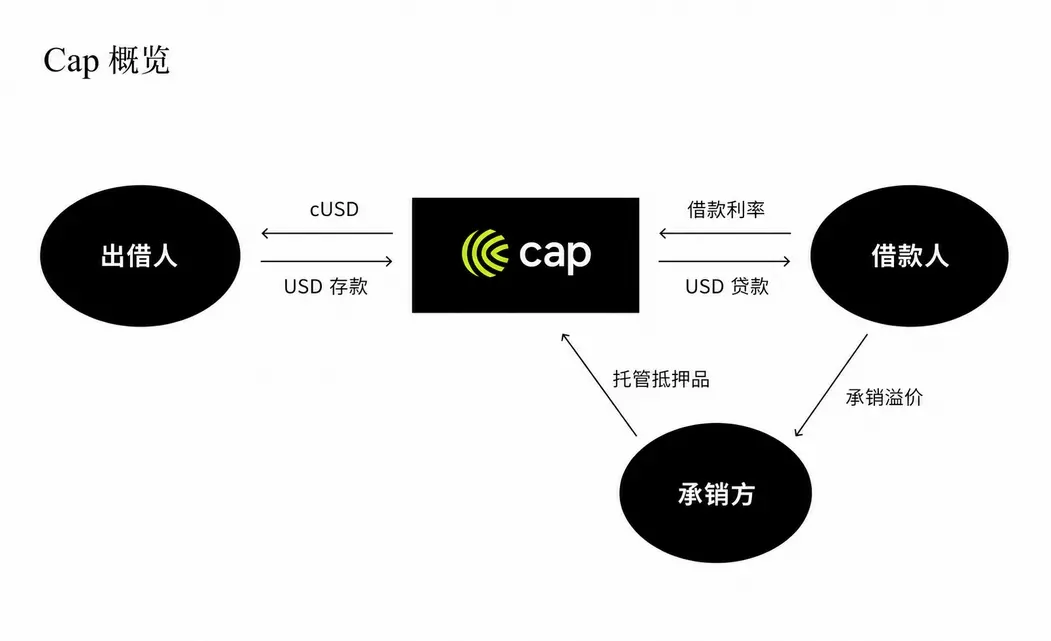
Brief Description of the Protocol Mechanism
- Cap Protocol Lending Mechanism (stcUSD)
stcUSD is a yield-bearing stablecoin in the Cap protocol, where users can earn income driven by the credit lending market by depositing stable assets (like USDC).
It is essentially a yield-bearing stablecoin system supported by "over-collateralization + underwriter guarantees + on-chain liquidation."
Participating Roles
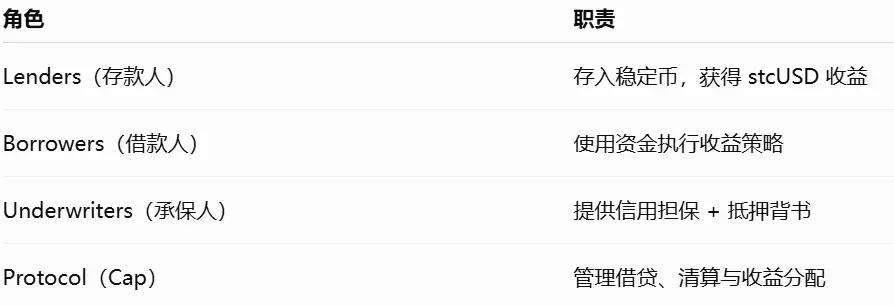
Basic Process
1) Deposit and Mint
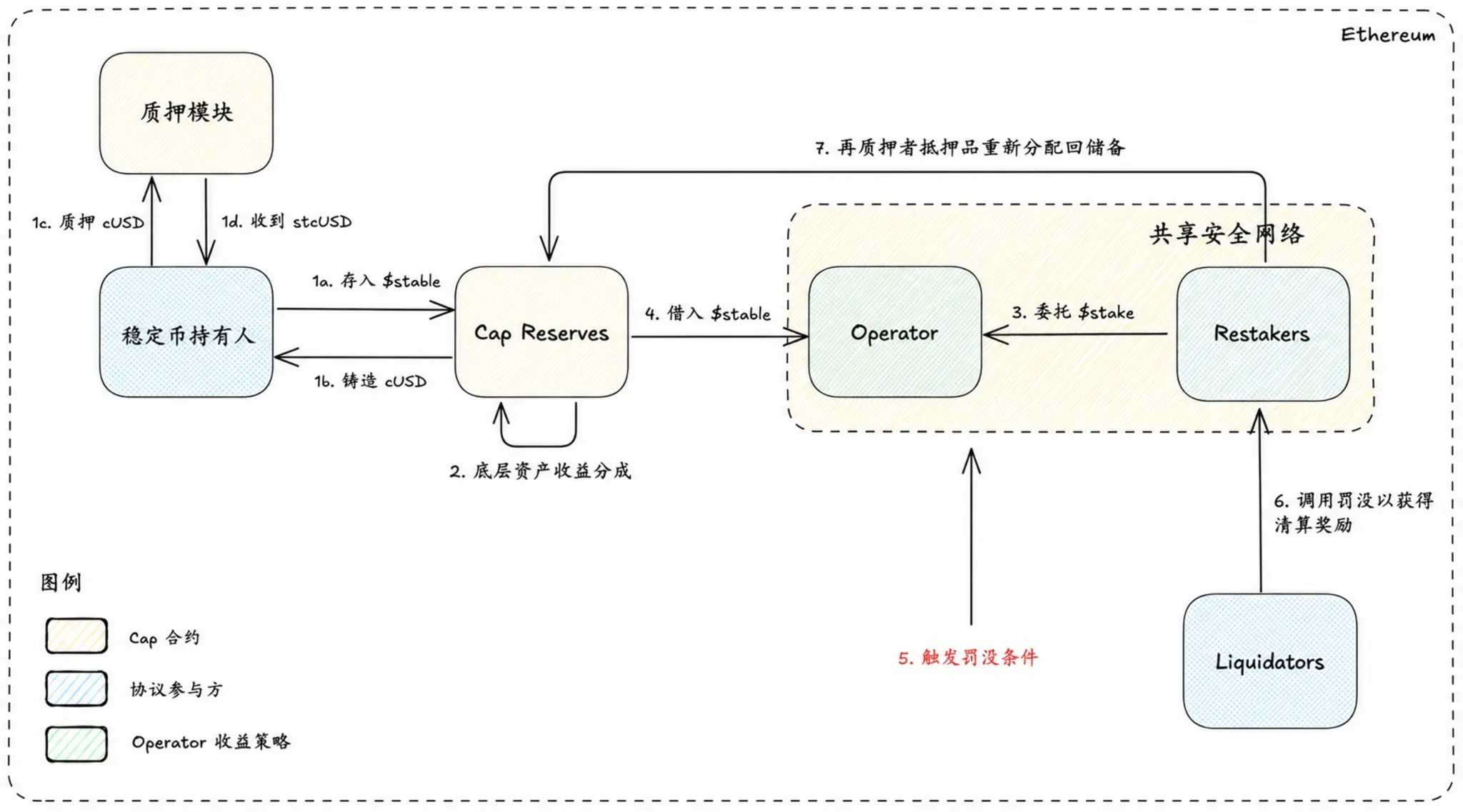
2) Sources of Funds and Income
Income comes from three parts:
Base stablecoin income (e.g., Aave / Morpho rates)
Interest paid by borrowers
Risk premium provided by underwriters
Lending Mechanism (Core Engine)
Borrowing Conditions
Borrower must:
Be over-collateralized
Obtain underwriter guarantees
Yield > Protocol benchmark yield (Hurdle Rate)
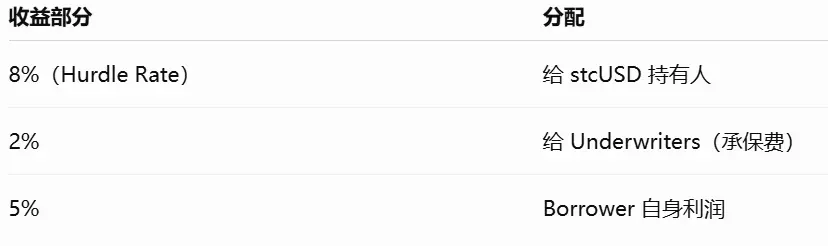
Income Distribution Model
Assuming Borrower earns 15%:
Two Operating Outcomes
- Normal Situation (Happy Path)
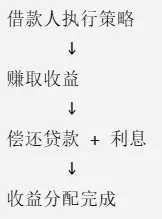
Results:
stcUSD earns stable income
Underwriter earns insurance fees
Borrower earns remaining profits
2. Risk Situation (Liquidation)
Trigger Conditions:
Borrower's collateral ratio < liquidation threshold
Process:
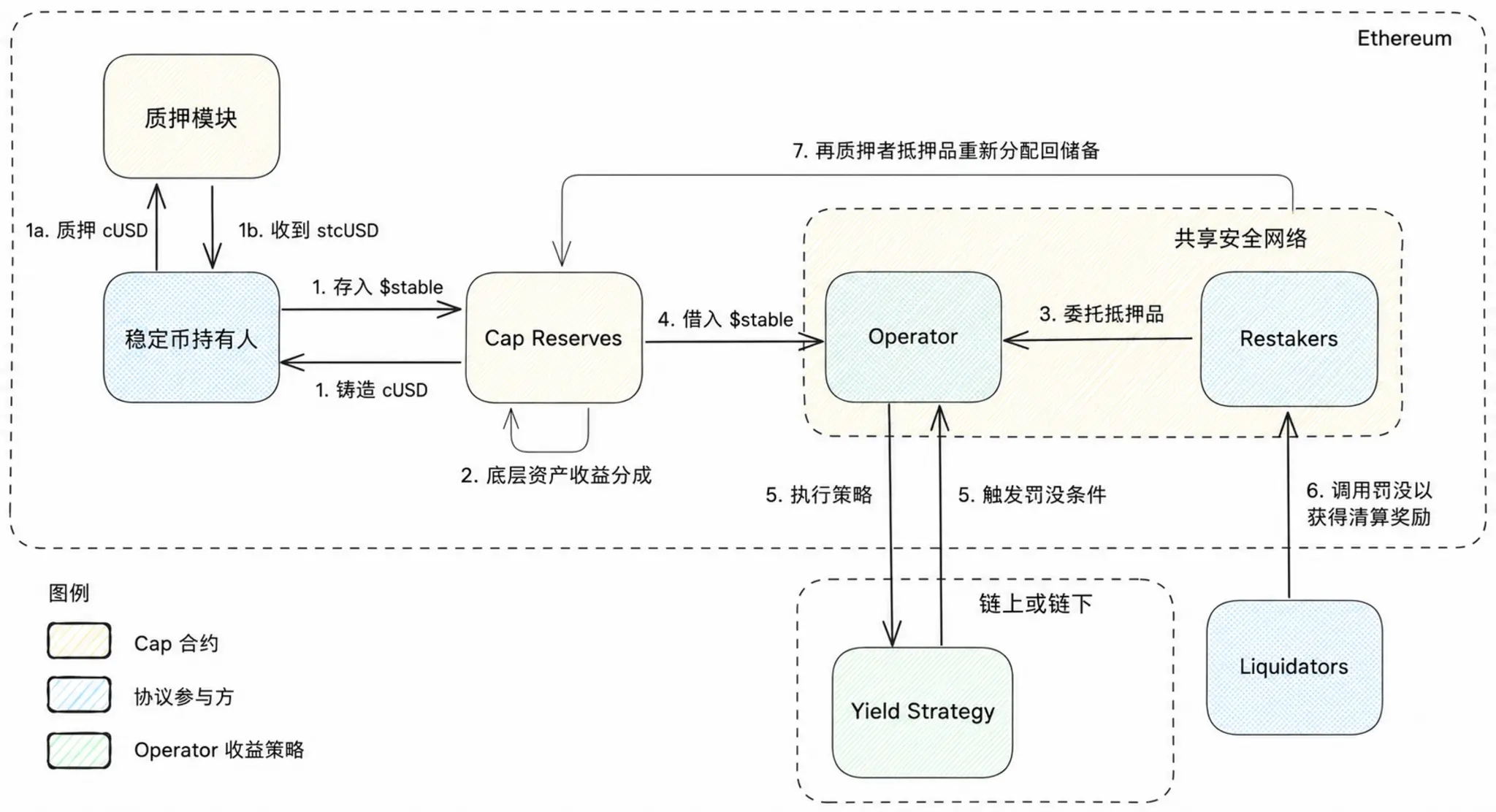
Results:
Borrower is forcibly liquidated
Underwriter's collateral is auctioned
stcUSD holders' funds are fully protected (1:1 guarantee)
Liquidation Mechanism (Dutch Auction)
Price decreases over time
The earlier the liquidator participates, the higher the reward
Used for rapid system risk repair
Function:
Ensures that bad debts do not transmit to stcUSD
Interest Rate Model (Borrow Rate)
Borrowing interest rate = composed of two parts:
- Base Rate (Minimum Rate)
Takes the maximum value of:
External market rates (e.g., Aave)
Protocol-set lower limit
- Utilization Rate Adjustment
The higher the utilization rate → the higher the interest rate
After exceeding the threshold → interest rate rises rapidly
Core Risk Structure
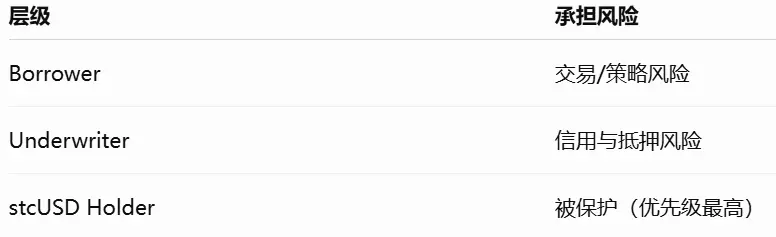
Core Design Logic
The essence of Cap is not an ordinary lending protocol, but a "yield-bearing stablecoin system backed by underwriter credit."
Key Designs:
Over-collateralization + credit guarantees as dual insurance
Income prioritized for stcUSD
Risks borne by underwriters
Liquidation mechanism ensures fund safety
2. Vault Mechanism Analysis
Fractional Reserves
Fractional Reserve is a yield enhancement and liquidity management module used in the Cap protocol to improve capital efficiency.
Core Objective: To invest "idle reserves" in safe DeFi strategies to generate additional income while ensuring cUSD can be redeemed at any time.
Basic Structure
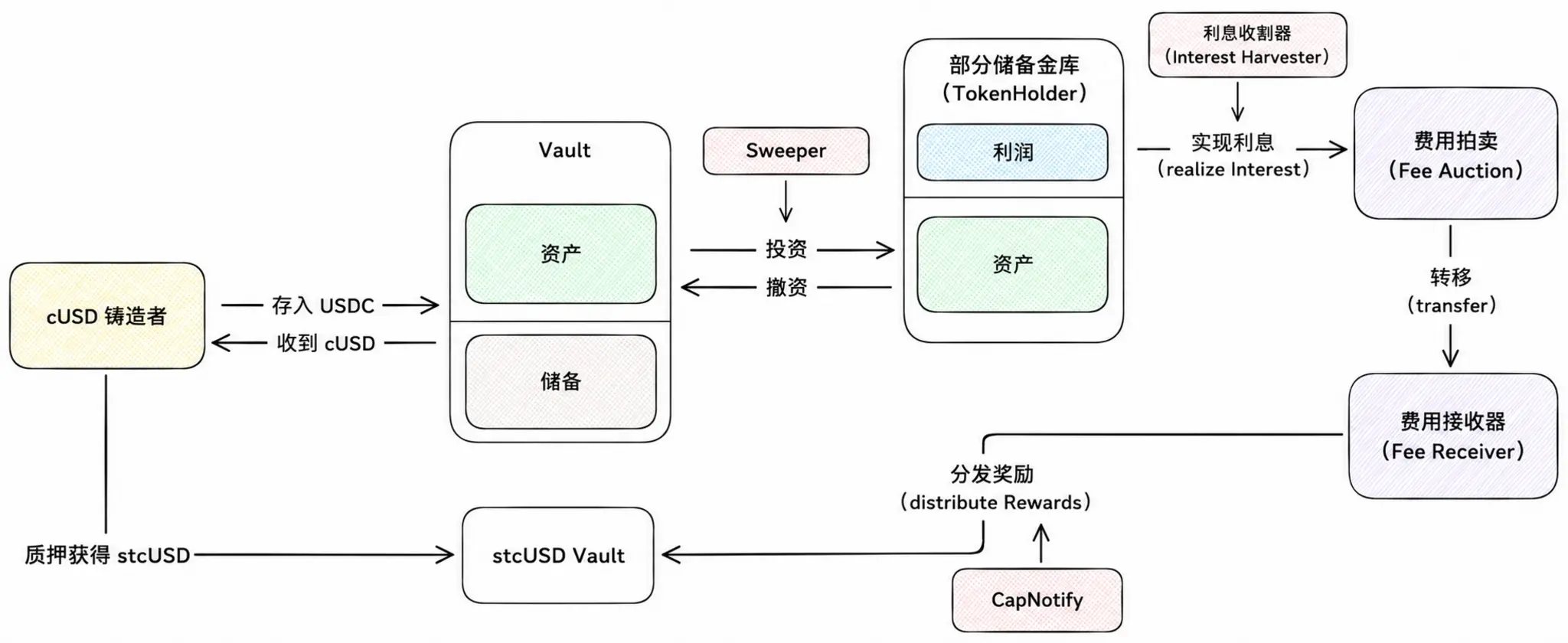
Flow of Funds
cUSD minters deposit assets into the Cap Vault.
Excess Capital is invested in the Fractional Reserve Vault, where passive income is generated by TokenHolder strategies.
Accumulated income is sent to the Fee Auction and converted into cUSD.
cUSD is then transferred to the Fee Receiver and periodically distributed to stcUSD holders.
Fractional Reserve Vault and Gelato Mechanism
Deploy an ERC4626 standard TokenHolder Fractional Reserve Vault for underlying reserve assets (like USDC), which operates as a strategy layer following the Yearn V3 Tokenized Strategy model (e.g., deployed to Aave V3). Only the Fractional Reserve Vault can perform deposit and withdrawal operations in the main Vault.
The CapSweeper contract automatically invests idle assets into strategies every 6 hours.
Strategies continue to earn interest until assets are withdrawn. CapInterestHarvester is used to automatically harvest Fractional Reserve strategy income and send it to the Fee Auction.
Key Fractional Reserve Parameters
Reserve Level: The minimum amount of each asset that must be kept in the Vault (non-investable portion).
Loaned Amount: The total amount of assets currently invested in Fractional Reserve strategies.
Interest Receiver: The address for receiving income (set to Fee Auction).
Claimable Interest: The current amount of income that can be redeemed from the strategy.
Investment Threshold: The minimum capital scale required to trigger strategy investment.
3. Cap Integration with Symbiotic
Cap integrates Symbiotic's re-staking infrastructure to build a delegation-based credit system, where underwriters provide risk coverage for borrowers.
Underwriters can deploy Vaults to provide staking support (coverage) for borrowers. Fund providers can deposit or withdraw assets in the Vault.
Relationship Between Vault and Borrower
Unique Pairing:
Each Symbiotic Vault can only correspond to one Borrower for delegation.If a Borrower wants to receive delegation from a new Vault, they must use a new Ethereum address.
If an underwriter wants to support a new Borrower, they must deploy a new Vault.
Once a Vault starts providing delegation to a Borrower, that Borrower address becomes immutable.
Symbiotic Vault Lifecycle
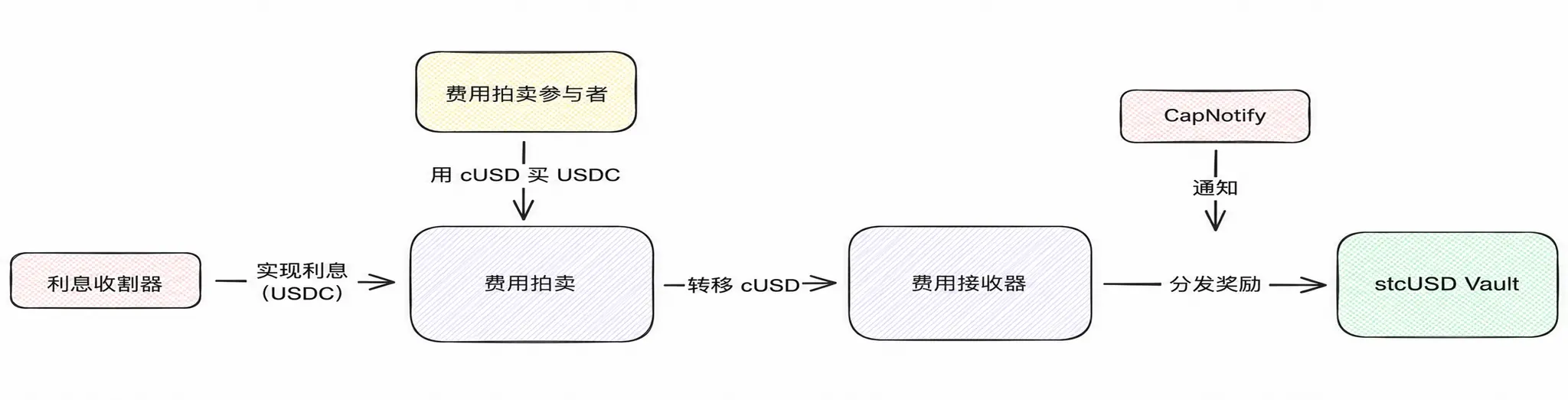
1. Vault Creation
Underwriter creates a Vault through Cap's Symbiotic Vault Factory contract:
- Each Vault supports only one type of ERC20 collateral asset.
2. Cap Whitelisting
After the Vault is created:
Cap adds the Vault and Borrower address to the system.
Simultaneously sets:
Loan parameters
Underwriting fees
3. Vault Management
Once the Borrower-Vault binding relationship takes effect:
Underwriter can control the depositor permissions of the Vault.
Can manage reward distribution.
If a risk event occurs, Vault liquidation will be executed.
Tron Comments
Cap's advantage lies in its innovative lending system that combines on-chain credit with re-staking capital through Shared Security Networks (EigenLayer / Symbiotic) + underwriter guarantees, allowing borrowers to obtain funding support without full collateralization, while underwriters provide credit backing through staked capital and earn risk premium income, achieving higher capital efficiency and market-based credit pricing; moreover, risks are controlled through borrower-level isolation and automated liquidation mechanisms, ensuring stablecoin holders are always prioritized for protection, with strong transparency and structured risk management capabilities.
Its disadvantage is that the overall mechanism relies on complex on-chain and off-chain coordination (SSN, re-staking, legal underwriting, liquidation systems), making the system structure heavy and the understanding and participation threshold high; at the same time, income and safety are highly dependent on the underwriter's risk assessment capabilities and the quality of re-staked assets, which may face risks of insufficient underwriting or liquidity contraction under extreme market conditions, introducing a certain degree of centralized underwriting and compliance reliance.
2. Detailed Explanation of Key Projects of the Week
2.1. Brief Analysis of Total Financing of $3.6 million, led by Bain Capital and ParaFi, with follow-on investments from Nascent, Robot Ventures, and Chapter One—Ground, an on-chain yield infrastructure layer aimed at institutional funds.
Introduction
Ground is an on-chain yield infrastructure platform for institutions, enabling banks, fintech companies, and various financial applications to earn income on stablecoins and cash balances through non-custodial integrations.
Through APIs and configurable portfolio strategies, Ground connects idle assets to diversified on-chain yield sources while providing transparency, risk control, compliance tools, and automated asset allocation management capabilities.
The platform helps enterprises create yield-generating financial products, improve capital management efficiency, and explore new revenue sources without having to build complex DeFi infrastructure themselves.
Core System Architecture Analysis
- Portfolio Wallets
Multi-strategy yield wallets with mixed yield rates, automatic rebalancing, and liquidity tier management capabilities.
Portfolio Wallets allow new banks, exchanges, and funds to invest idle stablecoins into the yield system. With a single API integration, customer deposits can be allocated to multiple yield sources—managed by Ground for asset allocation, rebalancing, withdrawals, and reporting.
Workflow (How it works)
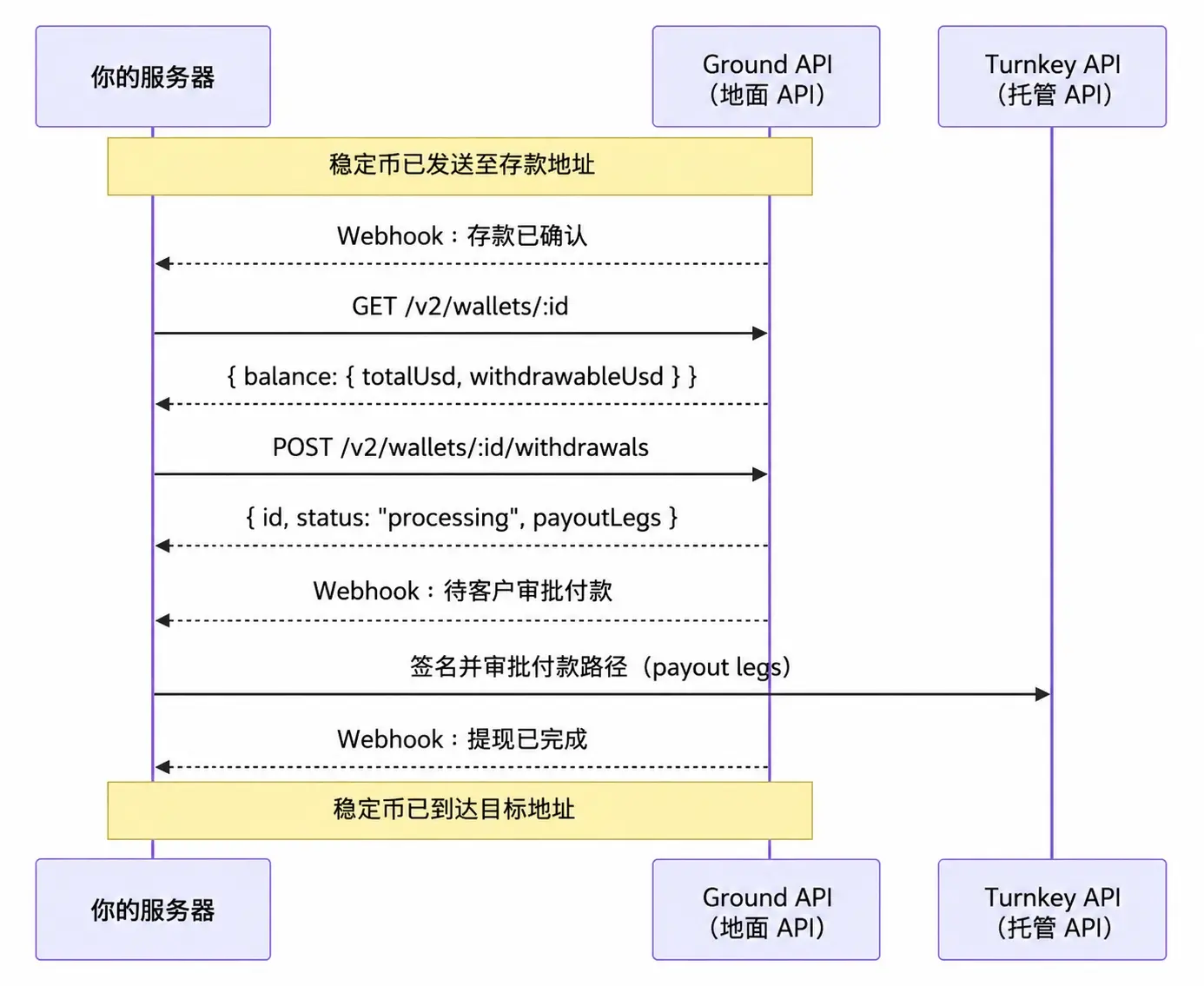
Configure—Select yield sources and target weights from the yield source directory.
Create—Create a wallet using the selected strategy, with Ground configuring deposit addresses for each chain.
Deposit—Send USDC to the corresponding chain's wallet deposit address.
Earn—Ground allocates funds to different yield sources and dynamically rebalances to maintain target weights.
Withdraw—Initiate a cross-chain withdrawal request, Ground will close positions, bridge across chains if necessary, and ultimately deliver USDC.
Once the wallet is created and a deposit address is obtained, the entire lifecycle becomes: deposit stablecoins → monitor balances and yields through polling or webhooks → initiate withdrawals when needed. The withdrawal process requires transaction signing through Turnkey, after which Ground will broadcast and complete fund settlement to the target address.
Custody and Security
Non-custodial key management—Each wallet's private key is managed by Turnkey, and Ground does not access any signing keys.
Signing policies—Institutions can customize which withdrawal operations require approval; policy updates are executed through API-authenticated target asset configuration changes, with subsequent rebalancing automatically executed asynchronously according to the strategy.
Dedicated addresses—Each wallet has a dedicated deposit address, and funds are not mixed between different wallets.
HTTPS only—All API and webhook communications are secured with encryption at the transport layer.
- Onchain Architecture
Deposit Flow
When users deposit USDC into their Portfolio Wallet, funds flow as follows:
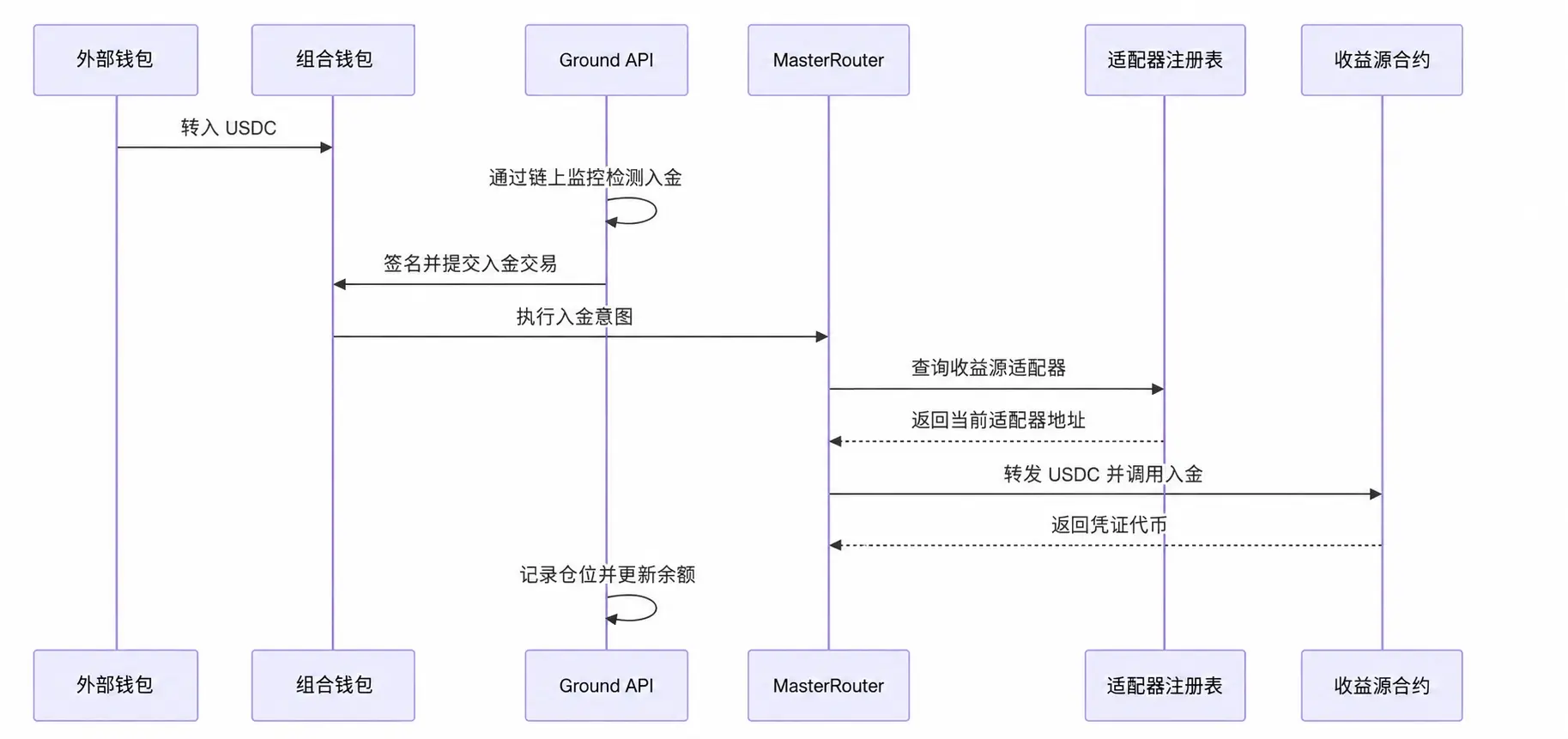
Flow Explanation
Users transfer USDC from External Wallet to the Portfolio Wallet's deposit address.
Ground detects the deposit through on-chain monitoring.
Ground signs and submits the deposit transaction.
Portfolio Wallet calls the MasterRouter contract.
MasterRouter resolves the corresponding yield source through AdapterRegistry.
USDC is deposited into the underlying yield protocol (e.g., Morpho vault or Maple pool).
Receipt tokens remain in the Portfolio Wallet.
Ground updates on-chain position and balance data.
Withdrawal Flow
The withdrawal process is the opposite of the deposit, closing positions first and then returning USDC, which is finally sent to the target address:
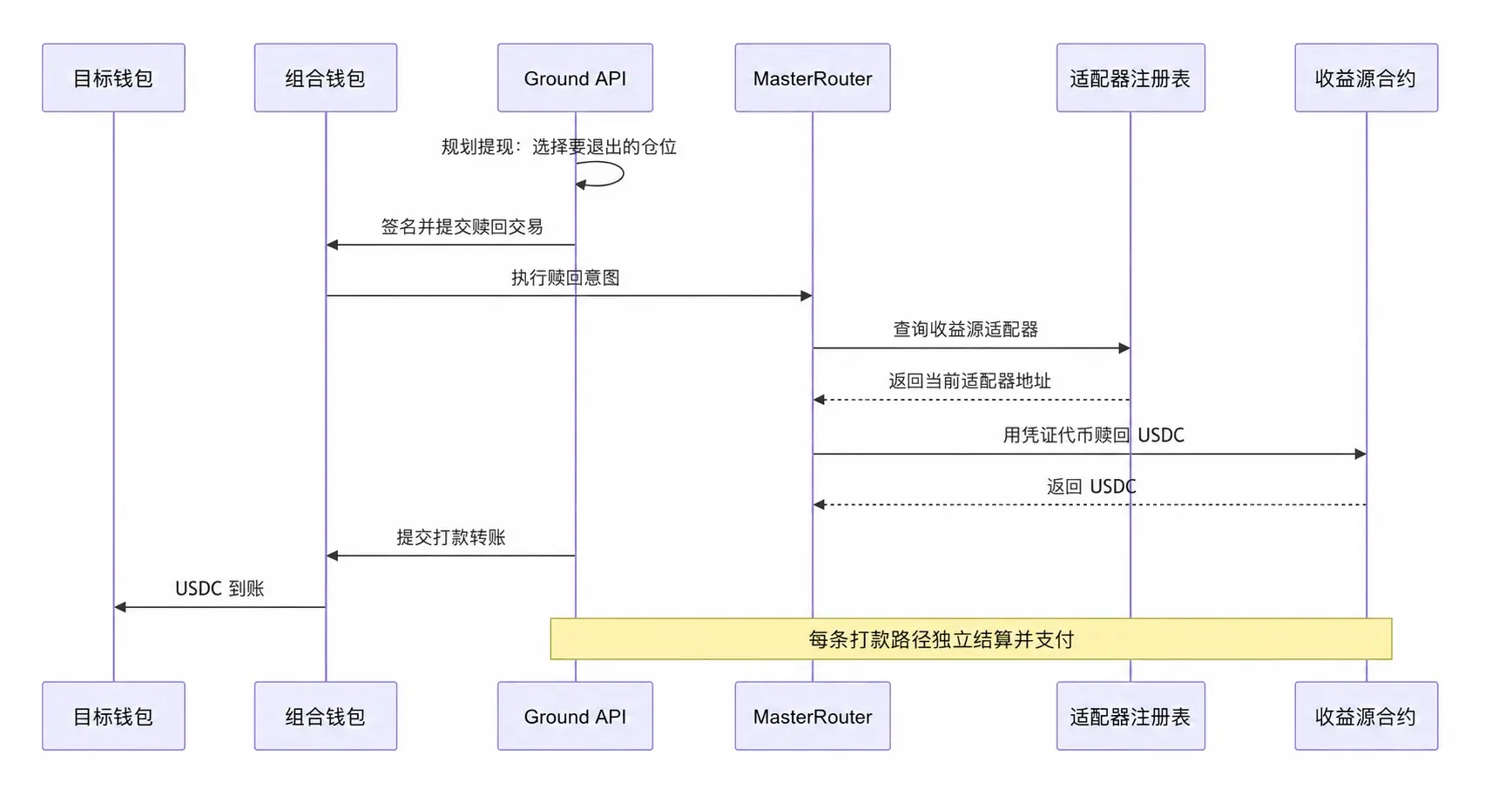
Flow Explanation
Each payout leg is settled independently and paid separately.
The API first plans the withdrawal path (determining which positions need to be closed, with each position constituting a payout leg).
For each payout leg, Ground signs and submits the redeem transaction.
Portfolio Wallet calls the MasterRouter.
MasterRouter resolves the corresponding yield protocol through AdapterRegistry.
Receipt tokens are redeemed from the underlying yield protocol and exchanged back for USDC.
After each payout leg is settled, USDC is immediately transferred from the Portfolio Wallet to the user's target address.
Each payout leg settles independently (parallel settlement).
Core Mechanism Summary (Maintaining Source Structure Semantics)
Deposit: User → Ground monitoring → Router routing → Yield protocol → receipt token credited.
Withdrawal: Yield protocol → redeem → USDC backflow → parallel settlement of payout legs.
Core Components: MasterRouter (execution routing) + AdapterRegistry (strategy mapping) + Portfolio Wallet (asset carrier).
Core Features: Multi-strategy unified entry + automatic routing + legged settlement + instant withdrawal capability.
Tron Comments
Ground's advantage lies in its provision of an institutional-level on-chain yield access layer for banks and fintech institutions through API + Portfolio Wallet + automatic routing architecture (MasterRouter + AdapterRegistry), allowing idle stablecoins to be automatically allocated to various yield protocols (like Morpho, Maple, etc.), achieving automatic rebalancing, cross-chain settlement, and real-time transparent reporting, while combining non-custodial key management (Turnkey) with strategic permission control, significantly enhancing capital utilization efficiency and productization capabilities while ensuring compliance and security.
Its disadvantage is that the system heavily relies on multi-layer on-chain routing and off-chain coordination (monitoring, signing, webhooks, cross-chain execution), leading to a high overall architectural complexity, with strong dependencies on infrastructure stability, protocol adaptability, and the quality of third-party yield sources, while still facing operational risks from liquidity and execution delays across strategies under extreme market conditions.
III. Industry Data Analysis
1. Overall Market Performance
1.1. Spot BTC vs ETH Price Trends
BTC
ETH
IV. Macroeconomic Data Review and Key Data Release Points for Next Week
This week's macroeconomic data review (August 16 to August 23): The U.S. macroeconomic landscape shows a clear characteristic of "growth differentiation, easing inflation pressure but the Federal Reserve remains vigilant." On August 18, the U.S. reported a significant month-on-month decline of 12.4% in new housing starts for July to an annualized 1.239 million units, down 13.5% year-on-year, indicating that high financing costs continue to suppress real estate investment; however, building permits increased by 5.0% month-on-month to 1.443 million units. The minutes from the July FOMC meeting released on August 19 show that there are still significant policy differences within the Federal Reserve: the July meeting maintained interest rates unchanged with a vote of 9:3, with several officials believing that if inflation does not further decline, interest rate hikes may still be necessary in the future, thus limiting market expectations for a rapid shift to accommodative monetary policy. However, the preliminary S&P Global Composite PMI for August, released on August 21, rose to 56.0, the highest in 52 months, with the services PMI rising to 56.8, while the manufacturing PMI fell from 53.9 to 53.2; meanwhile, input costs and sales price increases have slowed, forming a combination of "strong service sector growth, marginal cooling in manufacturing, and easing price pressures."
Key points for next week (August 24 to August 30): The most important time window for the market is concentrated from August 25 to 28. On August 25, the U.S. will release August consumer confidence, July new home sales, and June Case-Shiller home price data; August 26 is the most critical data day of the week, with the U.S. releasing July PCE, core PCE, personal income/consumption, and revised Q2 GDP, with the market expecting core PCE to be approximately +0.2% month-on-month and +3.2% year-on-year, which will directly impact market judgments on the September FOMC interest rate path. On August 27, initial jobless claims, July goods trade balance, and inventory data will be released; on August 28, the final consumer confidence for August from the University of Michigan and 1-year/5-year inflation expectations will be published.
Next week, the most concerning aspect is not just the economic data, but the repricing of central bank policy expectations. On August 28, Federal Reserve Chairman Kevin Warsh will speak at the Jackson Hole Global Central Bank Annual Meeting, and the market will closely observe how he evaluates the current inflation, which remains above target, recent growth resilience, and the possibility of future interest rate hikes.
V. Regulatory Policies
U.S. | The SEC officially proposed a brand new regulatory framework for the issuance of securities specifically targeting crypto assets.
On August 18, the U.S. SEC officially proposed "Regulation Crypto Assets," which is one of the most significant changes in global crypto regulation this week and marks the SEC's first attempt to establish a securities issuance system specifically adapted for certain crypto asset investment contracts. The new framework proposes two types of exemptions from the Securities Act registration: the first allows projects to raise up to $5 million over four years; the second allows projects to raise up to $75 million every 12 months but requires stricter financial disclosure and ongoing reporting obligations. At the same time, the SEC proposed a conditional safe harbor for "Investment Contracts": when the issuer has completed or permanently ceased its key management commitments and meets the corresponding conditions, the relevant crypto assets can no longer be considered bound by investment contracts. This proposal indicates that the U.S. regulatory approach is further shifting from relying on enforcement and case-by-case judgment to establishing a clear institutional path for Token financing and project development. The proposal was officially published in the Federal Register on August 21, with the comment period ending on October 20, 2026.
U.S. | The market structure legislation for the CLARITY Act has re-entered a clear advancement timeline.
On August 19, the White House convened executives from crypto and financial industry firms such as Coinbase, Kraken, Ripple, Gemini, and Robinhood, with SEC Chairman Paul Atkins and CFTC Chairman Michael Selig among the regulatory officials present. Trump publicly called for Congress to advance the CLARITY Act, which aims to establish a comprehensive regulatory framework for the U.S. digital asset market and further clarify the regulatory boundaries between the SEC and CFTC; the Senate has scheduled its procedural vote for September 15. Therefore, this week the U.S. has seen a "dual-track regulatory pattern of the SEC advancing securities issuance rules through Regulation Crypto Assets + Congress continuing to push the CLARITY Act market structure legislation." However, it is important to distinguish: as of August 23, the CLARITY Act has not yet been finalized, and this week's new progress is the clarification of the voting timeline and political push, rather than the bill already being enacted.
U.S. | The CFTC's federal regulatory role over on-chain financial activities such as DeFi and prediction markets has been further strengthened.
From August 19 to 21, the CFTC continued to advance regulatory discussions around digital assets, AI, and prediction markets. Notably, the regulatory authority conflict over prediction markets is worth attention: several U.S. states are attempting to take enforcement actions against relevant platforms under gambling laws, while the CFTC argues that such contracts fall under financial contracts within the federal Commodity Exchange Act framework and should primarily be regulated by the CFTC; currently, there is still a significant legal dispute between state regulatory agencies and federal regulatory authority. Although this change does not constitute a new written law for crypto assets, it reflects that U.S. digital asset regulation is expanding from the past "SEC-led disputes over securities attributes" to a further redefinition of the CFTC's regulatory boundaries over on-chain derivatives, prediction markets, and decentralized trading activities.
EU | MiCA has entered a comprehensive licensing regulatory phase, and this week ESMA continued to update the unified regulatory registration system.
On August 21, ESMA updated the MiCA Interim Register, continuing to disclose crypto asset white papers, asset-referenced token (ART) issuers, electronic money token (EMT) issuers, authorized CASPs, and non-compliant entities. It is important to emphasize the timeline: the full end of the MiCA transition period occurs on July 1, 2026, not a new policy this week; the changes from August 16 to 23 mainly involve ESMA continuing to update the central regulatory database and execution system during the comprehensive licensing regulatory phase. For the European market, this means that the regulatory focus has shifted from "formulating MiCA" to the actual execution phase of licensing, market access, non-compliant entity identification, and ongoing supervision.
 Risk warning