Analyzing the Value of Uniswap's Unified Proposal and the CCA Auction Protocol
 Core Viewpoint

 Uniswap's dual transformation, value capture and new asset issuance
Author| Shijiu Jun
Preface
Recently, the industry's excitement has shifted due to the rise of the X402 payment track, as well as the panic of Black Monday, Tuesday, Wednesday, Thursday, and Friday, along with the rotation of the privacy sector in the Cow End Legend.
This world is truly fascinating and also very noisy.
Whether it's a bear market or not, after all, one common mistake smart people make is: trying to optimize something that shouldn't exist (from Musk). Now, let's calm down and review the brilliance of past successful products, to see which players in the competition are engaging in ineffective operations, and which are the pigs on the wind, as the wind stops, we can truly see the long-term value of the future.
If asked, what are the representative track trends this year?
My first choice is Dex. It has been 4 years since the DeFi summer, and in 2025, there are multiple typical products that have firmly occupied a significant voice in the market, from concepts to market presence. The most magical aspect of this track is that just when you think everything that can be done has reached its peak, and the situation should have settled, you suddenly see certain projects emerging as dark horses from the details. Hyperliquid in Perps is one such example, and fomo in Meme bots is another.
Aside from the challenges from new platforms, the evergreen Uniswap in DeFi continues to innovate. This article will deeply analyze two major moves by Uniswap this week.
Uniswap's Market Status
As of today, Uniswap has processed approximately $4 trillion in trading volume. It is undoubtedly the leading Dex platform.
As seen in the chart below, even with new challengers emerging in 2025, it still occupies 70-80% of the market share on the Ethereum mainnet.
In October 2025, it had a trading volume of about $138B. Excluding monthly fluctuations, it averages a trading volume of 60-100B.
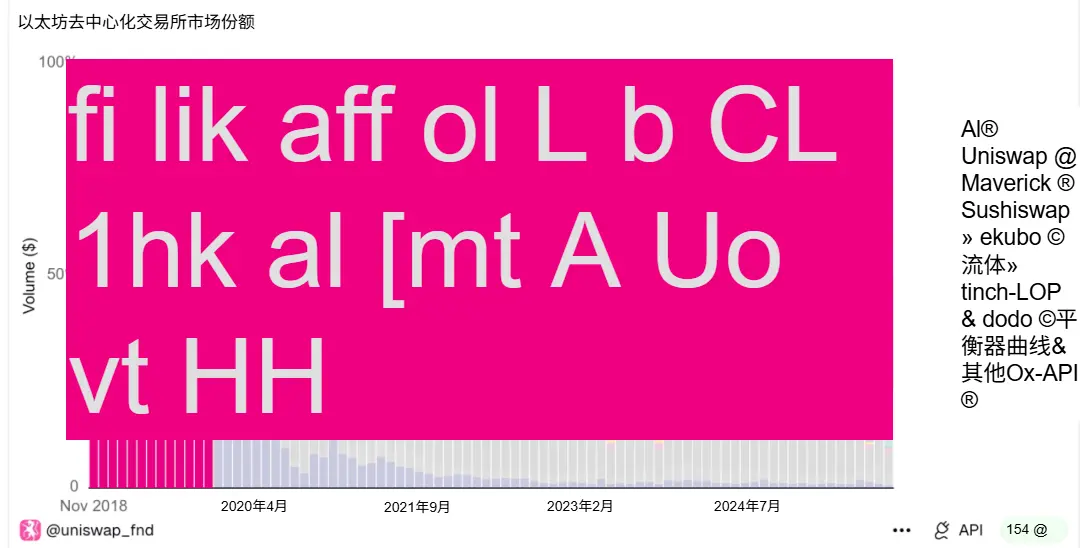 Market share of various Dex on Ethereum
However, beneath the prosperity, there are actually numerous challengers, as Uniswap's TVL continues to decrease, indicating that the market has better staking options. Moreover, despite the continuous launches of v3 and v4 with more performance, GAS, and LP optimizations, it is still competing for a shrinking market.
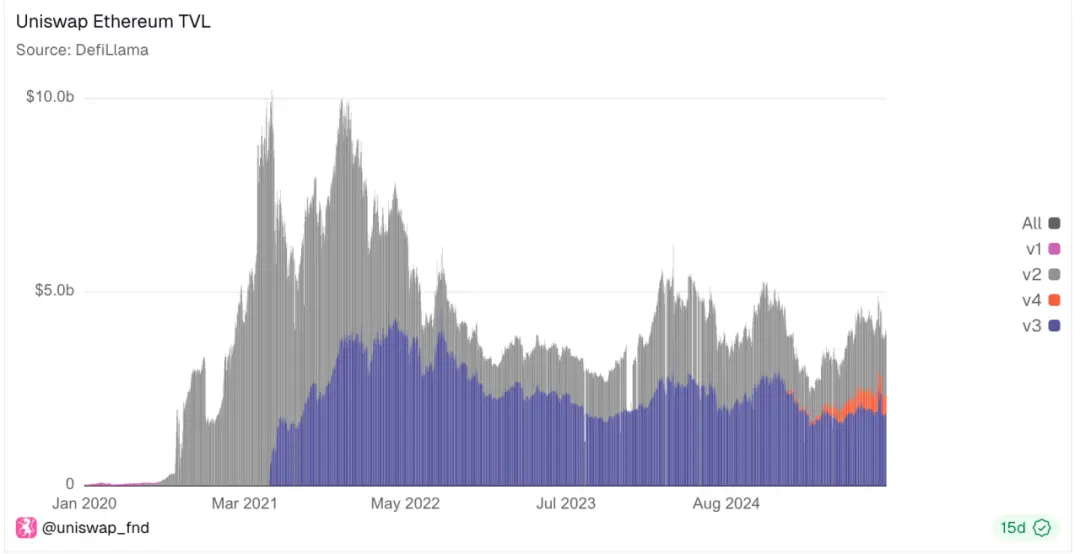 Market share of various versions of Uniswap on Ethereum
Furthermore, Uniswap is not the only player in the entire Dex market.
In the cross-chain swap market, the actual performance of UniswapX is far inferior to the experience optimizations of its competitor PancakeSwap. Since 2024, its market share has been continuously eroded. Now it holds only about 20-30% of the market.
However, even so, we cannot underestimate the potential of this market, as Uniswap still maintains a monthly cross-chain swap trading volume of around $200B.
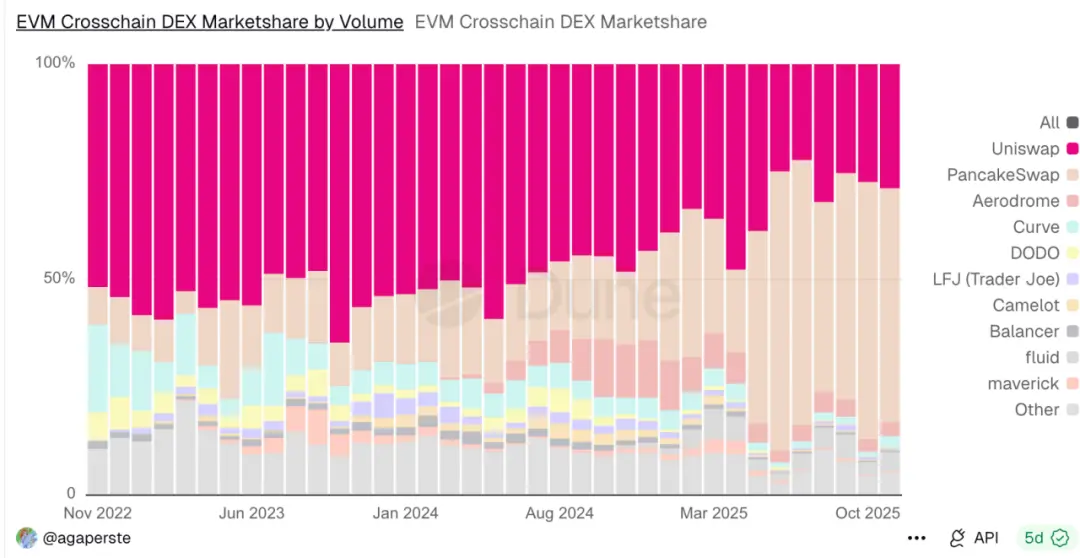 EVM-based cross-chain Dex trading volume
There are clearly a host of issues here. The most criticized is the poor performance of the UNI token itself. The current situation is dismal compared to its peak in 2021.
Can UNIfication help turn the tide?
UNIfication New Unification Proposal
UNIfication, a proposal jointly put forward by Uniswap Labs and the Uniswap Foundation, aims to fundamentally reform the operation of Uniswap—from fee distribution to governance structure to token economic model.
Key actions include:
Activation of protocol fees and UNI burn: Enabling a built-in "fee switch" that allocates a portion of each transaction fee to the protocol (rather than all going to liquidity providers). The fees collected by the protocol will be used to burn UNI tokens, thereby permanently reducing the supply of UNI. Thus, in the future, Uniswap's usage will be directly linked to the scarcity of the token.
Unichain Sequencer fees will be used for burns: Uniswap now has its own Layer-2 network called Unichain. The fees earned by the Unichain Sequencer (currently an annualized income of about $7.5 million) will also be used for the UNI token burn mechanism. Therefore, every layer of Uniswap (the main exchange and its L2 chain) participates in the same burn mechanism, and as usage increases, the scarcity of UNI tokens will also increase.
Protocol Fee Discount Auction (PFDA): A new mechanism that internalizes maximum extractable value (MEV) and enhances liquidity provider (LP) returns. In short, traders can bid for temporary fee discounts (i.e., trade without paying protocol fees for a short time). The highest bid (paid in UNI) will be used for contract burns. This way, MEV that would have gone to bots or validators will be captured by Uniswap and used to burn UNI.
Burning 100 million UNI tokens (retroactive burn): To compensate UNI holders for the fees they "missed" during the fee conversion shutdown, they propose a one-time burn of 100 million UNI tokens from the treasury. This amounts to about 16% of the circulating supply of UNI.
No more interface/wallet fees: Uniswap Labs will stop charging fees for its products (Uniswap official web app, mobile wallet, and API).
Introduction of a growth budget of 20 million UNI per year for Uniswap Labs (allocated quarterly).
How to Understand?
Well, there is indeed a lot of information, so let's think about it from the perspectives of different stakeholders.
1. For LPs
Clearly, the costs will be passed on to the liquidity providers. For example, in the Uniswap v2 version, the trading fee will be adjusted from 0.30% (all going to liquidity providers) to 0.25% for liquidity providers and 0.05% for the protocol. Therefore, after the activation of protocol fees, LPs will see their earnings per transaction decrease by 1/6.
Although this proposal also includes the PFDA scheme, which aims to expand the overall pie by internalizing some market execution value (MEV), guiding external liquidity, and charging certain fees, as well as generally increasing trading volume.
Some market analyses estimate that this mechanism will increase LP earnings by about $0.06 to $0.26 per $10,000 in trading volume. Considering that LP profits are usually very low, this is significant.
However, I am not so optimistic, as the feedback from capturing MEV to LPs and users has always been a major challenge. Additionally, LPs still bear the risk of impermanent loss.
2. For Regular Users
First, user fees will be directly reduced. On one hand, high-end users can obtain fee discount coupons through the PFDA mechanism combined with auctions. On the other hand, the fees for using the Uniswap app page have been completely eliminated.
However, UNI can finally benefit from Uniswap's success, which is significant because previously, UNI was merely a governance token and did not share in Uniswap's trading fees (which were all given to LPs).
Moreover, UNI itself has formed a deflationary asset closely related to cash flow, rather than being a passive governance token.
This clearly references the governance model of Hyperliquid, where, from a certain perspective, burning and repurchasing are analogous.
3. For Lab Operations
Previously, employee salaries were funded through additional fees from app usage, but now it will be through a budget of 20 million UNI. Based on the current market price, this amounts to a research and development budget of $140 million, which is quite substantial.
Sometimes I wonder if this is all just for the 20 million UNI, as this scale is far greater than previous fee income.
Furthermore, Uniswap Labs and the foundation will merge: Labs, responsible for protocol development, and the foundation, responsible for grants/governance, plan to combine. Most team members from the foundation will join Labs to form a united team focused on Uniswap's development. From this perspective, it seems to bring a new atmosphere of diligence and hard work.
4. Is this mechanism worth a long-term view?
Perhaps due to the recent black swan events, the valuation increase brought by the burn has quickly receded.
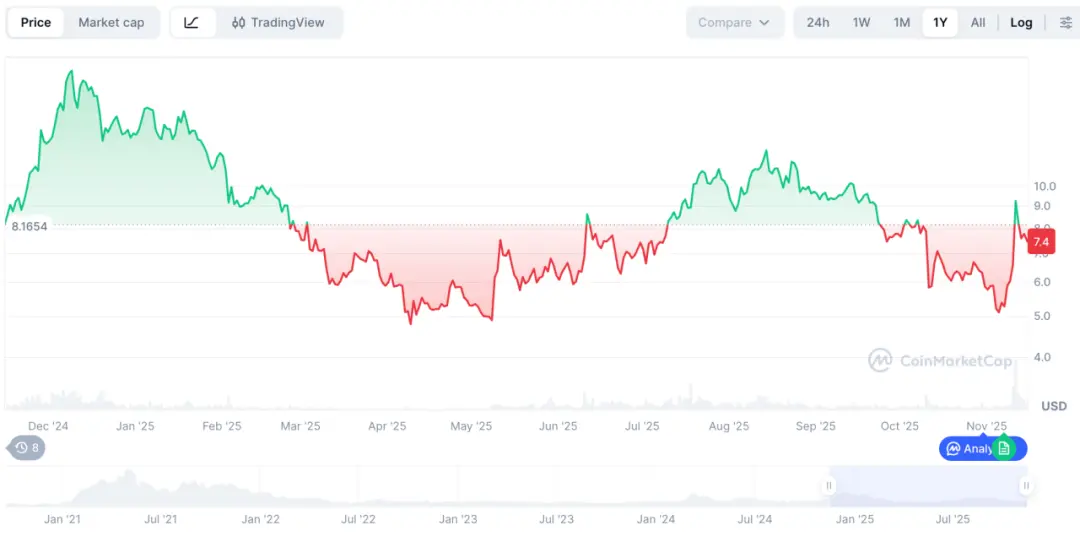
Aside from these external factors, I believe that its short-term fluctuations stem from the initial release where everyone quickly understood that it would burn tokens, thus increasing, but burning is not the source of long-term value.
Uniswap hopes that the increase in trading volume, MEV sharing, and other incentives can offset the impact of reduced earnings over time. How to stabilize LP earnings?
In the initial charts, we have already seen that long-term LPs on Uniswap are gradually migrating away.
Similarly, competitors (all doing LP) will have to hold a large amount of regular tokens, which often incur the largest losses during black swan events, further amplifying LP's impermanent losses. What about mainstream platform tokens? Staking Ethereum itself offers a clear annualized return of 4%, while those staking Solana can achieve returns of 8% or even higher, without worrying about the volatility of altcoins.
Therefore, the departure of LPs will ultimately affect trading depth, increase trading slippage, and ultimately harm the user level.
Thus, although UNI-fication is the biggest transformation since the launch of the UNI token, it addresses the long-standing issue of the lack of direct correlation between UNI token value and Uniswap's actual performance.
In the long run, competition among decentralized exchanges (DEX) in 2025 is exceptionally fierce, and Uniswap's scale means its liquidity can withstand fluctuations for some time. Launching this move at this time is reasonable but will inevitably bring volatility.
CCA (Continuous Clearing Auction)
This is the new protocol CCA recently launched by Uniswap and Aztec, specifically designed for price discovery and liquidity initiation for new assets.
After this auction process concludes, project teams can inject the funds raised along with tokens into Uniswap v4, directly connecting to secondary market trading.
1. Evolution of Asset Pricing Solutions
How to price has always been a grand issue. In my previous interpretations of UniswapX and UniswapV2 mechanisms, I mentioned that objectively speaking, Uniswap's rise was due to capturing the demand for new asset pricing back in the day.
After all, the formula x*y=k for two tokens in on-chain AMM is the easiest way to quickly return to a reasonable price in the performance-limited EVM architecture.
However, this mechanism is not perfect; significant slippage, MEV attacks, and LP's impermanent losses are key influencing factors.
Therefore, fair price discovery and fair initial token distribution have always been major propositions for DEX platforms. However, most current versions still feel like behind-the-scenes transactions disguised as "community activities." Insiders gain certainty while others get leftovers.
Later, various platforms have made many attempts at how to price new assets, such as team airdrops, Dutch auctions, fixed-price sales, LBP, Bonding Curve, Fee mint, fair launches, etc.
Moreover, the above solutions still have flaws, such as:
Fixed-price sales can lead to pricing errors and priority disputes, resulting in insufficient or unstable liquidity.
Dutch auctions create time-based games, giving professionals an advantage over genuine participants.
One-time auctions can reduce demand and often lead to last-minute rushes.
Various Curve models have path dependency and are easily manipulated.
2. Design Philosophy of CCA
Essentially, CCA is a protocol independent of Uniswap v4, a complete framework for issuance and pricing. However, it will leverage Uniswap v4's hooks mechanism to connect with the AMM core. In the entire issuance workflow, it is the CCA Auction module shown in the diagram below.
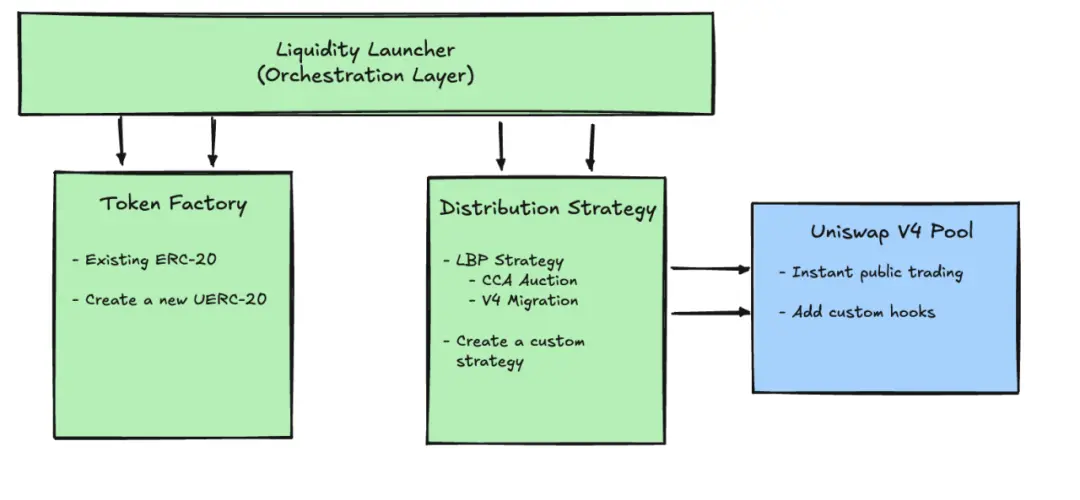
It is a configurable auction framework, and everything is conducted on-chain (which is better than uniswapX). The five stages are configuration stage -> bidding stage -> allocation stage -> clearing stage -> injection stage.
Configuration Stage: The auction initiator first sets the rules on-chain, such as start and end times, how many "rounds" or time periods the auction is divided into, what proportion of tokens is released in each time period, the minimum price (floor price), and additional configurations, such as whether a whitelist/verification is needed, and how to inject liquidity into Uniswap v4 after the auction ends, etc.
Bidding Stage: During the auction, participants can bid at any time. Each bid includes two parameters: how much capital is invested and the maximum acceptable unit price.
Allocation Stage: The system will automatically allocate a bid across the remaining "release periods." Therefore, the earlier the bid, the more time periods the participant can engage in, with opportunities to participate in more rounds of clearing.
Clearing Stage: In each round, the system accumulates all valid bids for that round and uses a unified rule to find a price that can sell all the tokens to be released in that round, serving as the final transaction price for that round.
Injection Stage: After the auction ends, participants can claim their acquired tokens and any unspent funds; the protocol will inject the assets raised and the other side of the assets prepared by the project team into Uniswap v4, officially starting the liquidity pool for the secondary market.
3. How to Understand
In summary, it essentially breaks a one-time auction into multiple rounds, distributing the game during the auction process across multiple instances, thus solving the previous issue where transactions were often completed in the last second (just before the block is mined), turning the auction into a black box.
But is this enough?
Clearly, the complexity may deter many new tokens from launching on this platform. Moreover, efficiency has decreased. Objectively speaking, since version X, Uniswap's auction logic has not been very successful, and too many DeFi protocols have left complexity to the users.
I believe this is difficult to replicate as the success of UniswapV1, which rewrote the history of new token issuance and pricing with 200 lines of code. Furthermore, its reliance on version V4, as shown by the data above, indicates a fivefold gap compared to mainstream V2 and V3.
On Asset Growth and Value Discovery
Regarding asset growth, the previous discussion focused on initial pricing platforms. I would like to add some thoughts on the pricing logic during the mid-to-large development stages.
While trading financial derivatives, especially perpetual platforms, is the most profitable across all trading links.
Many people have been drawn to this initially, but the true value of Perps lies in its ability to assist in pricing mid-sized assets.
Particularly small assets can be listed on Uniswap or meme platforms, and as they grow into mid-sized assets, they can be listed on BN's Alpha platform or other mid-sized CEX platforms. However, objectively speaking, before 2025, there was a lack of decentralized pricing platforms for large assets in the market.
Thus, during this interim period, market misjudgments are likely to occur, leading to the frequent sight of investors rapidly exiting after assets are listed on exchanges.
This is primarily because Perps are futures; to price an asset in the market, you must place it on the platform, locking its liquidity there, which is detrimental to the asset.
If the asset is too small, borrowing tokens to market makers can be easy, but often small tokens disappear because they fail to coordinate well with market makers, and both parties inflate prices together, leading to official sell-offs or purchases while inflating prices.
Thus, many of these market makers' influences prevent small tokens from rising. Then, at the mid-token stage, you must place liquidity on the platform to form a higher depth, which increases costs for the project team and makes LP returns unstable and unclear, as people are reluctant to hold highly volatile tokens long-term.
Therefore, from this perspective, perpetual platforms are advantageous for pricing mid-sized assets because you do not need to settle anything; you only need to believe in the price.
Recently, facing the transition between bull and bear markets, I have experienced two cycles. Objectively speaking, platforms that can survive long enough must capture long-term demand.
 Risk warning Risk warning