To the survivors of this cycle: Back from the casino, written on the occasion of SoDEX's launch
 Core Viewpoint

 Reconstructing trust with technology to serve global retail investors.
Mutual love, mutual benefit! — Mozi
Welcome aboard, let’s journey far together. Use technology to increase consensus, reduce disputes, and promote peace!
To the fellow travelers of the SoSoValue ecosystem:
Thank you for your participation and attention; this is a ticket for early participants. It is called a ticket because we are not just launching a product, but also gathering fellow travelers to embark on a journey to rediscover the original intention of the industry.
About the Ark of 2008 and the Misadventure Seventeen Years Later
The story begins with the financial tsunami of 2008, when the trust in the traditional financial system collapsed overnight. Satoshi Nakamoto published the Bitcoin white paper, creating an ark for the world. The initial design of that ark was simple: no need to trust any intermediary, everyone could control their private keys and their assets, using blockchain technology to reconstruct the way humanity establishes trust.
In the original vision, this technology was a gift for ordinary people, not a tool for Wall Street. In the eyes of believers in technology changing the world, AI and blockchain are shaping the world structure for the next 20 years from the two foundational dimensions of "productive forces" and "production relations."
However, seventeen years later, this ark named "Crypto" seems to be drifting away from its original course amidst fog and noise.
Bitcoin has become a giant, but the focus of the industry has quietly shifted. While AI is reshaping productivity at an exponential rate and continuously opening new value spaces, Crypto has gradually fallen into a mere liquidity speculation game, leading people to question the long-term value of blockchain technology for the world.
This rift became particularly clear in 2025: on one side, the tech-driven prosperity of the U.S. stock market; on the other, the internal involution of the crypto market, struggling to expand outward. In October 2025, the long-accumulated pure liquidity bubble began to burst in a chain reaction triggered by an incidental technical failure. Crypto assets entered their darkest hour over the past four months, diverging from the trends of all global risk assets. People began to doubt and worry: can blockchain technology still be one of the main lines of technology changing the world?
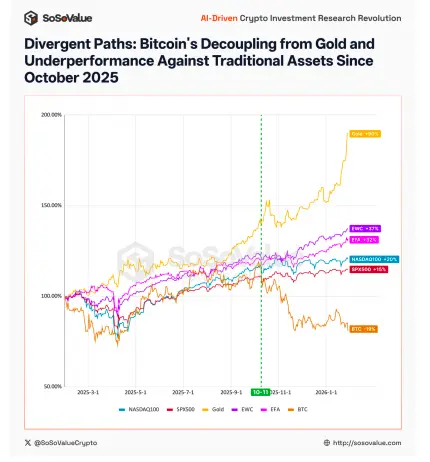
Figure 1: Since October 2025, Bitcoin has underperformed traditional assets and decoupled from gold trends. Data source: SoSoValue
What Happened in 2025? The Collapse of the Mirage in the Fog
In the recently passed year of 2025, amidst anxiety over a lack of substantial innovation, the crypto industry as a whole slid into a more pure and naked liquidity game—exchanges began systematically promoting high-leverage products—the implicit goal of product design was no longer to enhance trading efficiency, but to increase the probability of liquidation, with the attributes of a casino clearly overshadowing those of a trading platform.
At the same time, the main communication targets of project teams shifted from users to exchanges, market makers, and VCs. User value was almost completely absent during this phase. Issuing tokens was no longer a listing of assets, but rather the opening of a new gambling table. Asset quality was no longer the core standard for listing; the only requirement for this token issuance game was whether it could attract more people to place bets.
The original intention of crypto technology to reconstruct production relations and create a more decentralized and equitable world was exploited to the extreme by the most primitive desire business—casinos—as a fig leaf to evade regulation.
When "building" was mocked and "gaming" became mainstream, what we saw was not the increase of value through technology changing the world, but rather, under the name of blockchain technology, the acceleration of the world's entropy increase, leading the ark to drift. As the fog dissipated along with the mirage, it revealed the stark reality of the underlying issues in the industry while also taking away much of the noise, clarifying the journey ahead.
For this reason, this may be both the worst of times and the best of times. In the morning when the fog clears, steadfast builders find it easier to connect with each other. Only by forging ahead with like-minded individuals can this ark restore its intended course and move toward a brighter future.
The true way to use blockchain technology to reconstruct human society and establish trust is that the financial industry is composed of many modules that build trust. Therefore, we believe that the first stop for blockchain technology to change the world is to reconstruct the financial industry, allowing more people globally, including various entities such as AI agents, to have equal access to participate in financial life, making resource flow and allocation more efficient.
Looking Back at the Beginning of SoSoValue, Serving the Masses of Crypto Investors
SoSoValue was not initially a product developed specifically for consumers; it originated from our internal investment research needs. The intention was very pure: as a team focused on investing in the tech industry, like many survivors of the financial cycle deeply educated by common sense and lacking Crypto Native experience, when we were called to invest in crypto by the belief that blockchain technology could change the world, the chaotic and stark decision-making environment completely shattered the original paradigm of our investment research work.
The extremely fragmented and untraceable information dimensions, the inability to distinguish facts from opinions in social media noise, and the interpretations of the same concept from the perspectives of programmers, finance, marketing, and gambling, made us realize that the industry was still in its very early stages. We needed to build our own information filtering tools, and the birth of ChatGPT allowed us to quickly create tools based on our investment research needs.
This tool was initially shared only among friends, but based on the open spirit of blockchain, we made it available for free to the community. The name of the tool originated from a very chill discussion: "Jivvva, after filtering with your investment research tool, found that most cryptocurrencies have no value, just so-so." We felt that the name SoSoValue could remind us to persist in filtering out the vast majority of noise through research, as true value has always been in the minority in every era, requiring us to track, explore, and create.
At the beginning of 2024, the opportunity for mass adoption first smiled upon us. The team judged from an investment research perspective that a Bitcoin ETF was highly likely to be launched, which could not only reduce Bitcoin's volatility but also potentially become the main channel connecting the stock market and the crypto market, fundamentally changing the landscape of the entire crypto industry.
Thus, we launched the world's first Bitcoin spot ETF Dashboard, also the first platform to systematically propose and track the core metric of "net inflow and outflow." The market gave us unexpected feedback; by helping users truly "see" the flow of funds, we gained our initial million-level high-quality users.
Our vision and mission began to clarify: Enable crypto investment for the global masses! Everything centers around the investor, using AI and blockchain technology to create a platform that prioritizes investor interests, providing noise reduction, efficiency, and convenient investment services.
Once our vision was firm and the path clear, more like-minded individuals, top experts in blockchain technology, DeFi products, trading systems, asset issuance, and investment banking gradually joined the team, and the power of the community grew stronger. This became a challenging yet immensely enjoyable journey.
The foundational knowledge from different fields, continuously discussed and collided based on first principles, allowed us to learn a great deal from our partners along the way. With no urgent desire for results, we could focus on the continuous exploration of industry pain points and user needs, and the constant refinement of infrastructure and products.
Today, the full launch of SoDEX finally completes the foundational product map of SoSoValue.
Why Create SoDEX?
The birth of SoSoValue, SSI, and SoDEX did not stem from a sudden inspiration, but from logical deductions based on industry pain points.
First, we wanted to solve the information asymmetry problem for investors. SoSoValue Terminal achieved its first PMF, which is the cornerstone for our users: whether in traditional finance or crypto, the core pain point has always been that the "signal-to-noise ratio" is too low.
SoSoValue's Terminal provides users with a free professional filter to reduce noise, integrating the analytical framework of professional investors to filter and track information dimensions. This allows every ordinary crypto investor to enjoy Wall Street-level information services, achieving information equity. From the first launch of the ETF Dashboard to the accumulation of 10 million real users, it proved the market's thirst for "certain information."
Secondly, once investors understand, they need asset allocation, and SSI once again validated the PMF of passive investment. With the research terminal, users understand, and the next step is cognitive monetization—how to provide users with long-term safe asset allocation services. Our goal is to grow together with users over 20 years.
According to financial common sense, most users do not have the ability to beat the market; what they need is Beta returns, not Alpha gambling. Therefore, based on data platform observations, we launched the SSI (SoSoValue Index) protocol, aiming to decentralize the power of "defining assets," allowing excellent strategies to become tradable indices.
- For users: Like buying an ETF, one-click allocation of asset portfolios constructed by top researchers.
- For researchers: Use data and methods to publish their own indices, becoming "fund managers" in Web3. Provide users with richer, more convenient, and transparent return combinations, becoming the Vanguard on-chain. Allow more smart and honest people to become fund managers on-chain through the trust infrastructure we built.
In less than a year, SSI has garnered nearly 500,000 on-chain holders, with over 250,000 users holding Mag7.ssi. We confirmed one thing: users want not just data, but assets that can withstand cycles. Thus, we had our second goal: to assist users in configuring and managing assets on-chain and pursue long-term compounding.
Finally, we needed to solve the bottleneck of scaling on-chain asset issuance, which led to the timely emergence of SoDEX. When SSI was only operating on a small scale, the L2 public chain + third-party AMM model was "usable" enough. But once we wanted to expand categories, scale up, and truly deliver products to more ordinary users, the shortcomings of crypto infrastructure would be magnified. The convenience of user purchases and index synthesis, on-chain liquidity, and market maker capital utilization efficiency all became bottlenecks for scaling.
We needed a high-performance on-chain platform that supports an order book. We did not want to reinvent the wheel. However, after in-depth research, we found that no chain could simultaneously achieve three things: high-performance order book, spot-friendly, and support for RWA (real-world assets) issuance. Ultimately, we concluded that to sail along our original intention, we must build our own Layer 1.
The Mission of SoDEX—Rebuilding an Ark
If there is no road, then build one yourself. But during the preparation and research for SoDEX, we saw a more unbearable side of this industry. We discovered that the "difficulty of use" of infrastructure is just a surface issue; the deeper problem lies in the "misalignment" of business models.
- Brutal lifecycle—In this market, due to exchanges' pursuit of short-term traffic and profits, the average user lifecycle in this industry is less than 3 months. This "quick in and out" rhythm destined users to be mere passersby.
- Hidden "eating customer losses"—We discovered a widely existing unspoken rule in the industry: the main income of some platforms is no longer transaction fees, but the capital losses of users. When platforms survive by making users lose money, the relationship with users is no longer one of service, but a zero-sum game adversary.
- Bad money drives out good—Exaggerated KOLs occupy the center stage, while serious researchers, unwilling to cooperate in "harvesting," lack monetization pathways and face survival crises.
This "prosperity" under such rules is built on the consumption of user bases and the conscience of the industry.
At that moment, we realized that facing this unsustainable industry status, merely being a "better DEX" would not change the situation. Thus, we decided to build ValueChain and SoDEX ourselves.
Satoshi Nakamoto built the first ark, allowing ordinary people to hold undiluted assets. We want to follow the original intention of Satoshi's ark and create an on-chain financial ark, enabling ordinary people to invest and trade assets safely and efficiently, lowering the threshold for people to participate in financial life through blockchain technology.
SoDEX, adhering to the two principles of on-chain transparency and security, has two major features in its technical architecture:
Relying on the multi-subchain composite architecture of Valuechain L1, SoDEX connects the account systems of high-performance Spot (spot) and Perps (contract) trading subchains. This means users can trade crypto-native assets, stocks, indices, and other RWAs (real-world assets) in a one-stop manner without switching accounts, greatly enhancing capital efficiency and the convenience of asset allocation.
Reusing the Mirror Protocol infrastructure system of SoSoValue Indexes Protocol, adopting a combination of third-party custody and Bridge solutions to improve the security of multi-asset cross-chain transactions.
In terms of product positioning, we focus on two things:
The integration of Spot + Perps, enriching high-quality financial products: We hope you can buy spot assets as smoothly as in centralized exchanges while also managing risk exposure with contracts. You can also issue your own index based on SoDEX's infrastructure and participate in richer strategies.
Continuously optimizing product experience, making it accessible to the masses: We pay tribute to professionalism while transforming institutional-level performance and CEX-like smooth experiences into infrastructure that is accessible to every ordinary investor.
Today, SoDEX is launched. The blueprint in our hearts has finally closed the loop.
- SoSoValue—helping ordinary investors eliminate noise and see the truth.
- ValueChain—carrying performance, establishing trust through the openness and transparency of L1.
- SoDEX, SSI, and more open tools—creating a zero-threshold investment platform for users to access rich on-chain assets and enjoy a smooth trading experience.
The future that this new ark sails toward is a complete on-chain financial world; we build this chain not only for current cryptocurrencies but also for various assets to flow freely on the same transparent chain; SoDEX is the vessel prepared for that future.
Standing at a New "Renaissance" Moment
Finally, I want to talk about why we are so persistent. On many deep nights, we pondered: why is the current market so fragmented? On one side is the rapid advancement of AI, while on the other is the liquidity depletion of Crypto; on one side is the exponential explosion of productivity, while on the other, production relations are still playing the most primitive game of "pass the parcel."
This sense of tearing reminds us of Europe 500 years ago. It was an era known as the "Renaissance." At that time, the birth of two technologies completely changed the course of humanity:
- The Gutenberg Printing Press: It broke the church's monopoly on knowledge, allowing ordinary people to own books and igniting the liberation of cognition.
- Double-entry Bookkeeping: It established the foundation of trust in modern commerce, making cross-border capital cooperation possible and igniting financial prosperity.
History always rhymes. Today, we stand at the same crossroads:
- AI is the "printing press" of the new era: It makes intelligence and productivity extremely cheap and widespread, responsible for enlarging the cake.
- Crypto is the "double-entry bookkeeping" of the new era: It upgrades trust based on people to verification based on code, responsible for dividing the cake well.
This should be the singularity for ordinary people to change their destiny. This is also the underlying belief that drives us into this industry—we believe this is a ladder to a fairer world. We are not just building an exchange; we are maintaining a historical order of "technology for good."
One more thing.
SoDEX is a high-performance, highly trustworthy, zero-threshold, one-stop investment platform, not a casino that creates illusions. If you seek adrenaline-fueled short-term stimulation, this may not be the best place. But if you recognize "long-termism" and are willing to let wealth grow alongside the true value of the industry through "compounding," then we are fellow travelers.
What Satoshi Nakamoto wanted to introduce to this world was not speculation, but autonomy. Everything we do aims to continue this choice: to safely manage your wealth in a transparent and fair system.
On this new ark, we are not adversaries but fellow explorers.
This letter is your ticket.
We will distribute "ticket rights" to eligible early users' accounts (specific rules will be subject to official announcements).
At the same time, we have also reserved an ecological incentive pool to support long-term participants and builders, rewarding genuine contributions and long-term companionship.
Stop Gambling. Start Compounding.
Mutual love, mutual benefit! — Mozi
Welcome aboard, let’s journey far together. Use technology to increase consensus, reduce disputes, and promote peace!
SoSoValue & SoDEX Founding Team, February 1, 2026
 Risk warning Risk warning
Popular articles