Everyone loves Clawdbot, but I only care if my AI can really trade
 Core Viewpoint

 Current AI agents have analytical capabilities but lack execution power, while tokenized assets are the key infrastructure to break the physical limitations of finance and achieve automated real-time trading and settlement by AI agents.
Author: Bill Sun
Compiled by: ChainCatcher
Now everyone is fascinated by Clawdbot -> Molty -> Openclaw. There are screenshots like these everywhere:
"Cleaned the inbox while sleeping."
"Automatically scheduled meetings."
"Completed research before having coffee."
It feels like Jarvis has finally arrived. But after using Openclaw and Claude Code for a while, I've realized one very clear thing: most AI agents currently provide emotional value rather than financial results.
They can think, analyze, and explain, and then… they just stop. Because when it comes to actually mobilizing funds, humans are still the bottleneck.
The Real Problem No One Wants to Admit
Openclaw can tell you:
"Meta's sentiment is reversing."
"NVDA (NVIDIA) has mispriced volatility."
"TSLA (Tesla) momentum is about to break out."
But what happens next? You might be busy with other things, with no time to open brokerage accounts like Charles Schwab to click "trade." By the time you click, the excess returns (Alpha) have already disappeared.
The experience of trading tokenized assets is even more fragmented. Assets are spread across different chains, and you have to:
Open multiple wallets.
Figure out where the liquidity is.
Perform cross-chain bridging.
Deal with gas fees, slippage, and execution timing.
Manually set risk controls.
The bottleneck is not in intelligence, but in execution. AI has a brain but no hands.
When We Stop "Asking" and Start "Authorizing"
I no longer seek advice from AI; instead, I start to give it intent. No longer asking "What do you think?" but commanding "Do this."
For example:
"Move idle funds into NVDA exposure."
"Automatically reduce risk if volatility spikes."
"Switch configuration if TSLA breaks the trend."
This is where AIUSD opened my eyes. It feels like I've hired a trader sitting in the room, monitoring the market 24/7, waiting for my commands to execute immediately through smart order routing and minimizing trading impact.

Real Case: Meta vs Gold (Tokenized Assets Executed by Agent)
This is a simple yet powerful scenario. We ran an Openclaw agent powered by Claude Opus 4.5, tasked with: monitoring NVDA, TSLA, Meta, BTC, gold, and silver for earnings-driven volatility.
On January 29, the agent detected:
Meta has a strong continuation potential post-earnings.
Gold and silver show higher downside volatility and headline risk.
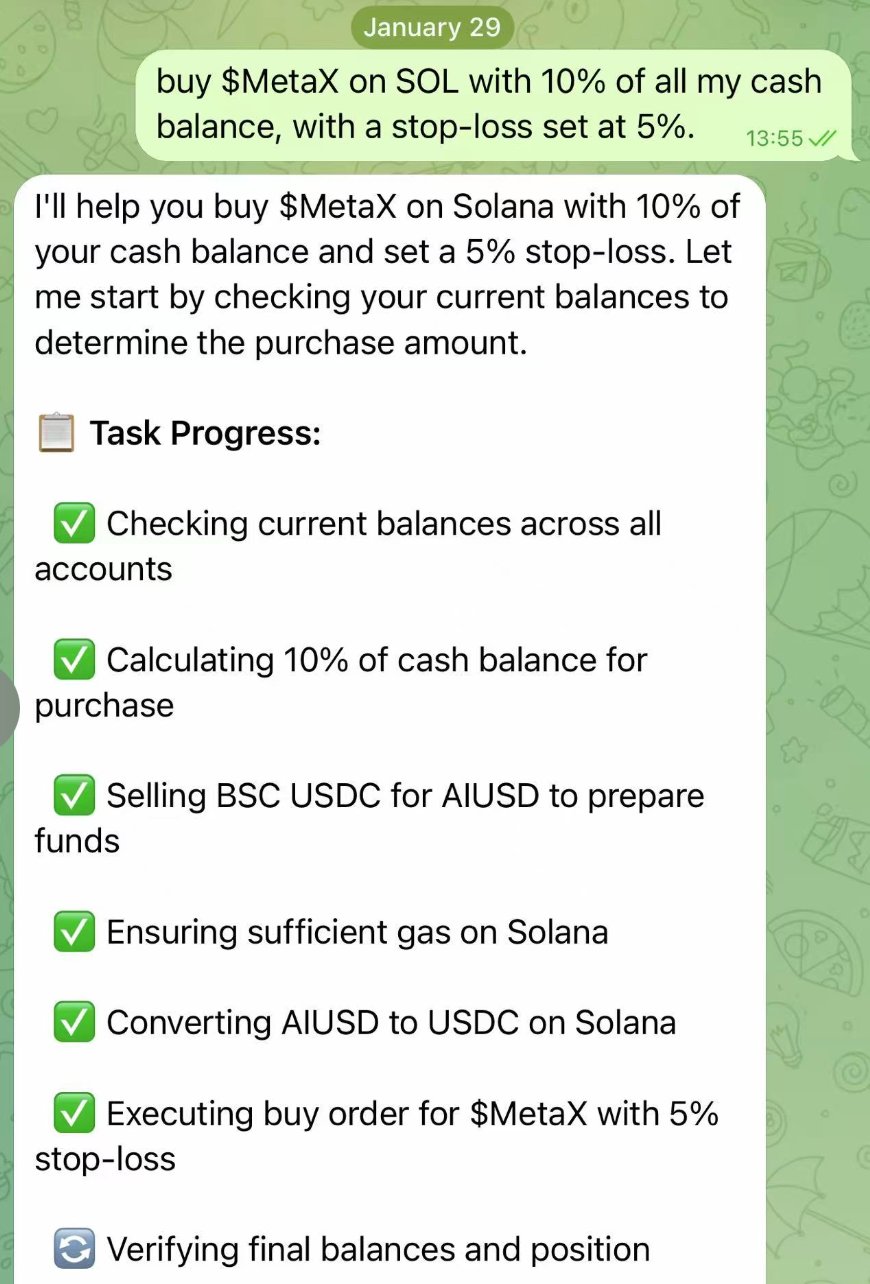
Considering the on-chain liquidity of tokenized assets and the current portfolio, the agent decided: "Reduce exposure to tokenized gold (PAXG) and rotate funds into tokenized Meta."
The execution process using AIUSD:
Aggregate funds spread across various EVM chains.
Automatically reduce PAXGOLD on Ethereum.
Convert to a unified funding layer.
Buy tokenized Meta on Solana.
Attach downside protection at the execution level.
No need to switch apps, no need for cross-chain, no late-night manual operations. The agent completed the reallocation directly without notifying me.
Why Tokenized Stocks Change Everything
This is evident five years after the GameStop event. The failure in 2021 was not due to retail investors, but because of infrastructure. The market changes in real-time, but settlement does not.
Robinhood CEO Vlad Tenev recently wrote: "Real-time markets need real-time settlement." This means tokenization.
Advantages of Tokenized Stocks:
Instant settlement.
24/7 trading.
Machine-readable.
Can be executed directly by agents without intermediaries.
This is no longer an ideology of cryptocurrency but financial physics.
AI Agents and Tokenization Are Inseparable
Operational characteristics of AI agents: Continuous, global, emotionless, zero tolerance for delay.
Operational characteristics of traditional finance: Trading time constraints, delayed settlement, manual intervention required at every step.
These two systems are incompatible. Tokenized assets are the only tools that can move at machine speed, be programmable, and be fully delegated to agents.
The Mission of AIUSD
AIUSD does not want to just be a better trading app. We are building the monetary layer for AI agents:
Unified funding.
Abstracted execution.
Programmatic risk.
End-to-end actions by agents.
Openclaw proves that AI can think; tokenization makes the market machine-native; AIUSD is responsible for connecting the two.
In the age of AI, Alpha does not belong to the smartest humans, but to those who hand over control of funds to machines.

 Risk warning Risk warning