Chips, energy, storage - among the three lines of AI infrastructure, which will rise first, which will rise the most, and which can still be pursued?

 Don't just focus on whether the model is popular; what truly drives the AI market forward are the three underlying infrastructure lines.
Author: Changan I Biteye Content Team
In November last year, Sun Yuchen tweeted:
"Short-term chip shortage, long-term energy shortage, forever storage shortage, the future of BitTorrent is unimaginable."
If we take this statement as an industry judgment rather than a catchy phrase, looking back we can see:
These three lines almost represent the most authentic profit paths of the AI market.
What would have happened if one had bought U.S. storage concept stocks after that tweet?
• Micron: +214%
• Seagate: +180%
• Western Digital: +190%
• SanDisk: +552%
This article will break down these three lines:
Why does AI first benefit chips, then force out energy bottlenecks, and finally raise storage demand in the long term? Which assets have already emerged in this round of structure?
1. Chips: The first to benefit from AI explosion is not the narrative, but the orders
What ignited AI first was not the application layer, but the underlying computing power.
Whether training large models, daily inference, agent invocation, or multimodal processing, the first step is to get the computation running, and this computation ultimately relies on GPUs, HBM, high-speed interconnects, and advanced processes.
In other words, the growth in AI demand will not first transmit to the later stages but will instead become a more direct reality:
More chips are needed, stronger chips are needed, higher bandwidth chips are needed.
This is also why AI demand first reflects in the chip sector.
Industry data has made this very clear. According to the fiscal year 2026, NVIDIA's revenue increased by 65% year-on-year, indicating that the demand for high-end computing chips continues to be released.
🌟 What assets are in this direction
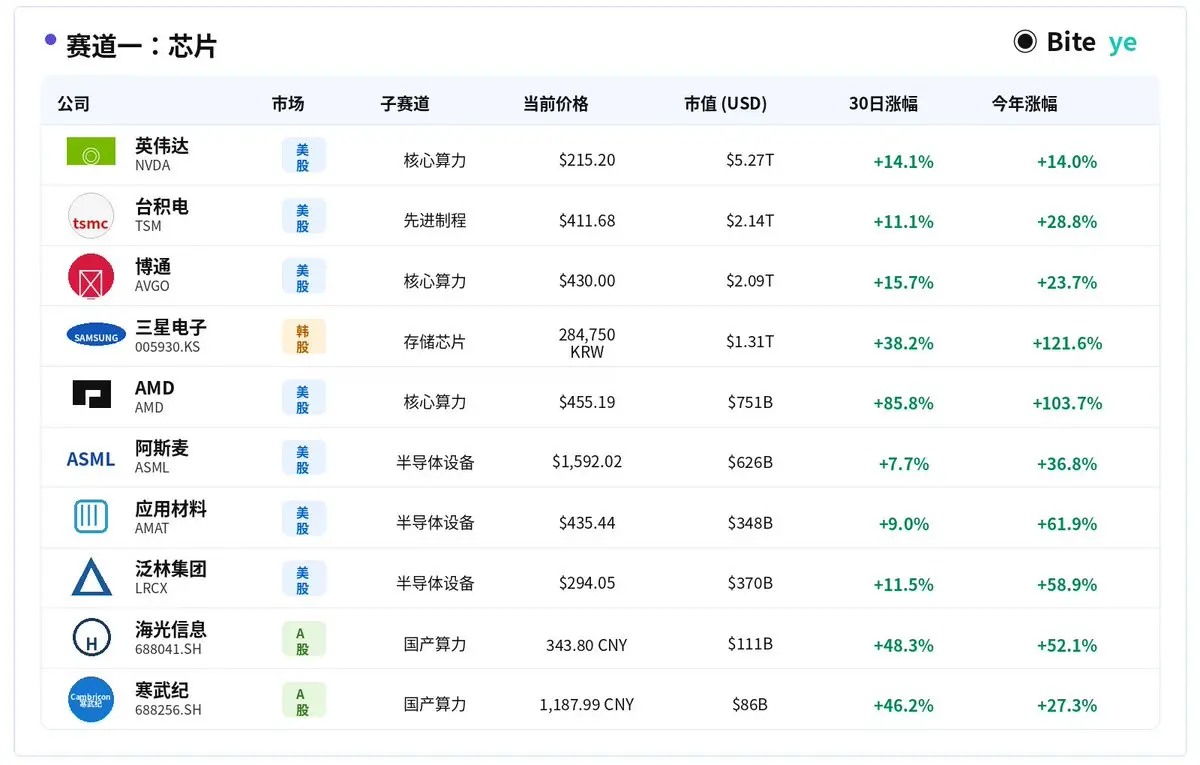
Core computing layer: NVIDIA (NVDA), AMD, Broadcom (AVGO), TSMC (TSM)
Domestic computing layer: Haiguang Information (688041.SH), Cambricon (688256.SH), etc. Among them, Haiguang Information is one of the representative companies of domestic x86 server CPUs, with a revenue of 9.162 billion yuan in 2024, a year-on-year increase of 52.4%.
Semiconductor equipment layer: ASML, Applied Materials (AMAT), Lam Research (LRCX). The stock price of the lithography machine giant ASML's ADR has reached a historical high at the beginning of 2026, with a single-day increase of over 8% on January 2, and a total increase of 27% since the beginning of 2026; Lam Research has increased by 30% since the beginning of the year; Applied Materials has increased by 28% since the beginning of the year, with all three semiconductor equipment giants' stock prices significantly outperforming the S&P 500 index.
🌟 Performance in the past year
The chip sector is the first to start and has the largest increase in this wave of AI market. As the leader, NVIDIA has seen a cumulative increase of over 1000% since the beginning of 2023. The equipment side continues to reach new highs at the beginning of 2026, and the overall trend remains in a strong upward cycle.
Citigroup released a research report predicting that the global semiconductor equipment sector will usher in a "Phase 2 bull market upcycle," with the main line of chip stocks in 2026 clearly falling on ASML, Lam Research, and Applied Materials.
2. Energy: After AI expands, the bottleneck shifts from chips to electricity
No matter how many chips there are, they won't run without power.
Buying chips is just the beginning; truly operating large models, data centers, and inference services in the long term requires continuous power supply and additional heat dissipation and cooling loads.
Traditional data centers typically have a single cabinet power of 5 to 15 kilowatts, while AI data centers have clearly increased to 50 to 100 kilowatts, with electricity consumption and heat dissipation pressure at a completely different level.
The IEA's analysis this year mentioned that electricity consumption in data centers will increase to about 945 TWh by 2030, roughly doubling from current levels, with AI being the main driving force. The U.S. Department of Energy has also stated that the growth in electricity demand from data centers is putting significant pressure on regional power grids.
🌟 What assets are in this direction
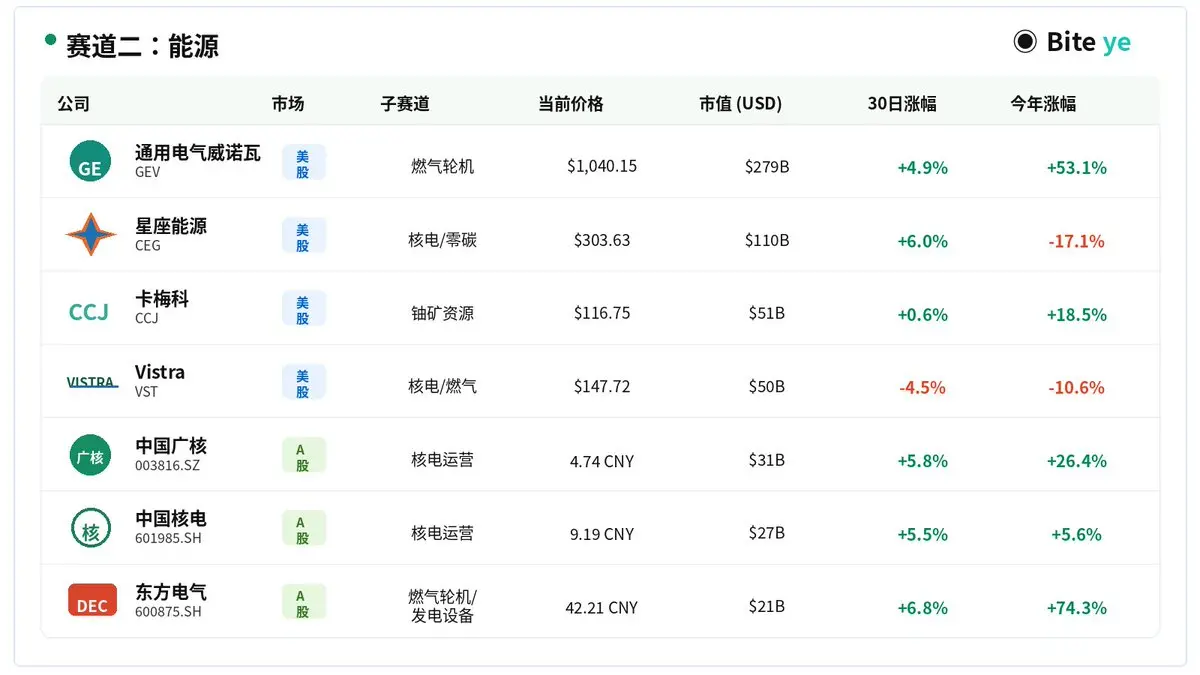
Gas turbines: GE Vernova (GEV): Gas turbine orders are booming, with total orders reaching $59 billion in 2025, and backlogged orders growing to $150 billion. Management has raised the revenue guidance for 2026 to $44 billion to $45 billion.
Independent power producers: Constellation Energy (CEG): The largest zero-carbon power operator in the U.S., with nuclear power assets directly signing long-term power purchase agreements with tech giants;
Vistra (VST): Combining nuclear and gas assets, with a median EBITDA guidance for 2026 up about 30% from 2025.
Uranium resources: Cameco (CCJ): The largest publicly traded uranium mining company globally, a beneficiary of the nuclear power restart upstream.
🌟 Performance in the past year
GE Vernova's stock price has increased by 167% over the past year. The 52-week low was $408, reaching a high of $1181, with an increase of nearly double in the range.
Constellation Energy reached a historical high in 2025, then retreated about 28% from the peak due to regulatory policy disturbances, currently at a relatively low level.
Vistra remains strong overall, with long-term power supply contracts for data centers continuing to be implemented. The energy sector has been repriced from traditional defensive positions to a core beneficiary direction of AI infrastructure.
3. Storage: The most easily overlooked but will benefit in the long term
The core logic benefiting storage is simple: AI is not a one-time call; it is essentially a system that continuously processes, accumulates, and calls data.
Training requires reading large amounts of data, checkpoints need to be stored during training, inference requires model adjustments and caching, and RAG and agents need to continuously read knowledge bases, logs, and memories.
As a result, AI brings not just "more data," but:
• More frequent data read/write
• More real-time calls
• More complex management
• Greater pressure on migration and caching
Looking further, the more expensive the GPU, the less it can idle, so the industry will increasingly focus on how to deliver data to the computing power side faster and more stably.
In other words, as AI develops, storage becomes not just a "warehouse for data," but the data foundation that ensures the entire AI system can operate continuously.
🌟 What assets are in this direction
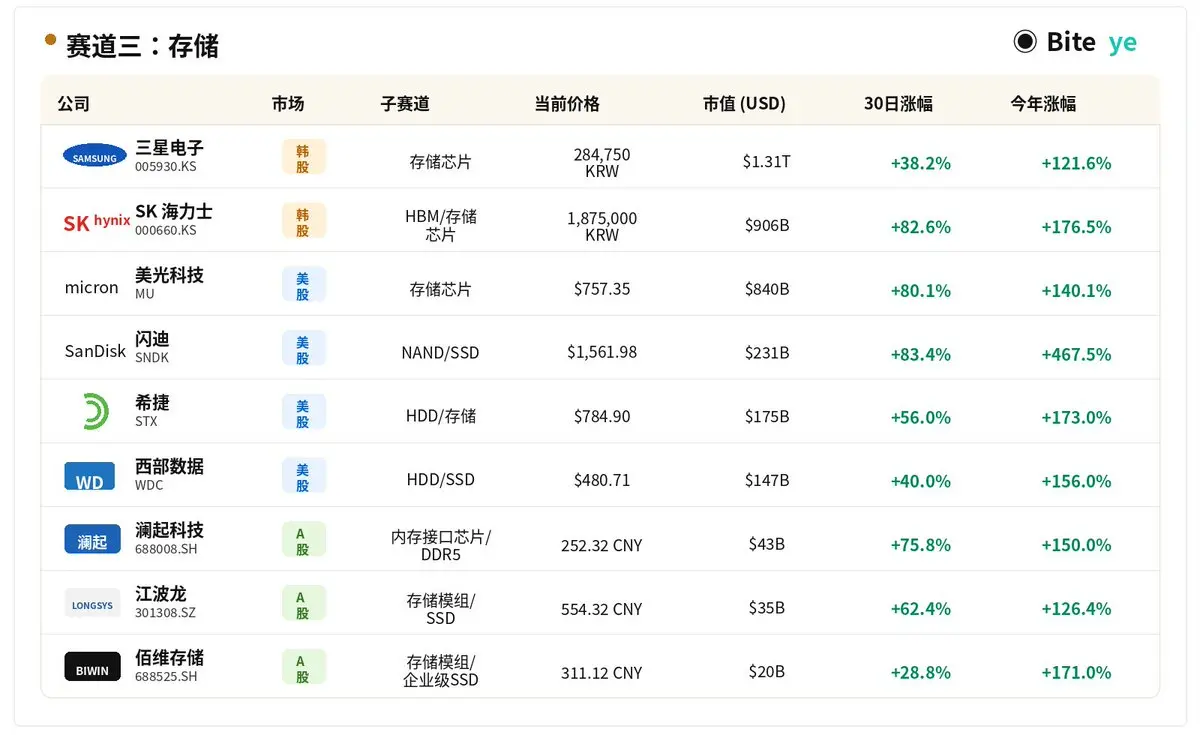
Storage chip manufacturers: SK Hynix (000660.KS), Samsung Electronics (005930.KS), Micron Technology (MU)
NAND / SSD / HDD manufacturers: SanDisk (SNDK), Seagate (STX), Western Digital (WDC)
Domestic storage design: Zhaoyi Innovation, Puran Co., Dongxin Co., Beijing Junzheng, Lanke Technology, as well as storage module manufacturers Demingli, Shannon Xinchuan, Jiangbolong, etc.
🌟 Performance in the past year
Since 2026, the storage sector has been one of the strongest branches in the AI industry chain.
In the U.S. market, driven by AI infrastructure investment and high-capacity storage demand, Seagate, SanDisk, and Western Digital have all seen significant increases this year, with Reuters mentioning at the end of April that Seagate and Western Digital have more than doubled this year, and SanDisk has increased by about 350% this year.
Storage chip manufacturers have also strengthened, with Micron significantly rising this year, while SK Hynix continues to benefit from HBM shortages and major manufacturers scrambling for production capacity, with Q1 revenue increasing by 198% year-on-year and operating profit increasing by 406%, further strengthening profitability.
In conclusion: Chips rise first, followed by electricity, and finally storage
The first wave of AI realization is chips; the second wave bottleneck is energy; the third wave long-term beneficiary is storage.
The logic is correct, but that does not mean the buying point is comfortable. There are structural opportunities, but it is not mindless chasing highs.
What is truly valuable is not the excitement itself, but which layer of the industry chain you stand on.
Disclaimer: The above is merely a review of the industry chain and does not constitute investment advice. Especially since some targets have already seen very exaggerated increases since 2026, correct logic does not equate to a comfortable buying point.
 Risk warning