How xBubble Breaks the Deadlock in VC's Heavy Investment in the OPC Economy
 Core Viewpoint

 DAPPOS launched xBubble, using the innovative model of "SOP is business" to solve the challenges of implementing AI Coding, allowing OPCs who do not understand technology to create a real business closed loop with zero threshold.
OPC (One Person Company) is transitioning from an eye-catching entrepreneurial concept to one of the most noteworthy new markets in the AI industry.
A few years ago, "a person building a billion-dollar company" was just a joke at Silicon Valley dinner tables. Now, the founders of the world's top AI companies are seriously discussing this matter:
Sam Altman once predicted that in the AI era, a type of company that never existed before might emerge: a company that doesn't hire a single employee and achieves a billion-dollar valuation solely through one founder.
Dario Amodei, founder of Anthropic, made an even bolder statement at the Claude developer conference, saying, "The first one-person billion-dollar company will likely appear around 2026."
The real core signal is not in the "billion-dollar" figure, but in Silicon Valley starting to redefine what a "company" is. In the past few years, AI entrepreneurship focused on whether it could make programmers, designers, and operations more efficient; now, it asks whether one person or a very small team can independently complete a business's closed loop.
Capital has already put a price tag on this: Replit completed a $400 million financing round in March 2026, with a valuation of $9 billion, aiming to enable non-developers to turn their ideas into software; Lovable completed a $330 million Series B round in December 2025, with a valuation of $6.6 billion, targeting the 99% of people with ideas but lacking technical skills. They may not use the term OPC, but they are doing the same thing, allowing those who feel that building a technical team is not worth it to turn their ideas into operational businesses.
The OPC referred to in this article is not just a narrow definition of "a company with only one person." It more broadly points to a type of small business node: individual creators, small merchants, and small to medium-sized enterprises that already know what to sell and to whom, but do not need to maintain a complete technical operations team.
1. OPC is Becoming the New Mainstream of AI Entrepreneurship
In the past few years, the most common question in AI entrepreneurship was: Can AI make existing employees more efficient?
Now, the market is starting to ask another, more important question: Can AI enable a business to be established with fewer people?
These two questions correspond to different markets. The former increases the output of existing organizations, while the latter allows small businesses that previously could not bear fixed costs to enter the market.
For OPCs, the value of AI is not just in saving labor hours, but in making previously unprofitable businesses profitable. Websites and sales materials can be produced at lower costs, and some repetitive processes can gradually be automated. When these costs decrease simultaneously, the starting point for a company changes. Operators no longer need to prove that the business can support a team before qualifying for digital capabilities. They can first validate their ideas at a lower cost and then decide whether to expand based on actual income.
At the same time, with the wave of layoffs in the AI era, more and more experienced former employees are looking for income sources beyond the traditional "getting a job at a big company." AI provides the execution layer to transform these individual resources into independent businesses.
Thus, OPC and AI business builders are not a short-term concept, but a new market that naturally forms after AI reduces business costs. AI is changing not just employee efficiency, but also the minimum number of people required to establish a business.
2. Replit and Lovable Prove: The Demand for AI Coding Among Non-Technical Users is Real
Whether a market exists ultimately depends on whether users and capital are willing to pay for it.
Replit and Lovable provide the most direct validation. As mentioned at the beginning, they both achieved nearly $10 billion valuations and attracted significant interest from well-known Silicon Valley institutions in their recent funding rounds.
Their high valuations are not just because AI allows programmers to write code faster, but because software development capabilities are transitioning from being exclusive to engineers to services that ordinary users can directly utilize. A person with an idea no longer needs to hire a development team to turn their needs into a website or application. The previously separate roles of need proposers, users, and application creators are beginning to overlap in the same person or small team.
There exists a market far larger than developer tools: a large number of users need digital tools tailored to their businesses but lack the time and energy to learn programming in depth, nor is it worth forming a technical team for every idea.
Replit and Lovable have proven that this demand is not just theoretical. AI coding is transitioning from an efficiency tool for developers to a way for a broader audience to build new applications.
However, they primarily validate the first half of the story: non-technical users are indeed willing to build applications directly.
What truly determines whether OPCs can emerge on a large scale is the second half of the story: whether these applications can operate continuously and stably, and whether they can support real businesses.
3. Existing AI Coding Tools Still Have a Structural Gap
Currently, a large number of AI coding tools have significantly reduced the cost of code generation, especially for "creating a demo webpage/app for social media display." However, when a demo needs to be implemented in a real business, it still assumes that users can manage the development process.
Users still need to break down business ideas into technical requirements, assess whether the results are reasonable, and then handle deployment and modifications. For developers, this is a normal process; for non-technical OPCs, this is precisely the most challenging layer.
An operator may be very clear about what they are selling and to whom, but they may not know how to design order statuses for an online store or judge whether the backend and database are reliable. AI can quickly generate pages based on a sentence, but when the page needs to integrate payments, record orders, or modify business rules, users still have to make a lot of technical judgments.
This is also the distance that is most easily overlooked between a demo and a business.
A demo only needs to run normally during the presentation. A real business, however, must face continuous changes: products will be updated, prices will be adjusted, and customers will make new requests. As long as every modification requires re-understanding the code, debugging the environment, or seeking outsourcing, the so-called "low-cost entrepreneurship" is difficult to truly establish.
Therefore, there is a structural contradiction in the current AI coding market:
Existing products have significantly improved the efficiency of personnel with IT backgrounds, such as developers and product managers, making it possible to quickly build and launch applications, but they have not completely solved the problem of fully replacing humans and allowing non-technical users to use AI to sustainably and stably support businesses. They provide users with increasingly strong development capabilities but still require users to take on the responsibilities of product definition, result acceptance, and continuous iteration.
For technical users, this freedom is an advantage; for non-technical OPCs, this freedom often means new learning costs or additional labor and outsourcing costs.
The next stage of competition in this AI track may not be about who can generate more code, but about who can further encapsulate the development process, truly replace technology or outsourcing, and allow non-technical users to directly obtain operational business results.
4. xBubble's Entry Point: From Prompt-to-Code to SOP-to-Business
xBubble, launched by DAPPOS, does not directly compare its coding capabilities with mature developer tools.
Its real entry point is changing the delivery unit of AI coding. Ordinary AI coding products mainly convert prompts into code or applications, while xBubble attempts to convert business goals into an executable business path.
Users no longer start from technical architecture but from business problems. They only need to specify what products or services they intend to offer, who their customers are, and how they want their business to operate. xBubble then uses SOP to convert this information into specific processes, completing the connections between pages, payments, and order backends.
This is the shift from Prompt-to-Code to SOP-to-Business.
The difference between the two is not that prompts become shorter, but that more segments that originally required user judgment are organized in advance. Ordinary AI coding provides users with a development assistant; xBubble further takes on the task of requirement breakdown and process management, allowing users to start operating their businesses without first learning to manage AI development.
For OPCs, this change is more important than simply increasing generation speed.
What they lack is not a stronger code editor, but a technical execution system that is cost-effective and can continue to be modified after going live.
xBubble's core judgment is that the underlying large model capabilities will continue to improve, but business needs will not automatically become standardized. Users still need to express rules, styles, and result requirements. A truly valuable product is not just a powerful and user-friendly tool, but one that completely replaces technical development or outsourcing companies, becoming a service that delivers results directly.
5. How xBubble Turns Business Goals into Operational Results
The core highlight of xBubble is its SOP system and network of third-party service providers.
Here, SOP is not a longer prompt but a set of organized execution processes around specific tasks. It encapsulates models, tools, and result standards, which the system calls based on user needs. Users are responsible for stating business goals, while xBubble is responsible for converting those goals into software processes.
For example, a small merchant selling World Cup merchandise already has traffic, products, and potential customers but lacks an independent sales system. On the surface, they just want to "create a mall webpage"; however, when they actually need to acquire customers and deliver, they require not just a seemingly problem-free display webpage but also uniformly styled product materials, transaction-capable pages, and a continuously updatable order backend.
If using ordinary AI coding, users need to supplement requirements item by item and assess whether each generation meets business needs. With SOP, the system can first recognize that this is a merchandise mall scenario and then complete application construction along the already organized process. Users still decide on products, prices, and sales rules but do not need to sort out the relationships between pages, orders, and backends from scratch.
The second change brought by SOP is shifting the focus from single-instance generation to continuous stability.
For real businesses, making a product demo for the first time in the AI era is not the most challenging part. What truly affects the user experience is whether the system can continue to function normally when changing products, adjusting prices, or modifying order processes. OPCs need not just a stunning demo but a deliverable path that can be executed repeatedly and continuously modified.
The Bubble Engine is responsible for generating and optimizing SOPs based on cases and result standards, solidifying verified business requirements and execution methods; the Bubble Pilot is responsible for understanding current needs and calling more suitable SOPs. Users face the business entry point, while model selection and tool combinations remain within the system.
Additionally, xBubble addresses the infrastructure issues involved in transitioning from code to real business launch through third-party service providers.
A website typically requires a domain name, server, and payment services to operate. For non-technical users, even if AI can provide operational instructions, purchasing accounts, configuring environments, and completing deployments remain unfamiliar processes.
xBubble does not lock all applications into a unified hosting platform but separates software construction from infrastructure services. Users can choose trusted third-party service providers or have AI match suitable providers. Service providers are responsible for resource procurement, environment configuration, and application deployment; xBubble continues to handle software generation, business processes, and subsequent modifications. Different service providers can use various cloud platforms, domain services, or payment solutions, and users can know what resources they are using, who provides them, and the corresponding costs.
Notably, users can directly use xBubble's points to pay for these infrastructure services in one step, rather than going through the cumbersome process of registering various infrastructure service provider accounts and passing through various platform reviews.
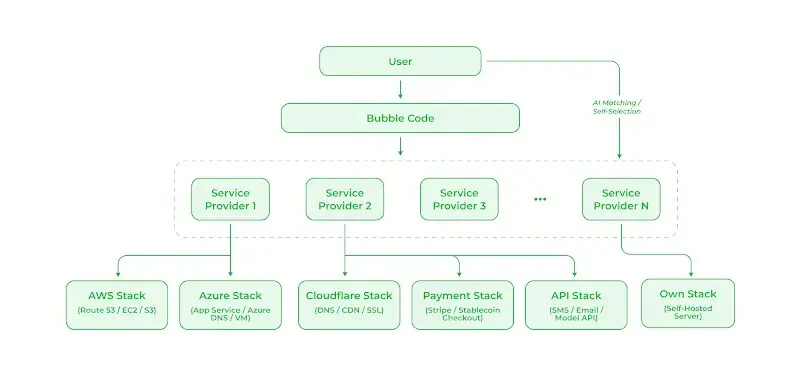
(The relationship between users and service providers in xBubble, source: official blog)
In this system, service providers are no longer traditional outsourcing companies but more like "on-site service engineers" from OpenAI/Anthropic. Most repetitive development is completed by xBubble's SOP, while the work requiring manual service and external links, such as infrastructure needs, is handled by xBubble's network of service providers.
Thus, xBubble delivers not just a generated application but a more complete business startup path: users propose business goals, SOP completes software construction, third-party service providers handle deployment, and subsequent needs can still be modified through xBubble.
This is the complete meaning of transitioning from Prompt-to-Code to SOP-to-Business.
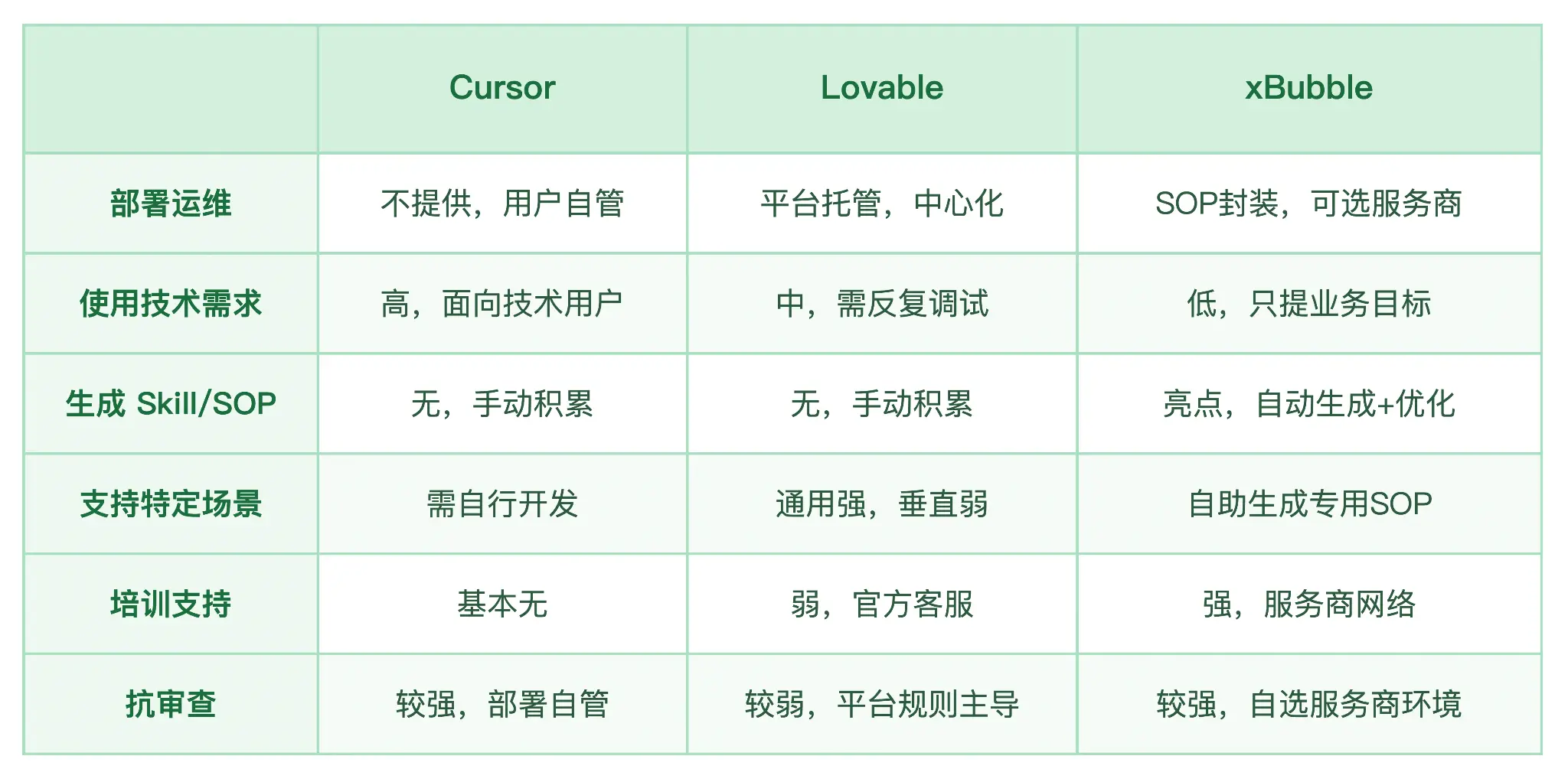
(A technical comparison table of xBubble with Cursor and Lovable AI coding companies)
6. Why xBubble Has the Opportunity to Capture the OPC Market
The demand for AI tools aimed at OPCs is rapidly growing, and non-technical users directly building applications has become a clear main line of interest for Silicon Valley products and capital. xBubble's opportunity lies in further advancing "building applications" to "starting businesses," thereby precisely meeting a group of OPCs that already have products, services, or customers but do not need to configure a technical team.
First, the sub-group of OPCs that xBubble targets is clear and not small.
xBubble is not targeting the "geeky one-person companies" that attract the most media attention, but a broader and more realistic type of small business node: they already have customer relationships, sales channels, or stable products and services, and can maintain their business through an understanding of niche markets, but technology is not their core competency. For these types of OPCs, the issue is often not "what to sell and to whom," but how to convert existing business resources into a sustainable online business at a sufficiently low cost.
This is precisely where xBubble's SOP model is most suitable to play a role and has the greatest opportunity to gain market share.
Second, xBubble's SOP has the potential to form an accumulation independent of the underlying model capabilities, making the user experience of business startup more friendly, mature, and stable.
A single-instance code generation agent workflow can easily be caught up with as the underlying model upgrades; however, a process that has been repeatedly adjusted through real business includes not just code but also understanding of requirements and standards for results. The more cases processed, the more opportunities SOP has to cover common issues in similar businesses, and the subsequent delivery costs will decrease accordingly.
xBubble's network of service providers allows this accumulation to be distributed. Many xBubble users choose to subscribe to xBubble to start their businesses after trusting a service provider that understands their industry and can showcase similar mature business cases. Service providers bring customer needs into the system and also bring mature SOPs to more similar clients.
In this way, product use and market expansion may form a cycle: more businesses bring more cases, more mature SOPs lower delivery costs, and lower delivery costs make more small businesses worth starting.
Finally, xBubble's support for crypto-native payments also aligns better with the actual needs of some OPCs: small operators targeting global users, digital services, or community transactions.
For them, the real challenge is to connect to payment, order, and settlement systems at a low cost while their business scale is still small. Wallet logins, stablecoin payments, and on-chain reconciliation can be directly integrated into business processes, reducing the complexity of cross-regional payment integration. xBubble further combines these capabilities with malls, backends, and SOP delivery, allowing operators to validate a crypto-native or cross-border business more quickly without needing to deeply understand Web3 technology.
These capabilities will not replace all traditional payment methods but can cover niche demands that general AI coding and standardized website building tools find difficult to meet, thus constituting another layer of differentiation opportunity for xBubble in the OPC market.
Of course, xBubble cannot create products and customers for users, nor can it replace the professional teams required for complex enterprise systems. What it truly needs to prove is whether SOP can be stably reused among different users, whether businesses can be continuously modified after going live, and whether the involvement of service providers can significantly improve delivery efficiency.
If these conditions are met, xBubble will not just be an easier-to-use AI coding product but may become a business startup system for the OPC market, or even the commercial infrastructure of the OPC era.
Conclusion
The OPC economy, especially the trend of non-technical users participating in software creation, has become a main line validated by real usage and capital investment. Meanwhile, products like Replit and Lovable have made the next layer of market gaps clearer: applications can be quickly built, but businesses still need to be organized and continuously operated.
xBubble's opportunity comes from a different solution to this gap. It does not require OPCs to first learn the complete AI coding process but instead transforms business goals into execution paths through SOPs, with service providers filling in the parts that cannot yet be fully automated.
From this perspective, xBubble does not need to prove that it can write code better than all AI coding products. What it needs to prove is that before a small business earns its first income, SOP-to-Business is more valuable than a powerful blank input box.
Silicon Valley has already proven that AI is handing software creation capabilities to more people.
What xBubble needs to prove is whether this capability can truly enable more people without technical teams to start operating.
 Risk warning