From Bitcoin to Digital Society: The Reconstruction of Trustworthy Collaborative Order in the AI Era

 The future digital civilization is neither the desperate struggle of carbon-based humans nor the blind revelry of silicon-based machines. It will be woven together by countless insightful Builders and their continuously evolving, trust-keeping digital avatars.
Author: m&WDAO Founder Jerry | Research Support: Gemini, ChatGPT
Prologue: In 2008, No One Realized What That Email Truly Changed
On October 31, 2008, the global financial system was deeply mired in an unprecedented profound crisis. Lehman Brothers collapsed, Wall Street trembled, and the trust structure that traditional civilization had built over hundreds of years on banks, intermediaries, and state credit was exposed for the first time so clearly in its inherent fragility and flaws.
At that special historical juncture, an extremely inconspicuous email floated into the cryptography mailing list. The sender was named Satoshi Nakamoto, and the subject contained just a few calm words: Bitcoin P2P e-cash paper. The first sentence of the email later became one of the most important proclamations in the history of digital civilization:
I've been working on a new electronic cash system that's fully peer-to-peer, with no trusted third party.
Today, people tend to summarize this email as the announcement of the birth of a new type of digital asset. However, if we return to that stormy night in 2008, the proposition put forth by Nakamoto had long since transcended the boundaries of currency itself. It answered a fundamental question that has troubled human civilization for thousands of years and constantly constrained the evolution of civilization in its latter half: When participants are strangers to each other and there is no centralized authority as a referee, can an open network still form a stable, self-driven, and continuously evolving collaborative order?
Throughout the long history of human evolution, large-scale collaboration has almost invariably been parasitic on centralized power structures. From ancient tribal states to modern banks, from giant corporations to internet platforms, humanity has defaulted to an unshakeable premise—if unfamiliar entities want to establish long-term cooperation, they must cede power to a trusted adjudicating center. Nakamoto was the first to show the world another possibility: trust does not have to come from towering institutions; order can entirely arise from open and transparent protocols.
Bitcoin never assumed that participants in the network were inherently good; on the contrary, it took selfishness, competition, and even potential malicious attacks as default parameters of the system. Through the clever intertwining of proof of work (PoW), longest chain consensus, and game-theoretic incentives, Bitcoin proved to humanity something that was nearly miraculous before: that strangers can establish large-scale collaboration across time and space under the cold gaze of no central authority.
Thus, what Bitcoin truly left to the world was not merely an asset, but a brand new civilizational paradigm—Trustless Coordination.
Many years later, people have come to regard Bitcoin as digital gold, to understand blockchain as financial infrastructure, and to simply define Web3 as the value internet. While these perspectives each have their emphasis, they all obscure a deeper fact: Bitcoin has never merely solved the transfer of wealth; it has addressed the sociological problem of collaboration. It answered how strangers can seamlessly exchange value in a trustless network.
And today, as artificial intelligence crosses critical thresholds at an astonishing speed, and as digital identities and autonomous agents flood the virtual world like a tide, a new era's examination paper has thunderously unfolded: When billions of humans migrate fully to digital space, and each person possesses their own digital avatar, how should long-term trustworthy collaboration be established among unfamiliar humans, complex machines, and autonomous intelligences across time?
This will be the ultimate question that the next generation of digital civilization must answer.
1. We Misread Bitcoin for Fifteen Years—From Value Settlement to Social Collaboration
If we observe Bitcoin from the grand scale of human civilization, its resonance has long surpassed the original intention when Nakamoto wrote the Whitepaper. The evolution of civilization is essentially a history of the continuous expansion of collaborative boundaries and an evolving history of trust mechanisms.
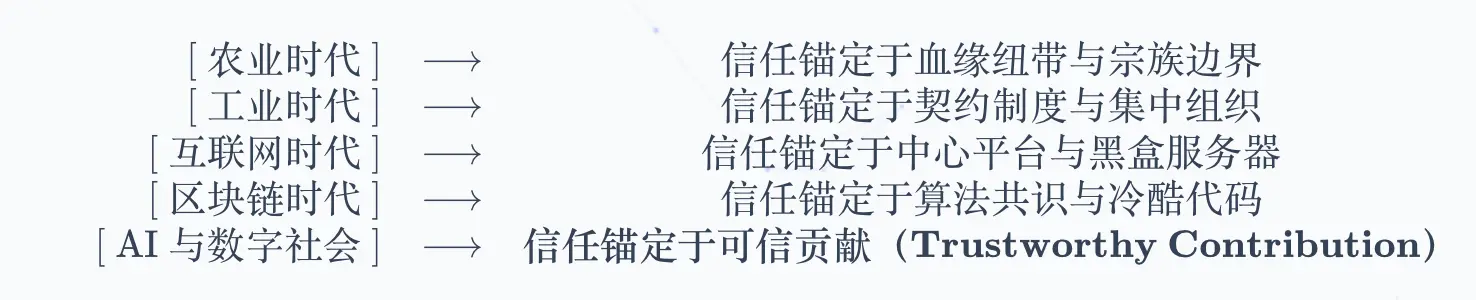
- Agricultural civilization relied on kinship and clans, maintaining trust within familiar societies;
- Industrial civilization created companies, laws, and contractual systems, allowing strangers to participate in large-scale collaboration;
- The internet greatly reduced connection costs but still established trust on centralized platforms—the platform's algorithms determine how we are seen, and the platform dictates how relationships form and rules are enforced.
The true greatness of Bitcoin lies in its first-time shift of the source of trust from centralized institutions to open protocols. It proved that rules can transcend organizations, value can reduce dependence on intermediaries, and collaboration can be built on cryptography, code rules, and economic consensus.
Ethereum continued along this path. If Bitcoin solved "how value flows in a trustless network," then Ethereum solved "how rules are executed in a trustless network." Smart contracts embed complex logic into open networks, making protocols themselves a new type of infrastructure for coordinating social resources, leading to the rise of decentralized finance (DeFi), DAOs, and on-chain applications.
However, as blockchain began to enter more complex social collaboration scenarios, a profound bottleneck gradually emerged: Blockchain can guarantee the trustworthiness of rule execution but cannot inherently guarantee the trustworthiness of contribution evaluation.
Smart contracts can accurately verify asset ownership, execute transaction logic, and trigger preset conditions, but they cannot independently determine whether a creation has long-term value, whether an action has a real impact, or whether a builder deserves to be granted higher authority. Because social collaboration requires not only deterministic code rules but also dynamic reputation formed based on behavior, context, and history.
This is precisely the most profound contradiction in the evolution of Web3 over the past decade. Blockchain has indeed built an open value network, allowing assets to flow freely for the first time, detached from centralized institutions. But relying solely on the flow of value can never spontaneously give birth to social evolution.
A truly prosperous digital society requires not only the recording of "who owns what" but also the engraving of "who created what"; it needs to complete instantaneous asset settlements while also establishing a foundation of trust that spans time. The past Web3 has reconstructed the ownership of assets but failed to establish long-term anchoring for contributors; it has laid the pipelines for value flow but has not built a long-term collaborative order among creators.
The explosion of AI has pushed this latent gap to the brink of rupture. Because this time, flooding into the digital network are not just flesh-and-blood humans but billions of digital avatars and silicon-based agents with autonomous action capabilities.
2. The True New Economic Entities of the AI Era—Builders and Digital Avatars
In recent years, the rampant growth of artificial intelligence has triggered a collective anxiety among humanity: Will AI completely deprive humans of their jobs? Will machines ultimately dominate this world? However, if we cast our gaze upon the profound river of technological revolution, we will find that the way this anxiety is framed has deviated from the essence from the very beginning.
Every profound technological revolution has never aimed simply to replace humans but to tear apart and reshape the boundaries of human capabilities in unprecedented ways—the roar of the steam engine extended the limits of muscle, the computational power of computers liberated the cumbersome calculations of the brain, the laying of the internet smoothed out the temporal and spatial barriers of connection, and the advent of artificial intelligence is expanding the depth of human cognition, creative radius, and action vision at an unprecedented density.
The most central brushstroke of AI in the history of civilization is not the creation of a silicon-based new species that stands in opposition to humanity but the first time it allows every Builder immersed in creation to possess a digital twin that can expand infinitely in parallel.
Thus, the most fundamental production unit in the future digital society will no longer be the isolated individual constrained by physiological limits, nor a cold AI operating without purpose, but a deeply collaborative organic entity:
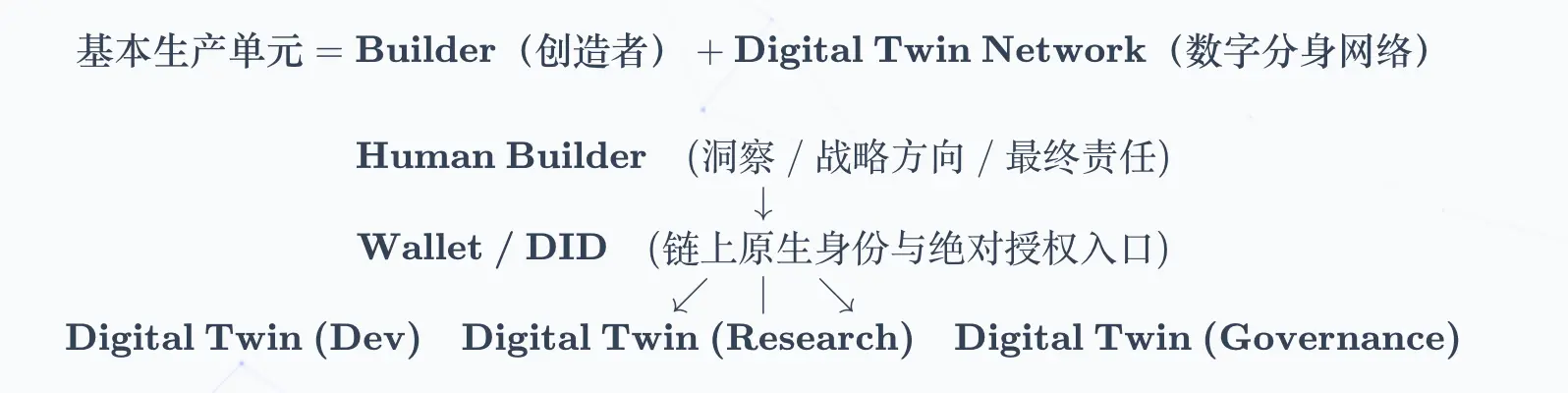
In this new production architecture, the Builder is the sole source and soul of value. Humans are responsible for anchoring ultimate goals, discerning social needs, making decisions with moral and aesthetic depth, bearing final ethical and economic responsibilities, and endowing each creation with civilizational significance; while digital avatars are the shadows and arms of Builders in the boundless digital space, capable of executing complex tasks at high frequencies beyond human reach, seamlessly invoking network tools, deeply extracting data intelligence, and continuously honing and evolving in practical exercises within distributed networks.
The relationship between humans and work is undergoing a revolutionary reconstruction. The heroes of the industrial age depended on how much horsepower they could harness; the giants of the internet age depended on how much user attention they could gather; but in the AI era, the productivity limit of a Builder no longer depends on how much work they can complete individually but on whether they can build and manage a high-reputation, evolvable, cross-protocol collaborative network of digital avatars—this is not only the ultimate lever of individual productivity but also the absolute barrier that is hardest to replicate in the future open network.
However, with the large-scale emergence of digital avatars, what is brought is not just a leap in productivity but an unprecedented crisis of order and trust. When agents can be copied in milliseconds, and when silicon-based entities begin to possess the ability to independently execute tasks, manage assets, and participate in economic activities, the entire open network must confront a series of glaring fundamental questions:
- Identity and Belonging: How can we be sure of the true ownership of a digital avatar, and whose will does it truly represent?
- Intent and Boundaries: Is its autonomous decision-making always faithful to the true intentions of its creator?
- Authority and Assets: Are its economic behaviors and asset allocations within clear and non-overstepping compliance authorizations?
- History and Reputation: Are its accumulated abilities, contributions, and reputation records real, reliable, and non-falsifiable?
- Breach and Accountability: Once it engages in cross-period collaboration with other entities, even leading to breaches and disputes, is there a certain mechanism for responsibility penetration and tracing?
If these underlying questions cannot be answered, the more powerful the digital avatars become, the more the friction and trust costs in the open network will soar exponentially. The real challenge that AI brings to humanity has never been a lack of intelligence but rather, when intelligence floods in like a geyser, our severe lack of a new type of order capable of accommodating this large-scale intelligent collaboration.
3. The Missing Piece in Digital Society—Coordination Layer
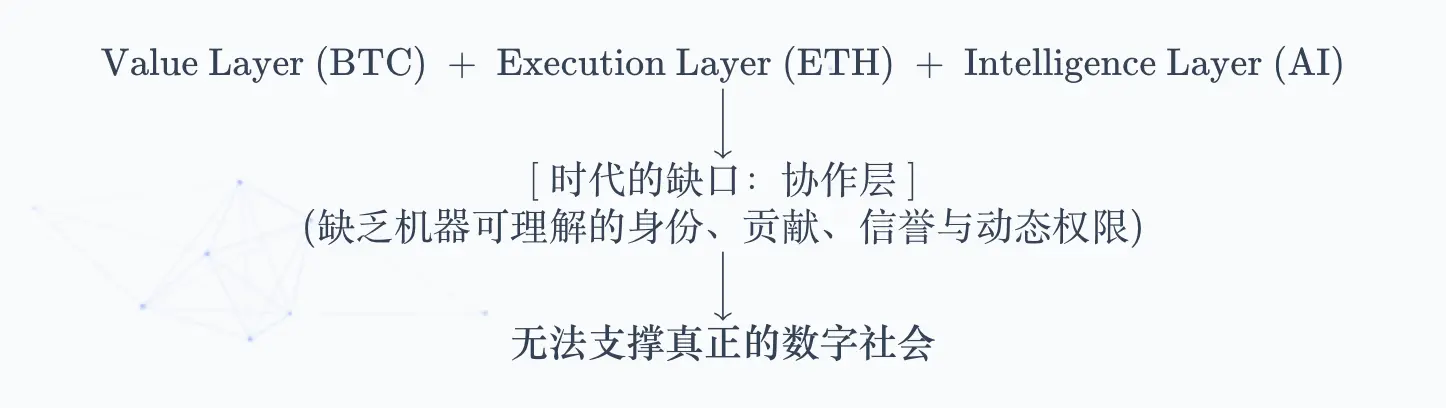
Looking back over the past decade, the speed of development of digital civilization is dazzling. We have built a hardcore passage for value flow with Bitcoin, laid the tracks for deterministic execution with Ethereum, and now welcomed the explosion of intelligence with large models and AI. From the perspective of technological components, humanity seems to have gathered all the hardcore elements needed to construct the digital world.
But if we re-examine this from the perspective of what allows a society to operate healthily, we will be astonished to find that this vast digital empire still hovers in mid-air—it lacks the most critical cornerstone, as the infrastructure of digital civilization still lacks the social layer that connects these capabilities.
The formation of a society cannot rely solely on the transfer of wealth, the execution of rules, and the growth of computational power. A society becomes a society because it contains identity recognition, relationship network connections, contribution recognition, reputation accumulation, responsibility attribution, and long-term collaboration that spans cycles.
However, these foundational mechanisms that support the operation of society have not formed a unified native infrastructure after entering the digital world. We already have highly developed value layers, execution layers, and intelligence layers, yet the Coordination Layer that twists these isolated capabilities into a cohesive force has collapsed; elements of social collaboration such as identity, contribution, reputation, and responsibility remain scattered across different systems.
From the Collapse of Static Identity to the Reconstruction of Dynamic Reputation
In the past, the internet and the crypto world relied on an extremely fragile static identity—a string account, an IP address, or an anonymous wallet address represented the entirety of the subject. But in the AI era, this static proof is facing a catastrophic demise. AI can fabricate resumes, write code, simulate social trajectories, and even create thousands of seemingly real false entities at almost zero cost.
The future digital society will no longer care about "who you claim to be" but will almost harshly interrogate: "What have you created in the past?" "What traces have your behavioral trajectories left?" and "Does your historical reputation support the current adjustment of authority?" Static identity proofs must fully retreat, making way for dynamic contribution records; only a trustworthy history refined over time can be the sole hard currency of the digital society.
The "Context Blindness" of Smart Contracts
The greatest achievement of blockchain lies in its realization of cold execution without intermediaries, but traditional smart contracts inherently suffer from severe "context blindness." They can rigidly verify the timestamp and hash of a code submission but cannot perceive whether this code has ingeniously restructured the underlying architecture or is filled with worthless garbage logic; they can accurately settle the voting numbers of a DAO but cannot measure whether a Builder stepped up to save the ecosystem in the community's most difficult moment.
Because real "contributions" are inherently intertwined with complex social contexts, intentions, and long-term impacts. The digital society urgently needs a new syntax that can seamlessly transform these socially contextual behaviors into machine-readable hard data.
In the Era of Machine-to-Machine Collaboration, a New Trust Primitive is Urgently Needed
Traditional trust in human society heavily relies on credentials, audit reports, institutional recommendation letters, and other carriers. However, these paper or electronic certificates are essentially "human-readable" unstructured information that is not only easily forged but also inefficient to process.
In the upcoming digital society, the main battlefield will be the instantaneous collaboration between agents and agents, and between intelligent entities and protocols, occurring in milliseconds. In such scenarios, traditional trust intermediaries will completely fail, and the network urgently needs a new trust primitive that is "machine-readable & computable."
This is precisely the historical opportunity for m&WDAO to redefine Attestation (proof of behavior and contribution). Attestation is by no means a cold on-chain record but the underlying credit primitive in the digital society—it penetrates identity, behavior, context, and proof, constructing a dynamic contribution network that can be efficiently parsed and seamlessly invoked by machines.
4. Attestation—The Credit Primitive of Digital Society
In the classical internet era, the flow of value was always hijacked by users' attention and behavioral data. Platforms recorded behaviors in black boxes, recommendation algorithms manipulated content, and internet giants monopolized and exploited users' value creation through data, while the true contributions made by Builders were locked in the private databases of various platforms, becoming their exclusive big data value.
The breakthrough of blockchain allowed asset ownership to achieve true autonomy for the first time. But as civilization evolves to the next stage, a more essential proposition emerges: If wealth can be autonomously owned, should the "contributions" that create wealth also autonomously accumulate? If assets can flow freely in an open network, should the "history" of value creation also transcend platforms to achieve cross-border accumulation?
This is the inevitability of Attestation's emergence.
Certificates issued by traditional societies are essentially "result proofs" (like a static diploma). However, the rapid iteration of the digital society requires us to shift towards "process proofs." Because the true core and value of a Builder never depend on a single speculative success but on the real trajectory of creation and problem-solving they have practiced over the long term in codebases, discussion forums, and governance layers.
In the underlying conception of m&WDAO, Attestation purifies sociological contribution behaviors from the real world into a machine-readable, verifiable, and computable digital credit structure:
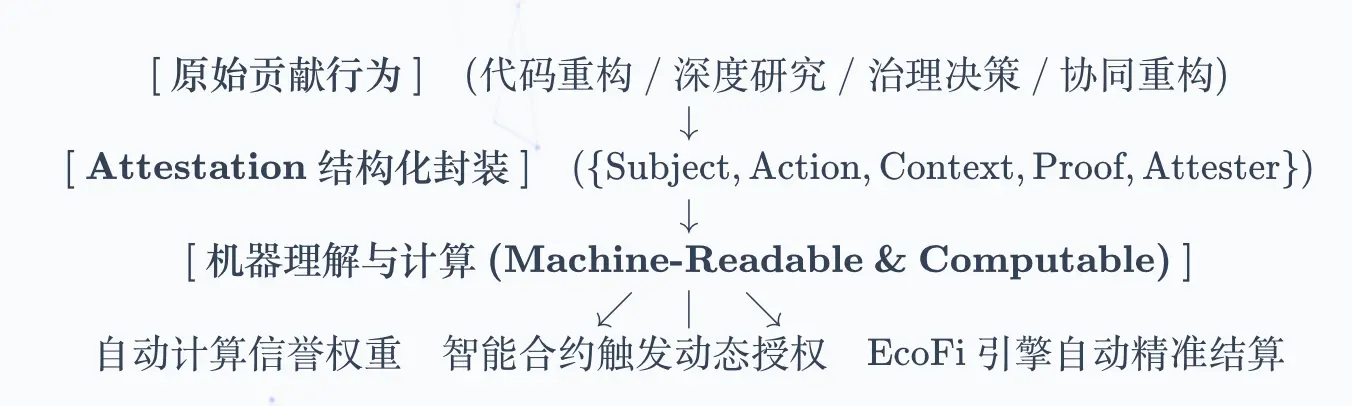
A standard Attestation is by no means a crude one-way data record but a highly rigorous multidimensional mapping tuple: Attestation={Subject, Action, Context, Proof, Attester}
- Subject (Contributor): Who (or which digital avatar) initiated this groundbreaking contribution?
- Action (Behavior Core): What specific dimensions of creation, reconstruction, or collaboration were accomplished?
- Context (Social Context): Under what ecological stage, project urgency, and spatial background did this behavior occur?
- Proof (Cryptographic Proof): What kind of zero-knowledge proof, Git hash, or immutable data fact supports it?
- Attester (Endorsing Verifier): Which high-reputation network nodes, DAO cores, or third-party entities provided cross-endorsement?
Through this structured mapping language, past social contributions that were difficult to capture with deterministic code finally have a pathway to enter the digital world in a verifiable form.
The process of a Builder establishing a thought stronghold, promoting open-source protocols, and building ecological networks can be disassembled and transformed into an Attestation chain composed of text creation, code submission, community recognition, architectural contributions, and ecological feedback, ultimately settling into a continuously growing, verifiable, and hard-to-alter dynamic reputation map.
When billions of digital avatars / AI agents carry the will of human subjects / creators / Builders into economic activities, Attestation will collapse from an option into a fundamental necessity for the entire silicon-based economy to operate—silicon-based intelligences cannot rely on the long-formed offline relationships, circle experiences, and implicit trust of human society to establish collaboration because they need direct access to a machine-understandable, computable credit network: What high-difficulty tasks has another agent completed? What is its historical performance in fulfilling obligations? What certifications has it received from trustworthy nodes? In the current scenario, what level of authority, resources, and collaboration qualifications should it be granted?
If Bitcoin created a value network that does not rely on centralized institutions, and Ethereum created an execution network that does not require permission, then Attestation is building a collaborative network based on historically trustworthy contributions that naturally generates trust. This is the infrastructure that m&WDAO is committed to constructing for the sustainable expansion and evolution of digital society.
5. System Engineering Architecture—The Operating Mechanism of m&W Protocol
When Bitcoin laid the value layer, Ethereum constructed the permissionless execution layer, and artificial intelligence opened the intelligence layer, digital civilization is entering the next stage: building a coordination layer that supports the collaborative operation of massive intelligent entities.
m&W Protocol is not an isolated AI application, nor a simple social protocol that overlays Web3 elements, but a distributed social collaboration protocol that connects underlying blockchain infrastructure with upper-layer agent networks. The problem it attempts to solve is: When Builders and their digital avatars become important production units in the future digital society, and when a large number of intelligent entities begin to autonomously participate in creation, trading, and governance, how can these entities possess clear identities, trustworthy histories, collaboration qualifications, and value return paths?
The core architecture of m&W Protocol consists of four interconnected protocol layers + an intelligence layer:
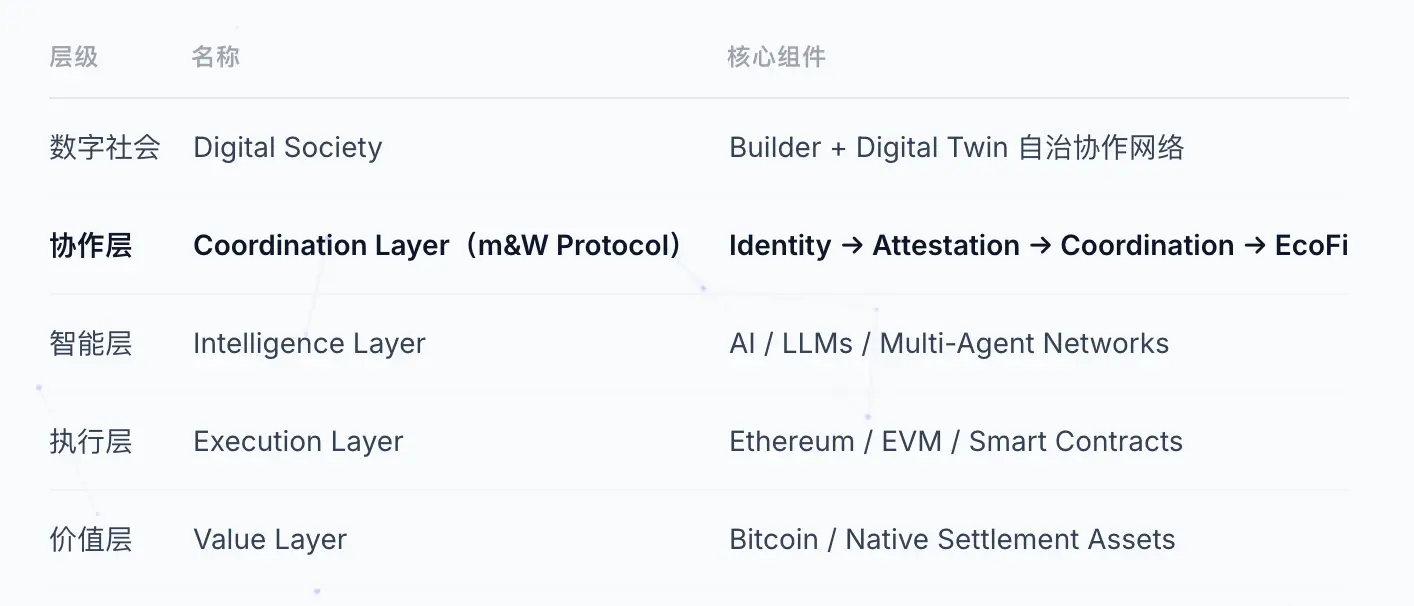
The core of m&W Protocol is not to create new intelligence but to establish a collaboration layer that enables intelligent entities to form long-term trustworthy relationships based on existing value, execution, and intelligence infrastructure.
Protocol Pipeline: From Subject Identity to Value Closed Loop
In the engineering implementation of m&W Protocol, every collaboration between a Builder and their digital avatar in the open network follows a complete protocol pipeline: Builder Intent / Agent Collaboration Request ⟶ Identity ⟶ Attestation ⟶ Coordination ⟶ EcoFi
This process transforms the identities, contributions, reputations, and value relationships that were previously scattered in human society into a protocol structure that the digital society can understand and execute.
Identity Layer: Sovereignty Confirmation and Digital Avatar Authorization
- Function Positioning: Solve "who is acting" and "what are the boundaries of action." In the traditional internet, an account is merely an entry point to access the system; but in the AI era, a digital twin will become a new type of digital entity capable of independently executing tasks, invoking services, and managing assets. Therefore, future identity systems cannot remain at the level of wallet addresses or account labels but must become sovereign infrastructure that connects Builders, digital avatars, and responsibility boundaries.
- Engineering Implementation: m&W Protocol establishes decentralized identities (DID) through wallets, combining rights NFTs, contribution certificates, and Soulbound Tokens (SBT) to form the native digital identity of Builders. Builders, as root subjects, grant clear permissions to different digital avatars through a contextual delegation mechanism, including: task scope, resource invocation permissions, asset management limits, time validity periods, and responsibility constraints. Thus, digital avatars can possess autonomous execution capabilities while always maintaining a deterministic connection with the Builder subject.
Identity is no longer just about "proving who you are" but becomes the anchor point of sovereign attribution, the basis for permission inheritance, and the path for responsibility tracking in the digital society.
Attestation Layer: Contribution Purification and Machine-Readable Credit
- Function Positioning: Solve "what happened" and "why is it worth trusting." Blockchain has already recorded asset transfers and transaction behaviors well, but for a large number of social values such as intellectual creation, code contributions, protocol construction, and ecological governance, there is still a lack of a unified expression method. These contributions have long existed in off-chain environments, making them difficult for machines to understand and accumulate across platforms. m&W Protocol transforms these real behaviors into structured, verifiable digital certificates through the Attestation Protocol.
- Core Structure: Can be represented as
Attestation = {Subject, Action, Context, Proof, Attester}(the quintuple definition is detailed above). Here, Subject refers to the contributor or digital avatar; Action refers to the specific behavior that occurred; Context refers to the environment and objectives under which the behavior occurred; Proof refers to the corresponding verification proof; Attester refers to the trustworthy subject providing the certification. Through verifiable credentials (VC), cryptographic proofs, and trustworthy data sources, Attestation transforms previously difficult-to-quantify social contributions into machine-readable credit data.
Thus: Identity answers "who are you"; Attestation answers "what have you created."
Coordination Layer: Computational Trust and Scalable Collaboration
- Function Positioning: Solve "how to enable a large number of digital entities to collaborate efficiently." As the number of digital avatars evolves from a few tools to a large-scale network entity, traditional interpersonal trust models can no longer apply. Future collaboration between agents will require a coordination mechanism that can automatically assess qualifications, risks, and matching relationships.
- Working Mechanism: m&W Coordination Layer will build a dynamic trust graph (Computable Trust Graph) based on the data accumulated from Attestation. When a digital entity requests to participate in a task, invoke resources, or establish a collaborative relationship, the system can comprehensively evaluate historical contribution records, task completion quality, collaboration fulfillment status, certification node reputation, and risk status, thereby achieving automatic judgment of collaboration qualifications, intelligent matching of task relationships, and dynamic adjustment of resource permissions.
The significance of the Coordination Layer lies in enabling digital entities in the open network to evolve from isolated intelligent nodes into a social network capable of long-term collaboration.
EcoFi Layer: Contribution-Driven Value Return Mechanism
- Function Positioning: Solve "how value accurately flows to the true contributors." The past Web3 has already established a highly mature financial infrastructure, but the improvement of financial efficiency has not automatically led to the perfection of a real value creation system. The EcoFi mechanism of m&W Protocol attempts to reconnect value distribution to contributions themselves.
- Positive Cycle: Through the trustworthy contribution graph formed by Attestation, EcoFi enables ecological resources, governance rights, incentive returns, and collaboration opportunities to flow dynamically based on real contributions. It no longer distributes resources solely based on capital scale or short-term market influence but allows long-term builders to receive continuous feedback: the more genuine the contribution, the more reputation accumulates, the richer the resources obtainable, and the greater the value that can be created. Ultimately forming a positive cycle of "contribution →→ Attestation →→ reputation →→ more collaboration opportunities →→ greater contributions."
Architecture Summary: The Operational Chain of Digital Society
Therefore, the four-layer architecture of m&W Protocol is not four independent modules but a complete operational chain of digital society: Identity establishes subjects; Attestation solidifies credit; Coordination organizes collaboration; EcoFi drives value circulation. It provides Builders and digital avatars, agents and agents, and human organizations and machine networks with a collaborative infrastructure that can be verified, executed, and continuously accumulated.
If the value layer solves "how value flows," the execution layer solves "how rules are executed," and the intelligence layer solves "how capabilities expand," then the collaborative layer constructed by m&W Protocol addresses the most core question of the next stage of digital civilization: how intelligent entities can form trustworthy relationships in an open network and jointly create long-term value.
6. The End of Civilization—The Ultimate Mission of m&WDAO
If the system architecture of m&W Protocol answers how digital entities establish trustworthy collaboration, then from the perspective of civilizational evolution, we can respond to the m&W White Paper: Concepts, Mechanisms, and Missions.
The Migration of Core Production Materials
Thus, the production materials of digital civilization are also undergoing a profound migration:
- Industrial Era: Capital, machines, industrial organizations
- Internet Era: Information, user connections, platform networks
- Early AI Era: Computational power scale, model capabilities, data resources
- Digital Society Era: Trustworthy Contribution Network
As foundational models gradually become open, computational power evolves into a universal infrastructure akin to water and electricity, and intelligence itself will ultimately become a universal capability. What will truly be irreplaceable in the future is not a specific model, a set of parameters, or a type of tool, but a Builder and their digital avatar, continuously creating, fulfilling obligations, and accumulating within a long-term collaborative process to form a trustworthy contribution network.
What it truly solidifies is not just historical records but a form of social capital that can be continuously inherited, verified, and invoked by the open network.
Models determine how much value intelligence can create; while the trustworthy contribution network determines whether these values can cross subjects, organizations, and protocols to continuously form larger-scale collaboration.
Thus, it ultimately becomes the new production material of digital society.
From Production Materials to Social Order
However, new production materials will not automatically evolve into a new civilization. What truly drives the continuous operation of civilization has never been the resources themselves but the organizational methods and collaboration rules established around those resources.
Therefore, the truly important significance of the trustworthy contribution network lies not in recording contributions but in its first-time provision of a systemic foundation that allows open networks to continuously generate trust, organize collaboration, and distribute value.
As previously stated:
- Identity establishes the sovereign attribution of digital entities;
- Attestation solidifies real contributions into machine-verifiable credit assets;
- Coordination makes credit the basis for network collaboration;
- EcoFi allows value to continuously flow along contributions.
The four together do not constitute several independent functional modules but a complete operational mechanism of digital society.
Within this mechanism, trust no longer relies on central institutions to grant it but arises from real actions that continuously occur; collaboration is no longer built on one-time identity endorsements but on long-accumulated trustworthy histories; and value no longer depends on centralized distribution but flows continuously in the open network along real contributions.
Thus, a self-reinforcing civilizational flywheel begins to form: Real Contributions ⟶ Credit Accumulation ⟶ Collaboration Expansion ⟶ Value Return ⟶ Stimulating New Contributions
For the first time, the digital society possesses a collaborative order that can continuously grow based on protocols. This is the true value created by the trustworthy contribution network.
The End of Civilization
As stated in the m&W White Paper: Concepts, Mechanisms, and Missions, the core mission is:
Using blockchain to establish order for intelligent networks.
The significance of this statement does not belong solely to m&WDAO; it actually answers the most important question of the entire AI era.
AI continuously creates new intelligence, and intelligence continuously creates new productivity; but what truly determines how far civilization can go is not the speed of intelligence growth but the capacity for order evolution. Without order, the stronger the intelligence, the more easily the system falls into chaos; without boundaries, the larger the scale of collaboration, the higher the trust costs; without rules, the open network ultimately cannot give birth to a truly meaningful digital society.
Therefore, blockchain is not merely a new infrastructure for AI but a new civilizational infrastructure. It grants digital entities verifiable identities, allows real contributions to accumulate credit, provides executable rules for open collaboration, and endows the entire intelligent network with an order capable of sustainable evolution.
This is the true significance of m&WDAO's existence. What it constructs is not just a protocol, not just a product, and certainly not a new application, but a set of collaborative infrastructure that supports the continuous operation of digital society.
Looking back to 2008, Bitcoin first liberated value from the control of centralized institutions, leading humanity into the digital economy era. Today, as AI makes intelligence a new productivity, as digital avatars become new production units, and as open networks begin to carry more and more real-world collaborative relationships, humanity is also stepping into another grander stage—the digital society.
And the ultimate competition in the digital society will no longer be about who possesses more models, who has more computational power, or who holds more capital. What truly determines the height of future civilization is who can establish a social operating mechanism that allows massive intelligent entities to continuously create trust, expand collaboration, and accumulate value.
- AI creates intelligence.
- Blockchain establishes order.
- Together, they constitute digital civilization.
This is also the formula that the m&W White Paper ultimately hopes to express:

Here, "止" (stop) does not mean to cease but to establish boundaries; it does not constrain innovation but restrains disorder; it does not limit intelligence but provides an order foundation that can serve civilization in the long term.
The future belongs to Builders who continuously create real value; to digital avatars that grow and fulfill obligations; and to everyone willing to participate in building the digital society.
Welcome to the digital society.
 Risk warning


Popular articles