Big short Burry: Now is the perfect time to buy the dip in Hong Kong stocks
 Core Viewpoint

 Michael Burry, the prototype of "The Big Short," has boldly called for a bullish stance on Hong Kong stocks, stating that now is an "excellent time" to look for cheap assets, and he has quietly increased his holdings in JD.com. The head of Goldman Sachs' Asia capital markets also pointed out that Hong Kong stocks have long entered the AI era, but the lagging index structure has obscured the real vitality. Morgan Stanley has echoed this bullish sentiment. Amid the tug-of-war between bulls and bears, whether the valuation gap and structural opportunities can translate into real returns will test investors' judgment.
Author: Zhao Ying
The long and short game represented by Michael Burry is unfolding in the Hong Kong stock market, with bullish voices continuing to gather.
Michael Burry, the investor who gained fame for accurately predicting the 2008 U.S. subprime mortgage crisis and was the prototype for the movie "The Big Short," recently publicly stated that now is an "excellent time" to look for cheap stocks in the Hong Kong stock market. His bullish logic is based on the anticipation that the global AI chip stock boom is cooling, believing that funds will flow out of South Korea, Japan, and the semiconductor sector, and seek out undervalued areas.
At the same time, Wang Yajun, head of Asian equity capital markets at Goldman Sachs, also pointed out that the Hong Kong market has effectively entered the AI era, although the main indices have yet to reflect this reality.
The two perspectives point to the same conclusion from different dimensions: there is a significant divergence between the current sluggish performance of Hong Kong stocks and the real vitality within the market, and this divergence itself may constitute an investment opportunity. For investors seeking undervalued areas, the attractiveness of Hong Kong stocks is rising.
Burry is bullish on Hong Kong stocks: undervalued areas after the cooling of the AI boom
Michael Burry, founder of Scion Asset Management, stated on July 17 on the X platform, "Now is an excellent time to look for cheap stocks in the Hong Kong stock market, which should perform well after the shine fades from South Korea, Japan, and SOXX (semiconductor ETF)."
Burry's statement has its market background. Global chip stocks have recently faced massive sell-offs, and concerns about whether AI companies can convert technological investments into actual profits have continued to rise, compounded by high capital expenditure pressures, putting pressure on the semiconductor sector that previously led the global market. In contrast, the decline of Hong Kong stocks this year makes their valuations relatively more attractive.
It is worth noting that Burry took action earlier this month—according to Bloomberg, he increased his stake in Chinese e-commerce company JD.com and established new positions in DraftKings and Flutter, indicating that his bullish stance on Hong Kong stocks and related Chinese concept stocks is not just verbal.
Hong Kong stocks have significantly lagged behind major global markets this year
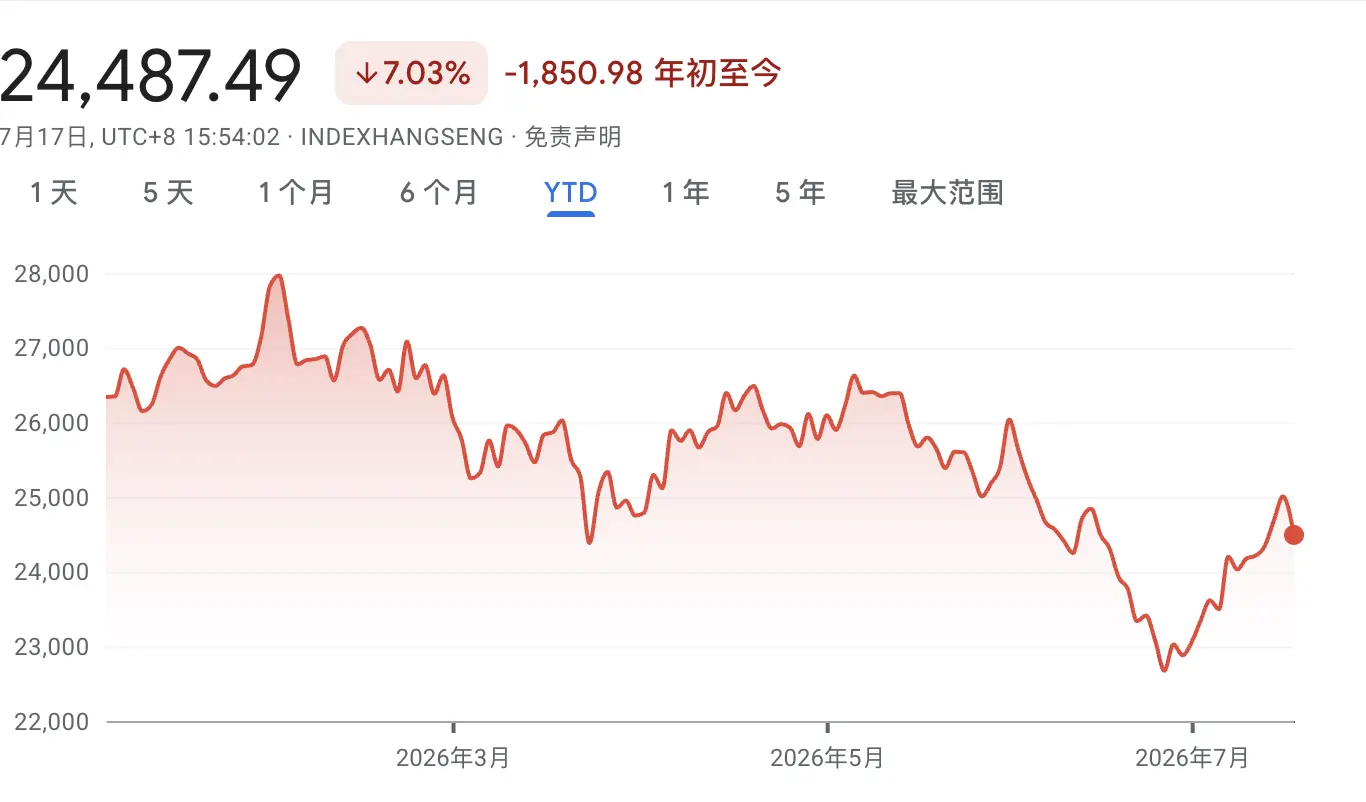
From a data perspective, the relative weakness of Hong Kong stocks is evident. The Hang Seng Index has fallen about 7% this year, while the Hang Seng Tech Index has dropped even deeper by 15.22%, with major drag factors including weak consumer spending and insufficient market confidence in the outlook for the Chinese e-commerce industry.
This starkly contrasts with the strong performance of other major global markets. According to Bloomberg data, South Korea's benchmark index has surged 62% this year, benefiting from the strong performance of two major chip giants; Japan's Nikkei 225 index has risen 26%; and the iShares SOXX ETF, which tracks the semiconductor sector, has soared 76%.
It is precisely this significant underperformance that leads Burry to believe that Hong Kong stocks meet the conditions for "bargain hunting"—as global funds begin to reassess the sustainability of the AI boom, previously overlooked Hong Kong stocks may welcome an opportunity for catch-up.
Goldman Sachs: Index distortion, Hong Kong stocks have entered the AI era
Goldman Sachs' perspective provides another dimension of interpretation— the sluggishness of Hong Kong stocks is, to some extent, a "false impression" caused by the structural lag of the index.
Wang Yajun, head of Asian (excluding Japan) equity capital markets at Goldman Sachs, recently stated at a media conference, "The Hong Kong market has entered the AI era, but the main stock indices have not yet been able to reflect this reality, which is the fundamental reason for the 'ice and fire' situation between the hot IPO market and the sluggish index performance."
Wang pointed out that the most active topic in the Hong Kong stock market this year is AI, with the most actively traded, best-performing, and highest financing amounts all being AI-related stocks. However, the adjustment of index constituents takes a long time, leading to a mismatch between the index and the true state of the market. He expects that the total equity financing in the Hong Kong market this year is likely to reach a historical high, with the total IPO financing expected to surpass the historical peak of 2021, and more AI companies are expected to go public in Hong Kong in the second half of the year.
In terms of fundamental judgment, Wang believes that supported by growth in end-user demand, capital expenditures of AI companies will continue, providing a foundation for the long-term performance of related sectors.
Multiple bullish voices converge, but differences remain
Burry is not alone in his stance. According to Bloomberg, Morgan Stanley has also recently called on investors to buy Hong Kong stocks, one reason being the optimistic outlook for corporate earnings, and believes that the impact of the unlocking of restricted shares will be relatively limited.
However, the logic of being bullish on Hong Kong stocks is not without challenges. The decline of the Hang Seng Index this year reflects the market's ongoing concerns about the pace of China's consumption recovery and the profitability of the e-commerce industry, and these structural pressures are unlikely to dissipate completely in the short term. The "mismatch between the index and the market" described by Goldman Sachs' Wang also means that ordinary investors, if they only use the index as a reference, may underestimate the structural opportunities within Hong Kong stocks and may overlook the pressures still faced by traditional weighted stocks.
For investors, Burry's bottom-fishing signal and Goldman Sachs' AI narrative together outline a picture of opportunities in Hong Kong stocks, but how to accurately position between the overall pressure on the index and structural highlights remains a core issue facing the market.
 Risk warning


Popular articles