Bitget UEX Daily Report | Federal Reserve's hawkish warning on inflation risks; Nasdaq plummets with the storage sector leading the decline; Middle East situation drives up oil prices (July 17, 2026)

 Bitget UEX Daily Report
# 1. Hot News
Federal Reserve Dynamics
Federal Reserve hawkish officials speak out intensively, emphasizing the stickiness of inflation and the necessity of restrictive policies
Dallas Fed President Lorie Logan and Kansas City Fed President Jeff Schmid expressed ongoing concerns about inflation in public speeches. Logan supports "moderate rate hikes" to better balance the dual mandate of price stability and full employment, noting that if inflation does not fall back to the 2% target, a restrictive policy stance must be maintained. Schmid emphasized that inflation remains significantly above target levels, with the core focus of the policy path still on inflation control. Fed Vice Chairman Jefferson further added that if AI infrastructure development and consumer demand outpace the realization of productivity gains, it could exert upward pressure on inflation.
Market Impact: Hawkish signals strengthen market expectations for a delayed rate cut path, providing short-term support for the dollar index and U.S. Treasury yields, while growth assets face valuation pressure, but it also provides a long-term allocation logic for precious metals.
International Commodities
Iran drone attack on U.S. military base in Bahrain raises geopolitical risks and pushes up oil prices
In the early hours of July 17, Iran launched an "Arash" drone attack on the U.S. military base in Bahrain as retaliation for previous actions by the U.S. The situation in the Middle East escalated suddenly, increasing risks to oil supply routes in the Strait of Hormuz. The market raised oil price premiums in the short term, with safe-haven funds flowing into both gold and the dollar.
Market Impact: Geopolitical events provide support for energy prices, but if the conflict does not escalate further, the upside potential for oil prices may be constrained by slowing global demand; precious metals maintain resilience under the dual drivers of inflation concerns and safe-haven demand.
Macroeconomic Policy
White House "insider betting" scandal exposed, Trump’s national address focuses on election and Iran issues
White House teleprompter operator Gabriel Perez is suspected of using non-public information from Trump’s speeches to profit over $100,000 in prediction markets and is currently negotiating a settlement with the CFTC. Trump will deliver a national address at 9 PM Eastern Time on Thursday (9 AM Beijing Time on Friday), continuing to emphasize election issues and mentioning the situation in Iran. The market is focused on the potential impact of the speech on policy and geopolitical expectations.
Market Impact: The scandal temporarily disrupts market sentiment, but the core remains on Trump’s statements regarding Middle Eastern policy and domestic political direction, which may exacerbate short-term volatility.
# 2. Market Review
Commodity & Forex Performance (Real-time Update)
- Spot Gold: $3993/oz, +0.4%
- Spot Silver: $55.6/oz, +0.21%
- WTI Crude Oil: $79.34/barrel, +1.38%
- Brent Crude Oil: $85.32/barrel, +1.29%
- Dollar Index (DXY): 100.0, -0.00%
Driving Factors Analysis: The Iranian drone attack highlighted by Futu Daily provides geopolitical premium support for oil prices, with market concerns about supply risks in the Strait of Hormuz pushing up short-term energy prices. Meanwhile, the two hawkish Fed officials warned of inflation stickiness and potential upward pressure from AI, reinforcing the long-term allocation logic for the dollar and precious metals. Today, gold and silver faced downward pressure mainly due to the stabilization of the dollar index and some profit-taking from previous gains. Institutional consensus suggests that if inflation data continues to exceed expectations, the high-level oscillation pattern for precious metals is unlikely to change; in the short term, geopolitical events dominate energy pricing, while the dollar's movement will still follow Fed policy expectations and economic data. Inter-asset linkage shows that when risk appetite declines, gold's safe-haven attributes and oil price supply disruptions complement each other, but overall commodity volatility increases, necessitating caution regarding demand-side slowdown risks.
Cryptocurrency Performance
- BTC: $63951, -1.04%
- ETH: $1868, -2.49%
- Total Cryptocurrency Market Cap: Approximately $2.27 trillion, -1.6%
- Market Liquidation Situation: Total liquidation in 24h approximately $332 million, with long positions liquidated around $281 million.
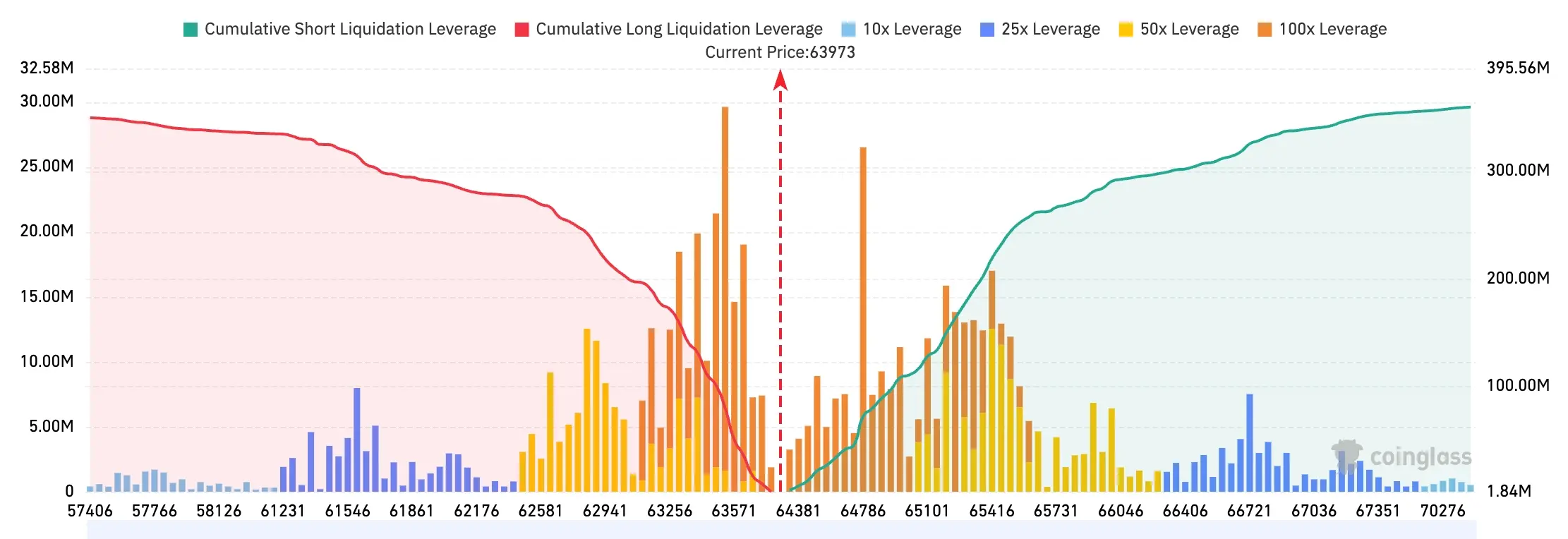
- Bitget BTC/USDT Liquidation Map: Current BTC price is approximately $63,973, with a significant concentration of short liquidation positions in the $64,500--$65,500 range, where there is notable pressure around $65,000; if broken, it may trigger concentrated short covering and push prices up. The $63,000--$63,600 range sees concentrated long liquidations, but the overall scale is lower than the short liquidity above, indicating a short-term market liquidation structure biased towards testing $65,000.
- Spot ETF Net Inflow/Outflow: BTC spot ETF saw a net inflow of approximately $108 million yesterday, with a current 24h dynamic net inflow of $46 million.
Driving Factors Analysis: The intertwining of hawkish Fed statements and Middle Eastern geopolitical events has heightened macro uncertainty, increasing volatility in risk assets, but the cryptocurrency market has shown some resilience. Recent BTC spot ETF fund flows have shifted from continuous outflows to net inflows, providing support for spot prices; liquidations in the leveraged market are primarily from long positions, indicating that previously overly optimistic positions are being cleared, which helps repair short-term sentiment. ETH has performed relatively stronger than BTC, possibly benefiting from a rebound in DeFi and Layer 2 activities and ongoing institutional interest in smart contract platforms. Institutional views suggest that regulatory progress (South Korea incorporating crypto assets into national asset frameworks, Japan's finance minister supporting crypto ETF research) and the launch of institutional products are long-term positives; in the short term, the divergence between BTC and ETH may continue, and attention should be paid to ETF flows and the impact of subsequent Fed speeches on risk appetite.
U.S. Stock Index Performance

- Dow Jones: 52552.97 (-0.20%), slight adjustment for three consecutive days
- S&P 500: 7533.76 (-0.51%), key support level around 7530 facing testing
- Nasdaq: 25881.95 (-1.47%), significant drag from chip and AI-related sectors
Tech Giants Dynamics
- NVDA: $207.40 (-2.40%)
- AAPL: $333.26 (+1.76%)
- MSFT: $401.10 (+1.38%)
- GOOGL: $354.46 (-4.44%)
- AMZN: $249.89 (-1.99%)
- META: $664.54 (-2.46%)
- TSLA: $391.06 (-0.86%)
The tech sector faced overall pressure on July 16, with the Nasdaq leading the decline primarily due to pullbacks in AI hardware and storage chains. Individual stocks showed significant divergence—AAPL and MSFT remained relatively resilient due to product iterations and the rollout of AI tools; NVDA, GOOGL, AMZN, and META faced valuation digestion and profit-taking pressure. Storage/memory concept stocks (like MU) saw significant pullbacks, reflecting market caution regarding the short-term pace of hyperscaler AI capital expenditures. Institutions generally believe this round of adjustment is a healthy correction rather than a trend reversal, with quality AI applications and cloud business leaders still holding allocation value; valuation pressure is mainly concentrated on high PEG hardware and infrastructure targets, while consumer electronics and enterprise software are relatively more resilient.
Sector Movement Observation
Semiconductor and Storage Sectors significantly declined
- Representative stocks: NVDA -2.40%, MU (storage concept) leading the decline within the sector
- Driving Factors: Short-term digestion of AI infrastructure demand, with the market sensitive to high valuations and inventory data; the optical communication-related supply chain is also adjusting, compounded by a decline in macro risk appetite.
# 3. In-depth Analysis of U.S. Stocks
1. Netflix - Revenue growth expectations slow, raising market concerns
Event Overview: Netflix announced a Q3 revenue growth expectation of only 11.7%, a new low in nearly three years, with shares dropping over 8% in after-hours trading. The company faces dual pressures from slowing subscription growth and intensified content competition; although advertising business and content library continue to expand, the cautious macro consumption environment raises doubts about growth prospects.
Market Interpretation: Several institutions believe Netflix has entered a mature phase, needing to rely on pricing strategies and advertising monetization after the new user dividend fades; the Q3 guidance below expectations reflects an extended return cycle for content investment. Analysts generally maintain a "hold" rating but lower short-term target prices, emphasizing the need to observe user retention and international market performance.
Investment Insight: Short-term volatility is increasing; attention should be paid to the proportion of advertising business and user growth data in Q3 actual financial reports, while long-term prospects remain optimistic regarding its content moat and global layout.
2. Alphabet - Delay in Gemini 3.5 Pro raises AI progress concerns
Event Overview: The release of Google’s Gemini 3.5 Pro model has been delayed by several months, interpreted by the market as a failure to fully meet technical goals, with shares dropping about 4.4% on the day. In the context of an intensifying AI race, the slowdown raises short-term concerns about Google’s leading position in generative AI.
Market Interpretation: Institutional views are divided; some believe the delay reflects Google’s cautious attitude towards model quality and safety, with long-term competitiveness unaffected; others worry that competitors (like OpenAI and Anthropic) may take the opportunity to widen the gap. The fundamentals of search and cloud business remain robust, still serving as important channels for AI deployment.
Investment Insight: Short-term AI execution risks are magnified, but Alphabet's ecosystem and data advantages are significant, making it suitable for phased allocation, with attention to subsequent model update rhythms and cloud revenue contributions.
3. Apple - Upcoming release of new iPad mini boosts hardware expectations
Event Overview: Apple plans to launch a new OLED iPad mini as early as this fall, with updates to the entry-level and Air series potentially following next year. The product line iteration is seen as an important lever to boost hardware sales and the rollout of AI features.
Market Interpretation: Institutions generally view Apple’s ecosystem barriers and hardware + services dual-drive model positively; the new iPad mini targets the mid-to-low-end market, expected to expand the user base and provide a platform for AI features (Apple Intelligence). Supply chain data shows active stocking, reflecting the company's confidence in demand.
Investment Insight: The dual catalysts of product cycles and AI rollout make it suitable for long-term holding; in the short term, attention can be paid to supply chain and channel data ahead of the fall launch event.
4. Microsoft - AI vulnerability detection tool strengthens enterprise security narrative
Event Overview: Microsoft is preparing to launch an AI-driven vulnerability detection and remediation tool, deepening Azure cloud and enterprise AI security solutions, interpreted by the market as an important signal of accelerated AI monetization.
Market Interpretation: Institutions believe this move strengthens Microsoft’s competitiveness in the intersection of enterprise-level AI and cybersecurity; cloud business and Copilot subscription growth remain the main driving forces. The commercialization path for AI tools is clear, helping to enhance overall gross margins and customer stickiness.
Investment Insight: AI is moving from concept to practical application stage, with Microsoft being strong in both infrastructure and applications, highlighting its allocation value; attention should be paid to cloud revenue and AI-related subscription metrics.
5. Meta - Resilience in advertising business alongside AI investments
Event Overview: Meta's stock price adjusted alongside the tech sector, but the fundamentals of its advertising business still show resilience; the company continues to increase investments in AI infrastructure, with the market focusing on its progress in generative AI and recommendation algorithms.
Market Interpretation: Institutional views suggest that Meta’s advertising efficiency improvements and AI-driven monetization capabilities remain advantageous, despite short-term valuation pressure; growth in Reels and international markets provides important support. Increased AI spending may impact profit margins in the short term, but could translate into competitive barriers in the long term.
Investment Insight: With advertising recovery and AI investments running in parallel, it is suitable to monitor user engagement duration and advertising price trends, serving as a potential allocation option within the tech sector amidst volatility.
# 4. Cryptocurrency Project Dynamics
The U.S. Congress is making a final push on the Clarity Act, with lawmakers expressing optimism, but ethical clauses surrounding Trump’s conflicts of interest remain the biggest obstacle.
Fed's Logan stated that the Federal Reserve should raise interest rates to address high inflation issues—this statement suggests she may be prepared to oppose the decision to maintain rates later this month.
Google has fallen behind its original schedule by several months in launching its most powerful flagship AI model, Gemini 3.5 Pro, as the company attempts to enhance its capabilities (especially in coding), but progress has not met expectations. Insiders report that the delay has caused frustration among engineers, AI researchers, and management, raising concerns that Google may lose its edge in competition with Anthropic and OpenAI.
JPMorgan analysts stated that Strategy's recent increase in cash reserves and positive capital inflows into Bitcoin futures are "encouraging signs" for Bitcoin's prospects, although spot Bitcoin ETF fund flows remain unstable. Strategy's dollar reserves have increased from $2.55 billion to $3 billion, covering about 20 months of preferred stock dividends.
T. Rowe Price, with approximately $1.9 trillion in assets under management, officially launched the TKNZ actively managed multi-token crypto ETF on Thursday, listed on the NYSE Arca, nearly nine months after its initial application. This fund is the first actively managed multi-token spot crypto ETF, with initial assets of about $15 million and a management fee of 0.75%. The ETF's initial allocation includes 40.75% Bitcoin, 18.42% Ethereum, 9.44% Solana, among others.
Circle has minted another 500 million USDC on the Solana chain. By 2026, a total of 70.01 billion USDC has been minted on the Solana chain.
# 5. Today's Market Calendar
Data Release Schedule
|-------|-----|--------------------|------| | 17:00 | Eurozone | June CPI/Core CPI Final | ⭐⭐⭐ | | 20:30 | U.S. | June Housing Starts, Building Permits, Import Price Index | ⭐⭐⭐⭐ | | 21:15 | U.S. | June Industrial Production | ⭐⭐⭐ | | 22:00 | U.S. | July Michigan Consumer Sentiment Preliminary | ⭐⭐⭐⭐ |
Important Event Forecast
- Trump National Address: 9 PM Eastern Time on Thursday (9 AM Beijing Time on Friday)------focus on statements regarding the situation in Iran and domestic policies
- U.S. Monthly Options Expiration Day: pay attention to end-of-day volatility and gamma effects
Institutional Views
Several investment bank analysts pointed out that the hawkish warnings from Federal Reserve officials regarding inflation stickiness and potential upward pressure from AI indicate that policymakers still have doubts about the current inflation trajectory, and the pace of rate cuts may be more cautious than previously expected. Geopolitical risks (Iran attacks) provide short-term premiums for oil prices, but overall market liquidity remains relatively ample. The adjustment in U.S. stocks is viewed as a healthy correction, with quality tech and AI application leaders still holding medium- to long-term allocation value; high-valuation growth stocks face short-term revaluation pressure. The cryptocurrency market shows resilience under positive ETF fund flows and regulatory and product progress in South Korea and Japan, with institutions generally believing that the role of digital assets in diversified allocations is gradually strengthening, but leverage use still requires caution. It is recommended to closely track U.S. inflation and employment data, subsequent Fed speeches, and the impact of geopolitical developments on risk appetite.
Disclaimer: The above content is compiled by AI search, with human verification for publication, and does not constitute any investment advice. Data in the text may inevitably contain deviations; please refer to real-time market data.
 Risk warning




Popular articles