Is the fastest and largest tech stock sell-off in history nearing its end?
 Core Viewpoint

 Goldman Sachs' Reflection on the Market's "Brutal Rotation"
Source: Wall Street News
The technology momentum trading is experiencing the most severe collapse in history. In just 17 trading days, the U.S. tech momentum factor (TMT MoMo) has dropped 40% from its peak, setting a record for the fastest and deepest drawdown in history, affecting a wide range from semiconductors, hedge funds to the credit market.
Goldman Sachs partner and head of EMEA hedge fund business Mark Wilson conducted a systematic review of this "brutal rotation" this week, pointing out that this round of selling is historically rare in both speed and depth, but its roots lie more in crowded positions and concentrated leverage rather than a substantive deterioration in the economy or corporate earnings. He stated that the unwinding process of the momentum factor is "nearing its end," but there is a lack of immediate catalysts for a reversal in the short term.
It is noteworthy that this round of momentum collapse occurred against a backdrop of overall stability in macro and corporate fundamentals—U.S. banking reported a 17% year-on-year increase in corporate loans, TSMC raised its revenue growth guidance for 2026 to over 40%, and inflation data was also mildly below expectations. This divergence between fundamentals and market price behavior is the core contradiction in the current market.
Technology Momentum Factor Faces Historic Sell-off, Drawdown Speed and Depth Exceed Historical Median
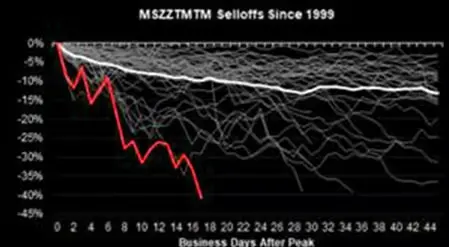
According to data from Morgan Stanley's Quantitative and Derivatives Strategy team (MS QDS), this round of momentum factor drawdown has lasted 17 trading days, with a peak-to-trough decline of 28%. In contrast, since 1999, the historical median drawdown for momentum factors has been 22%, averaging 33 trading days.
This means that the current decline has surpassed historical median levels in both speed and depth, marking the most severe since the 29% drawdown from December 2022 to February 2023.
The situation in the tech sector is even more extreme. The TMT momentum factor (TMT MoMo) has dropped 40% from its peak, according to MS QDS data, this is the fastest and deepest sell-off of the tech momentum factor in history.
From various sub-sectors, the Korea Composite Stock Price Index (Kospi) has fallen 27% from its peak, U.S. AI technology beneficiaries have dropped 25%, global memory chip stocks are down 36%, and European semiconductors have declined 23%. Among these, memory chip stocks account for about two-thirds of the overall decline, while broader AI beneficiary stocks have fallen about 24% from their highs.
Surface Low Volatility Masks High Intensity Inside, Market Risk Structure is Disintegrating
The price decline is only the surface of this turmoil; the changes in the internal risk structure of the market are equally noteworthy.
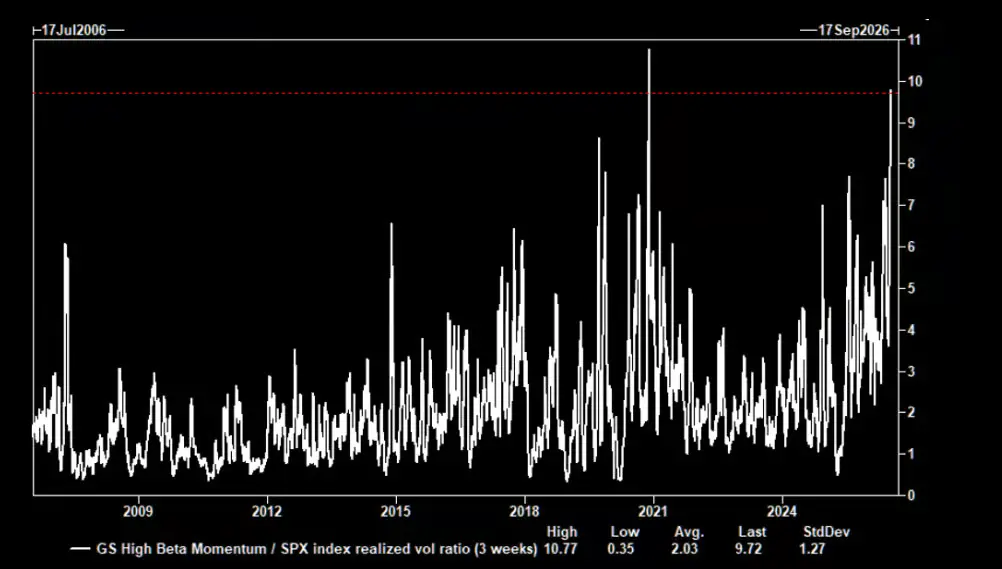
According to Goldman Sachs' volatility trading desk data, the volatility of Goldman Sachs' high beta momentum portfolio (GSPRHIMO) is currently about 10 times that of the S&P 500 index volatility. In the past 20 years, such a disparity in volatility ratios has only been comparable to the period during the pandemic shock in November 2020.
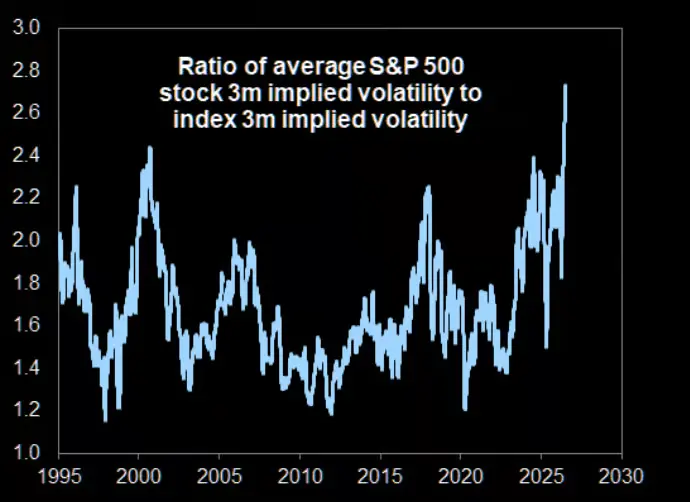
At the same time, the gap between individual stock volatility and index volatility has widened to historical extremes. Goldman Sachs data shows that the average implied correlation of S&P 500 constituents over three months dropped to a historical low of 0.14 this week, leading to the S&P 500 index volatility remaining low, while the average implied volatility of individual stocks reached 40%, which is 2.8 times that of the index implied volatility, also setting a historical record.
Positions Still Crowded, Risks Not Cleared
Despite the momentum factor recently experiencing a historic level of drawdown, hedge funds' net exposure to it remains high from a long-term perspective. Data from JPMorgan shows that the current combination of position levels and drawdown magnitude continues to make the momentum factor one of the most concerning core risks in the market.
Meanwhile, Goldman Sachs' high beta momentum factor has dropped 33% from its June peak, with year-to-date gains plummeting from 60% to just 12%, which Mark Wilson also noted.
He cited signs of deleveraging in the Korean market as evidence: reports indicate that this week, about 1 in every 30 adults in Korea had their stock margin accounts forcibly liquidated, showing that the deleveraging process has been significantly underway.
Fundamentals Intact, Risks Lie in Positions and Structure
The uniqueness of this round of momentum collapse lies in its occurrence against a backdrop of generally positive corporate fundamentals and macro data.
Mark Wilson pointed out that U.S. banking earnings reports this week presented a "clear and positive interpretation" of the economic situation: corporate loans increased by 17% year-on-year, setting a historical record, covering all sectors of the economy; U.S. consumer spending tracking growth is in the mid-single digits, with credit card spending increasing by 6%; investment banking-related business lines grew by over 40%; large banks' tangible equity return reached 19%, a new high since the financial crisis.
In terms of tech capital expenditure, TSMC raised its revenue growth guidance for 2026 to over 40% (based on over $150 billion in revenue), while ASML's earnings report triggered market expectations for a 15% to 30% upward revision in its earnings per share over the next one to three years.
However, both companies' stock prices fell after the earnings announcements, showing a typical "buy the rumor, sell the news" pattern. In contrast, IBM's stock price hit its largest single-day drop in over 20 years due to delays in large contracts and disappointing consulting business performance.
Mark Wilson emphasized that this round of selling "is difficult to find clear signals at the fundamental level," reflecting more structural factors such as positions, leverage, crowding, and concentration.
Rotation Nearing Its End, But Reversal Catalysts Yet to Appear
Mark Wilson stated that he tends to believe that the unwinding process of the momentum factor is nearing its end, but at the same time pointed out that there is a lack of immediate catalysts for a market reversal in the short term.
He also indicated that as efficiency and business implementation capabilities improve, new leading directions in the market will gradually emerge, and market breadth will expand accordingly—an example being the Dow Jones Transportation Index breaking new highs again this week.
However, he also warned that the second derivative of earnings growth (i.e., the slowdown in growth) will become increasingly important after the market digests the second-quarter earnings and enters summer, while current valuation indicators show that tech sector valuations remain relatively high.
Additionally, traditional asset classes and the correlations within assets are experiencing abnormal breaks, for instance, the three-month correlation between gold and oil has dropped to extreme inverse levels in 35 years of history, further increasing the difficulty of risk management and portfolio construction.

 Risk warning