Google's Q2 cloud business exceeded expectations again, but the negative free cash flow triggered a reevaluation of its valuation
 Core Viewpoint
 Alphabet's Q2 revenue and cloud business exceeded expectations, but the increase in Capex dragged free cash flow into negative territory, and core EPS fell short of expectations. The competitiveness of Gemini remains in doubt, with a drop of about 3% in after-hours trading.
Alphabet released its Q2 2026 performance: revenue, cloud computing, and advertising business overall exceeded expectations, with Google Cloud's growth rate again surpassing the most optimistic predictions from buyers; the company also raised its full-year capital expenditure guidance and expects to significantly increase investments in 2027, supporting the AI chip, server, storage, and data center supply chain.
However, the rapid growth in capital expenditure has driven free cash flow to turn negative, and the EPS excluding investment income was also below expectations. Management acknowledged that Gemini still needs to improve its coding capabilities but has not provided a clear timeline or verifiable quantitative targets for catching up. The backlog of cloud business orders continues to grow, but the growth rate has significantly slowed down. Alphabet's stock price fell about 3% in after-hours trading.
Q2 Performance: Revenue Exceeds Expectations, Core EPS Slightly Below Expectations
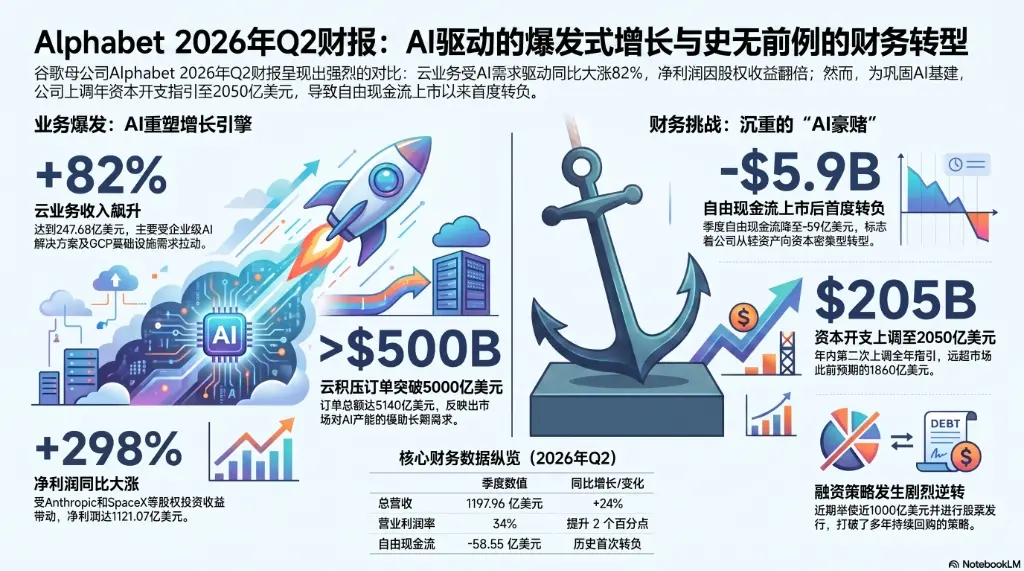
Q2 revenue was $119.8 billion, a year-on-year increase of 24%, higher than the consensus expectation of $116.96 billion.
Net profit increased by 297.6% year-on-year to $112.1 billion, with an EPS of $9.11. Among them, the unrealized net gain from the increase in equity investment valuation contributed $77.1 billion to net profit; excluding other income, the EPS was approximately $2.85, below the consensus expectation of $2.95.
Therefore, the significant growth in net profit and GAAP EPS was mainly driven by investment income, while the performance of core business is better assessed through operating profit, cloud business growth, and cash flow.
Cloud Business Surpasses Most Optimistic Expectations, Backlog Growth Rate Slows
Google Cloud revenue was $24.77 billion, a year-on-year increase of 81.8%, further accelerating from Q1's 63.4%, significantly higher than the consensus expectation of 64.3% and the buyers' optimistic expectation of 75%.
The backlog of cloud business orders grew by 11.7% quarter-on-quarter to $514 billion, with an increase of approximately $54 billion in a single quarter, mainly driven by demand for enterprise AI products and TPU orders, with more than half expected to recognize revenue in the next 24 months. However, the increase in backlog orders has significantly slowed compared to previous periods, and whether Cloud can maintain its current growth rate will still depend on the scale of new contracts, the speed of computing power delivery, and the revenue recognition pace of TPU.
Gemini Enterprise has become an important growth driver for Cloud, with nearly 90% of the Fortune 100 companies using it. The volume of model calls processed by customers through APIs rose to over 22 billion tokens per minute, a 37.5% increase from the previous quarter's 16 billion, indicating that enterprise AI demand is still rapidly expanding.
The advertising business overall met expectations:
- Total advertising revenue was $81.63 billion, a year-on-year increase of 14.4%, slightly above the market expectation of $81.1 billion.
- Search revenue was $63.27 billion, a year-on-year increase of 16.8%, basically in line with the market expectation of $63 billion, but the growth rate was lower than Q1's 19.1%.
- YouTube advertising revenue was $11.06 billion, a year-on-year increase of 12.9%, higher than the expected $10.8 billion.
- Google Network revenue was $7.3 billion, a year-on-year decrease of 0.7%, still slightly above the expected $7.13 billion.
Capex Raised Again, Free Cash Flow Turns Negative
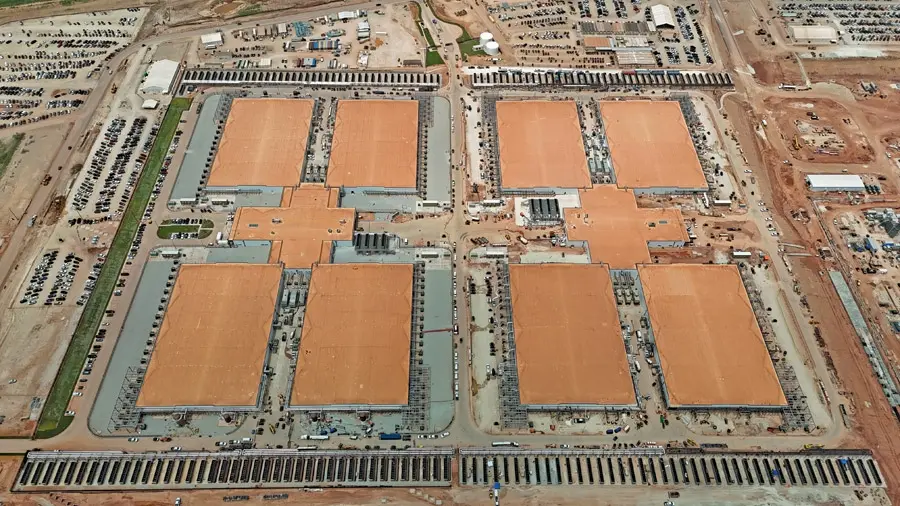
Q2 capital expenditure reached $44.92 billion, a year-on-year increase of 100.5% and a quarter-on-quarter increase of 25.9%. The company raised its 2026 capital expenditure guidance from $180 billion - $190 billion to $195 billion - $205 billion, with both the upper and lower limits increased by $15 billion, and it expects capital expenditure to continue to grow significantly in 2027.
The ongoing increase in investment reflects that Google Cloud, Gemini training, and TPU demand are still constrained by computing power supply, providing medium to long-term demand support for AI accelerators, storage, servers, optical communication, and data center construction.
The corresponding cost has already been reflected in cash flow. Q2 free cash flow decreased from $10.12 billion in the previous quarter to negative $5.86 billion, with capital expenditure exceeding operating cash flow for the first time. As depreciation, energy, and data center operating costs gradually enter the profit and loss statement, the market's valuation of Alphabet will become more reliant on the revenue conversion speed and capital return rate of AI investments.
Conference Call: Computing Power Tightness Continues, Gemini 4 Still Needs to Prove Competitiveness
Management stated that the company still severely lacks computing power. In Q3, it will temporarily expand third-party computing power rentals to avoid losing large customers due to short-term capacity shortages. The cost of third-party computing power is relatively high and is expected to put some pressure on Cloud's profit margins, but it helps retain the value of long-term contracts.
Google delivered TPU systems to customers for the first time this quarter and recognized revenue, with only a small amount of revenue expected to be recognized in 2026; the vast majority of existing TPU contract revenue will be recognized in 2027. The sale of TPU has expanded from internal infrastructure to external systems, increasing the potential market for Google Cloud and improving visibility into the demand for upstream advanced processes, HBM, servers, and network equipment.
In terms of models, Google has launched the largest pre-training for Gemini 4, hoping to regain a leading position in next-generation cutting-edge models. Management also acknowledged that the current model's coding and agent programming capabilities still need improvement. Since Gemini 4 has not yet announced a clear release date, performance data, and commercialization path, the conference call did not fully alleviate market concerns about Google's model competitiveness.
This financial report proves that enterprise AI demand remains strong, and Google Cloud is also accelerating the realization of AI investments. The after-hours decline reflects that the market's evaluation standards have further increased: while cloud revenue exceeding expectations is still positive, negative free cash flow, ongoing capital expenditure expansion, and the uncertainty of Gemini's cutting-edge capabilities will jointly determine Alphabet's valuation space in the next phase.
 Risk warning