Bitget UEX Daily Report | Trump claims the U.S. military will strike Iran hard; the Federal Reserve remains inactive as Waller reiterates the 2% target; Microsoft's performance exceeds expectations while Meta's capital expenditure increases significantly (July 30, 2026)

 Bitget UEX Daily Report
# 1. Hot News
Federal Reserve Dynamics
The Federal Reserve remains unchanged, and Waller reiterates the 2% inflation target while downplaying forward guidance
- The Federal Reserve keeps interest rates unchanged. Chairman Waller clearly reiterated at the press conference that the committee is firmly committed to achieving a 2% year-on-year inflation target, with no "soft targets" or any other implicit goals.
- Waller stated that not providing forward guidance in the current highly uncertain environment is a prudent approach; the market has already priced in expectations for tighter monetary policy, and the Federal Reserve will closely monitor but will not passively follow market pricing.
- After the decision, CME data showed that the probability of maintaining interest rates unchanged in September rose to 36.8%, while the cumulative probability of a 25 basis point rate hike was 63.2%. Market impact: The policy path remains uncertain, with hawkish signals coexisting with "no action," providing short-term support for the dollar and suppressing risk asset valuations, while intensifying pricing concerns about inflation stickiness.
International Commodities
Trump claims to strike hard at Iran, U.S. military plans airstrike options lasting up to two weeks
- Trump stated at the White House that due to Iran launching missiles at U.S. troops in the Middle East, the U.S. "will give Iran a heavy blow," and "it's time for the U.S. to retaliate," adding that Iran has requested the U.S. not to launch strikes.
- U.S. media reported that the U.S. Central Command has drafted a punitive airstrike plan lasting up to 10-14 days, aimed at crippling Iran's missile capabilities, pending Trump's final decision; the military also warned of a critical shortage of air defense munitions.
- Trump is also seeking to include provisions in relevant sanctions legislation to authorize tariffs on Iran. Market impact: Expectations of escalating geopolitical conflict quickly raised the risk premium for crude oil, leading to a significant rebound in oil prices, while intensifying inflation and Federal Reserve policy dynamics, with market sentiment highly sensitive.
Macroeconomic Policy
The Treasury may delay adjusting the Treasury issuance guidance, with political factors dominating
- JPMorgan strategists believe that the U.S. Treasury will avoid disturbing the bond market before the midterm elections, and it is expected that there will be no adjustments in the wording of the quarterly refinancing statement next week, delaying the signal to increase Treasury issuance.
- The U.S. may face a financing gap of about $3.7 trillion over the next four fiscal years, but political considerations may take precedence over debt management goals. Market impact: Long-term U.S. Treasury yields are nearing the highs since Trump's inauguration, with policy and political factors intertwined, increasing volatility in fixed income and risk assets.
# 2. Market Review
Commodity & Forex Performance
- Spot Gold: Approximately $4,081/ounce, +0.37%
- Spot Silver: Approximately $58/ounce, +1.55%
- WTI Crude Oil: Approximately $84/barrel, +0.06%
- Brent Crude Oil: Approximately $83/barrel, significantly up in 24h
- Dollar Index (DXY): Approximately 100.9, +0.08%
Driving Factors Analysis: Trump's statement to "strike hard at Iran" and the exposure of U.S. military airstrike plans quickly raised geopolitical risk premiums, leading to a significant rebound in crude oil. Gold and silver showed diverging performances against the backdrop of rising oil prices and increased divergence after the Federal Reserve's decision, with overall safe-haven demand limited. The dollar's relative strength reflects ongoing policy uncertainty. The asset linkage logic is clear: geopolitical escalation → rising oil prices → heightened inflation concerns → sustained high probability of hawkish Federal Reserve, with short-term commodity volatility highly dependent on the evolution of the Iranian situation and subsequent economic data.
Cryptocurrency Performance
- BTC: Approximately $63,718, -0.17%
- ETH: Approximately $1,900, -0.52%
- Total Cryptocurrency Market Cap: Approximately $2.28 trillion, -0.1%
- Market Liquidation Situation: Total liquidation of $389 million in 24h, with long positions liquidated at $270 million.
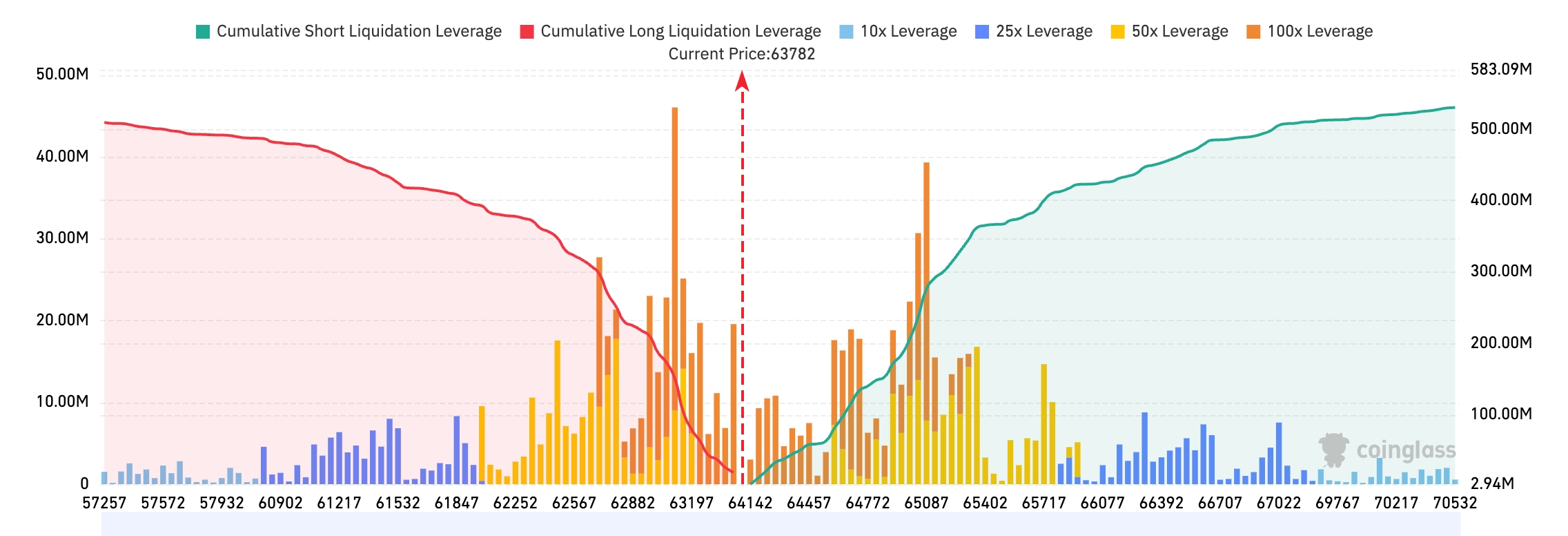
- Bitget BTC/USDT Liquidation Map: Current price (63,782) has limited liquidation pressure nearby, while the $64,700--$65,300 range has a large concentration of 50x and 100x short liquidation orders. If the price breaks through this area, it may trigger concentrated short covering, amplifying upward momentum. The cumulative short liquidation scale above is about $500 million, higher than the $440 million in long positions below, indicating that short risks still dominate, and the market is more likely to experience a short squeeze in the short term, but attention should be paid to the resistance of the high-leverage liquidation concentration area near $65,000.
- Spot ETF Net Inflow/Outflow: BTC spot ETF saw a net outflow of approximately $50 million yesterday, with a dynamic net outflow of approximately $58 million today, marking five consecutive days of net outflows.
Driving Factors Analysis: After the Federal Reserve remained unchanged, the market has digested some uncertainty regarding the policy path, with marginal recovery in risk appetite, leading to rebounds in both BTC and ETH. Oil prices and inflation concerns driven by geopolitical conflicts still exert macro pressure, but reduced leverage liquidation pressure supports price stabilization. ETF fund flows remain cautious, indicating that institutions are still in a wait-and-see mode. The overall trend shows a strong oscillation, with short-term focus shifting to Apple and Amazon's earnings reports and developments in the Iranian situation.
U.S. Stock Index Performance

- Dow Jones: Closed at 51,594.14 points (-2.19%), significantly retracing
- S&P 500: Closed at 7,316.15 points (-1.52%), hitting a near one-month low
- Nasdaq: Closed at 24,442.94 points (-1.74%), significantly dragged down by chip stocks
Tech Giants Dynamics
- NVDA: $190.01 (-3.55%)
- AAPL: $338.19 (-0.56%)
- MSFT: $390.54 (-0.71%)
- GOOGL: $335.76 (+0.95%)
- AMZN: $226.65 (-1.82%)
- META: Approximately $585.61 (-1.31%)
- TSLA: Approximately $298.32 (-2.97%)
Performance Summary and Driving Analysis: The tech sector continues to diverge. Chip and storage stocks significantly retraced, with Micron down nearly 10%, AMD and Intel down over 5%, and Nvidia down over 3%, dragging down the Nasdaq; AI application software, however, continued to show strength, with Adobe up nearly 6% and Workday and others up over 5%. Apple and Microsoft showed relative resilience, while Google rose against the trend. Microsoft rebounded significantly in after-hours trading due to strong cloud business performance, indicating that the market's preference for "earnings realization" remains. Overall, the pattern reflects hardware pressure, while software and some large tech stocks remain relatively stable, highlighting ongoing concerns about the returns on AI capital expenditures.
Sector Movement Observation
Storage Concept continues to decline sharply
- Representative stocks: Micron down nearly 10%, SanDisk down over 7%, SK Hynix-related stocks down nearly 3%
- Driving factors: Cooling expectations for AI storage demand, combined with chip sell-off sentiment.
Optical Communication collectively weakens
- Representative stocks: Applied Optoelectronics down over 13%, Coherent down nearly 9%, Lumentum down nearly 8%
- Driving factors: Following concerns about capital expenditures and hardware sentiment.
AI Application Software continues to show strength
- Representative stocks: Adobe up nearly 6%, Workday and Datadog up over 5%, ServiceNow up nearly 5%
- Driving factors: Software implementation and visibility of profitability are more favored by funds.
# 3. In-Depth Analysis of U.S. Stocks
1. Microsoft (MSFT) - Cloud business exceeds expectations, significantly rebounds in after-hours trading
Event Overview: Microsoft saw a slight decline during the day but rebounded nearly 8% in after-hours trading due to quarterly cloud revenue growth exceeding expectations. The market is focused on the actual return progress of its AI infrastructure investments. Market Interpretation: Against the backdrop of overall tech hardware sell-off, Microsoft's strong cloud business performance proves that large-scale AI capital expenditures have begun to translate into revenue, alleviating some market concerns about "over-investment and uncertain returns." This contrasts with the ongoing retracement of chip stocks, highlighting the relative advantage of "earnings realization" targets. Investment Insight: Progress in cloud and AI commercialization is a core observation point, and subsequent guidance will determine the valuation recovery space.
2. Micron Technology (MU) - Down nearly 10%, storage sentiment worsens
Event Overview: The stock price fell nearly 10%, leading the storage and semiconductor sectors, putting pressure on the Philadelphia Semiconductor Index. Market Interpretation: Market concerns about the sustainability of price increases for HBM and conventional storage have deepened, with funds continuously withdrawing from overvalued storage targets. Previously, expectations for AI server demand had driven the sector up, but recent sentiment corrections have taken precedence. Investment Insight: Short-term sentiment dominates, and close tracking of major clients' capital expenditures and inventory data is necessary.
3. Nvidia (NVDA) - Down over 3%, AI hardware pressure continues
Event Overview: The stock price fell 3.55% to $190.01, continuing to be pressured by AI infrastructure costs and competitive concerns. Market Interpretation: The market is still digesting multiple concerns regarding the capital expenditure return cycle, financing structure, and competitive landscape, leading to weak rebounds. This sharply contrasts with Microsoft's cloud business exceeding expectations, showing an increasing divergence between hardware and software/cloud services. Investment Insight: The long-term logic of AI demand remains unchanged, but short-term valuations and spending rhythms still need strict verification.
4. Apple (AAPL) - Relatively resilient, certainty premium remains
Event Overview: The stock price fell 0.56% to $338.19, outperforming most tech stocks. Earnings report will be released after today’s trading. Market Interpretation: Amid widespread pressure on the hardware sector, Apple has gained a relative certainty premium due to its robust cash flow and resilience in service business. The market is waiting for its earnings report to further validate growth in devices and services, as well as the commercialization progress of AI-related investments. Investment Insight: Certainty assets are favored in volatile markets, and the earnings report results will influence short-term fund flows.
5. Meta (META) - Pullback, capital expenditure guidance under scrutiny
Event Overview: The stock price fell about 1.3%, with the market focusing on its capital expenditure outlook after hours. Previously, the market remained sensitive to the scale of AI-related investments. Market Interpretation: Investors still have doubts about the return cycle of super-large tech companies continuously ramping up AI infrastructure, and any upward revision of capital expenditure guidance could trigger volatility. This contrasts with Microsoft's cloud business exceeding expectations, showing that the market prefers already realized revenue growth. Investment Insight: Capital expenditure discipline and AI monetization efficiency are key pricing factors.
# 4. Market & Project Dynamics
Samsung Electronics reported on Thursday that its net profit for the second quarter was 71.62 trillion won (approximately $49.6 billion), a year-on-year increase of 1299.9%. Samsung Electronics is one of the world's largest suppliers of high-end high-bandwidth memory (HBM) semiconductors. The company stated in a regulatory filing that its operating profit for the period from April to June increased by 1813.8% year-on-year, reaching 89.49 trillion won; revenue grew by 130%, reaching 171.49 trillion won.
The Ethereum Foundation appointed Pascal Caversaccio (pcaversaccio) as the fourth board member, joining current board members including President Aya Miyaguchi, founder Vitalik Buterin, and Swiss legal advisor Patrick Storchenegger. Caversaccio is a co-founder of the Ethereum security organization SEAL 911, known for his technical security expertise and commentary on crypto-punk culture, privacy, and decentralization philosophy, and is also the author of the "Ethereum Crypto-Punk Manifesto."
U.S. President Trump stated to the media at the White House on July 29 that due to "Iran launching missiles at U.S. troops in the Middle East," the U.S. "will give Iran a heavy blow," and it is now "time for the U.S. to retaliate." Trump stated, "Iran knows this strike is inevitable and has requested the U.S. not to launch strikes," but the U.S. will "teach them a lesson."
Microsoft reported fourth-quarter revenue of $90.01 billion, an 18% year-on-year increase; Meta's second-quarter revenue was $60.8 billion, a 28% year-on-year increase.
On July 29, the latest minutes from the Federal Open Market Committee's monetary policy meeting showed that the committee decided to maintain the federal funds rate target range at 3.5% to 3.75% with a vote of 9 to 3. Waller reiterated the 2% inflation target, rejecting the notion that the Federal Reserve is "staying put."
# 5. Today's Market Calendar
Data Release Schedule
|----|----|--------------|-------| | After Hours | U.S. | Apple, Amazon Earnings | ⭐⭐⭐⭐⭐ | | This Week | U.S. | Core PCE, GDP, and other data | ⭐⭐⭐⭐ |
Important Event Forecast
July 30 (Thursday)
- ★★★★★ The Federal Reserve announces interest rate decision, with the market expecting no change, followed by a press conference with Chairman Waller; focus on statements regarding the future interest rate path and whether to restart rate hikes in September; current inflation pressures coexist with tariff uncertainties.
- ★★★★★ The U.S. releases June Core PCE Price Index, preliminary annualized quarter-on-quarter GDP for the second quarter, and weekly initial jobless claims.
- ★★★★★ Apple and Amazon release earnings reports, testing the effectiveness of AI commercialization.
- ★★★★ Samsung Electronics releases complete Q2 financial report (storage and AI chips).
- ★★★ Coinbase and Strategy release earnings reports after hours. July 31 (Friday)
- ★★★★ Kioxia releases earnings report (the three major storage companies in Japan and South Korea conclude).
- The U.S. releases July Chicago PMI and final consumer confidence index from the University of Michigan.
Institutional Views:
Analysts generally believe that Trump's statement to "strike hard at Iran" significantly raised geopolitical risk premiums and oil prices, exacerbating inflation concerns and complicating the Federal Reserve's policy path. Waller's reiteration of the 2% target and downplaying forward guidance indicates that the Federal Reserve remains vigilant about inflation. U.S. hardware and storage continue to be under pressure, reflecting ongoing repricing of AI capital expenditure returns; however, Microsoft's cloud business exceeding expectations provides some support. The cryptocurrency market stabilized and rebounded after the decision, but macro uncertainty remains high. The overall consensus is that dual factors of geopolitics and policy will dominate short-term volatility, with Apple and Amazon's earnings reports becoming the next key pricing window.
Disclaimer: The above content is compiled by AI search, with human verification for publication, and does not constitute any investment advice. Data in the text may inevitably contain deviations; please refer to real-time market data.
 Risk warning



Popular articles