Tron Industry Weekly Report: This week's non-farm payrolls may test BTC $62000 support, analysis of Morpho's creation of an on-chain fixed-rate credit market

 A brief analysis of building the identity and payment standard layer ACK (Agent Commerce Kit) for the AI Agent economy, creating the underlying infrastructure Morpho for an on-chain fixed-rate credit market.
I. Outlook
1. Summary of Macroeconomic Trends and Future Predictions
This week, the global macro market primarily focused on the Federal Reserve's monetary policy path, inflation trends, and economic growth expectations. The Federal Reserve maintained interest rates at its July meeting, with policymakers continuing to seek a balance between "controlling inflation" and "avoiding excessive economic slowdown." Market attention has shifted to the impact of future economic data on the pace of interest rate cuts, with the U.S. labor market, inflation levels, and consumer performance becoming core indicators for assessing the direction of monetary policy.
At the same time, economic performance among major global economies has shown divergence, with the European economy still facing growth pressures, while some emerging markets continue to stimulate their economies through interest rate cuts and easing policies. Overall, the market remains in a policy waiting period under a high-interest-rate environment, with the U.S. dollar, Treasury yields, and global risk assets remaining volatile due to changes in macro expectations.
In the coming week, the market will focus on U.S. non-farm payroll data, unemployment rates, manufacturing and services data, as well as subsequent inflation-related indicators, which will further influence market judgments on the Federal Reserve's future interest rate policy. If the labor market continues to cool and inflationary pressures ease further, the market may raise expectations for future monetary easing; however, if economic data is strong or inflation rebounds, the Federal Reserve may extend the duration of its restrictive interest rate policy.
Additionally, global trade policies, geopolitical risks, and changes in fiscal policies of major economies will continue to be important factors influencing market sentiment, and the macro market is expected to revolve around the "economic resilience and policy shift expectations" game in the coming week.
2. Market Movements and Warnings in the Crypto Industry
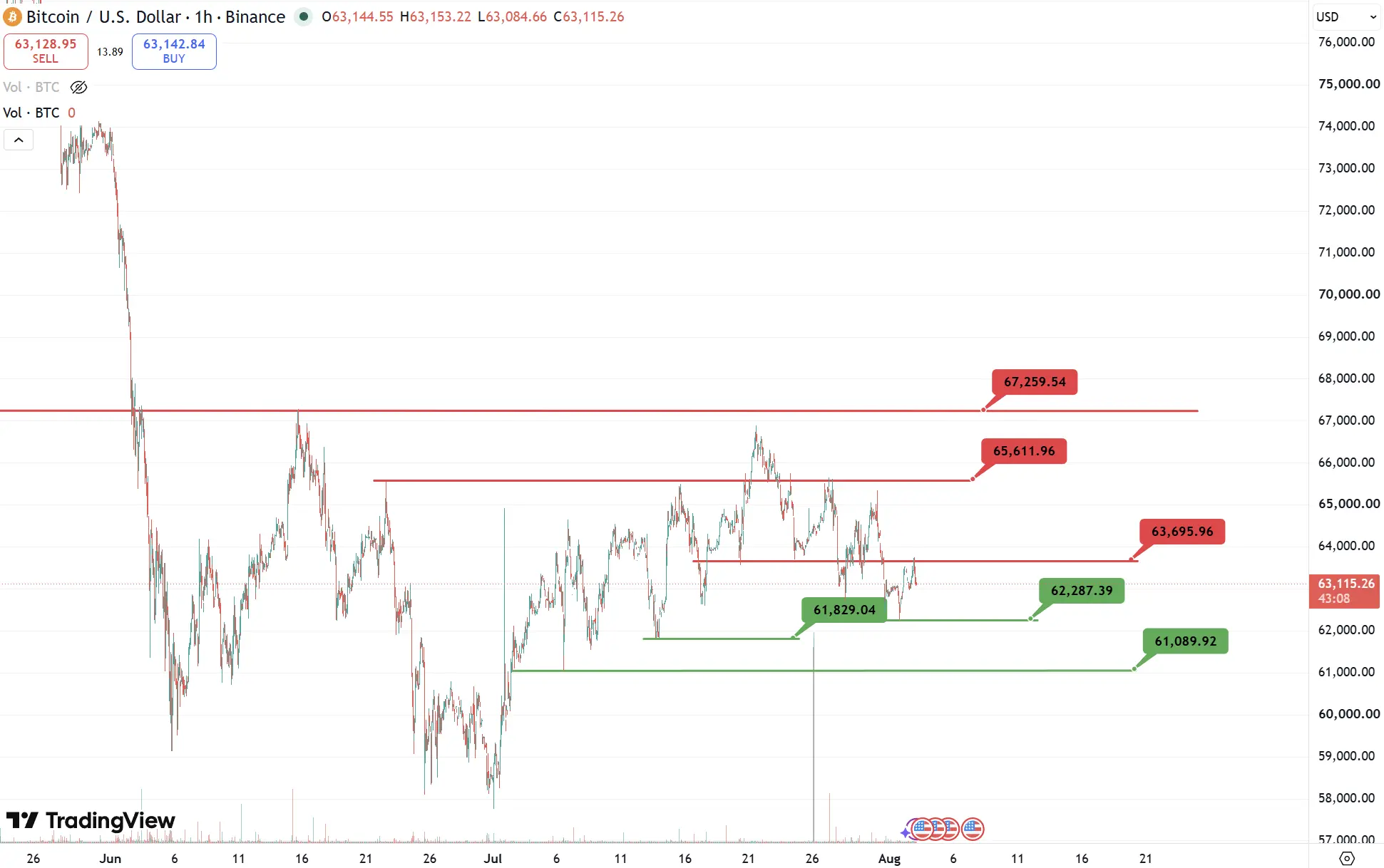
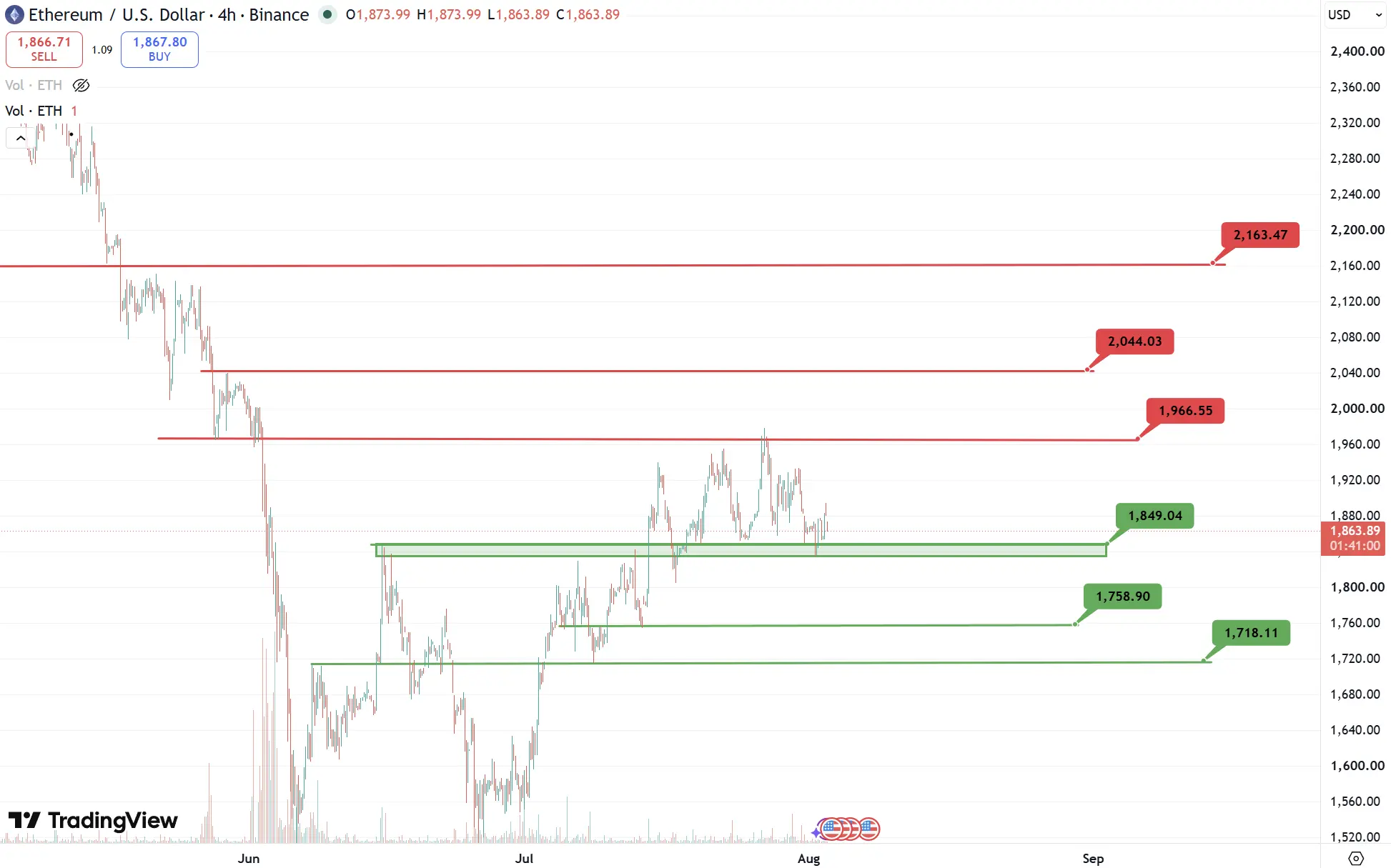
This week, the crypto market overall maintained a weak oscillating trend, with macro factors and Federal Reserve policy expectations remaining the main influences. BTC opened near $63,674 on July 27, rebounding to $64,777 at one point during the week (on July 30), before falling back to around $62,820 on July 31, oscillating overall in the $62,000–$65,000 range, continuing to face pressure from previous highs. The market was mainly affected by ETF fund flows, interest rate expectations, and declining risk appetite, with investors remaining cautious after the FOMC meeting. ETH performed weaker than BTC, with prices continuing to operate in the $1,800–$1,900 range, and capital exposure to assets outside the mainstream has contracted. Altcoins generally followed the market adjustment, with high market cap public chains and infrastructure assets like SOL, AVAX, and LINK showing relatively strong liquidity, but popular projects in AI, DePIN, and RWA have shown significant divergence, with some tokens that previously increased significantly experiencing profit-taking, leading market funds to further concentrate on BTC, stablecoin yields, and institutional assets.
In the coming week, the market will focus on signals from the Federal Reserve, the trend of the U.S. dollar, and changes in institutional fund flows. If BTC can stabilize in the $64,000–$65,000 range, accompanied by ETF fund inflows, the market is expected to rebound towards the $66,000–$68,000 area; however, if it breaks below the $62,000 support, it may further test around $60,000. For ETH, the short-term key support level is at $1,800; if funds flow back and break through $1,900–$2,000, it may drive the recovery of Layer 2, DeFi, and staking ecosystems; otherwise, it may continue to maintain a weak oscillating trend. For altcoins, it is expected that the short-term will still be dominated by structural trends, with sectors like AI Agent, RWA, PayFi, and stablecoin infrastructure that have real application narratives likely to continue attracting funding, while small-cap tokens lacking fundamental support will still face liquidity pressure.
3. Industry and Sector Hotspots
This week, the hotspots in the crypto industry mainly focused on PayFi, RWA, AI infrastructure, DeFi risk management, and institutional-level financial infrastructure, with funds continuously concentrating on infrastructure projects that have real commercial landing capabilities.
RWA and institutional finance remain core sectors, with projects like Securitize, Gauntlet, and Morpho continuously promoting the on-chainization of traditional assets and optimization of yield strategies, shifting market focus from simple asset tokenization to a combination model of "RWA + DeFi yield layer." The AI + Crypto direction continues to heat up, shifting focus from the AI Agent concept to AI Agent payments, data assets, and automated financial execution infrastructure, promoting the development of on-chain smart economies.
In terms of DeFi infrastructure, risk management, yield optimization, and on-chain asset management have become important entry points for institutional funds. Projects like Gauntlet provide institutional-level management capabilities for lending protocols and yield vaults through quantitative models, automated strategies, and risk control systems; at the same time, the PayFi sector continues to develop around stablecoin payments, cross-border settlements, and AI Agent automated payments, becoming an important direction connecting the crypto market with real business.
II. Market Hotspot Sectors and Potential Projects of the Week
1. Overview of Potential Projects
1.1. Brief Analysis of Total Financing of $18 million, led by renowned crypto VC A16z, with follow-on investments from Circle and Breyer Capital—building the identity and payment standard layer for the AI Agent economy, ACK (Agent Commerce Kit)
Introduction
ACK (Agent Commerce Kit) aims to establish a unified infrastructure for the interaction between AI Agents and financial systems through open standard protocols and a universal architecture, addressing identity, payment, and regulatory issues faced by AI Agents when participating in digital business activities.
Its core includes three major modules:
- Verifiable Agent Identity
Utilizing open identity standards and cryptographic mechanisms to bind AI Agents to their underlying individual or institutional owners.
Ensuring that the actions of Agents have traceability, accountability, and trusted identity authentication capabilities.
- Agent-Native Payments
Supporting AI Agents to autonomously initiate and execute payments across different payment networks and financial systems.
Providing verifiable payment receipts through standardized Digital Receipts, achieving auditable and verifiable payment results.
- Integrated Oversight
Introducing human participation mechanisms in necessary scenarios.
Supporting compliance reviews, risk control, customer support, and escalation handling for anomalies, ensuring that Agents' commercial behaviors comply with regulatory requirements.
Brief Description of the Protocol Mechanism
ACK is an open architectural framework for AI Agent commercial activities, achieving secure, verifiable, and compliant interactions between AI Agents and financial systems through Identity Verification (ACK-ID) + Payment Protocol (ACK-Pay) + Human Oversight Mechanism.
Core Roles
ACK defines six types of core participants:
|--------------------|----------------------------| | Role | Function | | Client Agent | AI Agent initiating service requests or payments | | Server Agent | Service provider validating identity and receipts | | Identity Provider | Providing DID/VC identity authentication services | | Payment Service | Responsible for payment execution, compliance checks, and fund settlement | | Receipt Service | Issuing and verifying verifiable payment receipts (ACK Receipt) | | Settlement Network | The underlying network (banks, card organizations, blockchains, etc.) that actually completes the fund transfer |
These roles can be undertaken by independent systems or combined by the same institution.
Two Core Interaction Modes
1. Server-Initiated
Applicable for:
API payment calls
MCP service calls
AI Agent purchasing resources
Process:

Core Logic:
Pay first → Deliver service later
2. Client-Initiated
Applicable for:
Paying bills
E-commerce settlements
Known payment obligations
Process:
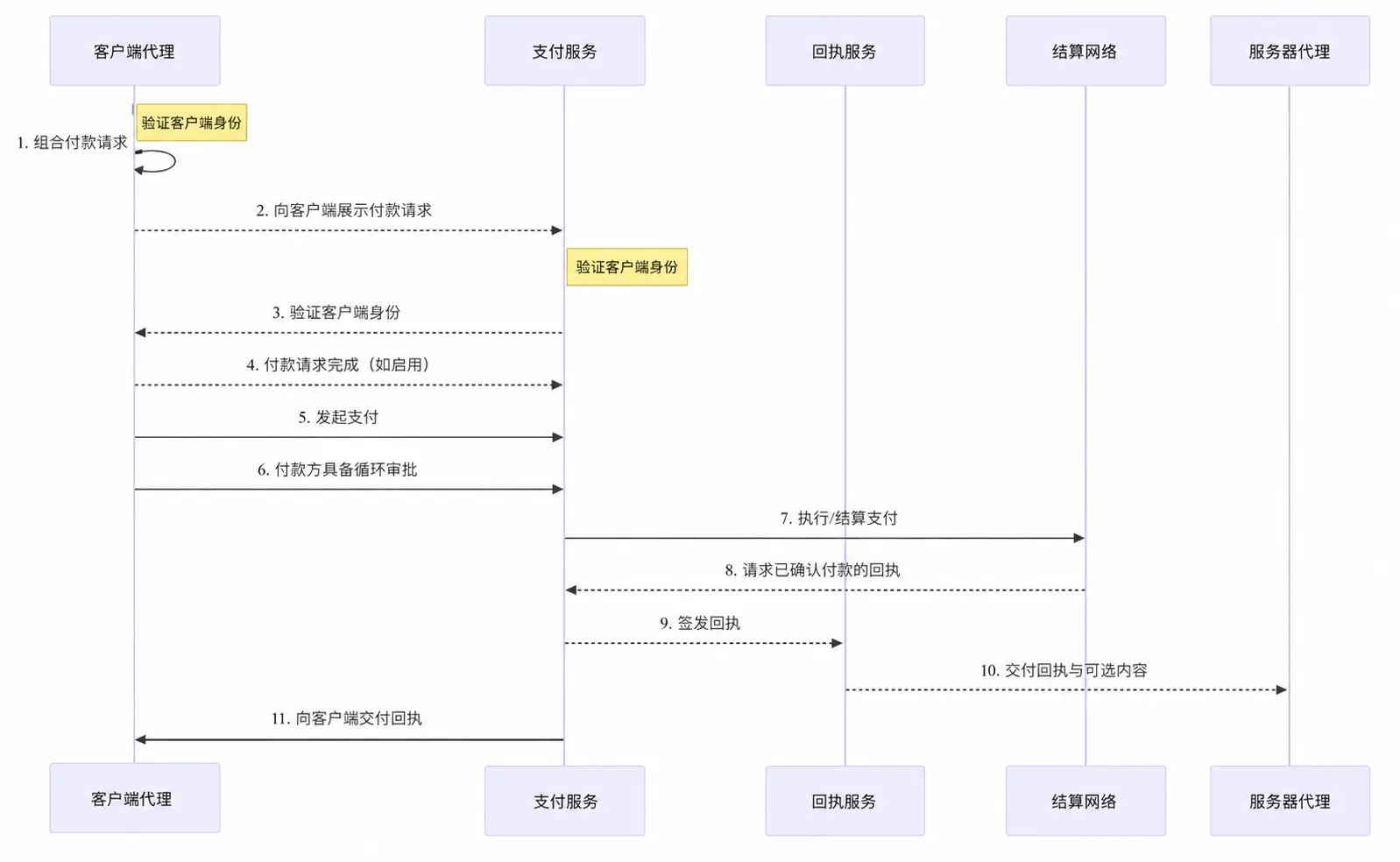
Core Logic:
Generate payment demand first → Complete payment later
ACK Receipt
ACK introduces a standardized digital receipt.
Features:
Based on Verifiable Credential (VC)
Can be cryptographically verified
Auditable
Tamper-proof
Acts as:
A standardized electronic invoice and payment receipt in the AI Agent world.
After payment completion:
Payment Service → Receipt Service → ACK Receipt
Ultimately serves as proof of payment.
Human-in-the-Loop
ACK does not allow Agents to operate completely autonomously.
It reserves regulatory interfaces for human-machine collaboration:
Operational Oversight
For example:
Large payment audits
Suspicious transaction reviews
Risk control
User Authorization
For example:
When exceeding payment limits
During sensitive operations
Requires manual user confirmation.
Implementation Flexibility
ACK does not specify a particular tech stack.
Organizations can freely choose:
Bank payment systems
Credit card networks
Stablecoin payments
Blockchain networks
As long as they adhere to:
ACK-ID identity standards
ACK-Pay payment standards
ACK Receipt receipt standards
Interoperability can be achieved.
ACK essentially builds a unified commercial protocol layer for the AI Agent economy:
ACK-ID (identity)
+
ACK-Pay (payment)
+
ACK Receipt (receipt)
+
Human Oversight (regulation)
↓
AI Agent Commerce
It aims to solve the three most critical issues in the large-scale commercialization of AI Agents:
How does an Agent prove its identity?
How does an Agent complete a payment?
How does an Agent prove that payment has been made?
Thus enabling AI Agents to participate in digital business activities safely and credibly, just like enterprises or individuals.
Tron Comments
The advantage of ACK lies in that it does not build a separate payment network or identity system but attempts to establish a set of universal commercial standards for the AI Agent economy, achieving standardization and interoperability of Agent identity, payments, and transaction receipts through ACK-ID (identity authentication), ACK-Pay (payment protocol), and ACK Receipt (verifiable receipt), allowing different Agents, enterprises, payment institutions, and financial systems to collaborate within a unified framework; while retaining the Human-in-the-Loop mechanism, it strikes a balance between automation and compliance, demonstrating strong openness and industry adaptability.
Its disadvantage is that ACK itself resembles a protocol framework and standard layer rather than directly providing liquidity, payment networks, or user entry points, with its value highly dependent on the widespread adoption by ecosystem participants such as payment service providers, identity providers, and AI Agent platforms; additionally, cross-institution identity authentication, payment settlement, and regulatory collaboration involve complex legal and compliance requirements, and differing regulatory standards across regions may also affect its global implementation speed.
2. Detailed Explanation of Key Projects of the Week
2.1. Detailed Explanation of Total Financing of $204.4 million, led by well-known VCs Paradigm, A16z, and Ribbit Capital, with follow-on investments from Coinbase, Pantera, and Hashkey—building the underlying infrastructure for on-chain fixed-rate credit markets, Morpho Midnight
Introduction
Morpho Midnight is a non-custodial fixed-rate lending protocol deployed on the EVM (Ethereum Virtual Machine).
The protocol is built around isolated markets, each characterized by:
Immutable
Permissionless creation
Fixed maturity date
Its lending mechanism is realized through the trading of credit units and debt units. The yield structure of these units is similar to zero-coupon instruments and settles at market maturity.
Participants trade by posting or accepting offers. Unlike traditional lending protocols:
No funds need to be locked when making offers
Liquidity is only actually called upon at final settlement
Thus, market makers can provide quotes for multiple markets simultaneously without needing to lock up large amounts of capital in advance, significantly improving capital utilization efficiency.
In terms of market structure, Morpho Midnight supports:
Single-collateral markets
Multi-collateral markets
Additionally, the protocol supports access control through Gates to meet specific market compliance or participation restrictions.
Core Analysis of System Architecture
1. Introduction (Project Positioning and Design Philosophy)
Core Content
Midnight is a fixed-rate lending protocol launched by Morpho, aimed at solving the issues of interest rate volatility, liquidity fragmentation, and capital efficiency faced by traditional pooled lending (such as Aave, Compound).
Its core design includes:
Fixed-rate lending
Fixed maturity date
Isolated markets
Permissionless market creation
Non-custodial architecture
Unlike traditional liquidity pools, Midnight delegates risk management, market selection, and asset allocation to market participants rather than the protocol itself.
2. Fixed-Maturity Lending Markets
Markets
Each market, once created, is permanently fixed:
Loan assets
Maturity time
Collateral asset types
Risk control parameters
These cannot be modified.
Credit Unit & Debt Unit
Midnight does not record traditional lending positions but trades two standardized units:
Credit Unit
Represents the right to future payments
Belongs to the lender
Debt Unit
Represents future repayment obligations
Belongs to the borrower
Essentially similar to zero-coupon bonds
Settles at face value upon maturity.
Fungibility
All Credit and Debt are uniformly accounted for at the market level.
Thus:
There are no peer-to-peer lending relationships
Positions generated at different times can be fully merged
Improving liquidity.
Early Exit
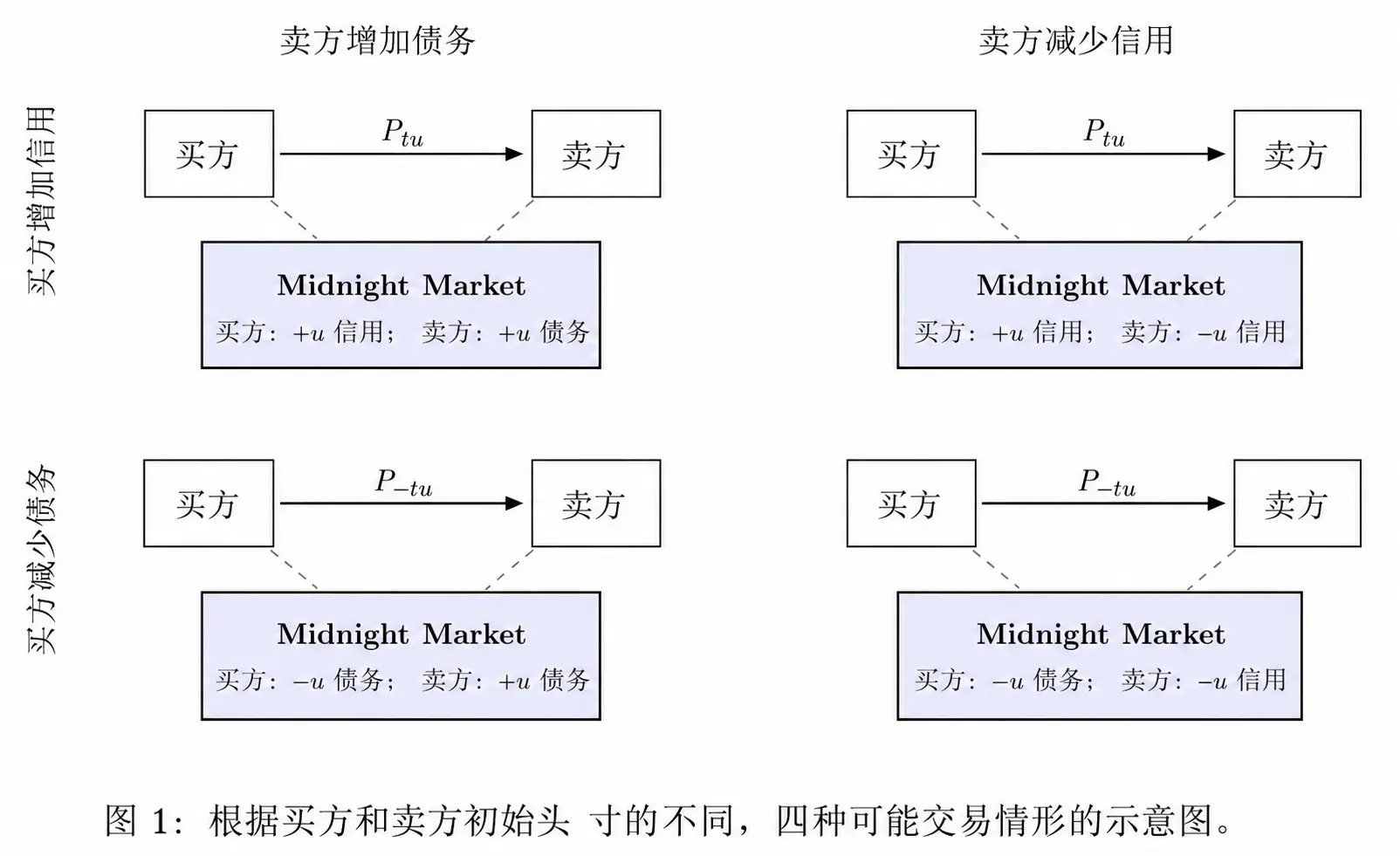
Borrowers and lenders do not need to wait until maturity.
They can:
Lenders sell Credit Units
Borrowers buy back Debt Units
To exit early.
3. Offer-Based Markets
Offer Mechanism
Midnight does not use order books or liquidity pools.
Market makers publish:
Interest rates
Prices
Maximum transaction sizes
To form offers.
The offers themselves:
Do not require locking funds
Only actually call upon funds when a transaction occurs.
Maker Callback
Funds are only extracted upon transaction completion.
For example:
Funds remain in Morpho Blue earning yields
Automatically extracted when the offer is executed
Improving capital utilization.
Multi-Market Offers
The same liquidity can serve multiple markets simultaneously.
For example:
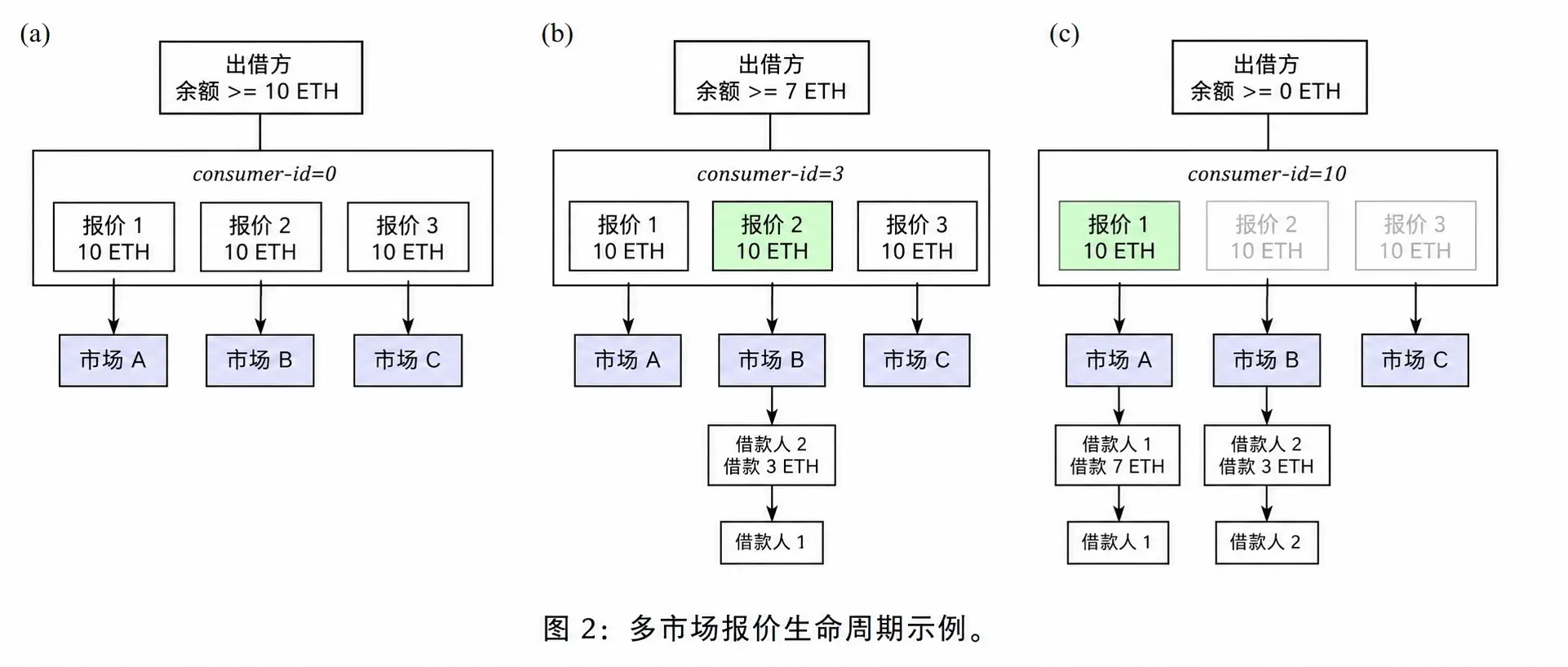
As long as the total transaction volume does not exceed 10 ETH.
Effectively alleviating liquidity fragmentation.
Routing Mechanism
The protocol does not facilitate matching.
Routers are responsible for:
Searching for optimal offers
Comparing liquidity across different markets
Selecting the best transaction path
The entire process occurs off-chain.
Tick Structure
Midnight employs a fixed Tick grid.
Purpose:
Prevent tiny price competition
Improve market depth
Ensure offer quality
Similar to the minimum quote unit in traditional exchanges.
4. Liquidations
Maximum Debt
Supports multi-collateral markets.
Maximum borrowing capacity:
Collateral value × LLTV
The total value of all collateral determines the borrowing limit.
Liquidation Incentive
When a position is unhealthy:
Liquidators repay part of the debt
Receive discounted collateral
The size of the incentive is determined by market parameters.
Unhealthy Liquidation
When:
Debt > Maximum borrowing capacity
Liquidation can be triggered.
Features:
Only the portion needed to restore health is liquidated
The entire position will not be liquidated directly
Protecting borrowers.
Overdue Liquidation
Even if a position is healthy:
If repayment is not made after maturity,
It can still be liquidated.
Using a mechanism similar to:
Dutch Auction
Gradually increasing liquidation rewards.
Avoiding excessive penalties for borrowers.
Bad Debt Handling
If collateral is insufficient to cover the debt:
Bad debt is generated.
Midnight's handling method:
Immediately recognize losses
Proportionally reduce lenders' Credit
Avoiding long-term concealment of bad debt.
5. Access-Control Gates
Midnight supports market-level permission control.
Enter Gate
Controls:
Who can enter the market.
But does not prevent exiting.
Ensuring funds are not locked.
Liquidator Gate
Controls:
Who is eligible to participate in liquidations.
Applicable for:
Institutional markets
Whitelisted markets
Compliance markets
And other scenarios.
6. Authorizations
Midnight provides a unified authorization model.
Users can authorize third parties:
To manage all Midnight account statuses on their behalf.
Including:
Lending
Repayment
Adjusting positions
However, the protocol does not support fine-grained permission management.
For more complex permission controls:
External contracts must be used.
7. Fees
The protocol charges two types of fees.
Settlement Fee
Charged per transaction.
Features:
Related to remaining term
Slightly higher fees for longer terms
Annual cap of about 0.5%.
Continuous Fee
Charged to lenders.
Features:
Accumulated over time
Deducted from Credit earnings
Annual cap of 1%.
Tron Comments
The advantage of Morpho Midnight lies in its introduction of traditional fixed-income market logic into on-chain lending, providing borrowers with predictable financing costs and clear yield expectations for lenders through fixed rates, fixed maturity dates, and Credit/Debt Unit models; at the same time, it adopts an Offer-Based mechanism, allowing market makers to quote across multiple markets without needing to lock funds in advance, and through Callback and Multi-Market Offer sharing liquidity, significantly enhancing capital efficiency and alleviating liquidity fragmentation issues. Additionally, it continues the isolated market structure of Morpho Blue, supporting multi-collateral, permission control (Gate), and customized markets, making it more suitable for institutional-level and professional credit market needs.
Its disadvantage is that the overall design is more complex compared to traditional DeFi lending protocols, with liquidity discovery relying on off-chain quotes and routing networks, making the user experience less intuitive than pooled lending like Aave; at the same time, fixed-term markets inherently bring about maturity management, rollovers, and liquidity dispersion issues, with a higher dependency on market makers and professional liquidity providers, where early market depth and activity will directly impact protocol efficiency.
III. Industry Data Analysis
1. Overall Market Performance
1.1. Spot BTC vs ETH Price Trends
BTC
ETH
IV. Macroeconomic Data Review and Key Data Release Points for Next Week
I. Review of Macroeconomic Data This Week
United States: Economic growth slows but inflation pressures remain, market continues to focus on the Federal Reserve's policy path
This week, the core focus of U.S. macro data was on economic growth, inflation, and Federal Reserve interest rate expectations. The U.S. GDP growth rate for the second quarter recorded 1.5%, slowing from the first quarter, mainly dragged down by increased imports, but consumer spending and investments related to AI companies remained resilient, indicating that the U.S. economy has not shown significant recession.
In terms of inflation, the PCE price index, which the Federal Reserve is concerned about, remains above the long-term target of 2%, and the market continues to assess the impact of energy prices, tariffs, and wage pressures on the subsequent inflation decline path.
Regarding monetary policy, the Federal Reserve kept interest rates unchanged at its July meeting, with the federal funds rate remaining in the 3.50%–3.75% range, but there are internal disagreements regarding the future policy direction, with some members leaning towards further tightening. Market focus has shifted to future employment and inflation data to assess the likelihood of interest rate cuts or maintaining high rates.
Europe: Inflation re-accelerates, interest rate cut expectations are suppressed
Eurozone inflation data for July shows that the overall CPI has risen to 2.9%, higher than previous levels, mainly driven by rising energy prices; service sector inflation remains high, limiting the European Central Bank's future policy space.
Although the Eurozone economy maintained growth in the second quarter, the repeated increase in inflation has raised market concerns about the European Central Bank's further easing pace, with short-term market attention on whether energy prices and wage growth will push inflation pressures higher again.
II. Key Macroeconomic Data Release Points for Next Week
United States
Early August: Non-farm Payroll Data
The market will focus on:
New job creation
Unemployment rate
Average hourly wage growth
Employment data will directly impact the Federal Reserve's subsequent interest rate judgments. If employment cools significantly, it may enhance market expectations for interest rate cuts; if employment remains strong, it may push rates to stay high for longer.
ISM Manufacturing PMI
Key observations:
Manufacturing sentiment
Business order situation
Changes in cost pressures
This data will be used to assess whether the momentum of U.S. economic growth continues to slow.
Initial Jobless Claims
Focus on marginal changes in the U.S. labor market as an important reference indicator ahead of non-farm data.
V. Regulatory Policies
United States
Progress on the Digital Asset Market Structure Bill is hindered: Uncertainty has emerged regarding the advancement of the CLARITY Act (Digital Asset Market Structure Bill) in the U.S. Senate, with disputes centered on regulatory authority divisions, consumer protection, and the impact of stablecoin-related interests. Market expectations for short-term passage have declined.
Stablecoin regulation remains a policy focus: U.S. regulatory discussions continue to revolve around stablecoin issuance rules, reserve requirements, and the boundaries of banking system participation, but no new significant regulations have been implemented this week.
European Union
- MiCA enters the adjustment phase after implementation: This week, the focus is on market adjustments between platforms that have obtained MiCA licenses and those that have not completed compliance, shifting regulatory focus from legislation to the actual operational compliance of CASPs (Crypto Asset Service Providers).
Other Major Markets
- No significant new regulatory policies have been implemented this week: Regions such as the UK, Hong Kong, Japan, and Singapore continue to advance existing digital asset regulatory frameworks, but no new policies affecting the industry landscape were released between July 27 and August 1.
 Risk warning

Popular articles