TRX ETF lands on the Chicago Exchange, marking another milestone for Tron’s global compliance
 Core Viewpoint

 TRX ETF lands on the Chicago Stock Exchange, and Tron accelerates its integration into the global mainstream capital market.
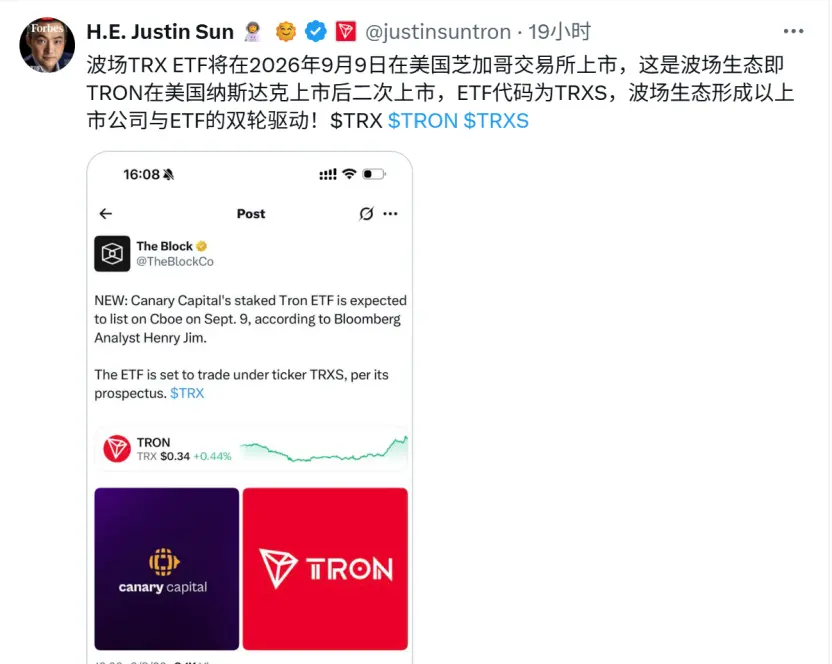
On September 8, Sun Yuchen, the founder of TRON, posted on platform X that the Canary Staked TRX ETF will be listed on the Cboe BZX Exchange in the United States on September 9, 2026, with the trading code TRXS. Following the listing of TRON Inc., a company related to the TRON ecosystem, on NASDAQ, TRX will also enter the mainstream securities market in the United States through the ETF. Sun Yuchen stated that the TRON ecosystem is forming a dual-driven pattern of "public companies + ETF."
For TRON, the significance of this ETF listing is not just to add an investment channel. In recent months, TRON's on-chain accounts, stablecoin scale, layout in the U.S. capital market, and AI business have all been breaking phase records, with several business lines achieving breakthroughs at the same time. This also means that TRON is expanding its on-chain scale and further moving towards a broader institutional and global development stage.
TRXS not only tracks TRX prices but also participates in on-chain staking
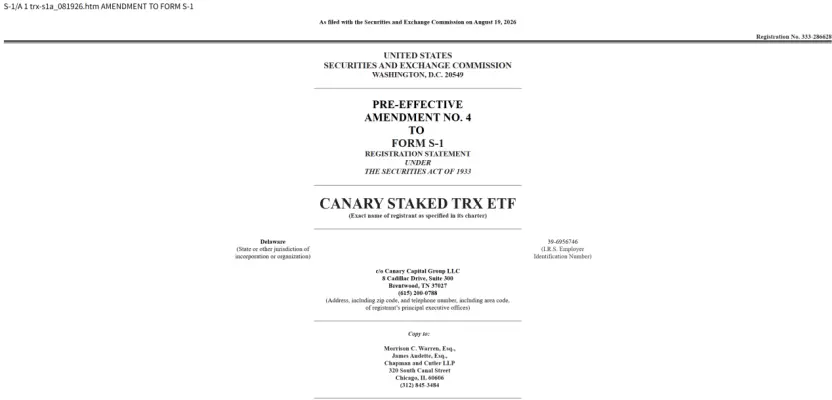
According to the S-1/A document submitted by Canary Capital to the U.S. Securities and Exchange Commission (SEC) on August 19, the primary goal of the Canary Staked TRX ETF is to provide investors with exposure to TRX prices while obtaining additional TRX through participation in staking on the TRON network.
From a product design perspective, TRXS differs from a spot ETF that simply holds crypto assets. The document indicates that the fund plans to use essentially all eligible TRX for staking, with the rewards generated from staking, after deducting related fees, being included in the fund's assets. The fees related to staking services are expected to account for about 20% of the staking rewards, with the remaining approximately 80% retained by the fund, and the accrued rewards will also be reflected in the daily net asset value (NAV) of the fund.
In other words, the traditional securities accounts will not only gain exposure to TRX prices in the future, but the staking rewards generated by the TRON network itself will also be incorporated into the ETF's product structure.
For TRX, this also allows its on-chain staking mechanism to enter the broader traditional financial market for the first time through the ETF product.
Before TRXS, the TRON ecosystem had already established a connection with the U.S. public market through the U.S. listed company TRON Inc.
TRON Inc. is already trading on NASDAQ and uses TRX as its core digital asset reserve. The company has continued to increase its TRX holdings and plans to further participate in the infrastructure construction of the TRON network. As of early September 2026, TRON Inc. holds over 712.8 million TRX and continues to expand its TRX digital asset reserves.
After the listing of TRXS, the investor demands for the two types of products are not entirely the same. TRON Inc. is more closely related to the public company revolving around TRX reserves and ecosystem business, while TRXS directly provides exposure to TRX assets and staking rewards.
Therefore, rather than saying that TRON is "re-listing," it is more accurate to say that TRX has added an important entry point in the U.S. capital market. The two public market tools of stocks and ETFs also make it more diverse for traditional investors to access the TRON ecosystem.
400 million accounts, $94.2 billion USDT, on-chain scale continues to break through
Beyond the capital market, TRON's recent on-chain data is also at a new level.
On August 23, 2026, the total number of on-chain accounts on TRON officially surpassed 400 million. The network has processed over 15.4 billion transactions, with a total transfer amount close to $30 trillion.
Stablecoins remain the core business foundation of TRON.
Currently, the issuance scale of USDT on the TRON network has reached $94.2 billion, surpassing other blockchain networks like Ethereum, becoming the largest USDT issuance network in the world.
This data better illustrates the current usage structure of TRON than just the number of accounts. A large number of on-chain activities on TRON revolve around USDT, from exchange deposits and withdrawals, personal transfers, to cross-border payments, fund settlements, and DeFi, with stablecoins becoming the main asset flow carrier on the network.
This advantage has continued to amplify this year. In the second quarter of 2026, the TRON network processed USDT transfers amounting to approximately $2.1 trillion; previously disclosed data also showed that the daily USDT transfer amount on TRON reached about $25 billion.
From a stock of $94.2 billion to daily on-chain circulation of hundreds of billions of dollars, TRON's competitive focus in the stablecoin market is no longer just about "how much USDT has been issued," but whether these stablecoins are truly high-frequency liquid. For payment and settlement networks, the latter is closer to real usage.
B. AI Token throughput breaks 1 trillion, AI business rapidly scales
In addition to the stablecoin business, the AI platform supported by TRON, B.AI, has also seen significant growth recently.
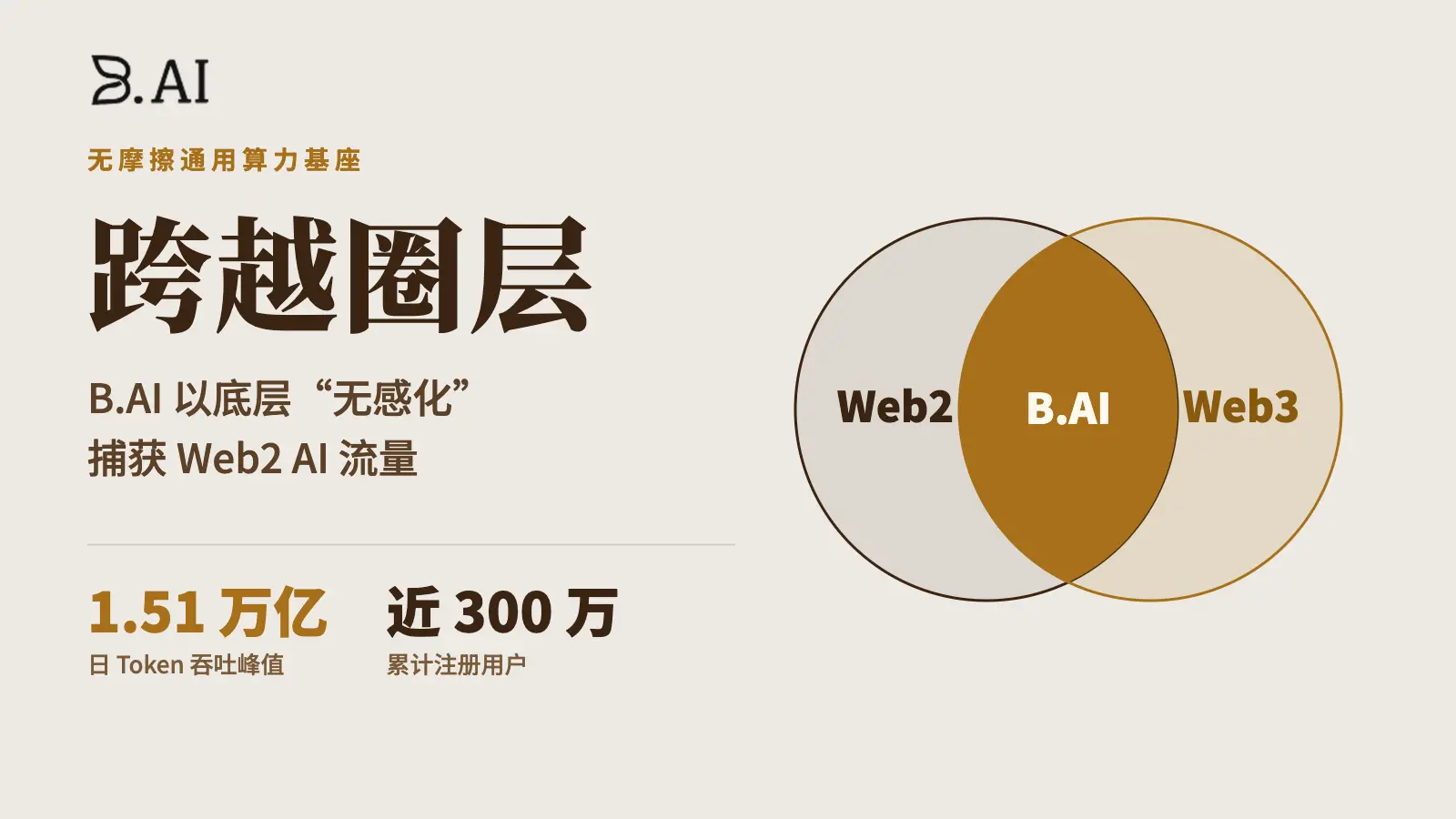
As of early September, the number of B.AI users has surpassed 2.4 million, with the platform's daily token throughput reaching a peak of over 1 trillion. Since the launch of the free activity on August 17, over 220,000 new API users have been added, with a cumulative throughput exceeding 10.9 trillion tokens, supporting over 8.956 million API calls.
This growth rate has clearly surpassed the scale at the initial launch of B.AI. After its launch in April this year, B.AI initially provided large model aggregation and API services, and has gradually added capabilities such as model access, AI Agents, and AI programming, expanding its service targets from ordinary AI users to developers and Agent scenarios.
B.AI and TRON currently belong to different business systems, but there is a noteworthy intersection between the two: payments.
If AI Agents are to truly participate in commercial activities, they ultimately need to complete actions such as payments, settlements, and cross-border transfers. Traditional payment systems require accounts, banks, and manual authorization, while stablecoins naturally support 24/7 operations and are easier to embed in programmatic processes. TRON has already supported over $94.2 billion USDT, while B.AI is rapidly accumulating AI users, developers, and model call volumes, providing a realistic foundation for the future integration of AI Agents and stablecoin payments.
In recent times, TRON has continued to make progress in multiple directions, including on-chain scale, stablecoins, capital markets, and AI. The listing of TRXS further broadens the channels connecting TRX with traditional financial markets, also advancing the globalization and institutionalization process of the TRON ecosystem.
As the core business foundation continues to expand and new businesses gradually scale, the ecological boundaries of TRON are also continuously extending. From public chain infrastructure and stablecoin networks to capital markets and AI scenarios, TRON is entering a more diverse development stage.
 Risk warning