Tron Industry Weekly Report: The Federal Reserve releases a hawkish signal, the cryptocurrency market enters a correction, and an in-depth analysis of the infrastructure for on-chain issuance and circulation of global securities assets, Securitize
 The total financing of $521.75 million was led by ARK, Jump, and Black Rock to promote the infrastructure Securitize for the issuance and circulation of global securities assets on the blockchain.
# I. Outlook
## 1. Macroeconomic Summary and Future Predictions
This week's macro summary (August 24, 2026 - August 30, 2026): This week, the global macro trading narrative further shifted towards "inflation re-emerging - major central banks turning hawkish again - growth resilience coexisting with policy tightening risks." In the United States, July PCE data showed both overall and core PCE rising by 0.2% month-on-month, with year-on-year rates of approximately 3.7% and 3.3%, indicating that inflation remains significantly above the Federal Reserve's 2% target. Meanwhile, Federal Reserve Chairman Kevin Warsh clearly stated in his speech at Jackson Hole on August 28 that inflation is still "too high," and recent data is insufficient to prove that the underlying inflation trend has materially improved. If inflation does not continue to decline, the Federal Reserve still has room for further action, leading the market to reassess the pricing of interest rate hikes within the year. However, he also affirmed the overall performance of the U.S. economy, suggesting that the current environment is closer to "acceptable growth with high inflation" rather than a recession-driven easing cycle. Europe is also facing inflationary pressures, with August Eurozone inflation rising year-on-year to about 3.3%, driven mainly by energy prices, increasing pressure on the ECB to tighten policy further. In Asia, the Bank of Korea raised its benchmark interest rate by 25 basis points to 3.00% on August 27, reflecting a global trend towards tighter monetary policy. Meanwhile, the situation in the Middle East, energy prices, and trade frictions continue to pose tail risks for global inflation, with the overall macro environment shifting from previous expectations of interest rate cuts to a repricing of "high rates being maintained longer or even further rate hikes."
Future week prediction (August 31, 2026 - September 6, 2026): The most critical variable next week will shift from the policy statements at Jackson Hole to the verification of U.S. employment data: the market will sequentially focus on JOLTS job openings, ADP employment, ISM, and the most important August non-farm payroll report. The core question is whether the job market can continue to withstand a high-interest rate environment. As of this weekend, market expectations for a 25 basis point rate hike by the Federal Reserve in September have risen to over 50%. Therefore, if non-farm employment, wage growth, and ISM data are significantly strong, it will reinforce the judgment that "the economy can withstand further tightening," and U.S. Treasury yields and the dollar still have room to rise, continuing to suppress high-valuation risk assets. Conversely, if employment deteriorates significantly, it could quickly weaken expectations for a September rate hike, but with inflation still above target, the threshold for the Federal Reserve to shift directly to easing remains high. Currently, European inflation is heating up again, and geopolitical risks in the Middle East continue to affect energy supply. In the coming week, global markets may still maintain a pattern of high volatility, with high-interest rate expectations and growth concerns competing against each other. The macro direction will ultimately depend on whether U.S. employment is sufficient to support the Federal Reserve's continued tightening of policy.
## 2. Market Movements and Warnings in the Crypto Industry
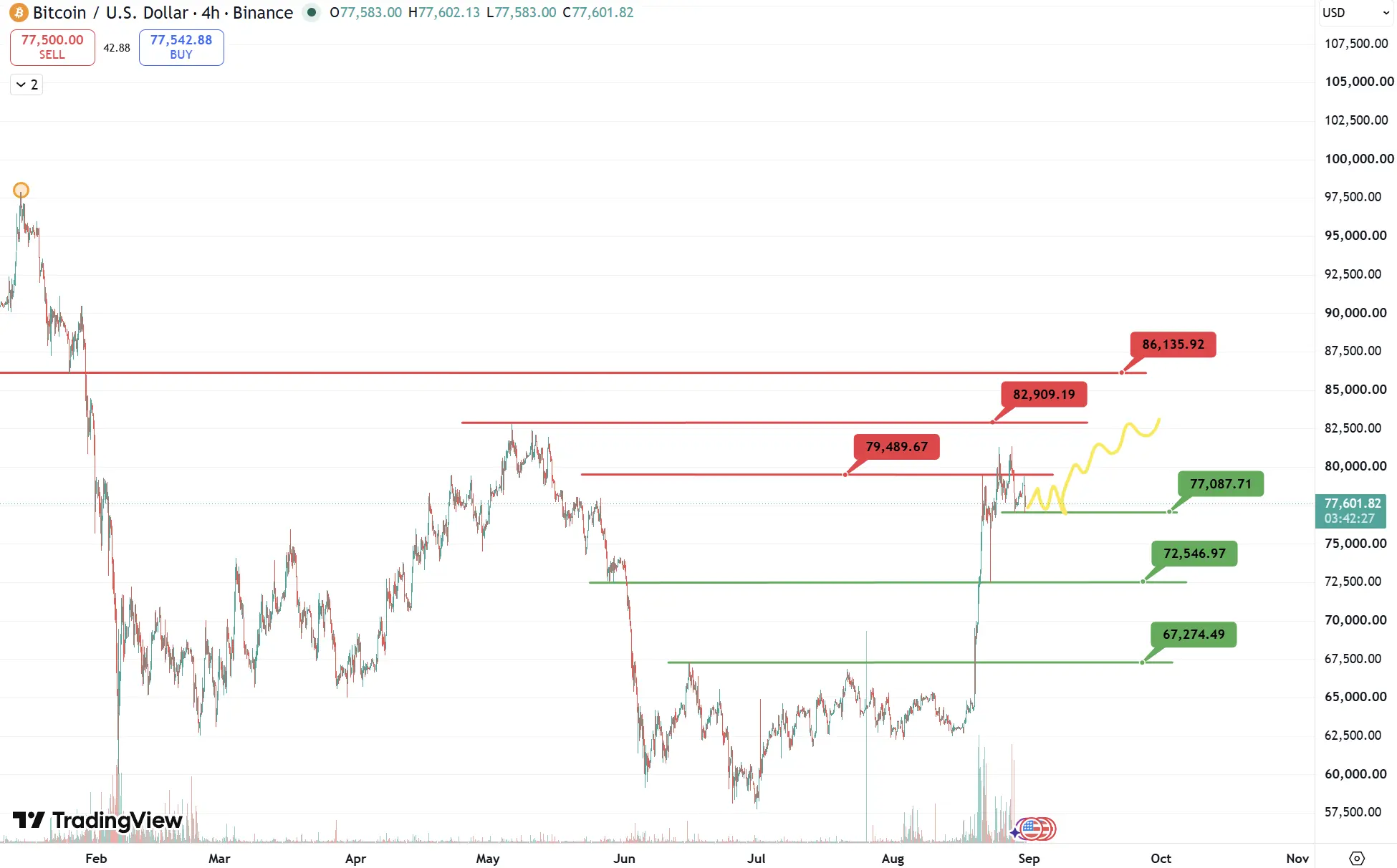
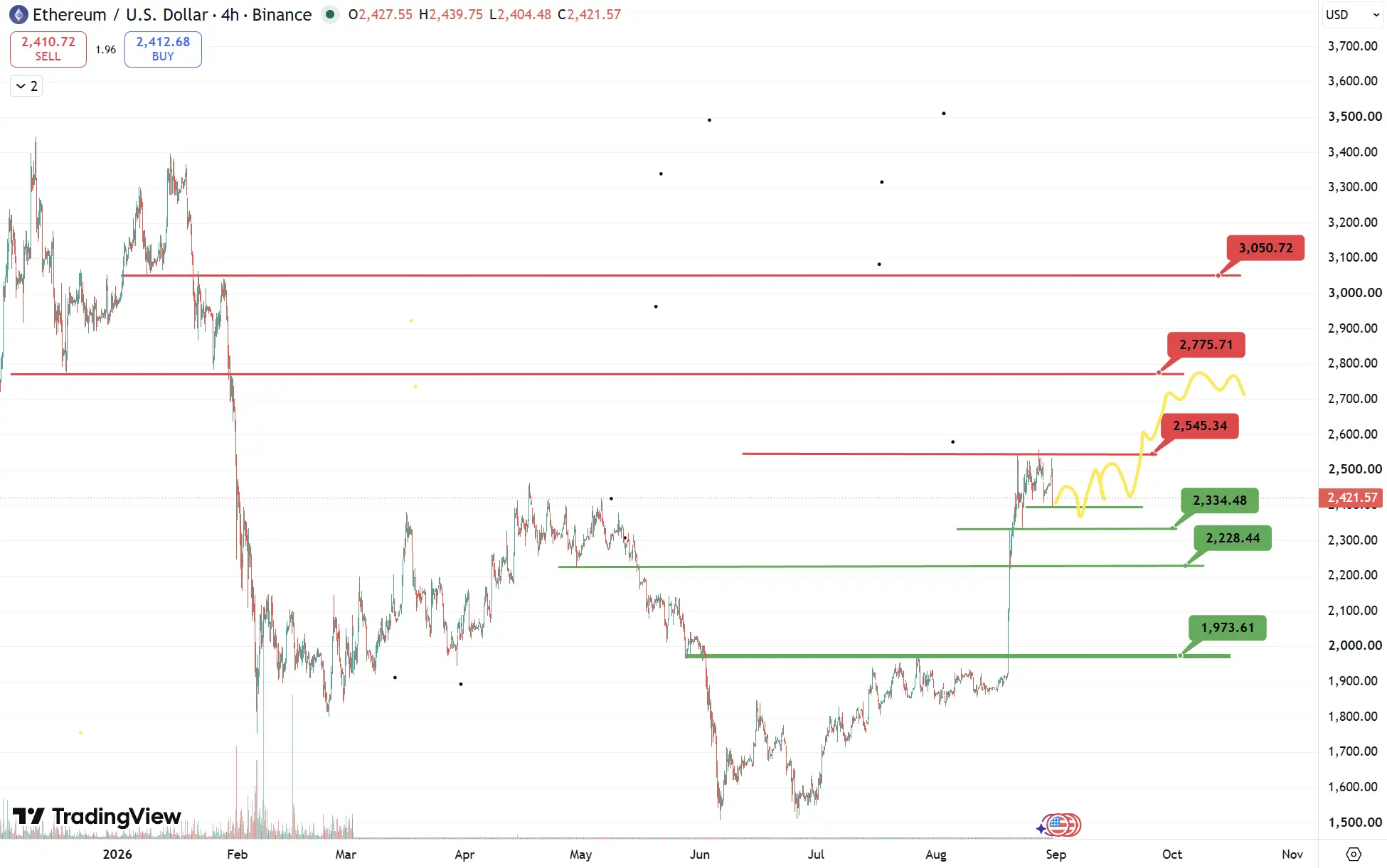
Market movements this week (August 24, 2026 - August 30, 2026): The crypto market exhibited a clear pattern of rising and then retreating, with high volatility. BTC started rebounding from around $77,700 on August 24, peaking close to $80,000 on the same day, further reaching about $81,200 on August 25, and then fluctuating repeatedly in the $78,000 - $81,000 range. On August 28, influenced by Federal Reserve Chairman Kevin Warsh's hawkish signals at Jackson Hole, market expectations for a September rate hike rose significantly, leading to a stronger dollar and U.S. Treasury yields, with BTC dropping about 3% in a single day, hitting a low of around $76,900, and stabilizing back around $78,000 by the weekend. ETH's overall trend was in sync with BTC but with weaker elasticity, primarily operating in the $2,408 - $2,560 range this week, closing at about $2,483 on August 24, briefly rising above $2,500 on August 26-27, falling back to around $2,443 on August 28, and maintaining around $2,450 over the weekend. The funding situation formed strong support at one point, with U.S. spot BTC ETFs experiencing continuous net inflows from August 24-27, including about $338 million on August 24 and about $314 million on August 25, but turning to a net outflow of about $202 million on August 28. ETH spot ETFs also continued to show net inflows, indicating that institutional funds have not completely withdrawn, but macro policy expectations have once again become the dominant factor in the short-term market.
Future week prediction (August 31, 2026 - September 6, 2026): The market is expected to enter a phase driven by macro data, with core pressures coming from the renewed interest rate hike expectations following Jackson Hole and next week's U.S. employment data. Warsh's hawkish statements have led the market to reprice September policy risks. Therefore, if employment, wages, or other inflation-related data continue to be strong, U.S. Treasury yields and the dollar may rise further. BTC needs to focus on the support zone of $76,000 - $77,000; if it effectively breaks below this, further testing of $73,000 - $75,000 cannot be ruled out. Conversely, if macro data weakens and alleviates rate hike expectations, while ETF funds resume continuous net inflows, BTC may stabilize above $80,000 and challenge the $81,000 - $82,000 resistance zone again. ETH should focus on the short-term support of $2,400 - $2,430; if it holds, there is still a possibility of retesting $2,550 - $2,600, but if BTC enters a risk release phase, ETH and high-beta altcoins are expected to face greater retracement pressure. Overall, next week is more suitable to be defined as a high-volatility, cautious consolidation period. Whether ETF fund flows can turn positive again and whether U.S. employment data further strengthens rate hike expectations will determine whether the market continues to break upward or re-enters a phase of adjustment.
## 3. Industry and Sector Hotspots
From this week's capital flow perspective, the strongest main line is not a new L1/L2 but rather "the integration of Crypto and traditional financial infrastructure": RQD represents institutional clearing, custody, and tokenization; Fasset represents stablecoin payments and digital banking; Hivemind represents RWA/institutional asset tokenization; Entropy represents on-chain capital markets and derivatives; Beldex represents privacy infrastructure in the AI Agent era. Weekly financing data also shows that five out of eight major financings are concentrated in market infrastructure, on-chain finance, or tokenized assets.
Therefore, if we distill the most important financing trend from August 24, 2026, to August 30, 2026, it can be summarized as: capital is clearly concentrating on "stablecoin finance + RWA/tokenization + institutional-level clearing and custody + on-chain capital markets," with traditional large financial capitals such as SBI, Bain Capital, M&G, and ABN AMRO continuously entering, indicating that the core narrative of this round of crypto financing is shifting from pure protocol innovation to institutional-level infrastructure that can connect traditional finance, stablecoins, and on-chain assets.
# II. Market Hotspots and Potential Projects of the Week
## 1. Overview of Potential Projects
1.1. Analyzing total financing of $521.75 million, led by ARK, Jump, and Black Rock, with participation from star institutions like Morgan Stanley, Circle, and Aptos Labs ------ driving the infrastructure for the issuance and circulation of global securities assets on-chain: Securitize
Introduction
Securitize is a leading global compliance platform for tokenizing real-world assets (RWA), focusing on providing one-stop infrastructure for funds, private equity, credit, real estate, and other securities assets, covering issuance, tokenization, investor access, KYC/AML, asset management, and secondary circulation. The platform supports mapping traditional financial assets to the blockchain, enabling digital issuance, on-chain management, and global circulation of assets, enhancing liquidity, transparency, and operational efficiency while meeting regulatory requirements across jurisdictions.
Currently, Securitize has served top global financial institutions including BlackRock, Apollo, Hamilton Lane, and KKR, making it an important infrastructure connecting traditional finance and on-chain capital markets.
Brief Description of Protocol Mechanism
- Overall Architecture of DS Protocol
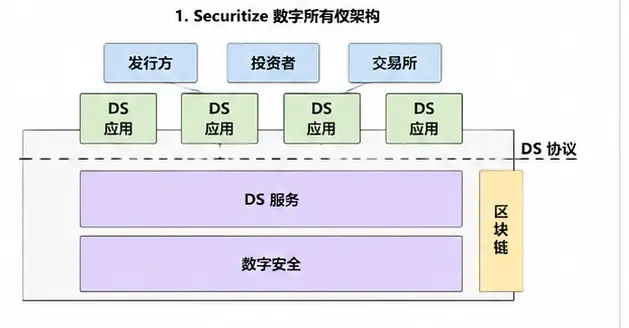
DS Protocol is an open digital securities protocol built by Securitize, with the core goal of providing standardized infrastructure covering issuance, management, trading, and lifecycle operations for digital securities. Unlike traditional Security Tokens that focus solely on asset issuance, DS Protocol views digital securities as a continuously operating financial product. Therefore, the entire system is divided into three independent layers: DS Token, DS Services, and DS Apps, decoupling the asset layer, service layer, and business layer, enhancing the protocol's scalability and long-term upgrade capability while meeting regulatory requirements.
The entire architecture adopts a modular design. DS Token, as the core carrier of digital securities, is responsible for asset issuance, holder records, and on-chain transfers, and has expanded capabilities such as investor management, permission control, and compliance verification based on the ERC20 standard. DS Services provide underlying public services such as identity verification, investor registration, compliance checks, and communication, allowing all digital securities to share unified data and rules. DS Apps are responsible for specific business logic such as dividends, governance voting, and buybacks, enabling issuers to flexibly expand functionalities based on their needs without modifying the underlying Token contract.
The most significant feature of this architecture is the separation of business logic and asset logic. All securities assets maintain a unified standard, while different businesses achieve their goals through independent Apps calling underlying services, allowing the protocol to quickly add new financial functions while avoiding the impact of upgrading business logic on already issued assets. Additionally, open interfaces allow third-party developers, wallets, exchanges, and custodians to directly access DS Protocol, collaboratively building a digital securities ecosystem and enhancing the overall openness and compatibility of the protocol.
- DS Ecosystem
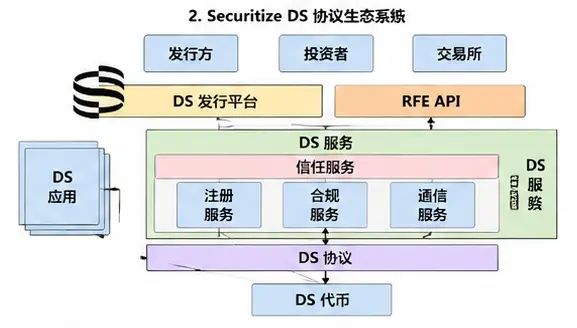
DS Ecosystem illustrates the collaborative relationships among various participants in the digital securities ecosystem. Issuers are responsible for asset issuance and lifecycle management; investors hold and trade digital securities after completing identity verification; exchanges, wallets, and custodians manage asset circulation and storage; third-party developers can develop applications for dividends, governance, buybacks, etc., based on DS Apps. All participants are connected through identity, registration, and compliance services provided by DS Services, ensuring that digital securities maintain unified data standards and regulatory rules throughout the entire process of issuance, holding, transfer, and management.
Compared to traditional securities systems that require multiple centralized institutions to coordinate identity, registration, transfer, and corporate actions, DS Protocol integrates these capabilities into a unified on-chain protocol, allowing issuers to avoid redundant infrastructure construction, developers to avoid re-implementing compliance logic, and trading platforms to avoid maintaining independent investor databases, significantly reducing the costs of issuing and operating digital securities, providing standardized and sustainably scalable infrastructure for institutional-level RWA and digital securities markets.
Core Components of DS Protocol
- DS Token
DS Token is the core asset layer of DS Protocol and serves as the foundational carrier for the entire lifecycle of digital securities. Built on the ERC20 standard, DS Token adds capabilities for identity management, compliance verification, and permission control, allowing it to represent not only securities ownership but also meet the management needs of real securities markets regarding investor qualifications, transfer restrictions, and regulatory requirements. All securities assets are issued based on a unified standard, while different business logics are completed through external modules, avoiding impacts on the assets themselves due to business upgrades.
Every time DS Token is transferred, it calls the Compliance Service for real-time verification of both parties in the transaction, ensuring that only addresses meeting regulatory rules can complete asset transfers. Additionally, the Token has built-in functions such as freezing accounts, restricting transfers, investor iteration, and permission management, supporting various digital securities issuance scenarios such as equity, fund shares, and bonds, providing a unified data foundation for subsequent applications like dividends, governance, and trading.
- DS Services
DS Services is the foundational service layer of the entire protocol, providing unified identity, registration, compliance, and communication capabilities for all digital securities, and serves as the core hub connecting the asset layer and application layer. All DS Tokens and DS Apps rely on this layer for data queries and business verifications, allowing different applications to share unified data standards without needing to redevelop underlying capabilities.
Trust Service
Trust Service manages the authorization relationships among participants within the protocol, including issuers, exchanges, custodians, and third-party applications. Through a unified trust mechanism, only authorized entities can execute securities issuance, lifecycle management, and trading services, ensuring the security and reliability of the entire digital securities ecosystem.
Registry Service
Registry Service is used to manage investor identities and on-chain registration information, serving as the core database for the compliant operation of digital securities. The service records investor KYC/AML statuses, multiple wallet addresses, and holding relationships, achieving a one-to-one correspondence between on-chain identities and real identities. It also supports Registry Federation, allowing different issuers to share identity information, avoiding repeated authentication of investors across multiple platforms, and improving collaboration efficiency among institutions.
Compliance Service
Compliance Service provides real-time compliance verification capabilities for the protocol. During each asset issuance, transfer, and trading process, the system automatically checks investor identities, holding restrictions, regional regulatory requirements, and securities issuance rules, ensuring that all asset flows comply with regulatory frameworks such as Reg D and Reg S. By isolating compliance logic, the protocol can flexibly upgrade rules according to regulatory changes without modifying already issued Tokens.
Comms Service
Comms Service establishes a unified communication mechanism between issuers and investors, which can be used to send dividend notifications, governance votes, corporate announcements, and other lifecycle events. Compared to traditional securities markets that rely on emails or third-party notification systems, Comms Service integrates message management into the protocol system, allowing corporate actions to be executed in sync with digital securities, improving information transmission efficiency and transparency.
- Components of DS Services
DS Services is composed of four major modules: Trust, Registry, Compliance, and Comms, which together form the foundational infrastructure of the protocol. Among them, Registry is responsible for identity management, Compliance handles regulatory checks, Trust provides permission control, and Comms achieves on-chain message synchronization. Each module operates independently yet collaboratively, providing unified support for the issuance, trading, and lifecycle management of digital securities. This design ensures both the modular expansion capability of the protocol and that future new business or regulatory rules do not impact the underlying asset standards.
- DS Apps
DS Apps is the application layer of DS Protocol, designed to carry various business functions throughout the lifecycle of digital securities, such as dividends, governance voting, buybacks, and asset redemptions. Unlike traditional Security Tokens that embed all logic into the Token contract, DS Protocol separates these business functions into independent applications, with all Apps obtaining identity, holding, and compliance information through DS Services, and then interacting with DS Token to complete specific business tasks.
This design provides digital securities with high scalability. Issuers can freely combine different applications based on product types, while third-party developers can also develop new financial services based on open interfaces without redesigning Tokens or the underlying protocol. When new corporate actions or financial products are added in the future, deploying new DS Apps will suffice for expansion, significantly reducing development costs and ensuring historical issued assets remain compatible.
Overall, DS Token, DS Services, and DS Apps constitute the three-layer architecture of DS Protocol: DS Token provides asset standards, DS Services offer underlying public capabilities, and DS Apps deliver business functionalities. The three operate independently and collaboratively, making the protocol standardized, modular, and scalable, providing complete on-chain infrastructure for institutional-level digital securities and RWA assets.
Complete Lifecycle of Digital Securities
- Token Issuance
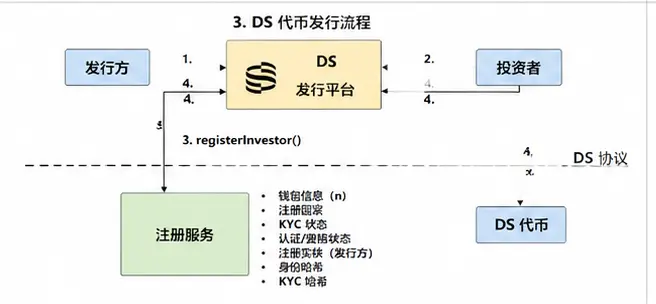
DS Protocol standardizes the digital securities issuance process, achieving full on-chain management from investor access, asset issuance to Token allocation. The issuer first creates the digital securities and sets the issuance parameters, then completes identity verification and KYC/AML checks for investors through the Registry Service, allowing only qualified addresses to participate. Once the issuance conditions are met, DS Tokens are minted and allocated to investors' wallets, while all investor information, holding records, and issuance statuses are updated in the protocol database, providing a unified data foundation for subsequent trading, dividends, and governance.
Unlike traditional securities issuance, which requires multiple institutions to separately complete registration, custody, and investor verification, DS Protocol unifies the issuance process under protocol management, forming a complete closed loop for identity verification, asset issuance, and holding registration, not only reducing issuance costs but also improving asset issuance efficiency and transparency. Additionally, since all securities are issued based on a unified standard, newly issued assets can directly access existing trading, governance, and corporate action modules of the protocol without needing to redevelop underlying functionalities.
- Dividend Mechanism
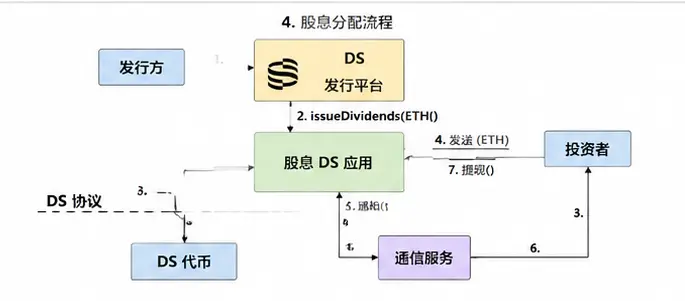
Dividend is one of the most important corporate action modules in DS Apps, designed to help issuers automatically distribute cash dividends or other earnings to holders. After creating a dividend plan, the system automatically calculates the dividend amounts each investor should receive based on the holding snapshot recorded in the Registry Service, and re-confirms investor qualifications through the Compliance Service to ensure that the dividend recipients meet regulatory requirements.
After the calculation is completed, the Dividend App sends the dividend results to the corresponding investors and issues notifications through the Comms Service. If investors can receive funds normally, the dividend is completed directly; if funds cannot be credited due to account status, payment failure, or other reasons, the system retains the unclaimed amounts, allowing investors to claim them later without affecting the dividend process for other investors. This design ensures the automatic execution of corporate actions while avoiding the inefficiencies of manual calculations and payments seen in traditional securities markets.
Compared to traditional listed companies that rely on registration agencies, banks, and payment systems to gradually complete dividends, DS Protocol integrates the entire process into the on-chain protocol, achieving an integrated approach to holding statistics, earnings calculations, payment management, and notification mechanisms, significantly enhancing the execution efficiency of corporate actions.
- Voting (Governance Voting)
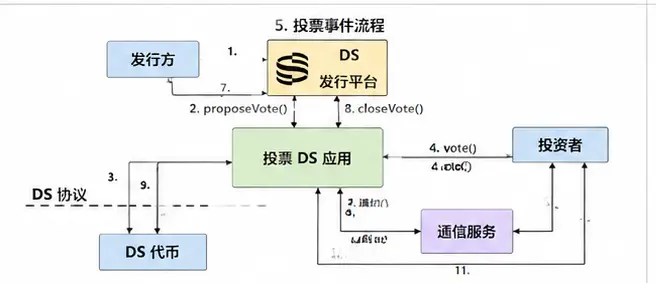
The Voting module is responsible for governance decisions made by digital securities holders, such as board elections, major issue votes, and fund governance. Issuers can create voting proposals and set voting times, participation conditions, and counting rules. The system automatically determines voting eligibility based on the investor identity information and holding data saved in the Registry Service, calculating corresponding voting weights based on holding quantities, achieving a shareholder voting mechanism consistent with traditional securities markets.
After voting concludes, DS Protocol automatically counts the results and synchronizes the final resolutions to the issuer and all investors. The entire process retains on-chain records, allowing for auditing and verification at any time, enhancing the transparency and credibility of the governance process. Since Voting is an independent DS App, issuers can expand new governance methods based on different types of securities in the future without modifying the underlying Token or redeploying the protocol.
By standardizing the governance process, DS Protocol not only reduces corporate governance costs but also enables digital securities to achieve more transparent and efficient on-chain governance, providing complete lifecycle management capabilities for institutional-level securities.
- Trading (Secondary Market Trading)
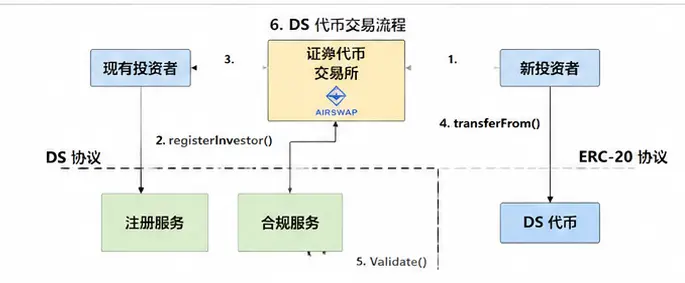
DS Protocol designs digital securities trading to be compatible with various market structures, supporting different trading modes such as peer-to-peer (P2P), decentralized exchanges (DEX), and centralized exchanges (CEX) while ensuring regulatory compliance. Regardless of how assets circulate, each transaction first undergoes identity and compliance verification through the Registry Service and Compliance Service, ensuring that both parties in the transaction meet investor qualifications, holding restrictions, and regulatory requirements. Only after verification will DS Tokens complete on-chain transfers. This design allows digital securities to maintain unified regulatory standards across different trading scenarios while enhancing asset liquidity.
In P2P trading, investors can directly complete asset transfers, with the protocol automatically verifying both parties' identities and trading qualifications. In DEX trading, DS Protocol links on-chain transactions with investor registration information in real-time through protocol interfaces, ensuring compliance with securities regulations in an open trading environment. For CEX scenarios, the protocol supports both independent wallet custody for investors and unified wallet custody by exchanges, allowing traditional centralized trading platforms to access the digital securities market at a lower cost while balancing asset management efficiency and regulatory requirements.
Compared to traditional securities markets that rely on brokers, registration agencies, and clearing institutions to complete transaction confirmations, DS Protocol integrates identity authentication, transaction verification, and asset settlement into a unified on-chain protocol, achieving standardized circulation of digital securities across different markets while maintaining complete auditability and regulatory compatibility.
Regulatory Compatibility and Protocol Expansion
- Harbor R-Token Compatibility
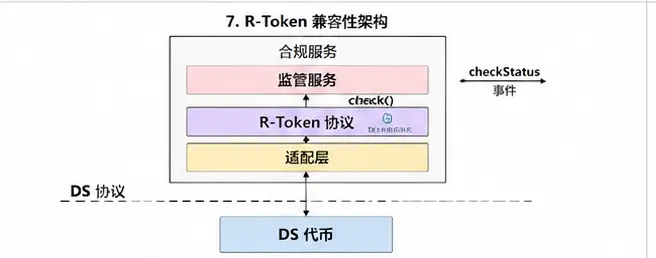
From the outset, DS Protocol was designed with the evolving standards of digital securities in mind, thus providing a protocol compatibility layer (Adaptation Layer) that can accommodate other mainstream Security Token standards. For Harbor R-Token, DS Protocol maps Harbor's compliance verification logic to its own Compliance Service through adaptation interfaces, allowing existing assets to access DS Protocol's identity management, lifecycle management, and corporate action systems without needing to reissue. This approach reduces the costs of migrating historical assets and enhances interoperability between different digital securities ecosystems.
- Polymath ST-20 Compatibility
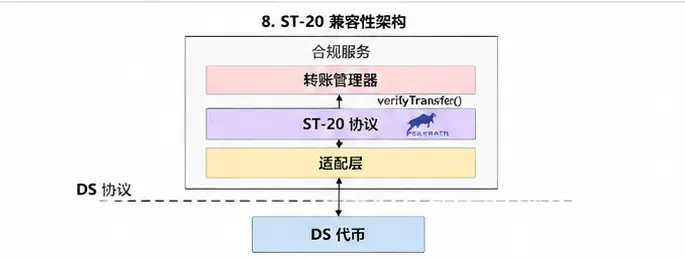
In addition to Harbor, DS Protocol is also compatible with the Polymath ST-20 standard. The protocol provides a unified encapsulation of interfaces such as verifyTransfer() for ST-20 through the adaptation layer, allowing ST-20 Tokens to call DS Protocol's registration, compliance, and lifecycle services without modifying the underlying asset contracts. Through this compatibility mechanism, DS Protocol can integrate existing digital securities ecosystems and reserve expansion space for supporting more industry standards in the future, avoiding the need for asset reissuance due to regulatory policy or technical standard changes, thus achieving a more long-term, open, and sustainable digital securities infrastructure.
Exchange Integration
DS Protocol offers a standardized access solution for exchanges, allowing centralized exchanges to support digital securities trading without altering their existing trading systems. After obtaining authorization through the Trust Service, exchanges can access the Registry Service to query investor identities and call the Compliance Service for real-time qualification verification for each transaction, ensuring that both parties in the transaction consistently meet securities regulatory requirements. This entire process eliminates the need for exchanges to maintain independent KYC databases, significantly reducing the costs of launching and operating digital securities.
At the same time, the protocol supports two access modes: independent wallets for investors and unified custody wallets by exchanges, allowing exchanges to choose different custody methods based on business needs and interact with the protocol through a unified API for account opening, trading, asset transfers, and corporate action synchronization management. For issuers, this standardized interface can quickly connect multiple trading platforms, enhancing the liquidity of digital securities; for exchanges, it allows them to expand digital securities services while maintaining their existing business structure, forming a more open and regulatory-compliant on-chain capital market ecosystem.
TSSO (Trusted Single Source Oracle)
TSSO (Trusted Single Source Oracle) is a single data source oracle solution for RWA (real-world assets) and private fund net asset value (NAV) proposed jointly by Securitize and RedStone. Targeting traditional oracles that rely on multiple data sources for aggregation, which are difficult to apply to assets like private funds that only have a single authoritative data source, TSSO introduces cryptographic verification mechanisms to ensure the authenticity, integrity, and verifiability of on-chain NAV data while maintaining a unique data source.
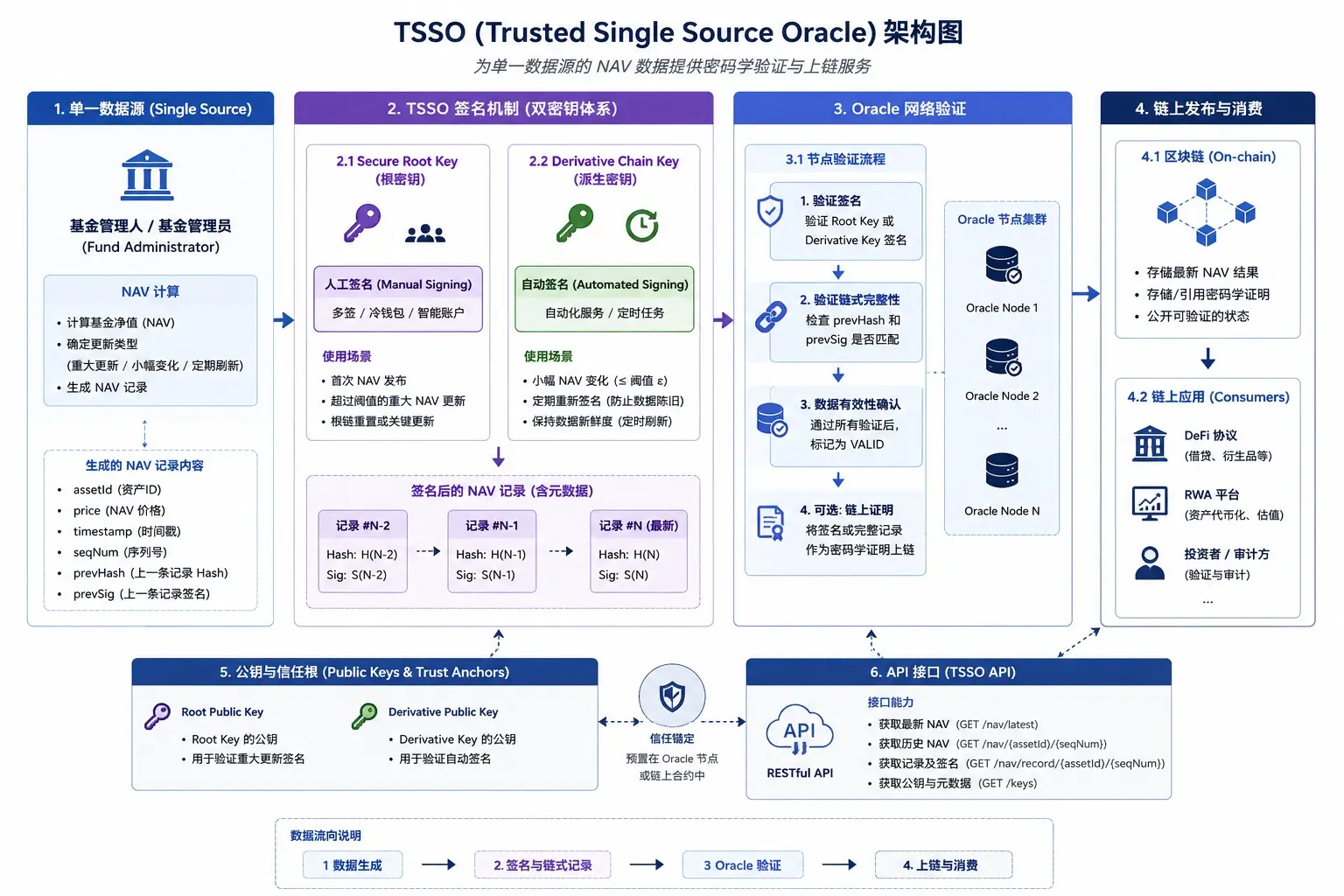
The overall architecture revolves around "trusted single data source + cryptographic signatures + oracle verification," with fund managers providing unique NAV data, completing data authentication through a dual-key signature mechanism, and then having the Oracle network verify and synchronize it to the blockchain. Compared to traditional price oracles that rely on multiple price sources for cross-verification, TSSO is more suitable for RWA scenarios such as fund shares and private assets that cannot aggregate market prices, providing a more secure and standardized price infrastructure for institutional-level asset on-chain.
- Core Mechanism of TSSO
The core innovation of TSSO lies in the use of a dual-key (Dual-Key) signature system that combines manual approval with automatic updates, enhancing data update efficiency while ensuring security.
The Secure Root Key is responsible for significant NAV updates or initial price releases and can be authorized through multi-signature, cold wallets, or smart accounts to ensure that critical data has the highest security level. The Derivative Chain Key is responsible for minor NAV changes within preset thresholds and periodic data refreshes, achieving automated updates, avoiding frequent manual signatures, and improving Oracle update efficiency.
Each NAV data entry not only includes asset ID, price, timestamp, and serial number but also records the hash and signature of the previous record, forming a continuous cryptographic data chain (Cryptographic Chain). Thus, each new data entry references the information of the previous entry, and any tampering with historical records will invalidate the entire data chain, ensuring that NAV data remains immutable and traceable.
- Derivation Signing Mechanism
The derivation signing mechanism primarily addresses the issues of automatic updates and data freshness. The protocol sets a price change threshold, and when the latest NAV does not exceed this threshold compared to the most recent Root Key-signed price, the Derivative Key can automatically sign without requiring manual approval, significantly reducing operational costs while ensuring that minor price fluctuations are promptly synchronized to the blockchain.
Moreover, even if the NAV has not changed, the Derivative Key will still re-sign the latest NAV data at fixed time intervals to prove that the current price remains valid, preventing the Oracle from being deemed outdated due to long periods without updates. This mechanism ensures that on-chain NAV remains up-to-date while reducing manual intervention and improving the usability of institutional assets in DeFi.
- Oracle Verification Mechanism
TSSO provides the signed NAV data along with the signature, public key, and historical records to the Oracle network, where each Oracle node independently completes data verification without relying on centralized trust. Each node first verifies whether the digital signature of the Root Key or Derivative Key is valid, then checks whether the current record correctly references the hash and signature of the previous record, confirming that the entire data chain has not been tampered with. Only data that passes both signature verification and chain integrity verification can be pushed to the blockchain as valid NAV.
On this basis, the Oracle can also choose to publish the received signatures or complete NAV records on-chain as cryptographic attestations, allowing asset issuers and other participants to further verify whether the on-chain data is entirely consistent with the original off-chain data. At the same time, the protocol supports limiting the visibility of proof information based on business needs, balancing data reliability with the privacy requirements of institutional assets. This verification mechanism ensures that a single data source not only has a trustworthy origin but also possesses continuous verifiability and traceability capabilities on-chain.
- Algorithmic Implementation
The algorithmic implementation of TSSO revolves around signing and verification. In the signing phase, the system first reads the hash and signature of the previous NAV record and combines them with the asset ID, NAV price, timestamp, and serial number to form a new signature message. It then selects the corresponding key based on the update type: significant or initial NAV updates use the Root Key for signing, while minor price changes use the Derivative Key for automatic signing, forming a continuous cryptographic data chain that ensures each record is immutably linked to historical data.
In the verification phase, Oracle nodes reconstruct the signature message based on the current record, checking whether the hash and signature of the previous record are consistent, and verifying the digital signature's legality using either the Root Public Key or Derivative Public Key. When both chain integrity and signature verification pass, the record is deemed VALID; otherwise, it is marked as INVALID. Additionally, TSSO provides a standardized REST API for querying historical NAV by asset ID and serial number, as well as obtaining the latest NAV data, enabling DeFi protocols to quickly access and verify current and historical net asset value information, providing a unified data interface for RWA price referencing, auditing, and asset management on-chain.
Tron Comments
Securitize's advantage lies in its construction of a comprehensive lifecycle infrastructure covering digital securities issuance, investor management, compliance verification, corporate action management, and secondary circulation. Through the modular architecture of DS Token, DS Services, and DS Apps, it decouples identity authentication, compliance management, and business logic, ensuring strong scalability and compatibility while meeting regulatory requirements. It supports various digital securities standards such as Harbor and Polymath, providing mature RWA and digital securities issuance capabilities for institutions like BlackRock and Apollo, making it one of the most complete infrastructures in the current institutional asset tokenization field.
Its disadvantage is that the platform is highly oriented towards the compliant securities market, with strong reliance on KYC/AML, regulatory approvals, and issuance qualifications, resulting in relatively limited openness. Additionally, the overall architecture involves multiple modules such as registration, trust, compliance, and communication, leading to higher system complexity and relatively larger deployment and operational costs, with a strong dependence on the maturity of traditional financial institutions and regulatory environments.
# II. Industry Data Analysis
1. Overall Market Performance
1.1. Spot BTC vs ETH Price Trends
BTC
ETH
# III. Macroeconomic Data Review and Key Data Release Points for Next Week
I. Macroeconomic Data Review for This Week | August 24 - August 30
The U.S. second-quarter GDP second estimate remains at 1.5%, indicating a clear slowdown in economic growth. On August 26, the U.S. BEA released the second estimate of second-quarter GDP, with actual GDP annualized quarterly growth at 1.5%, consistent with the initial estimate and significantly lower than the first quarter's 2.1%. Structurally, consumption, exports, and investment still contributed positively, but a decline in government spending created a drag; notably, private domestic final sales growth was revised up from the initial estimate of 3.9% to 4.2%, indicating that private sector domestic demand still has some resilience. During the same period, real GDI grew by 2.2%, and corporate profits increased by approximately $400.9 billion.
U.S. PCE inflation has re-emerged, becoming the most important macro signal of the week. Also released on August 26, July PCE price index rose by 0.2% month-on-month and 3.7% year-on-year; core PCE rose by 0.2% month-on-month and 3.3% year-on-year. Meanwhile, personal income grew by 0.4% month-on-month, disposable personal income grew by 0.5%, nominal personal consumption expenditures only grew by 0.2%, and real PCE remained flat, with the personal savings rate dropping to 3.0%. This indicates that the current U.S. economy presents a clear combination of "growth cooling but inflation still high," constraining the Federal Reserve's short-term policy space.
Internal inflation data for the second quarter has also been further revised up. The second estimate of GDP shows that the overall PCE price index in the second quarter annualized rose by 5.3%, revised up by 0.2 percentage points from the previous estimate; core PCE annualized rose by 3.6%, also revised up by 0.2 percentage points; the domestic purchase price index reached 5.8%. Therefore, the core of this week's data is not whether GDP has been significantly revised but rather reconfirms that the U.S. economy is slowing while price pressures have not completely dissipated.
II. Key Data Points for Next Week | August 31 - September 6
Next week's market focus will rapidly shift from "inflation + GDP" to "the job market." The most important data will be the U.S. July JOLTS job openings data on September 1 and the U.S. August non-farm payroll report on September 4; the latter will also announce new non-farm employment, unemployment rate, and average hourly earnings, serving as the core basis for judging whether the U.S. labor market is further cooling. Since the next FOMC interest rate decision will be held on September 15-16, the employment report on September 4 will become one of the most critical data sets before the meeting.
Additionally, on September 3, the U.S. will release July international trade data, with the BEA's official schedule confirming the release time as 8:30 AM Eastern Time; manufacturing and services PMI/ISM and other high-frequency economic indicators are also worth closely observing, as they will help assess whether U.S. corporate activity further weakens at the beginning of the third quarter.
Core Judgment: The macro main line from August 24 to August 30 can be summarized as "U.S. growth slowing, but inflation stickiness re-emerges as a constraint" ------ Q2 GDP grew only by 1.5%, but July PCE year-on-year reached 3.7%, and core PCE reached 3.3%, preventing the market from forming strong easing expectations solely based on economic slowdown. Next week's biggest variable will shift to the U.S. job market, especially the non-farm data on September 4: if employment and wages both cool significantly, it will strengthen subsequent rate cut expectations; conversely, if employment remains resilient, in the context of PCE still being high, the rationale for the Federal Reserve to maintain a cautious stance will further strengthen.
# IV. Regulatory Policies
United States | August 24, August 25-26
The U.S. regulatory focus has two main points: first, the Treasury Department on August 24 further expanded the scope of sanctions on digital asset activities related to Iran, targeting behaviors that utilize crypto assets to assist oil revenue and cross-border capital flows, indicating that U.S. regulation of crypto assets has further extended into sanctions enforcement and national security. Second, the SEC on August 25 submitted a revision proposal for investment advisors and fund digital asset custody rules for review by the White House OMB, which was publicly reported on August 26; this proposal aims to clarify how institutions can compliantly custody client crypto assets, marking an important advancement in U.S. institutional-level crypto custody regulation.
United Kingdom | August 24, August 27
The UK's FCA updated the transitional arrangements for the new crypto regulatory regime on August 24, clarifying that existing crypto businesses that fail to obtain authorization under the new regime in a timely manner may conduct an orderly exit under certain conditions, further preparing for the future implementation of comprehensive regulation. Subsequently, on August 27, the UK government announced plans to grant the Bank of England a new "payment innovation" secondary objective, explicitly covering payment systems using stablecoins and other digital settlement assets, while requiring the regulatory framework to more actively support innovations in digital currencies and new payment infrastructure while maintaining financial stability as a priority.
Thailand | August 24, August 25
Thailand is one of the markets in Asia with the clearest regulatory actions this week. On August 24, the Thai SEC officially solicited opinions on the local Crypto ETF regulatory framework, initially proposing to allow ETFs to primarily invest in Bitcoin and Ethereum, and requiring funds to mainly use digital asset custodians regulated by the Thai SEC, while setting qualification standards for foreign digital asset custodians. On August 25, the Thai cabinet further approved four capital market law drafts, including amendments to laws related to digital asset businesses, covering the development of the digital capital market, regulation of digital asset operations, and enforcement efficiency, indicating that Thailand is simultaneously advancing "Crypto ETF product opening + digital asset regulatory system upgrades."
Japan | August 26
In Japan, the important direction this week is the on-chain transformation of the securities market. Reports indicate that relevant agencies in Japan plan to initiate the construction of a blockchain-based stock and bond settlement system, with specific institutional designs expected to be clarified by 2027. This is not merely a relaxation of crypto trading regulations but a formal advancement of blockchain technology into traditional securities issuance, trading, and settlement infrastructure, marking an important signal of Japan's digital asset policy expanding from "crypto asset regulation" to "tokenization of traditional financial assets."
Pakistan | This week entered the actual implementation period of the crypto licensing system
The Pakistan Virtual Assets Regulatory Authority has launched a licensing system for crypto businesses under the Virtual Assets Act 2026, requiring qualified existing operators to apply for a No-Objection Certificate. The regulatory scope covers various virtual asset businesses, including exchanges, custody, and stablecoins. Although the licensing portal itself opened on August 22, slightly earlier than this week's starting point, it does not strictly count as a new policy after August 24. However, from August 24, the system entered the actual implementation and industry集中申报阶段, making it a noteworthy regulatory event this week.
 Risk warning


Popular articles