Tron Industry Weekly Report: Non-Farm Payrolls Lean Hawkish but CPI Will Determine Whether BTC Can Hold Steady at 80,000, Detailed Explanation of Building Digital Content and IP Assetization of KOR Protocol

 The total funding of 7.5 million USD was led by 1k(x) and Blockchain Capital for the KOR Protocol, which builds global digital content and IP assetization.
I. Outlook
1. Summary of Macroeconomic Aspects and Future Predictions
From August 31 to September 6, 2026, the global macroeconomic focus shifted from "growth resilience" to "inflation pressure and risks of monetary policy tightening." In August, the U.S. non-farm payrolls added 162,000 jobs, the unemployment rate remained at 4.1%, and average hourly wages increased by 3.1% year-on-year; the ISM PMI for manufacturing and services reached 54.6 and 55.4, respectively, indicating that economic activity is still in an expansion phase, reducing the necessity for short-term easing by the Federal Reserve and prompting the market to raise expectations for a rate hike in September. The inflation rate in the Eurozone rose from 2.9% in July to 3.3% in August, mainly driven by rising energy prices. Although the core inflation rate slightly fell to 2.4%, overall inflation pressure remains significant.
From September 7 to 13, 2026, market focus will be on the U.S. August PPI, CPI, and the European Central Bank's interest rate decision. The market expects the U.S. overall CPI year-on-year to remain around 3.4%, while the core CPI may drop from 2.5% to 2.4%; if actual inflation exceeds expectations, especially if energy price increases begin to transmit to core goods and services, the probability of a rate hike by the Federal Reserve in September may further increase, supporting U.S. Treasury yields and the dollar, while global stocks, gold, and crypto assets may come under pressure. Conversely, if core inflation is significantly lower than expected, the market may reconsider the likelihood of rates remaining unchanged. Following the rise in Eurozone inflation to 3.3%, the European Central Bank is likely to raise rates by 25 basis points to 2.5% and maintain a hawkish guidance. Overall, the global market in the coming week will be in a high-volatility environment characterized by "growth not yet stalling, inflation risks rising, and easing expectations retreating."
2. Market Changes and Warnings in the Crypto Industry
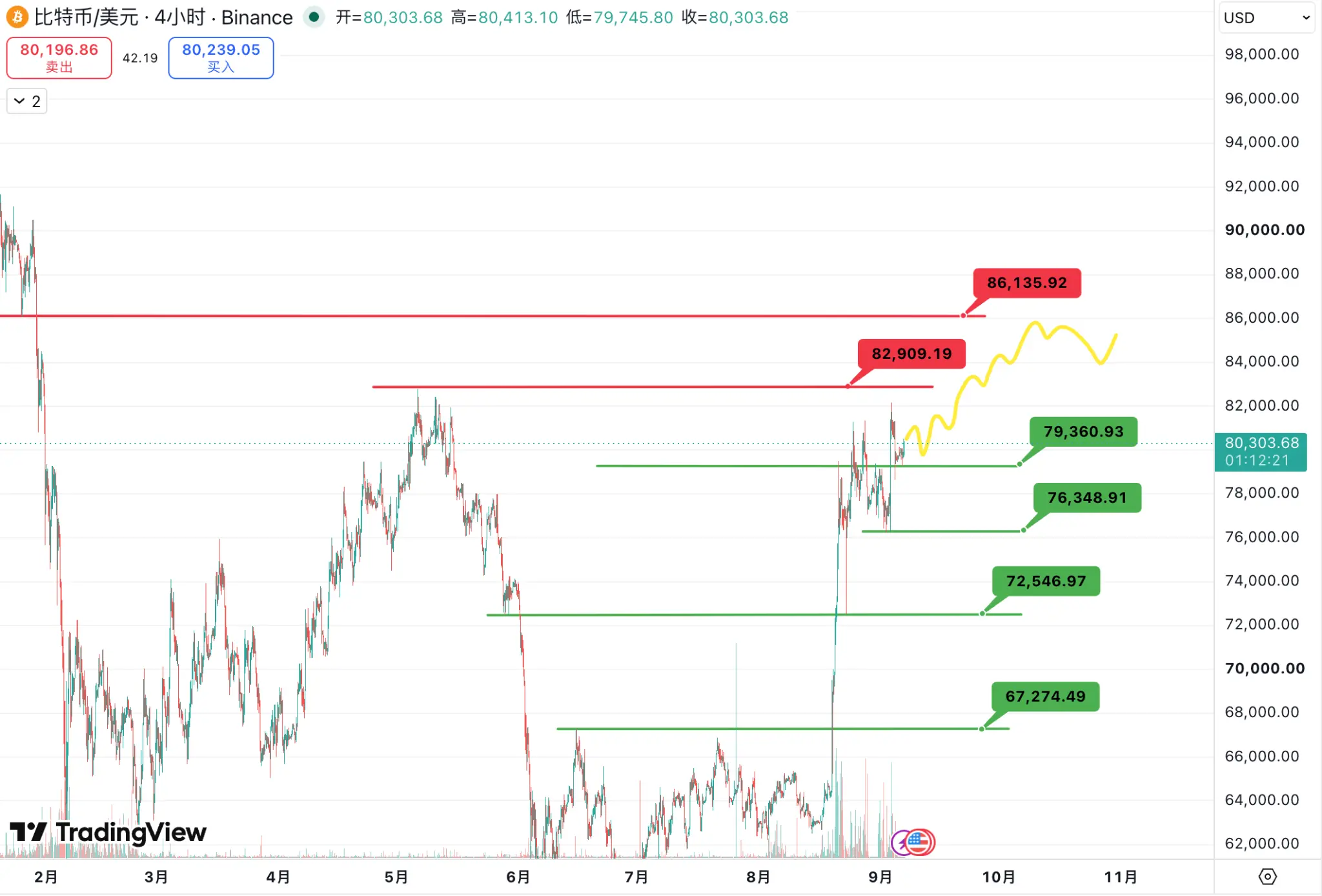
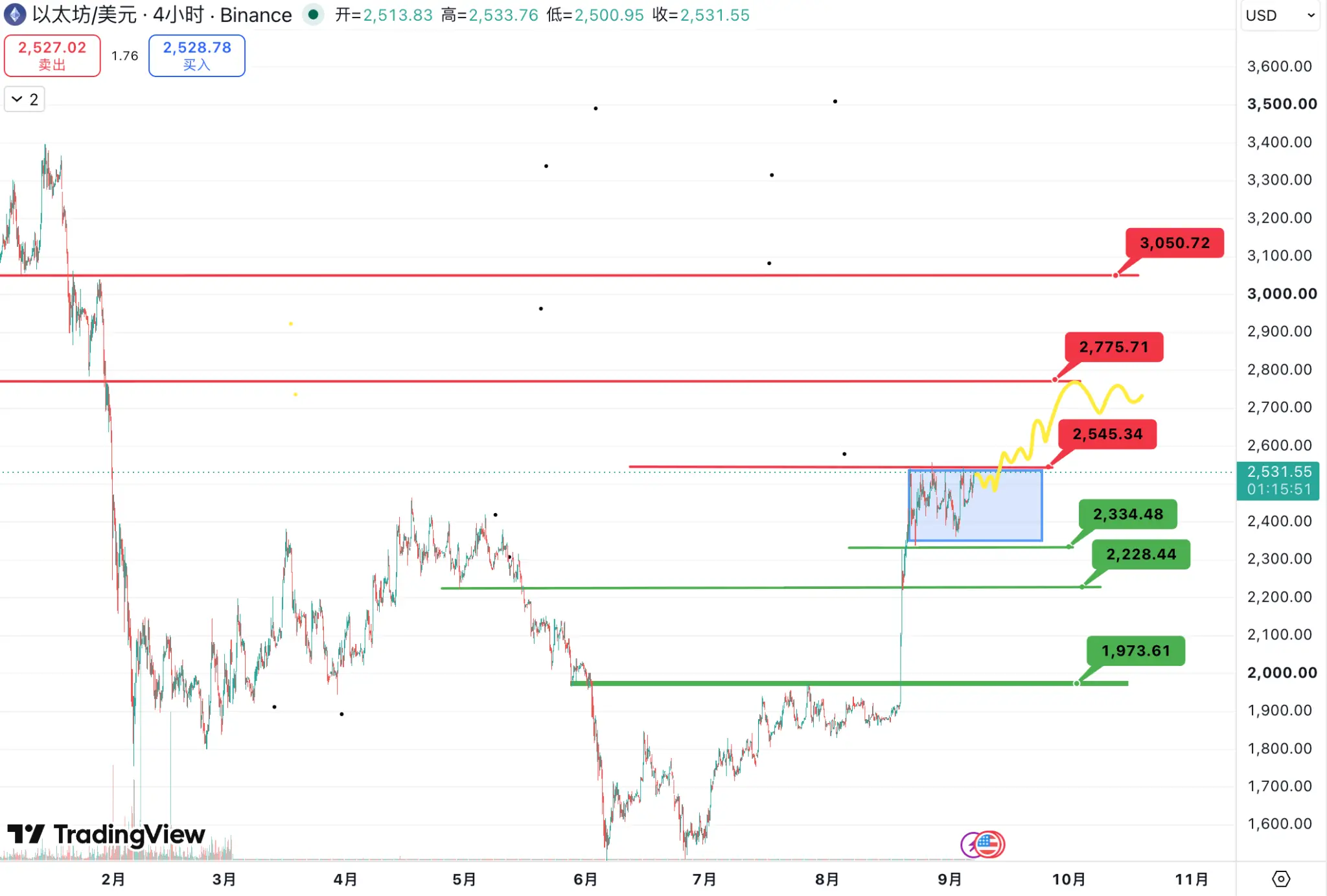
From August 31 to September 6, 2026, the crypto market exhibited a pattern of initial weakness followed by strength, with fluctuations. BTC closed at approximately $78,570 on August 31, dipped to a weekly low of about $76,300 on September 1-2, and then surged to around $82,180 on September 3 due to dovish statements from Federal Reserve officials and short covering, reaching a multi-month high; however, after the U.S. added 162,000 non-farm jobs in August, significantly above expectations, the market raised the probability of a rate hike in September, leading to a strengthening of U.S. Treasury yields and the dollar, causing BTC to retreat and stabilize around $79,500-$80,000 over the weekend, resulting in a roughly 1.7% increase for the week compared to August 31. ETH experienced even greater volatility during the same period, with a low of about $2,358 and a high of around $2,546 on September 3-4, returning to the range of approximately $2,490-$2,515 on September 6, showing a slight increase from about $2,468 on August 31; the total market capitalization briefly reached about $2.82 trillion mid-week before falling below $2.8 trillion. Structurally, funds have not fully exited risk assets, with ZEC rising nearly 40% during the week, and some mainstream altcoins like BNB, XMR, and ADA also recording significant gains, indicating that there are still strong structural trading opportunities in the market. However, BTC's failure to maintain above $82,000 suggests that macro rate expectations remain the biggest short-term suppressive factor.
Looking ahead to September 7-13, the market's core variable will focus on the U.S. August CPI on September 11. Following the strong non-farm payroll report, market expectations for a rate hike by the Federal Reserve on September 16 have risen to nearly 60%, so BTC is likely to continue to maintain a high volatility range this week: if CPI is below expectations and core inflation continues to decline, easing rate hike expectations, BTC may break above $80,000 again and test the previous high of $82,200; if it effectively stabilizes, there may be further room to expand towards $84,000-$85,000; conversely, if CPI is hotter than expected, with yields and the dollar continuing to rise, BTC will first focus on the support at $78,500-$79,000, and if that is lost, it may retest the $76,300-$77,000 area. ETH's short-term focus will be on the support at $2,435-$2,450 and the resistance at $2,525-$2,550, with further rebound potential only if it effectively breaks through. Overall, the judgment is that next week's market direction will still be dominated by macro data rather than purely on-chain narratives, likely maintaining range-bound fluctuations before the CPI announcement, with volatility significantly increasing after the data is released; until BTC stabilizes above $82,000, this week's rebound should not be directly viewed as the start of a new trend upward.
3. Industry and Sector Hotspots
From August 31 to September 6, the financing trend was very clear: funds have noticeably shifted from pure token narratives to stablecoins, payments, tokenized deposits, crypto banking, and institutional-level on-chain financial infrastructure. Felix Pago's $200 million comprehensive financing, Cari's $32.5 million bank capital, OpenReserve's $25 million seed funding, and Diameter Pay's $10 million Series A indicate that stablecoin + payment + banking is the most concentrated capital direction this week; meanwhile, Firelight represents DeFi risk infrastructure, GAEA represents AI × Crypto, and ParlayX represents prediction market infrastructure, showing that funds are still looking for crypto-native projects with clear practical application scenarios.
II. Market Hotspot Sectors and Potential Projects for the Week
1. Overview of Potential Projects
1.1. Analyzed total financing of $7.5 million, led by 1k(x) and Blockchain Capital, with participation from Republic, Sfermion, SevenX, and CAMP—building global digital content and IP asset infrastructure KOR Protocol
Introduction
KOR Protocol is an on-chain clearing platform for creative content and digital assets. It spans the entire process of a creative work from inception to commercialization, primarily responsible for three things: confirming the source and copyright ownership of the work, accurately matching the work to users in need, and helping all participants automatically complete revenue distribution and value settlement.
KOR Protocol is built on the Base network, using stablecoins as the native settlement asset, specifically designed for a future digital content ecosystem where AI agents can complete content authorization, purchase, and settlement at machine-level speed.
Brief Description of Protocol Mechanism
KOR Protocol is built around three core engines: Verify, Route, and Settle, and adopts a layered architecture of SDK → Backend → Blockchain. Developers interact with the backend through the SDK, which is responsible for generating and signing transactions, ultimately submitted on-chain by the user's wallet. This design encapsulates complex blockchain interactions in the backend, significantly reducing development and usage thresholds while ensuring user asset self-custody and on-chain security.
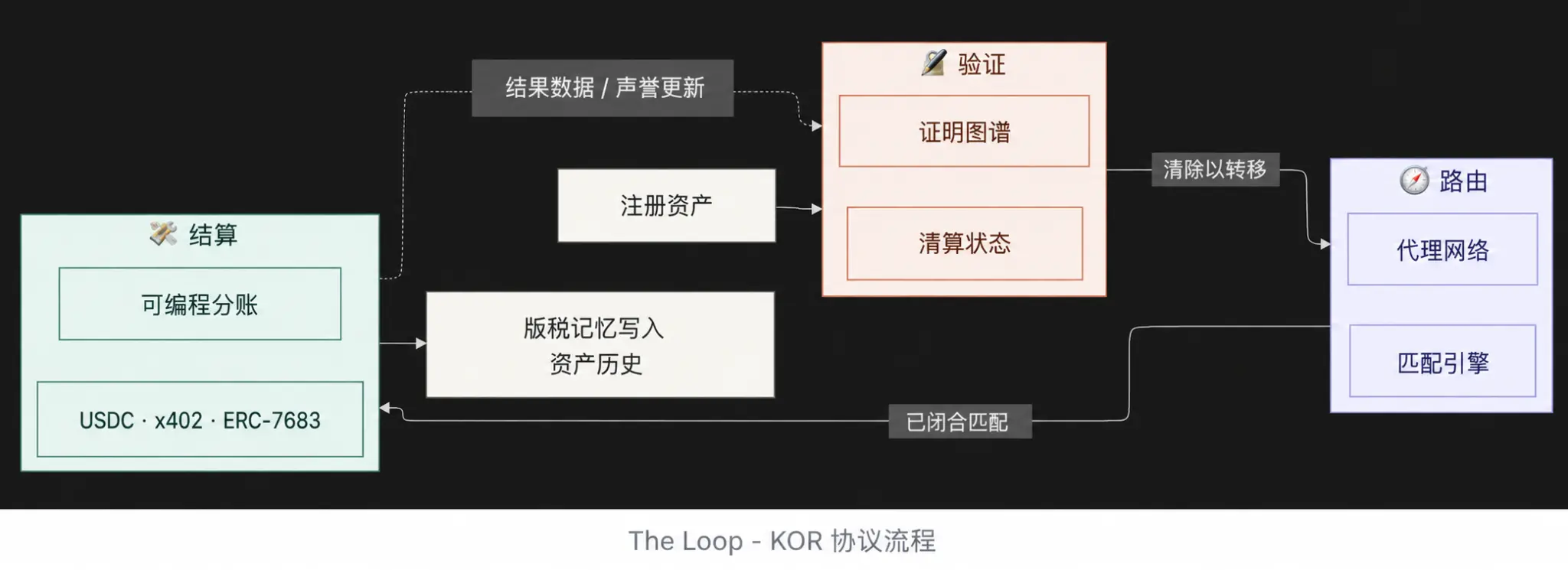
All operations of KOR Protocol follow a unified "Registration → Routing → Settlement → Feedback" closed-loop process.
Registration: Creators first register their works in the protocol, generating a unique on-chain identity identifier (Canonical ID) for the work, establishing copyright and ownership proof (Attestation Graph), and confirming copyright circulation (Clearance) based on the work's status.
Routing: Once the work is registered and meets authorization conditions, it can be accurately matched and distributed to potential users through the Route Engine, achieving content authorization and commercial cooperation. (This module is still under development.)
Settlement: Once an authorization transaction is reached, the Settle Layer automatically completes value settlement. All revenues are automatically split according to preset rules, paid in stablecoins, and all participants' revenue distribution is completed in one atomic on-chain transaction.
Feedback: After each settlement is completed, the protocol writes the transaction results back on-chain, continuously accumulating copyright and commercial history for the work, including transaction time, counterparties, authorization terms, and revenue records, forming a complete and traceable digital copyright asset file.
- Event Listener Service
The Event Listener Service is a core component of the KOR Protocol architecture, responsible for real-time monitoring and processing various on-chain events generated by the protocol's smart contracts. It ensures that all important blockchain events are captured, processed, and stored in a timely manner, facilitating subsequent data analysis, business calls, and system queries.
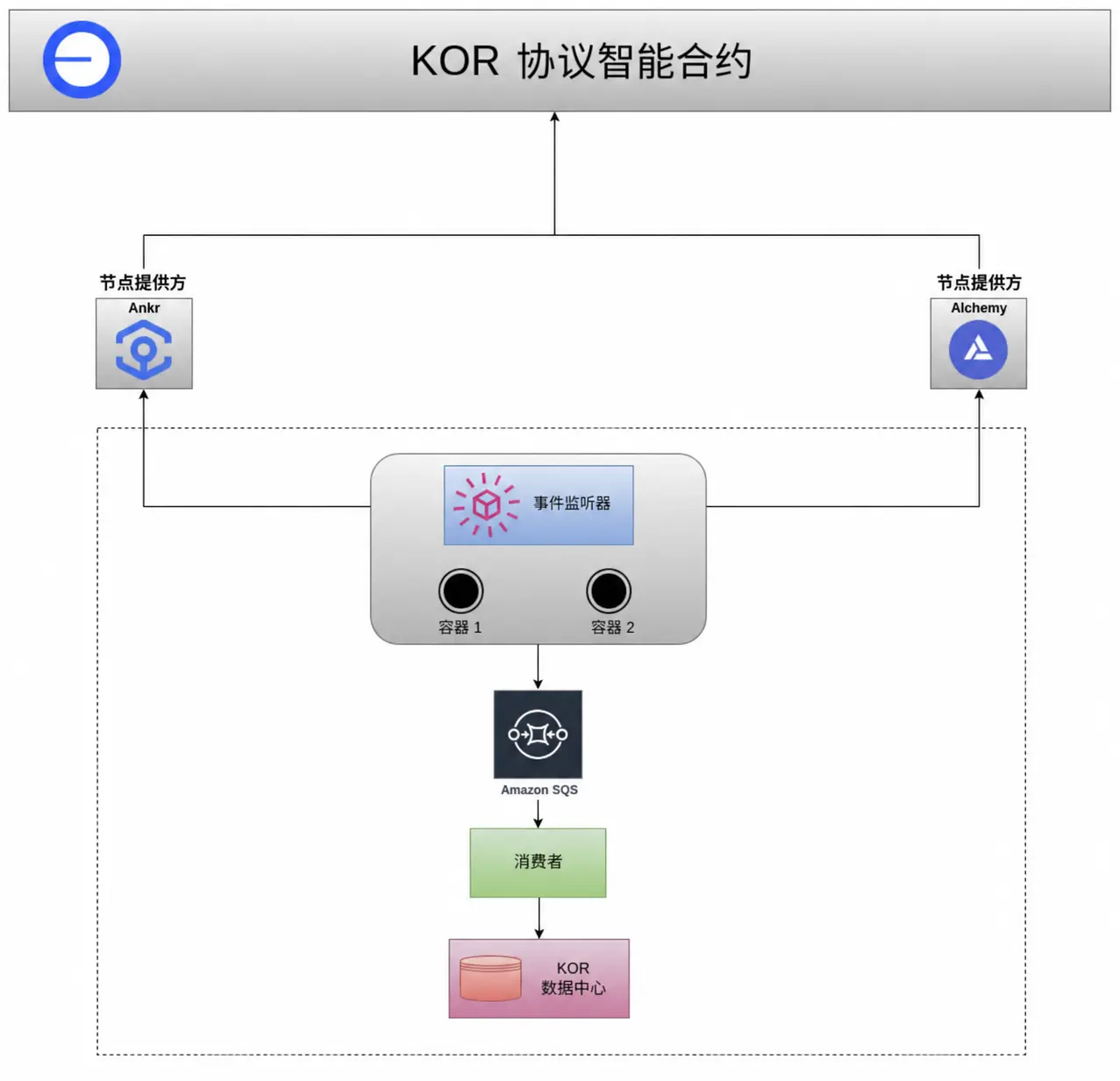
Overall Architecture (High-Level Architecture)
Connect RPC Nodes
The Event Listener Service connects to both Ankr and Alchemy RPC service providers, reliably accessing the Base/Ethereum network to continuously monitor various events generated by KOR Protocol smart contracts.
Event Listening
When KOR Protocol smart contracts trigger new on-chain events, the Event Listener Service detects the event immediately, ensuring that no important on-chain operations are missed.
Message Queue
Upon detecting an event, the system sends the event data to the AWS SQS (Simple Queue Service) message queue, separating "event listening" from "event processing." This design enhances the system's scalability and improves stability and fault tolerance in high-concurrency scenarios.
Event Processing Service
The Consumer Service reads event data from AWS SQS, parses, decodes it, and extracts the key information needed for business use, preparing it for subsequent system applications.
Data Storage
Processed event data is written to a database and indexed for storage. This allows for quick querying of historical events and provides efficient data support for data analysis, business presentations, and other applications.
- NFT Module
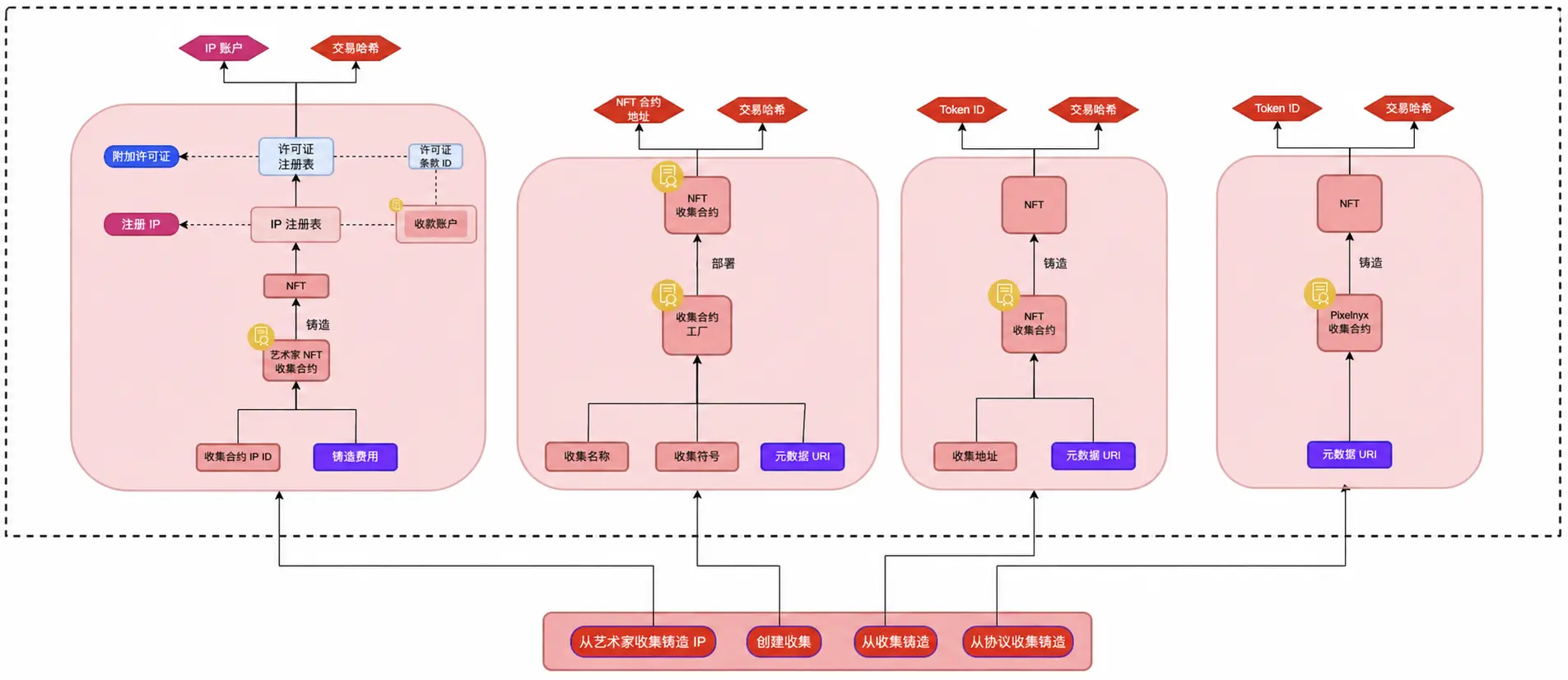
The NFT Module is the digital asset creation module of KOR Protocol, consisting of a series of smart contracts developed and extended based on various ERC standards, helping creators quickly complete the creation and management of NFTs and IP assets. Through this module, users can:
Create their own NFT Collection;
Mint NFTs from the NFT Collection and further register them as on-chain IP (Intellectual Property);
Create your own IP Collection (IP series);
Directly mint on-chain IP assets from the IP Collection;
Use the NFT contract provided by the protocol to directly mint NFTs.
Through a unified NFT and IP creation process, KOR integrates the confirmation of digital content, assetization, and subsequent commercialization into the same protocol.
Mint IP from the Collection
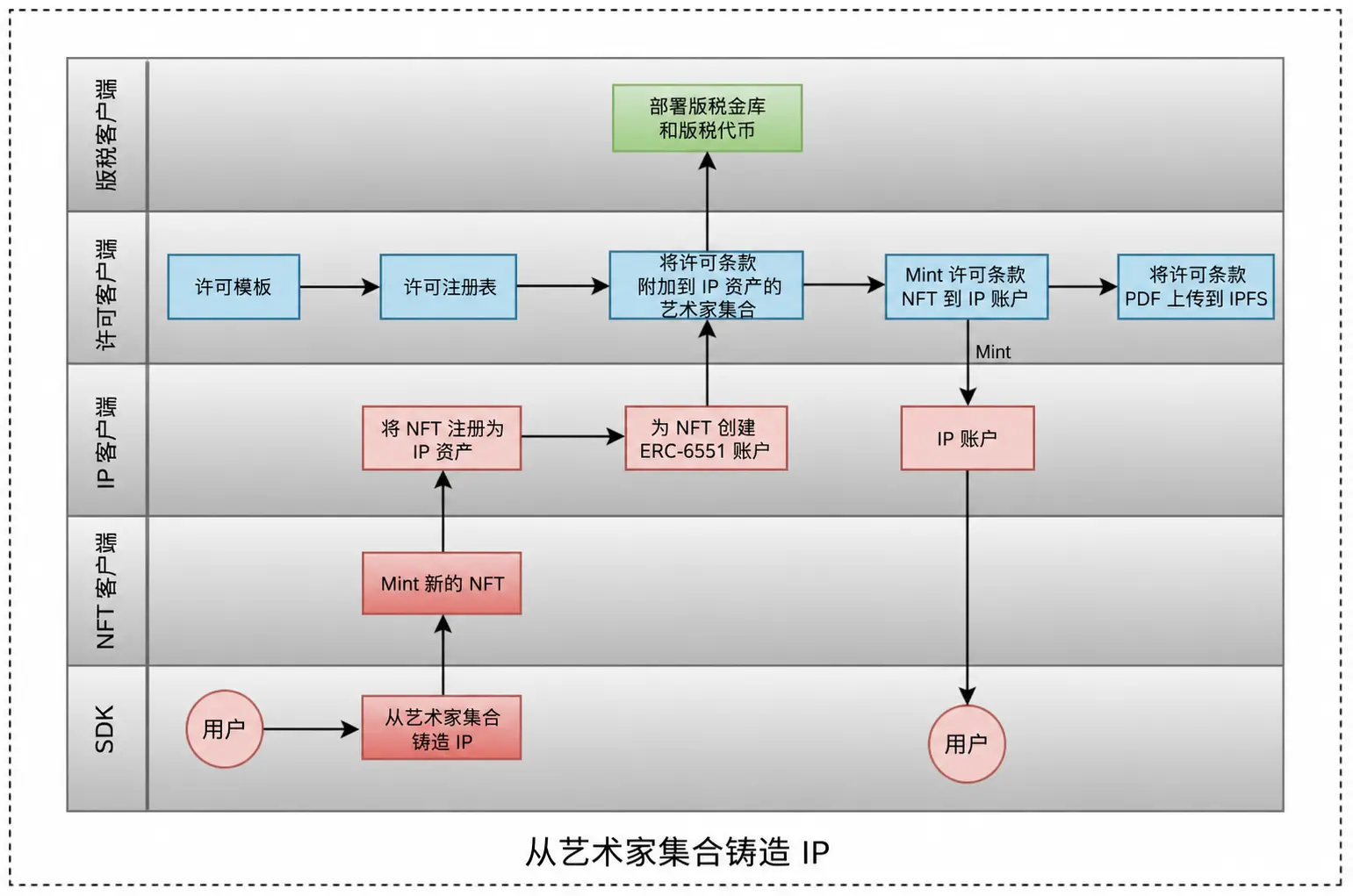
KOR supports users to directly mint complete IP assets from the creator's IP Collection without the need to manually complete NFT registration and license binding operations.
The entire process is automatically completed by the SDK: first, mint NFTs from the creator's Collection, then automatically register the NFTs as on-chain IP, followed by binding the License Terms preset by that Collection, and finally minting and sending the generated complete IP Asset to the user in one go. Compared to traditional processes that require multiple on-chain operations, this one-click IP minting significantly lowers the usage threshold for creators and developers and improves the efficiency of creating and circulating digital copyright assets.
- IP Module
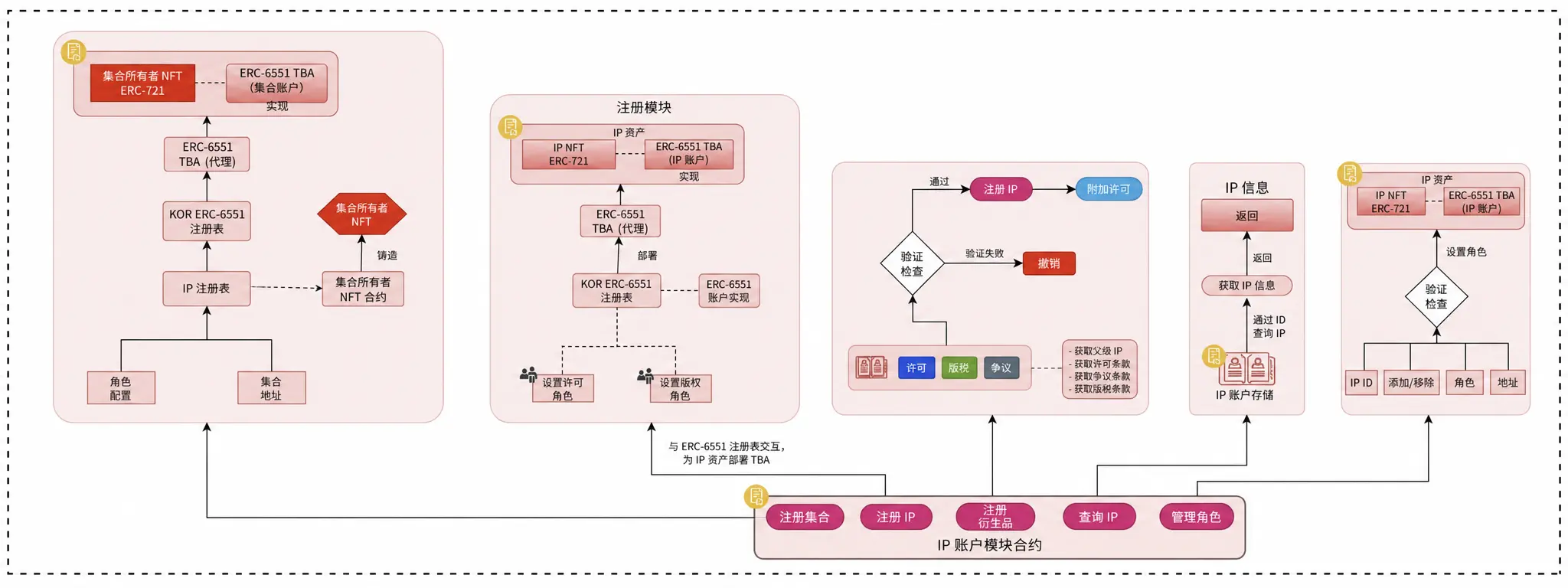
The IP Module is the core module responsible for IP (Intellectual Property) asset management in the KOR Protocol, mainly providing capabilities for IP registration, management, and lifecycle maintenance, including:
Registering NFTs as on-chain IP Assets;
Creating KOR Token Bound Accounts for NFTs (modified based on ERC-6551);
Managing role permissions for IP (such as copyright holders, licensees, etc.);
Registering derivative works (Derivative IP);
Querying and retrieving on-chain IP information;
Registering the entire NFT Collection as one IP.
Through this module, KOR upgrades NFTs from mere digital collectibles to on-chain IP assets with copyright, licensing, and commercialization capabilities.
Register IP Asset
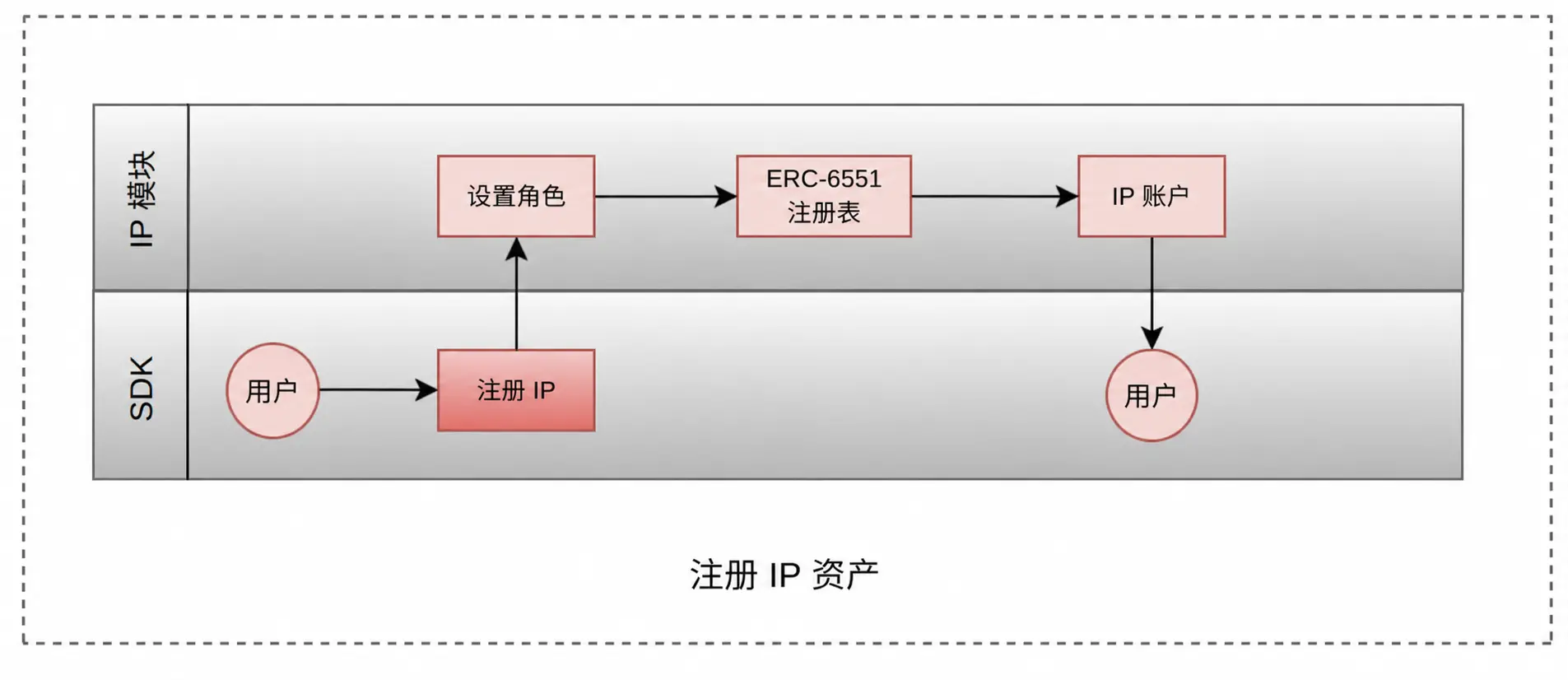
When users register an NFT as an IP Asset, the system first configures different role permissions for that IP, such as Copyright Role (copyright holder), Licensee Role (licensee), etc. Subsequently, the IP Registry creates a KOR Token Bound Account (modified based on ERC-6551) for that NFT, known as the IP Account. This account serves as the exclusive on-chain account for the IP, responsible for managing the authorization, revenue, transactions, and subsequent commercial activities of the work, ensuring that each IP has independent asset and permission management capabilities.
Register Collection as IP
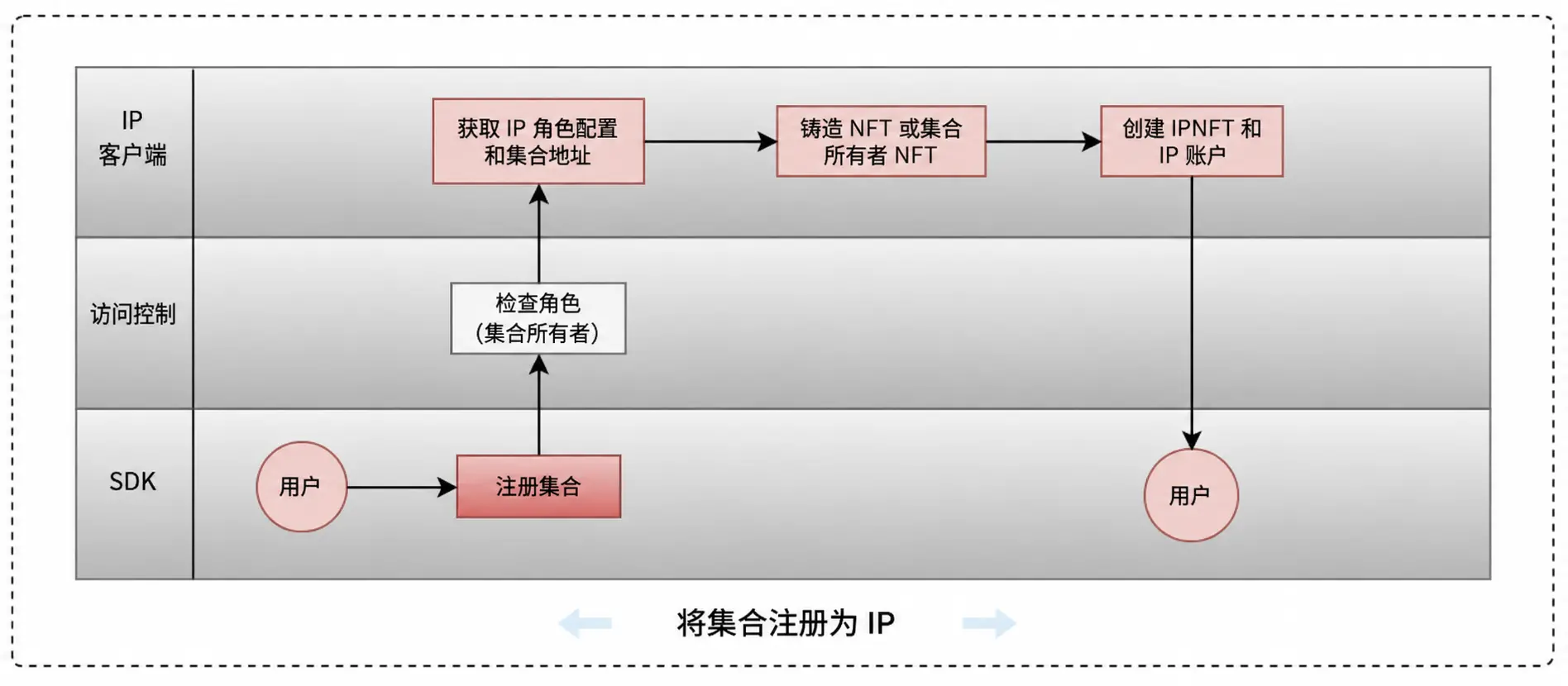
KOR also supports registering the entire NFT Collection as a unified IP, not just individual NFTs. During registration, users first need to configure the role permissions for that Collection, after which the SDK automatically mints an NFT representing the entire Collection for the creator and creates a KOR Token Bound Account (modified ERC-6551) based on that NFT, known as the Collection Account.
The Collection Account serves as a unified management account for the entire series of works, allowing centralized management of copyright, authorization rules, and commercialization logic for all works under that series, providing a unified entry point for subsequent bulk licensing, revenue distribution, and IP operations, and facilitating AI Agents and applications to directly call the entire IP series without managing individual works one by one.
- License Module
The License Module is the core module responsible for IP licensing and permission management in the KOR Protocol, used to manage the licensing rules and commercialization processes of IP, mainly providing the following functions:
Binding License Terms to IP Assets;
Binding unified License Terms to IP Collections;
Minting License Tokens for creating derivative works;
Registering new License Terms (license agreement templates);
Minting License Terms NFTs;
Calling the Royalty Module to deploy Royalty Vaults and Royalty Tokens;
Automatically generating and uploading License Terms PDFs to IPFS for permanent storage.
The License Module integrates licensing agreements, copyright management, and revenue distribution into a unified process, making IP licensing and commercialization more standardized and automated.
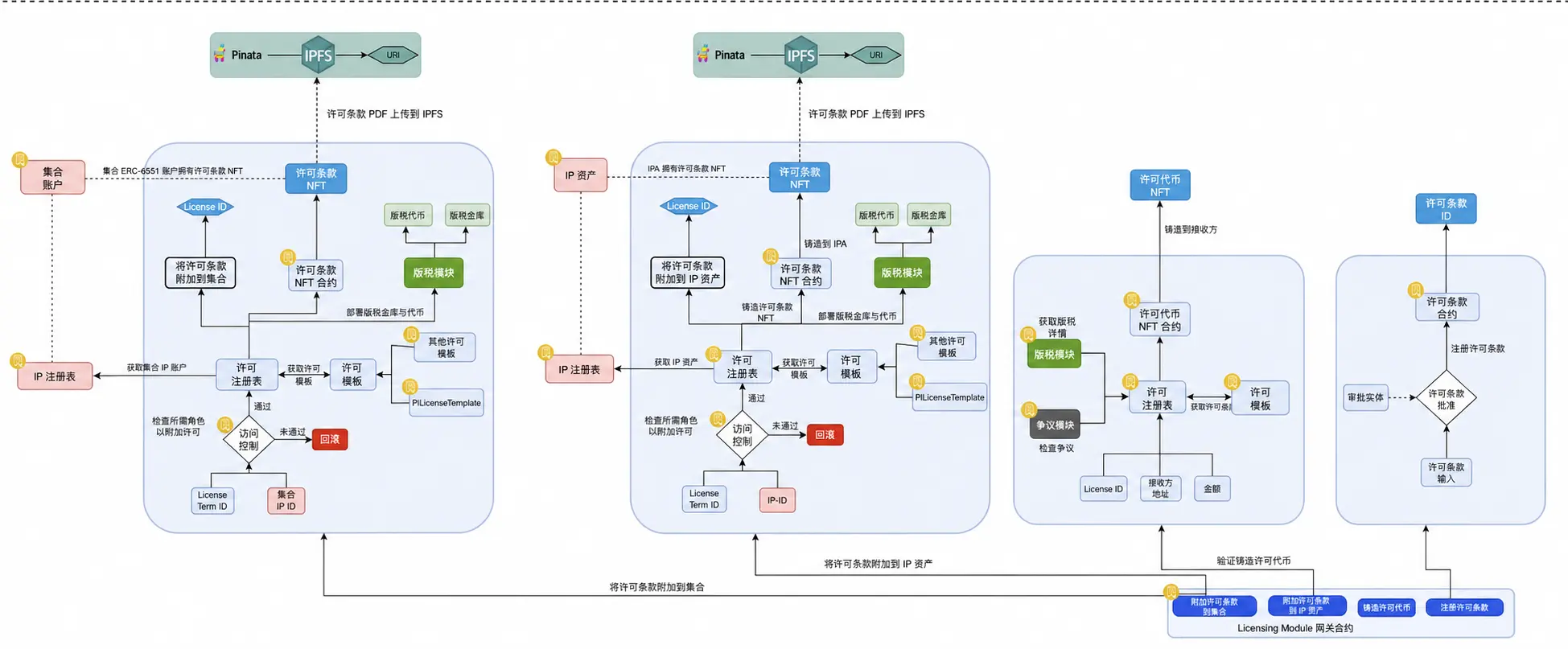
Attach License to IP
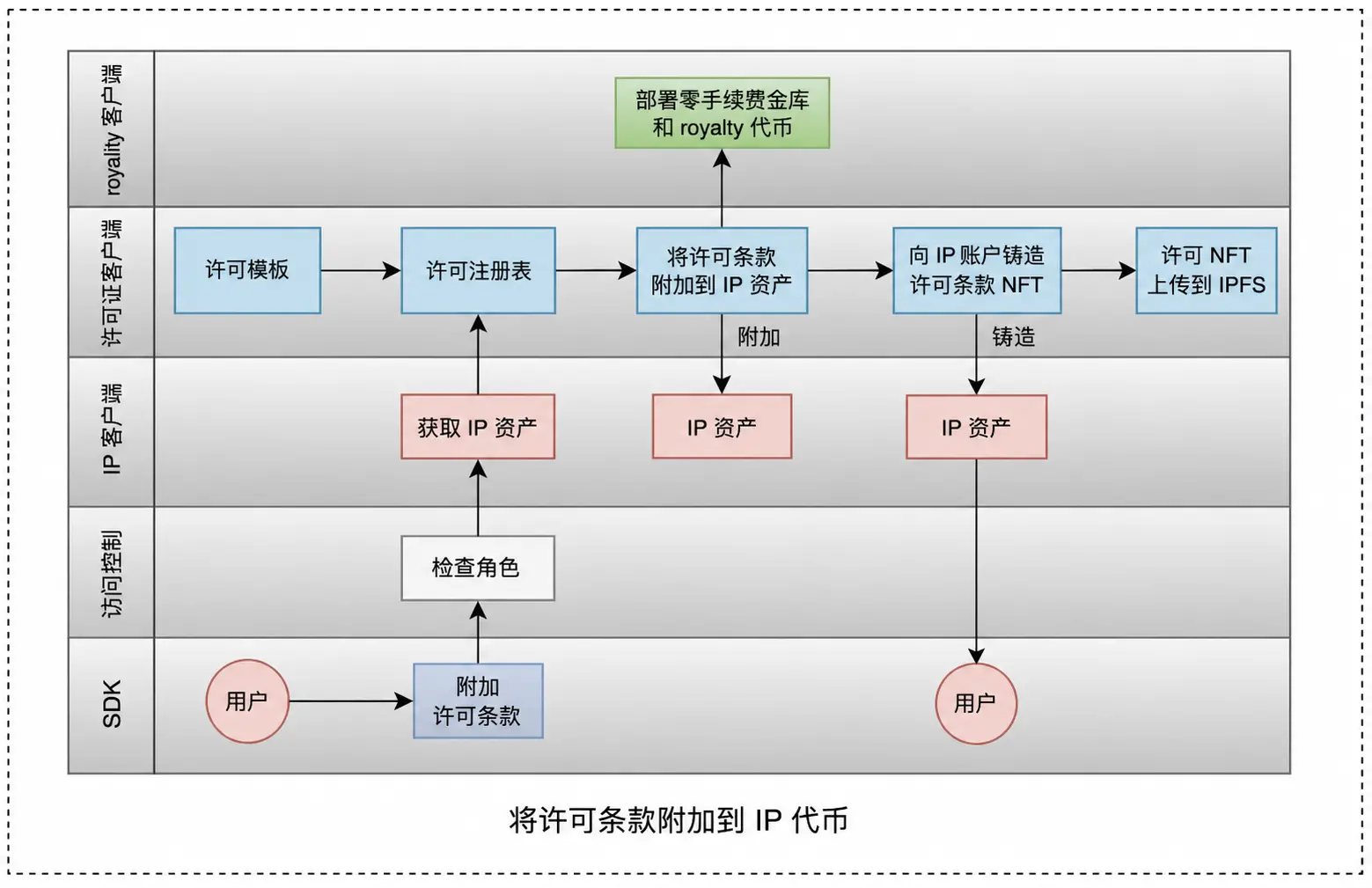
When binding License Terms to an IP Asset, the SDK first verifies whether the operator has the corresponding permissions. Upon successful verification, the License Registry binds the corresponding licensing agreement to that IP Account based on the input License Term ID and automatically mints a License Terms NFT as on-chain authorization proof.
Subsequently, the system automatically generates the PDF of the licensing agreement and uploads it to IPFS for permanent storage. Once the licensing agreement is successfully bound, the License Registry calls the Royalty Module to automatically deploy the Royalty Vault and Royalty Token for that IP, preparing for subsequent royalty distribution and revenue settlement, achieving an integrated process of authorization, proof, and revenue management.
Attach License to Collection
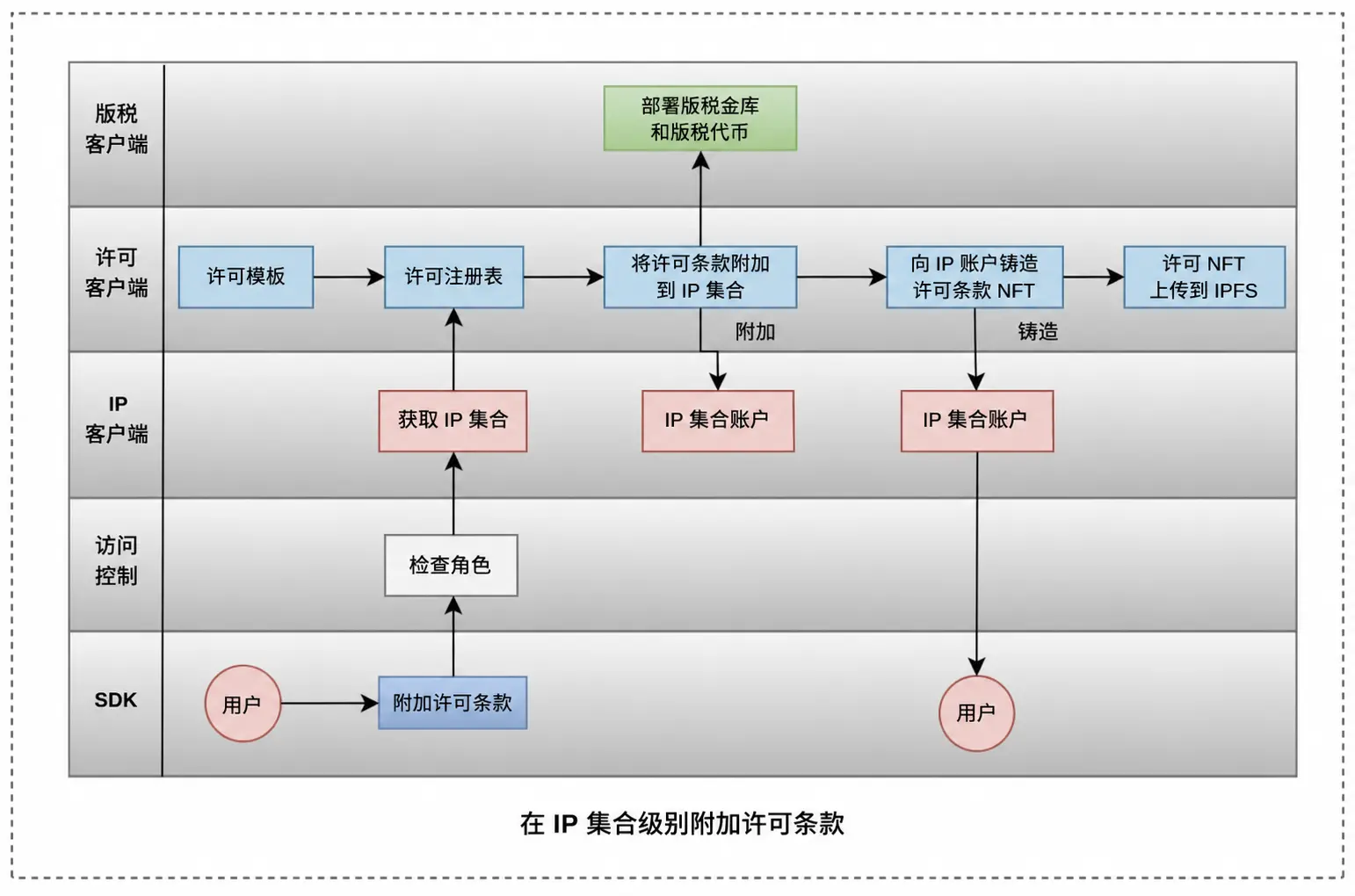
KOR also supports uniformly binding License Terms to the entire IP Collection. The entire process is basically consistent with that of a single IP: the SDK first verifies user permissions, then the License Registry binds the specified License Term ID to the Collection Account and automatically mints the corresponding License Terms NFT.
The system then generates the licensing agreement PDF and uploads it to IPFS, while automatically calling the Royalty Module to deploy a dedicated Royalty Vault and Royalty Token for the entire Collection. This design allows the entire series of works to share unified licensing rules and revenue distribution mechanisms, facilitating subsequent bulk licensing, royalty management, and automatic calls by AI Agents, significantly improving the commercialization efficiency of large IP series.
- Royalty Module
The Royalty Module is the core module responsible for royalty management and revenue distribution in the KOR Protocol, covering the entire revenue process after IP commercialization, mainly providing the following functions:
Collecting royalties (Pay Royalties)
Withdrawing royalty earnings (Claim Royalties)
Deploying Royalty Vaults and Royalty Tokens through factory contracts
Automatically calculating royalty amounts
Distributing royalty earnings according to rules
Managing License Fees
Through the Royalty Module, KOR fully integrates IP licensing, revenue settlement, and royalty distribution on-chain, achieving transparent and automated copyright revenue management.
Mint License Token
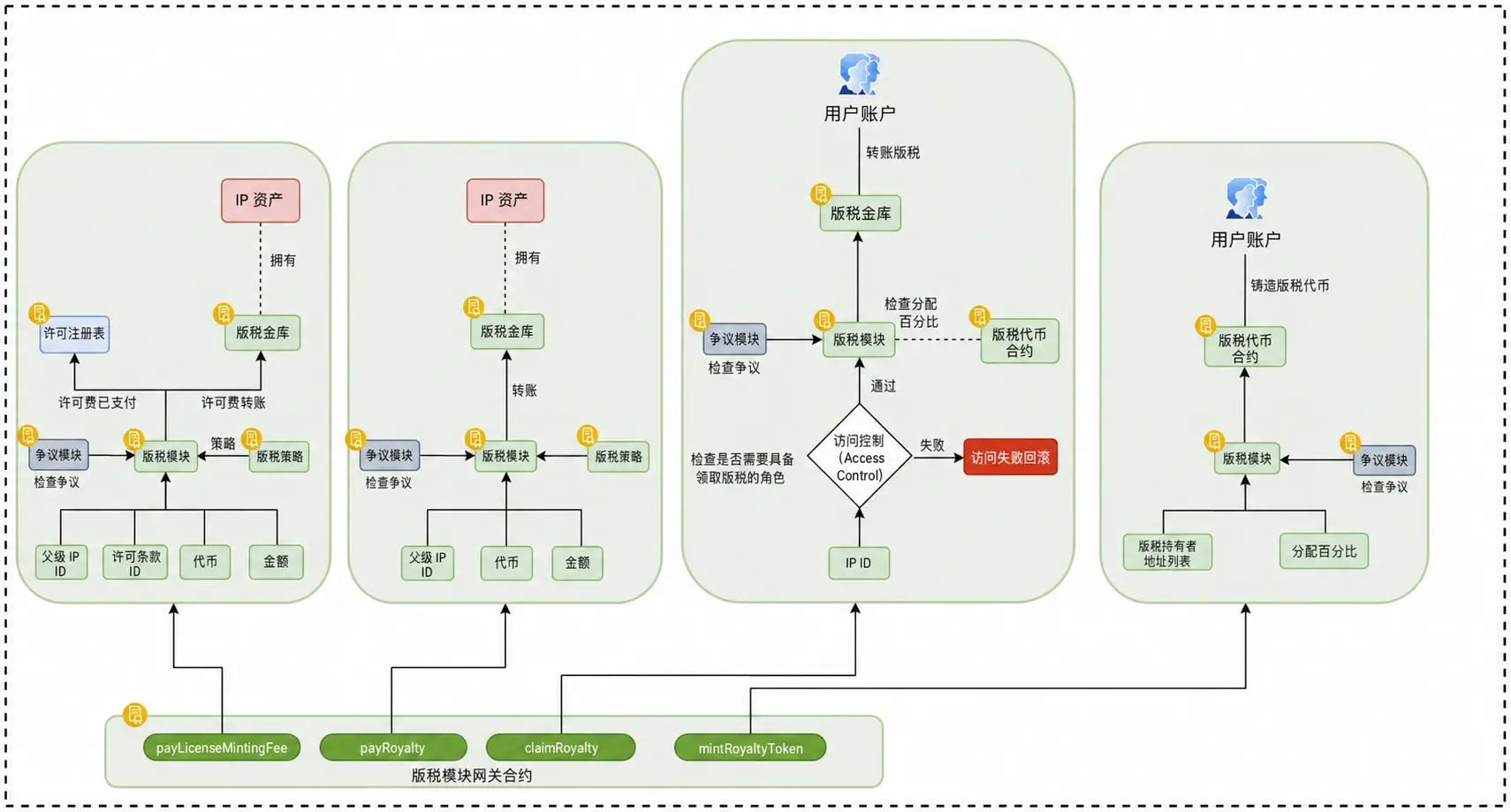
When users apply to mint a License Token for a certain IP Asset, the SDK first checks whether there are any copyright disputes regarding that IP. If there are no disputes, it continues to read the Royalty Policy defined in the corresponding License Terms of that IP to determine whether a License Mint Fee is required.
If payment is required, after the user completes the payment, the funds will automatically be deposited into the Royalty Vault of the corresponding IP. Upon successful transaction, the system will mint the corresponding License Token for the user, serving as an on-chain certificate for obtaining the IP licensing.
Pay License Mint Fees
The License Mint Fee is the licensing fee predefined in the License Terms. When a user purchases or acquires an IP license, this fee will be automatically collected by the Royalty Module and directly transferred to the Royalty Vault of the corresponding IP.
All licensing income will be uniformly deposited into the Royalty Vault, providing a funding source for subsequent copyright revenue distribution, thereby automating and increasing the transparency of the licensing fee process.
Pay Royalty
When a user needs to pay royalties to a certain IP, the Royalty Module will first check if there are any copyright disputes regarding that IP. If the IP status is normal, the system will directly transfer the royalties paid by the user into the corresponding Royalty Vault of that IP, ensuring that all royalty income is managed uniformly and serves as a funding pool for subsequent revenue distribution.
Claim Royalty
When the copyright holder or beneficiary applies to claim royalties, the SDK will first verify the identity and permissions of the caller. Then, the system will calculate the share of revenue they should receive based on the number of Royalty Tokens held by the user and automatically transfer the corresponding royalties from the Royalty Vault to the recipient's account.
This design allows for the automatic execution of royalty calculation, revenue distribution, and fund settlement by smart contracts, enabling IP revenue to be distributed in real-time and transparently to all copyright participants according to preset rules, reducing manual settlement costs while enhancing the efficiency of copyright commercialization.
- Asset Module
The Asset Module is the foundational module in the KOR Protocol responsible for digital content on-chain and asset management, mainly used for content storage, identity identification generation, and metadata management, providing the following core functions:
Upload digital assets to IPFS
Generate ISCC (International Standard Content Code) for assets
Create Metadata for IP or Collection
Upload Metadata to IPFS
Compare and verify ISCC encoding
This module uses ISCC (International Standard Content Code) as the unique identification standard for content and permanently stores assets and metadata on IPFS through Pinata, providing a unified data foundation for subsequent copyright confirmation, licensing, and transactions.
Upload Asset
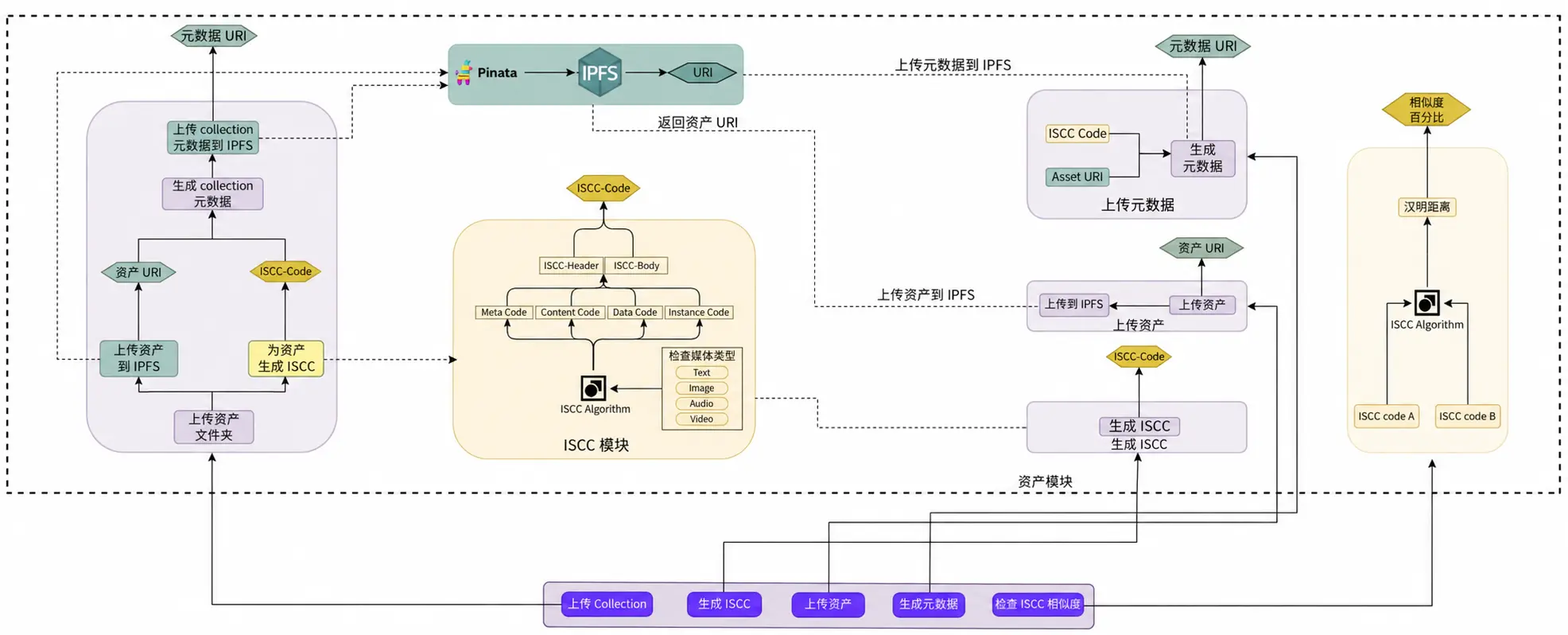
When a user uploads digital content, the SDK will first automatically generate an ISCC code for that asset to uniquely identify the work's content. Then, the system will upload the asset to IPFS and return the corresponding Asset URI as the permanent access address for that digital content on-chain.
Through the combination of ISCC and IPFS, each work has a unique identity and decentralized storage capability, providing a reliable data foundation for subsequent IP registration and copyright management.
Upload Collection
When creators upload an entire Collection, the SDK will automatically traverse each asset within it, generating an ISCC code for each work and uploading them to IPFS one by one. Once completed, the system will return all corresponding Asset URIs for the works, facilitating the unified creation of Collections, IP registration, or batch licensing management.
This batch processing mechanism can significantly improve the efficiency of on-chain operations for large digital content libraries and reduce the complexity for creators managing multiple works.
Upload Metadata
After the asset upload is complete, the SDK will automatically generate standardized Metadata by combining the ISCC code, Asset URI, and other metadata information such as work name, description, and author. Subsequently, the Metadata will also be uploaded to IPFS, and the corresponding Metadata URI will be returned.
The Metadata URI serves as a unified descriptive entry for digital assets, providing a complete and standardized on-chain data index for NFTs, IP Assets, Collections, and subsequent licensing, transactions, and AI Agent calls.
- Dispute Module
The Dispute Module is the module in the KOR Protocol responsible for copyright dispute arbitration and conflict management, aimed at ensuring the legality of IP assets and copyright security, mainly providing the following functions:
Raise Dispute
Resolve Dispute
Query dispute details
Manage Arbitrators
Manage dispute handling fees
Through the on-chain arbitration process, the Dispute Module protects the rights of copyright holders while preventing disputed IPs from continuing to be licensed, derived, or commercialized.
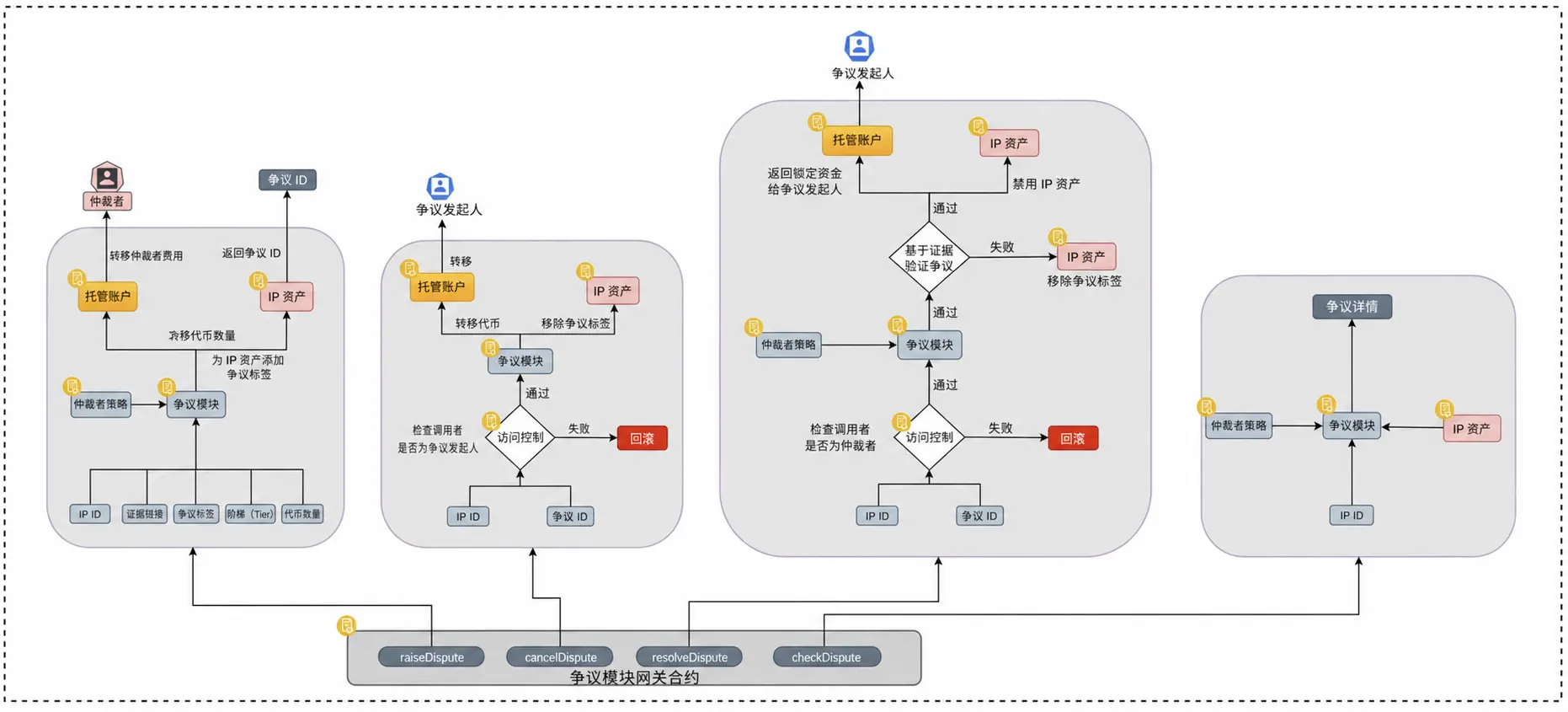
Raise Dispute
When a user believes there is a copyright issue with a certain IP Asset, they can raise a dispute. When initiating, they need to submit a Dispute Evidence Link, select the corresponding Dispute Tier, and pledge a certain amount of tokens according to the tier.
The pledged funds will be transferred into the Escrow Fee contract, part of which will be used to pay arbitration fees. Once the dispute is successfully submitted, the IP will be immediately marked as Disputed, and the creation of new derivative works or continued licensing will be suspended until the dispute is resolved, thus preventing the dissemination and commercialization of content with copyright risks.
Resolve Dispute
Disputes can only be handled by an Arbitrator. The arbitrator will review the submitted evidence and determine whether the dispute is valid.
If the dispute is valid, the remaining pledged tokens will be refunded to the dispute initiator, and the IP will be Locked, prohibiting further use or commercialization; if the dispute is invalid, the remaining pledged tokens will be handled by the platform according to the agreement rules, and the IP will be released from the Disputed status, restoring normal licensing, trading, and derivative creation capabilities.
This mechanism effectively reduces the impact of malicious reporting and copyright disputes on the protocol ecosystem through pledge constraints, professional arbitration, and on-chain status management while protecting original copyrights.
Tron Comments
The advantage of the KOR Protocol lies in its construction of a comprehensive IP infrastructure covering digital content confirmation, copyright management, licensing, royalty distribution, and dispute arbitration. Through the three major engines of Verify, Route, Settle, and modules such as NFT, IP, License, Royalty, Asset, and Dispute, it achieves a complete closed loop from registration, licensing to revenue settlement for creative works. Combined with ERC-6551 Token Bound Account, ISCC international content coding, IPFS decentralized storage, and stablecoin native settlement, it provides standardized and automated copyright trading and value distribution capabilities for AI Agents and the digital content ecosystem.
Its disadvantage is that the overall architecture of the protocol is relatively complex, involving multiple modules such as copyright registration, licensing agreements, royalty vaults, and arbitration mechanisms, resulting in relatively high integration costs for developers and creators. At the same time, some core functions, such as the Route Engine, are still under development, and the maturity of the ecosystem and actual commercialization scale still need further verification, with the platform's value largely dependent on the continuous growth of the content ecosystem, AI applications, and partners.
II. Industry Data Analysis
1. Overall Market Performance
1.1. Spot BTC vs ETH Price Trends
BTC
ETH
III. Macroeconomic Data Review and Key Data Release Nodes for Next Week
I. Review of Last Week's Macroeconomic Data (August 31 - September 6)
September 1 | U.S. JOLTS Job Openings: July job openings at 7.3 million, job opening rate at 4.4%; hiring and separations both at 5.1 million, overall changes limited, employment demand remains relatively stable.
September 4 | U.S. August Non-Farm Payrolls: 162,000 jobs added, unemployment rate remains at 4.1%; average hourly wage month-on-month +0.3%, year-on-year +3.1%. Meanwhile, June and July non-farm payrolls were revised up by 55,000, indicating that the labor market remains resilient overall.
Core Judgment: The most critical information this week comes from the employment side—job openings have not deteriorated significantly, non-farm employment has improved significantly, and the unemployment rate is stable, indicating that the U.S. economy has not yet shown signs of rapid recession; however, inflation remains the core variable determining the Federal Reserve's next policy move.
II. Key Data Nodes for Next Week (September 7 - September 13)
September 8: U.S. August NFIB Small Business Optimism Index, July Consumer Credit.
September 10: U.S. August PPI / Core PPI, Initial Jobless Claims—observing whether production-side inflation continues to heat up.
September 11: The most important node this week—U.S. August CPI / Core CPI; simultaneously releasing the preliminary value of the September University of Michigan Consumer Sentiment Index.
Key Focus: The September 11 CPI is a core risk point. Since the next FOMC meeting will be held on September 15-16, this will be one of the most important inflation data points before the meeting, directly impacting interest rate expectations for the U.S. dollar, U.S. Treasuries, and risk assets like BTC.
Overall, last week's employment data was relatively stable, and next week the market focus will shift from "employment" to "inflation," with the PPI on September 10 and CPI on September 11 becoming key nodes determining short-term macro trading direction.
IV. Regulatory Policies
1. United States: SEC Advances On-Chain Securities Infrastructure, CFTC Continues to Advocate for Regulatory Path for Crypto Perpetual Futures
On September 1, the U.S. SEC proposed the Registered Transfer Agent Rule Modernization. One of the significant changes in the new rules is the explicit inclusion of electronic and blockchain-based recordkeeping as well as uncertificated securities into the modernization of the traditional securities transfer agent regulatory framework. Although this is not a rule specifically targeting cryptocurrency issuance, it represents an important regulatory move by the U.S. to formally embed blockchain/tokenization technology into the regulated securities market infrastructure, indicating that U.S. regulatory focus is gradually shifting from merely discussing "whether tokens are securities" to "how to ensure on-chain securities operate compliantly within the existing financial infrastructure."
Meanwhile, on September 2, the CFTC applied to the federal court to dismiss CME's lawsuit regarding crypto perpetual futures. The core of the dispute is that the CFTC previously allowed designated contract markets (DCM) like Kalshi to list products such as Bitcoin perpetual futures as "futures," while CME argued they should be classified as swaps. The CFTC continued to uphold this regulatory approach this week, asserting that CME could not demonstrate substantial competitive harm. Although this is part of judicial proceedings rather than new legislation, its significance lies in the fact that U.S. regulatory agencies are effectively defending a legal pathway for regulated markets to offer crypto perpetual futures at both institutional and judicial levels, which may impact the future structure of the domestic Crypto Perpetuals market in the U.S.
2. Poland: Parliament Fails to Overturn President's Veto on Crypto Bill, MiCA Domestic Regulatory Framework Remains on Hold
Around September 4, the Polish parliament again failed to overturn President Karol Nawrocki's veto of the crypto assets bill. The House of Representatives (Sejm) ultimately supported the veto override with 241 votes in favor, 198 against, and 3 abstentions, but fell short of the required 266 votes (three-fifths majority) by 25 votes, thus the bill remains blocked. The bill was originally intended to implement the EU MiCA's domestic execution system and designate the Polish Financial Supervision Authority (KNF) as responsible for regulating and licensing the crypto assets market.
This outcome has significant industry implications: Poland currently lacks a complete domestic MiCA authorization and regulatory mechanism, leaving approximately 2,000 registered virtual asset service providers facing greater uncertainty regarding licensing pathways. Some businesses may need to turn to other EU member states like Germany, Lithuania, or Latvia to apply for MiCA authorization and then enter the Polish market through the EU Passporting mechanism. The main opposition from the president's side remains the belief that the existing bill imposes excessive regulation, including high compliance costs and the authority of regulatory agencies to block websites and restrict business activities. In other words, this week in Poland does not represent "regulatory easing," but rather a continued political deadlock over the domestic implementation of MiCA.
3. Pakistan: VASP Transition Period Reaches Critical Deadline on September 5, Crypto Industry Officially Enters Mandatory Licensing Phase
September 5 marks an important compliance deadline for Pakistan's new virtual asset regulatory system. According to the official requirements of the Pakistan Virtual Assets Regulatory Authority (PVARA), virtual asset businesses (Transitional Persons) that have been operating before March 5, 2026, must submit their No Objection Certificate (NOC) applications by September 5, or they must cease operations. This brings the Pakistan Virtual Asset Services Regulations 2026, which officially took effect in August, into the substantive execution phase this week.
The framework requires VASPs to obtain formal licenses before providing services in Pakistan, covering areas such as exchanges, custody, brokerage, consulting, lending, derivatives, asset management, transfer settlement, token issuance, and mining-related businesses; it also mandates compliance with KYC, transaction monitoring, suspicious transaction reporting, sanctions screening, AML/CFT, customer asset protection, and cybersecurity requirements. Therefore, September 5 can be seen as a critical juncture for the Pakistani crypto market, transitioning from "establishing a regulatory framework" to "mandatory compliance for existing institutions."
4. G20: Digital Asset Regulation Officially Included in Financial Regulatory Modernization Agenda, Focus Shifts to Cross-Border Risks of Stablecoins and FATF Implementation
From August 31 to September 1, the G20 meeting of finance ministers and central bank governors, hosted by the United States, took place in Asheville, North Carolina, and a chairman's statement was released on September 1. This is the most noteworthy signal regarding digital asset regulatory policy at the global level this week. The G20 explicitly acknowledges that digital assets can drive economic growth while committing to advancing a "responsible and effective" regulatory and supervisory framework that maintains financial stability while establishing a clear development path for digital finance and digital asset innovation, specifically noting the need to consider cross-border opportunities and risks.
Of particular concern is stablecoins and AML: the G20 clearly awaits the FSB's research results on the cross-border impacts of Global Stablecoin Arrangements and the regulatory challenges related to stablecoin data sources; it also calls for the FATF to prioritize the effective implementation of virtual asset AML/CFT standards in jurisdictions with significant virtual asset usage. This indicates that global regulatory discussions have further shifted from "whether to regulate crypto" to the cross-border movement of stablecoins, regulatory data transparency, AML/CFT, and cross-jurisdictional regulatory coordination.
 Risk warning

Popular articles