AI agents can finally spend money on their own: Cloudflare Wallets launched
 Core Viewpoint

 Cloudflare launches AI wallet: allowing machines to spend money and settle with stablecoins. With a dual-layer structure + identity system + x402 protocol, the carrier of 20% of global website traffic is integrating payments into the HTTP pipeline.
Written by: Xiao Bing, Deep Tide
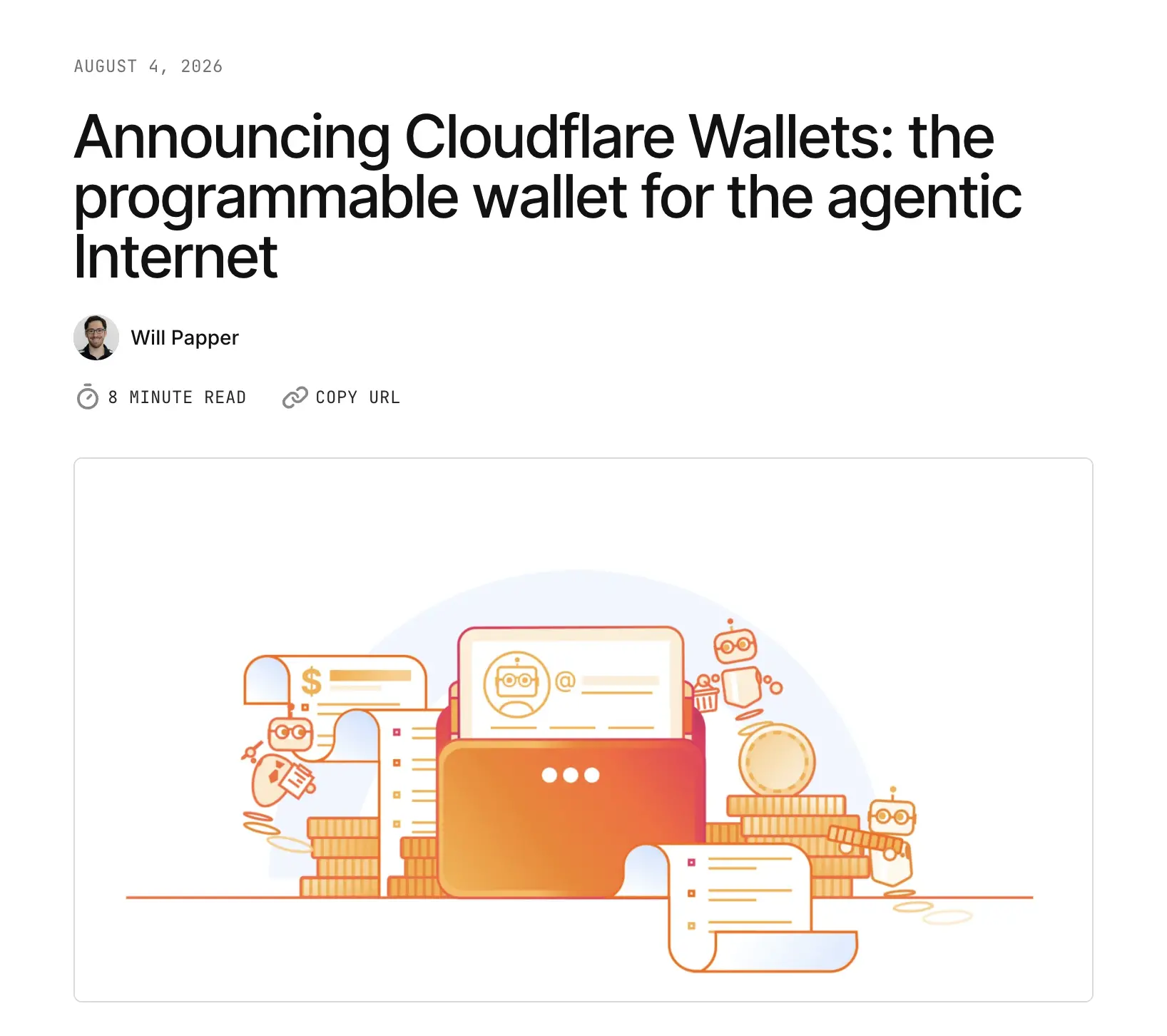
One of the largest internet infrastructure companies in the world, Cloudflare, announced the launch of Cloudflare Wallets yesterday.
First, it may not be the wallet you think of; it has nothing to do with MetaMask, exchanges, or DeFi. The wallet that Cloudflare has created is for AI agents.
What problem does it aim to solve?
Current AI agents face a fundamental barrier: they cannot spend money on their own.
When an AI agent needs to call a certain API, it must first register an account, bind a payment method, and generate keys. This entire process is designed for humans and is not accessible to agents. In most cases, agents can only pass these steps back to humans and wait.
The logic behind Cloudflare Wallets is: give agents a wallet so they can pay for themselves and buy services.
How does it work?
Two-layer structure.
The first layer is called Account Wallet, managed by humans. Recharge, withdrawal, and rule setting all occur at this layer.
The second layer is called Virtual Wallet, used by agents. Humans assign a virtual wallet to the agent, set a spending limit, a whitelist of allowed merchants, and a single transaction limit, allowing the agent to spend autonomously within this framework without needing to consult for every transaction.
An analogy: the Account Wallet is the company's finance department, while the Virtual Wallet is the employee's travel budget card. The card has a limit, and if exceeded, it stops automatically, but within the limit, the employee decides how to spend.
Payments are made using stablecoins, through a protocol called x402, which embeds payment information directly into HTTP requests. In simpler terms: the agent accesses an API, and payment and calling are completed in the same action, without needing a separate payment process.
There’s another layer: identity
Cloudflare also launched the cloudflare.pay domain service. Each wallet can be linked to a readable identity, such as research.example.cloudflare.pay, so merchants no longer see an anonymous machine request but can recognize it as "the research agent of a certain company."
This addresses the trust issue. Currently, websites treat agents similarly to how they treat VPN users; if they don’t know who you are, they default to distrust. With an identity identifier, merchants can choose to open trial limits or contract discounts to verified agents, just like they would for a real business customer.
Why is it worth paying attention to?
Cloudflare handles over 20% of global web traffic.
Its blog mentions that most of the traffic on the internet currently comes from bots. When this company decides to embed stablecoin payments and agent identity systems into its infrastructure layer, the signal it sends is far more significant than "just another Web3 project."
Several keywords: stablecoins as a payment medium, x402 protocol (embedding payments into HTTP), native identity and spending capability of agents.
This system, along with the Monetization Gateway released by Cloudflare last week (which helps website owners charge agents), forms a bilateral market: sellers use the Monetization Gateway to price and collect payments, while buyers use Wallets to pay and consume, with stablecoins as the currency and HTTP as the channel.
For the crypto industry, it is noteworthy that Cloudflare has not mentioned any public chain names, nor Ethereum, Solana, or Base, and has no intention of issuing tokens; it only referred to "stablecoins." This is a choice of an infrastructure company: what it wants is the functionality of stablecoins as a payment tool, with a tool-like, interchangeable attitude towards the underlying chains.
The scenario where stablecoins truly take off on a large scale may be machine-to-machine micropayments, far exceeding person-to-person transfers. Cloudflare has just paved this road into the internet's pipeline layer.
 Risk warning



Popular articles