The 2x Long Hynix ETF (07709) has been renamed; do investors still have hope of breaking even?
 Core Viewpoint

 The renaming event of a leveraged ETF
Author: Gelong
A fund changing its name sounds quite ordinary.
But "Double Long SK Hynix" becoming "At Most Double Long SK Hynix"—adding the words "at most" could mean the hopes of thousands of holders to recoup their investments are extinguished.
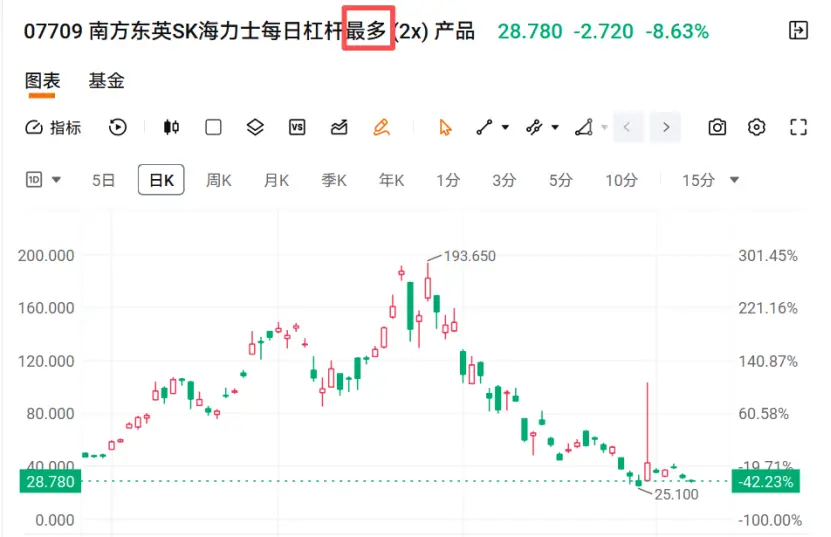
07709 is the Southern Eastern Double Leverage ETF, tracking the South Korean semiconductor giant SK Hynix.
When it was listed in October 2025, the issue price was only 7.8 HKD. Just as the AI wave swept the globe, SK Hynix, as a core supplier of HBM chips, saw its stock price soar. This product also went crazy, with the price skyrocketing to 193.65 HKD by June 2026, an increase of over 10 times, and its scale exceeding 130 billion HKD, becoming a hot commodity in the market.
However, leverage has always been a double-edged sword.
In late June, as SK Hynix's stock fell from its peak, the double long 07709 plummeted sharply. The maximum drop was nearly 87%, falling from 193.65 HKD to around 25 HKD, with hundreds of billions in market value evaporating. As of the time of writing, the latest price of 07709 is 28.6 HKD.
Just as holders anxiously waited, hoping for a rebound in the underlying stock to recoup their investments, the fund company Southern Eastern took action.
On July 27, it announced that starting August 3, the product would switch to a "Flexible Leverage Structure"—the leverage multiple would no longer be a fixed 2 times, but could be dynamically adjusted between 1.1 times and 2 times.
In plain language: when the market is good, it will try to give you 2 times, and when the market is bad, it will quietly drop to 1.1 times.
Objectively speaking, reducing the leverage multiple during a market downturn can lessen the ETF's decline, providing some protection for investors. However, the problem is that if the market rebounds from the bottom, lowering the leverage will slow down the recovery for losing investors, consuming more time and capital costs, etc. Especially in the case of the Korean stock index, where SK Hynix and Samsung Electronics' stock prices have already retreated significantly, Morgan Stanley has also reported that the clearing of leverage in Korean stocks is nearing its end, and valuations are becoming more attractive.
Of course, this change has a specific background, as the Hong Kong Securities and Futures Commission released new regulations on July 24 regarding leveraged products, allowing adjustments to target leverage multiples in extreme market conditions. From a procedural standpoint, the fund company may not have violated any rules.
But just because it is compliant, does it mean it is reasonable?
When the market is rising, "double" is a lure for funds; when it falls, "double" becomes "at most double," which can shrink at any time.
The same product, the same group of holders, experiences vastly different treatment between rises and falls.
Although this operation is not illegal, it effectively rewrites the rules of the game, touching on the core and most sensitive aspect of the fund industry, the financial market, and the business community—the spirit of the contract.
When a fund company in Hong Kong changes investment objectives, performance benchmarks, or diversification restrictions, such modifications harm investors' original expectations and constitute a significant change to the fund contract, which cannot be unilaterally altered by the manager.
The proper process for modifying rules is as follows:
1) The fund company and the trustee must report to the Hong Kong Securities and Futures Commission (SFC) in advance and obtain regulatory pre-review opinions; 2) A circular must be sent to all holders, and a meeting of holders must be convened; 3) A special resolution must be passed: it takes more than 75% of the voting shares present to be effective; 4) The notification period must be at least 30 days in advance, providing holders with a buffer time to redeem and exit; 5) Only after final approval from the SFC can the contract amendments be officially implemented.
Did this company follow these procedures for such a significant modification to the product? Did it obtain the consent of the fund holders' meeting? If there are issues with the procedures, should the fund holders unite to seek compensation for their losses?
What is even more intriguing is that this fund charges an annual management fee of 1.60%, accumulating about 356 million HKD since its listing.
When the net value skyrockets, management fees rise accordingly; when the net value plummets, management fees continue to be collected without fail.
Now that the rules have changed, the fund company has successfully avoided liquidation risks and continues to earn steadily, while holders who entered at high prices may have lost even the last hope of waiting for a rebound in the underlying stock and leveraging for a turnaround.
In simple terms, this name change essentially sacrifices the holders' potential to recoup their investments in exchange for the fund company's own survival.
This structural misalignment, where the manager profits while the holders incur losses, is the most terrifying aspect.
Theoretically, if the fund company anticipates a rebound in stock prices, it could adjust the leverage back to 2 times, but this requires very high trading skills and precise predictions. If the fund company truly had such capabilities, why couldn't it successfully predict the significant retreat over the past month?
The chill in this situation is not just about the candlestick chart; it is a brutal story about rules, contracts, interests, and trust.
 Risk warning

Popular articles