The July non-farm payrolls did not provide a clear answer for the Federal Reserve; "New Federal Reserve News Agency": Whether to raise interest rates in September depends on inflation
 Core Viewpoint

 Timiraos believes that the signals provided by the July non-farm payroll report are confusing, and this ambiguity in the report is "unlikely to significantly change" the Federal Reserve's current focus on inflation; if future inflation data is moderate, the Fed will have more reason to keep interest rates unchanged, while strong data will lead more decision-makers to support interest rate hikes. Wall Street economists generally view this as a jobs report that can provide justification for both hawks and doves.
Author: Wall Street Journal
The U.S. July non-farm payroll report unexpectedly recorded a net decrease in employment, but the unemployment rate fell to its lowest level in over a year. This seemingly contradictory employment report has made the policy outlook ahead of the Federal Reserve's September meeting even more uncertain.
Nick Timiraos, an economic reporter known as the "new Federal Reserve correspondent," believes that this report "provides almost no clear answers for the Federal Reserve." The ambiguity of the report "is unlikely to materially change" the Fed's current focus on inflation. What will truly determine whether to raise interest rates in September is not the employment data, but the inflation data to be released in the coming weeks.
Timiraos pointed out that this employment report sends two sets of opposing signals: the weak job growth in July and the significant downward revision of employment growth in the previous two months show that the labor market has not re-accelerated, while the decrease in the unemployment rate indicates that the job market has not yet shown enough slack to reassure the Fed. Therefore, for the Federal Reserve's decision-making body, which had three officials voting in favor of raising interest rates at last week's monetary policy meeting, this report is unlikely to change the policy balance.
Wall Street economists generally believe that this is a report that both hawks and doves can use to justify their positions. The decrease in employment supports maintaining the status quo, while the drop in the unemployment rate indicates that the labor market still has resilience. Moving forward, the Fed's focus will return to inflation data, especially the CPI and PCE to be released in the coming weeks.
Unexpected Decline in Job Growth, Unemployment Rate Hits Over One-Year Low
The July non-farm payroll report released by the U.S. Bureau of Labor Statistics (BLS) shows:
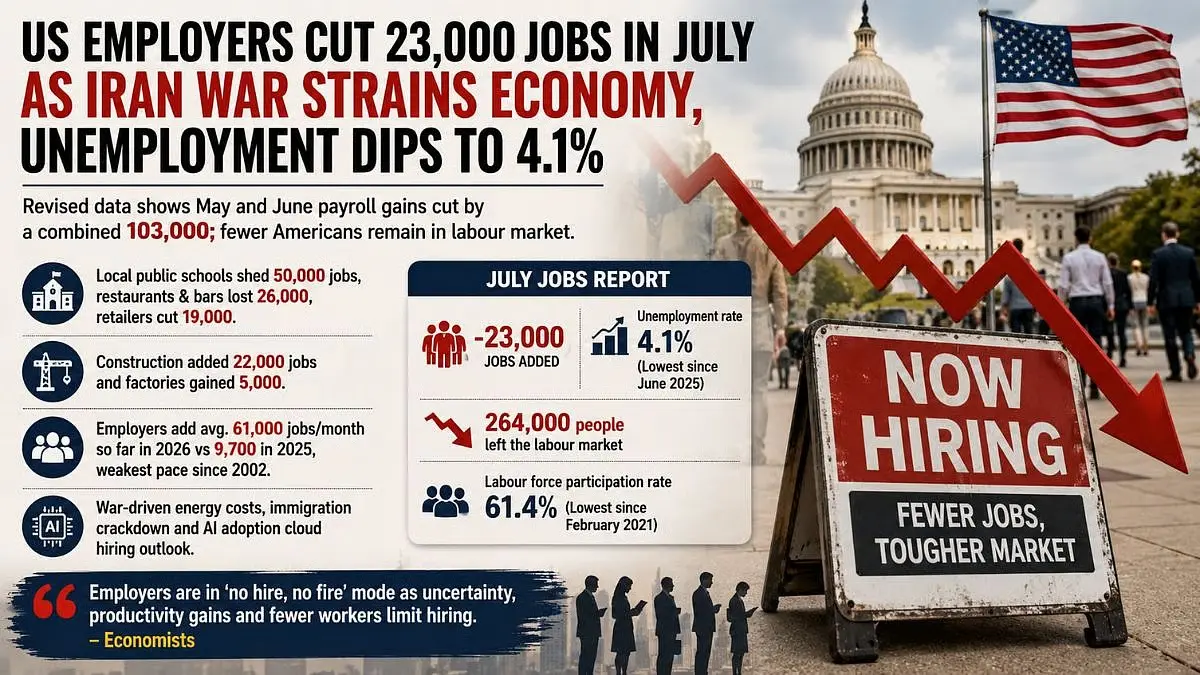
- Non-farm payrolls decreased by 23,000 in July, significantly deviating from the market expectation of an increase of 50,000 to 140,000;
- The job growth numbers for May and June were revised down by a total of 103,000, indicating that the labor market was weaker than initially reported;
- Private sector employment increased by 30,000 in July;
- The unemployment rate fell from 4.17% to 4.09%, the lowest since June 2025;
- The labor force participation rate dropped from 61.5% in June to 61.4% in July, the lowest level in nearly five and a half years;
- Average hourly earnings increased by only 0.1% month-over-month, below the market expectation of a 0.3% increase, and the year-over-year increase in average hourly earnings was 3.2%, lower than the market expectation of 3.5%, marking the lowest year-over-year increase in over five years.
On the surface, the decline in employment seems to indicate a significant cooling of the labor market, but the further drop in the unemployment rate suggests that the job market still maintains a certain level of resilience, with the two most important indicators sending entirely different signals. Wage data has become an important signal for doves; unlike previous market concerns about "overheating in the labor market potentially pushing inflation back up," the slowdown in wage growth indicates that supply and demand in the job market are continuing to rebalance.
Timiraos: Non-farm Report Almost Clarifies the Fed's Most Concerned Issues
As an important window for observing the Fed's policy direction, Nick Timiraos's comments on this report can be summarized in one sentence: it almost clarifies nothing about the Fed's current most concerned issues.
He wrote:
"The July employment report will be a messy report for the Federal Reserve."
In Timiraos's view, the greatest significance of the report is not to tell the market what the Fed should do next, but to indicate that the current data is still insufficient to support any clear conclusions.
On one hand, the slowdown in job growth, the negative job growth in July, and the significant downward revisions of the previous two months' data all indicate that the labor market is not re-accelerating, which undoubtedly weakens the rationale for a rate hike in September.
On the other hand, the continued decline in the unemployment rate means that the labor market is still quite far from being truly weak, making it difficult for the Fed to conclude that the economy has clearly cooled.
Therefore, this report has not changed the core of the policy discussion.
Future Moderate Inflation Data Will Provide More Reasons to Maintain Rates, Strong Data May Lead to More Support for Rate Hikes
Timiraos believes that what will truly determine the outcome of the September FOMC meeting is not employment, but inflation.
He pointed out that last week's Federal Reserve Open Market Committee (FOMC) meeting decided to maintain interest rates, but among the 12 voting FOMC members, three voted against the rate decision in support of a rate hike. This indicates that there is a clear division within the FOMC on whether further tightening of policy is needed.
Future inflation data will determine whether this division widens or narrows.
Timiraos stated:
"Whether price pressures are intensifying or easing will determine whether more officials conclude that it is impossible to achieve the expected return of inflation to target levels while maintaining current interest rates.
If inflation data is moderate, it will strengthen the rationale for keeping rates unchanged (as two consecutive months of low inflation data begin to show trend characteristics rather than just short-term fluctuations); conversely, if the (inflation) data is strong, it may again raise doubts about inflation expectations and could prompt dissenting officials to seek a fourth opposing vote."
In other words, in a context where the job market has neither re-heated nor significantly deteriorated, the Fed's next policy move will almost entirely depend on the price data to be released in the coming weeks.
If CPI and other inflation data continue to be moderate, then two consecutive months of low inflation will increasingly resemble a trend rather than statistical noise, which will give the Fed more reason to maintain rates. If these inflation data strengthen, it would mean that the Fed's expectations about inflation returning to the 2% target are once again challenged, potentially adding another vote in favor of a rate hike.
Decline in Unemployment Rate Does Not Mean Employment is Strengthening Again
Timiraos also provided a specific explanation for a point that the market might easily overlook.
He pointed out on social media that the unemployment rate fell to 4.09% in July mainly because the number of job seekers decreased, while the number of unemployed people in the statistical measure also declined simultaneously.
In other words, the decrease in the unemployment rate is not entirely due to a significant increase in job openings, but rather a result of changes in labor supply.
However, the unemployment rate has still fallen from 4.54% in November last year and 4.44% in February this year to the current 4.09%, the lowest since June 2025. This means that the Fed still cannot conclude that there has been a sufficiently clear slack in the labor market.
Job Reductions Mainly Concentrated in Public Education, Possibly Affected by Seasonal Factors
Timiraos also pointed out another characteristic of this employment report: the job reductions mainly came from government sectors rather than private enterprises.
The report data shows that private sector employment increased by 30,000 in July, although below the average increase of 40,000 over the past three months and 54,000 over the past six months, it still maintained positive growth.
At the same time, overall non-farm employment decreased by 23,000 in July, primarily concentrated in public education positions.
Timiraos cited some economists' analyses indicating that this may reflect seasonal adjustment factors due to school closures during the summer, rather than a sudden deterioration in government employment demand.
Therefore, while the headline number is surprising, the internal structure of the job market may not be as weak as the surface numbers suggest.
Wall Street: A Report Where Both Doves and Hawks Can Find Justification
Regarding this employment report, several Wall Street economists believe that it is difficult for the Fed to provide a clear policy signal; it contains factors supporting both a pause in rate hikes and continued focus on inflation.
Chris Low, chief economist at FHN Financial, stated that without the decline in the unemployment rate, this report could have been an important basis for a policy shift. However, the unemployment rate remains low, making it difficult for the Fed to announce that the labor market has clearly deteriorated.
Eric Winograd, an economist at AllianceBernstein, believes that job growth is slowing and wage pressures are decreasing, but the current data is still insufficient to prove that the economy is rapidly slowing down. The Fed still needs more evidence of inflation.
Satyam Panday, an economist at S&P Global Ratings, stated that the weakening job growth and declining wage growth indicate that the labor market is rebalancing. However, the decrease in the unemployment rate means that there has not been a clear deterioration in the market, so policymakers still need to wait for more data.
Kathy Bostjancic, chief economist at Nationwide, described it as a "complex" employment report. The decrease in employment and cooling wages support the Fed's patience, but the decline in the unemployment rate indicates that the labor market still has resilience.
Bloomberg economists Anna Wong and Andrew Sacher believe that the trend of cooling in the labor market is continuing, but it is currently insufficient to force the Fed to quickly change its policy direction. Future inflation data will remain a core variable for the September meeting.
Morningstar economist Caldwell also pointed out that the continuous decline in wage growth to around 3% indicates that there is still a certain degree of oversupply in the labor market, which will provide the Fed with space to remain cautious on inflation issues.
Market Refocuses on Inflation, Fed's September Decision Still Uncertain
Overall, the July non-farm report did not provide the Fed with a clear policy signal.
On one hand, the decrease in employment numbers, the significant downward revision of previous growth numbers, and the drop in wage growth to the lowest level in over five years all support the Fed's continued patience.
On the other hand, the unemployment rate falling to its lowest level in over a year and the resilience of the labor market mean that the Fed still cannot completely rule out the possibility of further tightening.
As Timiraos summarized, this employment report is "difficult to interpret" for the Fed; it has not changed the policy direction but has kept the focus on inflation.
As the September FOMC meeting approaches, the upcoming CPI and PCE data will determine whether the Fed maintains rates or reconsiders a rate hike.

 Risk warning




Popular articles