








Tron Industry Weekly Report: Stubborn inflation and oil prices may continue to affect BTC rebound, detailed explanation of the liquidity infrastructure of the on-chain reinsurance market Re Protocol

 A detailed explanation of the institutional-level arbitrage yield tokenization on-chain yield infrastructure Multipli and the liquidity infrastructure of the on-chain reinsurance market Re Protocol.
# I. Outlook
## 1. Macroeconomic Summary and Future Predictions
This week, the global macro trading narrative focused on "the marginal cooling of U.S. inflation and weakening consumption, but energy shocks make it difficult for monetary policy to shift towards easing." The U.S. CPI rose 0.1% month-on-month in July, with the year-on-year rate dropping from 3.5% to 3.4%, and the core CPI year-on-year falling from 2.6% to 2.5%, indicating that underlying inflation continues to decline slowly. Meanwhile, July retail sales unexpectedly fell 0.6% month-on-month, combined with previously weak employment data, suggesting that U.S. demand and labor market momentum are weakening. However, the situation in the Middle East and supply disruptions in the Strait of Hormuz remain the biggest macro variables: the IEA further lowered its global oil demand and supply forecasts for 2026, global inventories have significantly decreased, and this week WTI and Brent closed at approximately $82.40 and $88.52, respectively, with weekly increases of about 5.4% and 5.9%, leading to renewed input inflation pressure from energy prices. Therefore, the Federal Reserve is currently in a typical dilemma of "growth cooling but inflation still above target," maintaining the federal funds rate at 3.50% - 3.75% during the July meeting, with significant internal disagreement on whether further rate hikes are necessary; after the release of inflation and consumption data this week, U.S. Treasuries and the dollar weakened temporarily, but the 10-year Treasury yield ultimately remained around the high of approximately 4.70%. Overall, the macro environment this week does not conform to the traditional notion of "inflation reduction → interest rate cuts," but is closer to a gradual slowdown in growth, improvement in core inflation, while energy and geopolitical risks keep global interest rates elevated in a stagflation-like pull.
Next week, the macro market is expected to revolve around "whether growth data can further support economic cooling, and whether energy inflation forces central banks to maintain a hawkish stance." In the U.S., the market will focus on the Federal Reserve's July meeting minutes, PMI, industrial production, and real estate data; against the backdrop of declining CPI and significantly weakening retail sales, if subsequent economic data continues to be weak, expectations for further rate hikes by the Federal Reserve may continue to cool, putting some downward pressure on short-term Treasury yields and the dollar. However, as long as oil prices remain high, it will be difficult for the market to quickly shift to a clear rate-cutting trade. Europe and the UK will focus on PMI, UK employment, and inflation data; high energy costs mean that the European Central Bank and the Bank of England also face policy constraints of "economic growth under pressure, inflation risks resurfacing," so the baseline scenario is that the global macro environment remains in a phase of high interest rates, high energy prices, and cooling growth, with major central banks more likely to maintain a wait-and-see approach rather than quickly shift to easing; the biggest upside risk remains the deterioration of the situation in the Strait of Hormuz leading to a rapid breakout of oil prices, thereby pushing global inflation expectations and long-term Treasury yields higher again. Conversely, if geopolitical tensions ease and energy prices significantly decline, the combination of "declining inflation + slowing growth" will strengthen market expectations for a future shift towards easing monetary policy.
## 2. Market Movements and Warnings in the Crypto Industry
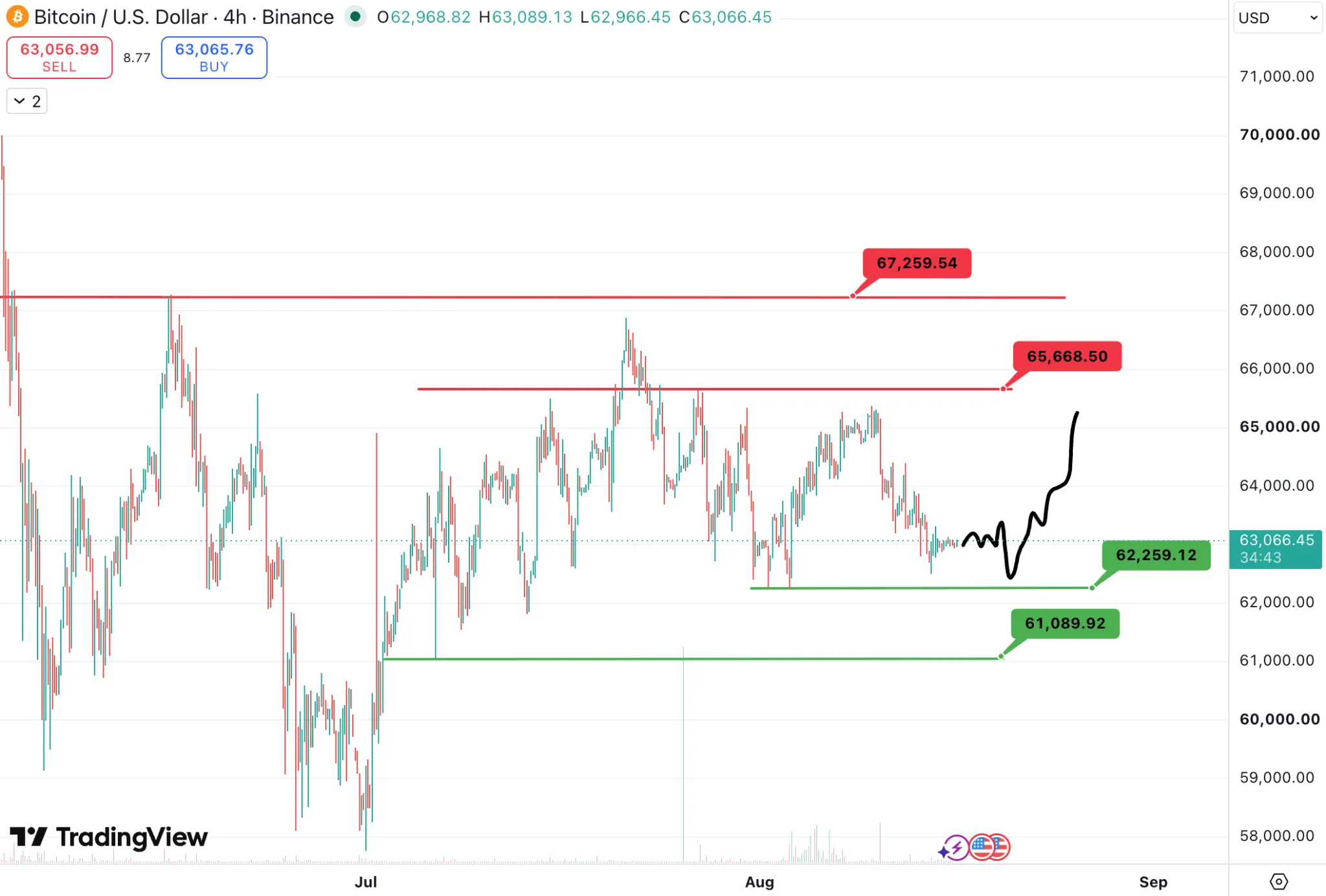
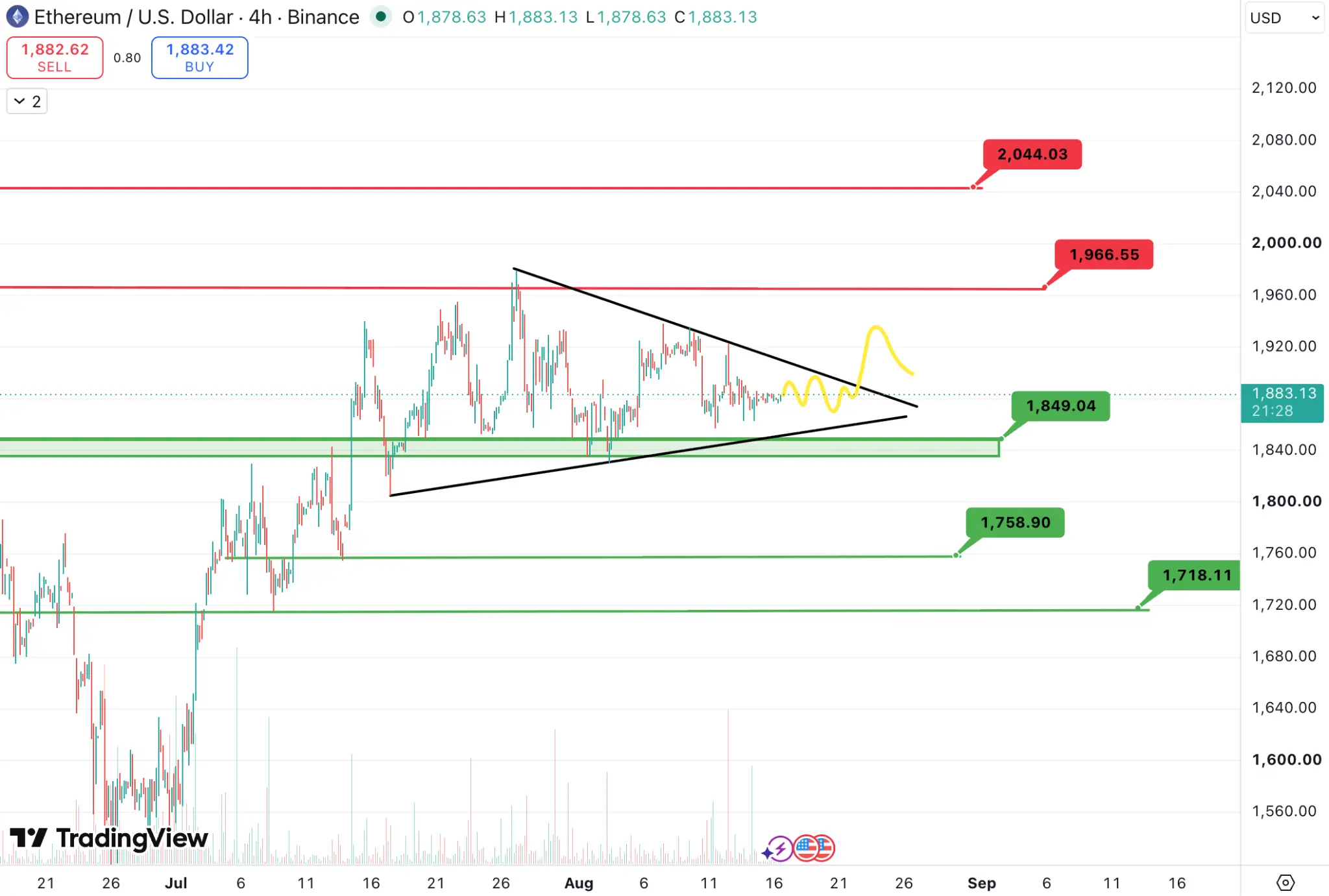
This week, the overall crypto market showed a pattern of rising and then continuously falling, with BTC declining more than ETH and altcoins diverging, primarily due to price pressure. BTC opened at approximately $64,845 on August 10, surged to $65,322 during the day, but then fell continuously, closing at approximately $62,976 on August 14, and around $63,000 as of August 15, a cumulative decline of about 2.9% from the opening on August 10; ETH was around $1,880 as of the 15th, down about 1.8% over the past week; SOL was around $75.4, down about 0.7% for the week, XRP was around $1.00, down about 3.7% for the week, while TRX was relatively resilient, around $0.331, up about 0.7% for the week. Notably, the price movements this week were particularly significant, as July's U.S. employment data unexpectedly showed a decrease of 23,000 jobs, which temporarily lowered expectations for Federal Reserve rate hikes and pushed BTC back above $65,000 around the 10th, but the subsequently released softer CPI/PPI did not further drive up coin prices, and BTC instead fell back toward $63,000, indicating that favorable macro data has become less effective in stimulating risk appetite; at the same time, demand for Bitcoin ETFs weakened, the U.S. SEC temporarily canceled a planned public meeting to discuss crypto financing rules, and the CLARITY Act did not make progress during the Senate recess, further dampening market sentiment, causing BTC to decline from around $65,000 at the beginning of the week to about $63,000 by the weekend.
Next week, the focus should be on whether BTC can hold the $62,000 - $63,000 range: currently, BTC has fallen to about $62,970 and is near/below the 50-day moving average. If regulatory expectations continue to weaken and ETF demand does not recover, breaking below recent lows may further open up downside potential; conversely, if it can regain stability above $64,000 - $65,000, it would indicate that the downward pressure from this week is beginning to ease. For ETH, the focus should be on the $1,850 - $1,900 range, for SOL, attention should be on $75, and for XRP, the $1 mark is critical; if these levels are effectively broken, volatility in altcoins may significantly increase.
## 3. Industry and Sector Hotspots
The technical hotspot of AI Agent × Crypto further focuses on machine-native payments and programmable authorizations, with x402-type protocols promoting Agents to automatically complete pay-per-use through APIs, supported by mechanisms such as API Key/Session Key, Allowlist, single transaction limits, KYA (Know Your Agent), and streaming settlement, indicating that competition in the sector is shifting from "AI Agents issuing tokens" to a complete execution stack of Agent Wallet + Identity + Policy Engine + Stablecoin Settlement.
Overall, the most noteworthy technical trend this week is not a new single narrative, but rather the convergence of RWA, stablecoins, AI Agents, and high-performance public chains within the same "on-chain financial execution stack"—with programmable transactions initiated by AI Agents/institutions at the upper layer, execution controlled through identity, compliance, and authorization strategies at the middle layer, and value settlement completed with stablecoins at the lower layer, relying on higher throughput, sub-second finality, and atomic settlement infrastructure.
# II. Market Hotspot Sectors and Potential Projects of the Week
## 1. Overview of Potential Projects
1.1. Multipli, raising a total of $21.5 million, with participation from Base Ecosystem Fund, Pantera, and Sequoia—an on-chain yield infrastructure that tokenizes institutional-level arbitrage returns.
Introduction
Multipli.fi is a decentralized, multi-chain yield infrastructure protocol focused on providing real and risk-adjusted returns for assets that are typically difficult to generate yields from (such as BTC, ETH, stablecoins, and tokenized RWAs). The protocol aggregates and tokenizes institutional-level fund strategies such as Delta Neutral (market-neutral) strategies, including contango and funding rate arbitrage, generating freely tradable xTokens that allow users to obtain institutional-level returns on-chain.
Its proprietary AlphaIQ engine dynamically allocates funds to the best-performing strategies, enhancing yield efficiency while maintaining liquidity and DeFi composability.
Brief Overview of Protocol Mechanisms
rwaUSD Mechanism
1. Collateral Selection Principle: Only High Liquidity RWAs Accepted
rwaUSD specifically uses institutional-grade, high-liquidity real-world assets (RWAs) as underlying collateral, primarily including:
Short-term U.S. Treasury Bills (T-Bills)
Highly liquid tokenized gold
Other publicly traded RWAs with continuous pricing and deep market liquidity
These assets possess price transparency, ample liquidity, and rapid redemption capabilities, meeting the collateral requirements of DeFi liquidation mechanisms.
2. Introducing Insurance Mechanisms to Enhance Security
To further enhance stability and market trust, rwaUSD plans to integrate an insurance system underwritten by Lloyd's of London.
Insurance primarily covers:
De-pegging of underlying collateral
Risks arising from specific regulatory policy changes
Fraud and failure risks at the custodian or collateral asset level
By employing a dual structure of "high-quality collateral + insurance protection," the system's risk resistance is improved.
3. General Collateral Asset for DeFi
Leveraging high liquidity RWAs and insurance mechanisms, rwaUSD is designed as a foundational collateral asset (Collateral Primitive) widely applicable in the DeFi ecosystem, capable of supporting various on-chain financial scenarios such as lending, leverage, and yield strategies.
4. No Mixing of Low Liquidity RWAs
Multipli will not include all RWA assets in the same system.
The following assets are excluded from the rwaUSD collateral pool:
Private Equity
Private Credit
Structured Fund Products
Assets with long lock-up periods or redemption cycles
The reason is that these assets have poor liquidity under market pressure, which can easily affect overall solvency.
Therefore, Multipli adopts high liquidity RWAs for the rwaUSD system, while low liquidity RWAs enter independent liquidity pools (Segmented Liquidity Classes) to avoid contagion between assets of different risk levels.
rwaUSD Architecture and Core Logic
1. Positioning of rwaUSD: A Unified Collateral Layer for RWAs
rwaUSD can be understood as a "Universal Collateral Adapter for RWAs."
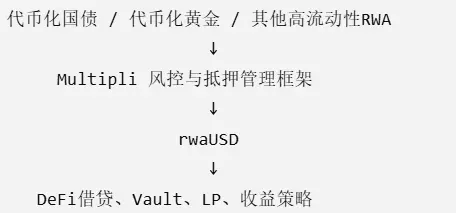
Its core goal is not to issue new RWAs but to standardize and convert high-quality RWAs from different issuers and types into a collateral asset that can be widely used in DeFi.
2. Responsibility Layering
rwaUSD isolates complexity at the bottom layer through a unified interface.
Asset Issuers
Responsible for asset issuance and compliance operations
Manage underlying assets such as Treasuries and gold
Multipli
Responsible for asset aggregation
Risk standardization
Solvency management
Maintenance of collateral frameworks
DeFi Protocols
Focus on lending, liquidity, and yield strategies
No need to adapt to each type of RWA separately
This design achieves a separation of responsibilities, enhancing the scalability efficiency of the entire ecosystem.
3. Solving the Fragmentation Problem of RWAs
As more institutions bring assets on-chain:
Tokenized Treasuries from different issuers
Different tokenized golds
Various publicly traded RWAs
Will create numerous independent liquidity pools.
If each DeFi protocol integrates separately:
OUSG
BUIDL
TBILL
Tokenized Gold
Other RWAs
It will incur significant integration and maintenance costs.
4. rwaUSD's Solution
rwaUSD will package these underlying assets into a composable, lendable, and tradable standard asset.
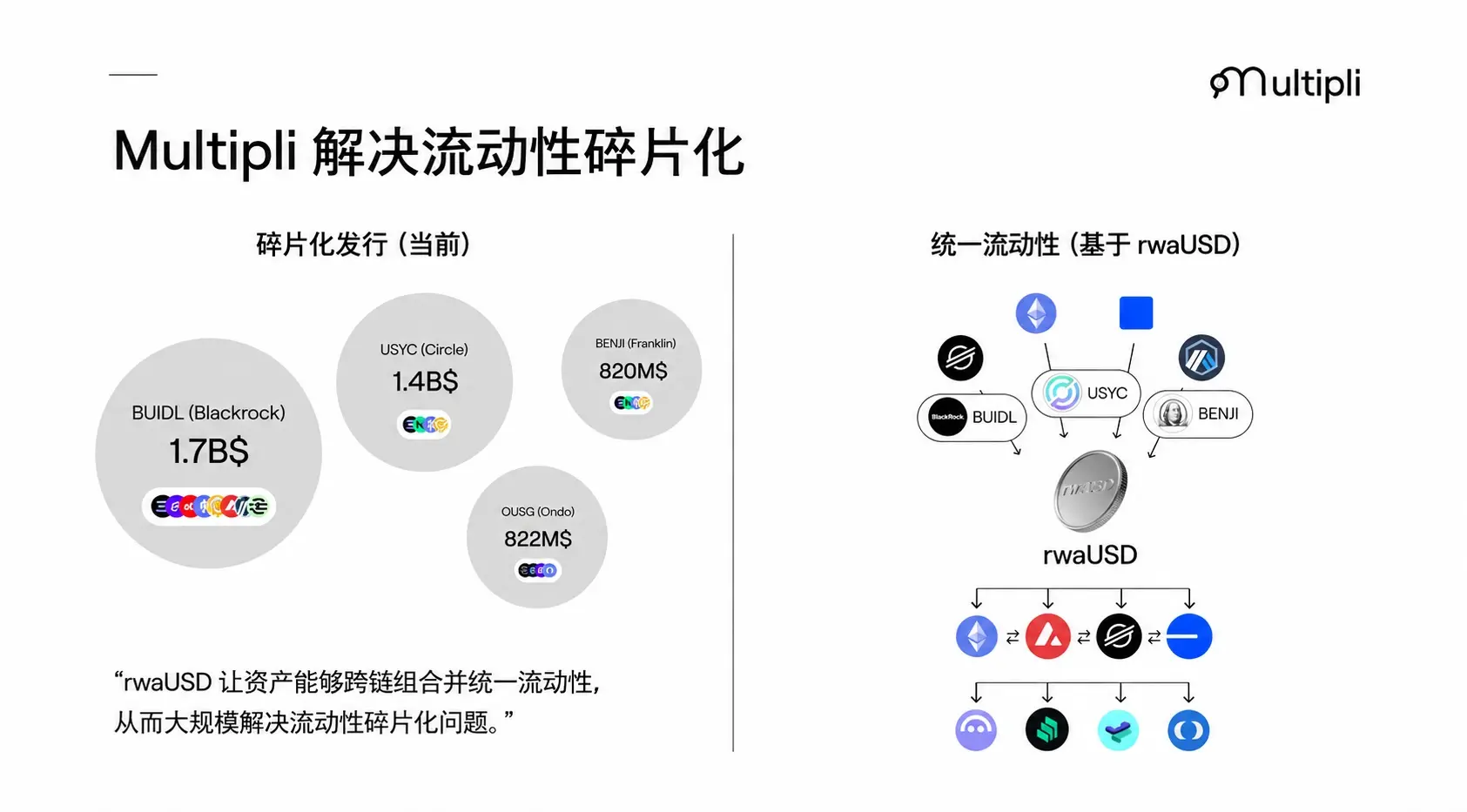
DeFi protocols only need to integrate rwaUSD once to indirectly gain liquidity from the entire RWA market.
### How rwaUSD Works
1. Project Positioning: A Standardized Entry for RWAs into DeFi
Currently, there are many on-chain:
Tokenized Treasuries
Money Market Funds
Tokenized Gold
But liquidity is fragmented, and risk control standards are not unified, making direct entry into DeFi difficult.
rwaUSD converts different RWAs into a standardized collateral asset through a unified risk framework.
2. Key Actors
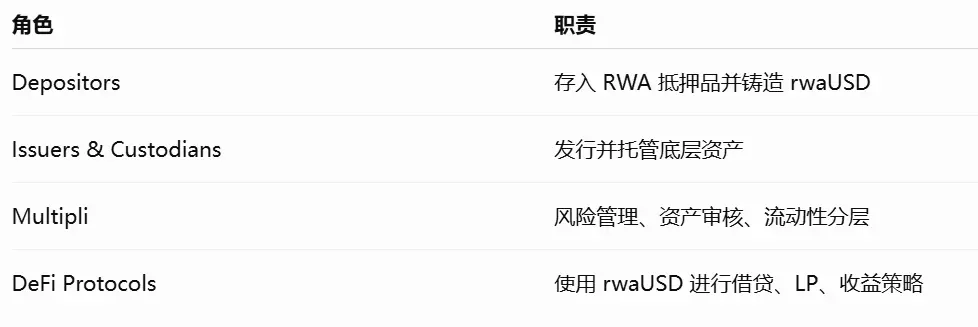
3. Core System Components
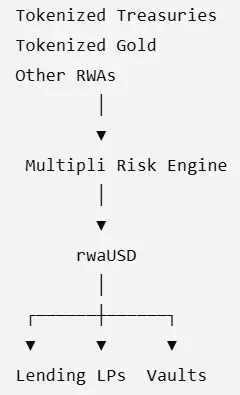
Collateral Vault
Custodies underlying RWAs
Manages assets by liquidity level
Risk Engine
Responsible for:
Asset admission review
Haircut settings
MTV settings
Risk buffer management
Liquidity level classification
Mint / Burn Module
Responsible for:
Minting rwaUSD
Burning rwaUSD
Supply control
Liquidation management
Transparency Layer
Discloses:
Collateral composition
Risk exposure
Liquidity layering
Solvency indicators
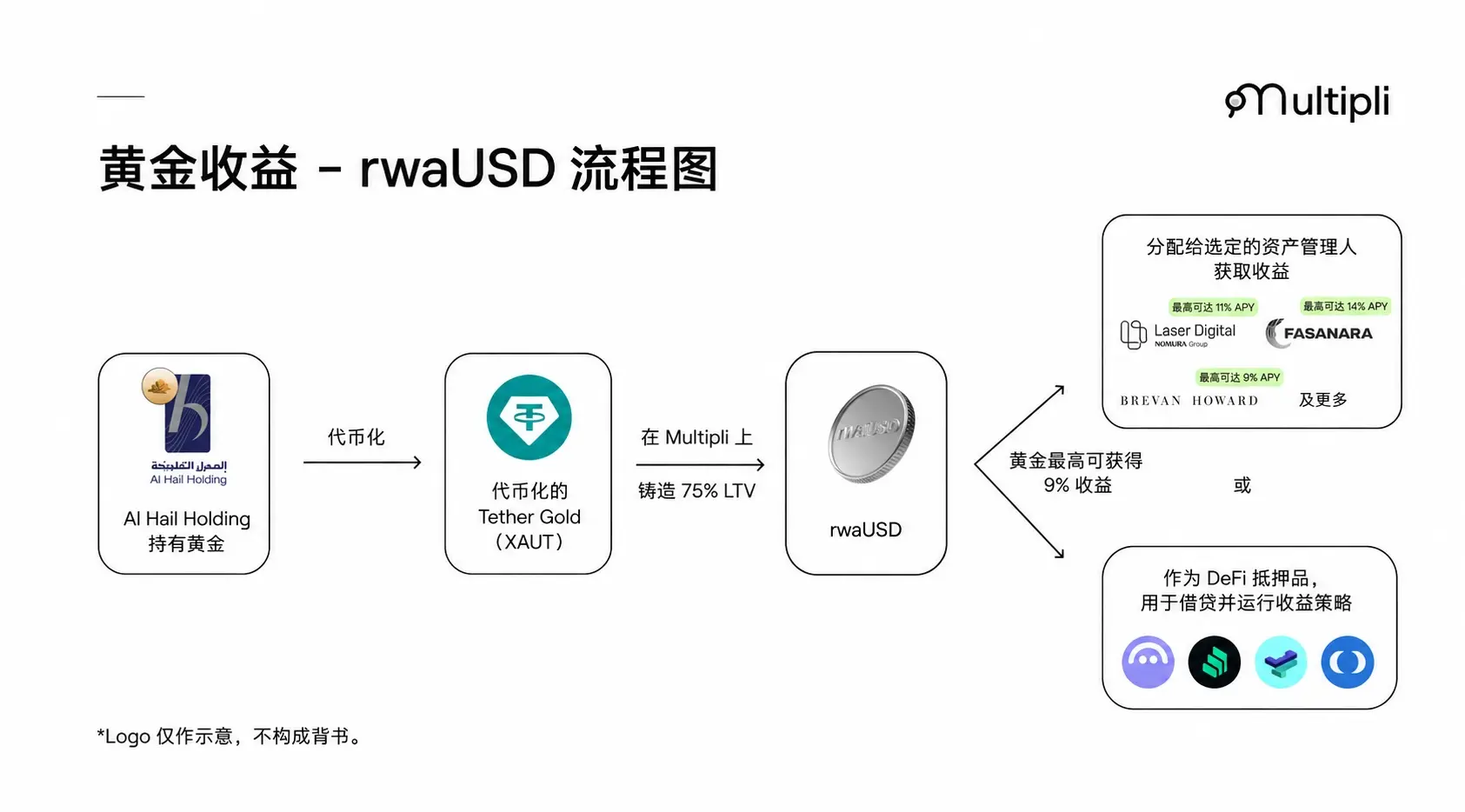
4. Lloyd's Insurance Mechanism
rwaUSD plans to introduce:
Lloyd's of London
Insurance support.
Covered risks include:
Collateral de-pegging
Specific regulatory shocks
Custodian fraud
Underlying asset failure
However, insurance is merely an additional layer of protection.
The system's security still primarily relies on:
Over-collateralization
MTV limits
Liquidity layering
Risk control mechanisms
Rather than the insurance itself.
## Lifecycle
Step 0: Asset Admission
Assets must undergo review before entering the system:
Token verification
Issuer due diligence
Custodian review
Liquidity analysis
Redemption capability assessment
This is one of Multipli's core values.
Step 1: Deposit Collateral
Users will deposit:
Treasury tokens
Gold tokens
Compliant RWAs
Into the collateral framework.
Step 2: Mint rwaUSD
The system generates rwaUSD based on risk parameters.
Key Indicator:
MTV (Mint-to-Value)
Determines how much rwaUSD can be minted at most.
Step 3: Deploy to DeFi
Once rwaUSD is obtained, it can be directly used in:
Lending markets
Liquidity pools
Yield strategies
Institutional allocation channels
At this point, the originally static RWAs begin to generate additional capital efficiency.
Step 4: Redemption Exit
Users receive:
Original collateral assets
orEquivalent redeemable assets
5. Liquidity Layering Design
Different assets adopt different redemption mechanisms.
High Liquidity Assets
For example:
Short-term Treasuries
Gold
Characteristics:
Quick redemption
More aligned with DeFi needs
Low Liquidity Assets
For example:
Assets with redemption windows
RWAs with poor liquidity
Characteristics:
Independent liquidity pools
Do not affect overall system liquidity
Avoid risk contagion.
# Yield Mechanics for rwaUSD
rwaUSD itself is not a yield-bearing asset but a yield-enabling primitive.
Its role is to:
Standardize RWA collateral
Aggregate on-chain liquidity
Provide a unified yield vehicle for DeFi and institutions
## Source of Yield One: Deployment in DeFi Markets
Minted rwaUSD can enter various DeFi scenarios like stablecoins:

## Source of Yield Two: Multipli's Delegated Yield Management
For institutions, DAO Treasuries, or large fund managers:
Do not wish to frequently manage multiple protocols
Do not have specialized DeFi teams
Focus more on stable execution and risk management
Multipli provides Curated Allocation (selected yield strategies)
Users can allocate rwaUSD to designated asset management strategies.
Asset managers may configure:
DeFi lending markets
Liquidity strategies
Money market instruments
Institutional liquidity channels
On-chain arbitrage strategies
Users do not need to operate the underlying protocols themselves.
In summary, rwaUSD does not directly generate yield but serves as a unified RWA collateral and liquidity layer, transforming tokenized Treasuries, gold, and other assets into productive capital that can be efficiently allocated in DeFi and institutional yield strategies, thereby unlocking the yield potential of on-chain RWAs worth tens of billions of dollars.
Tron Commentary
Multipli's advantage lies in its construction of a unified yield infrastructure connecting RWAs, institutional-level yield strategies, and DeFi liquidity, by standardizing high liquidity RWAs such as Treasuries and gold into rwaUSD, and utilizing the AlphaIQ™ engine and institutional-level Delta Neutral strategies (such as contango and funding rate arbitrage) to optimize yields, allowing originally yield-deficient BTC, ETH, stablecoins, and RWAs to achieve real and risk-adjusted returns; at the same time, the use of liquidity layering, risk engines, and insurance enhancement mechanisms improves asset security and institutional acceptability.
Its disadvantage is that yield performance largely depends on the ongoing effectiveness of underlying asset managers and arbitrage strategies, with risks of narrowing strategy yields and declining alpha due to changes in market conditions; additionally, the admission, custody, insurance, and compliance systems for RWA assets increase operational complexity, while rwaUSD, as an intermediate asset, requires sufficient institutional adoption and DeFi integration to fully unleash network effects.
## 2. Detailed Analysis of Key Projects of the Week
2.1. Re Protocol, raising a total of $21 million, led by Coinbase and Electric Capital, with follow-on investments from Tribe, Framework, Stratos, and Morgan Creek—creating liquidity infrastructure for the on-chain reinsurance market.
Introduction
Re Protocol connects decentralized finance (DeFi) with the global reinsurance market. Built on blockchain technology, Re Protocol aims to bring greater transparency, operational efficiency, and accessibility to this industry, which is worth trillions of dollars and has long been highly opaque and reliant on numerous intermediaries.
Core Analysis of System Architecture
reUSD: Yield-bearing Dollar Asset Supported by Insurance Risk
reUSD is a yield-bearing stable asset issued by Re Protocol, with underlying yields sourced from premium income in the global reinsurance market, rather than traditional DeFi lending rates or funding rate arbitrage.
Core Logic:
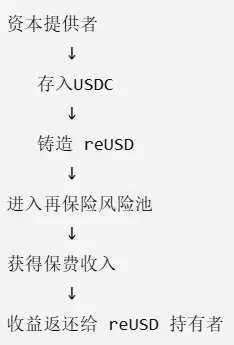
Essentially, reUSD = the on-chain version of insurance float.
## Source of Yield
Mainly from:
Reinsurance contract premiums
Risk underwriting returns
Insurance capital allocation returns
Thus, it has a low correlation with the crypto market cycle.
## Risk Structure
Capital effectively bears the insurance risk.
If claims < premium income, capital earns returns.
If significant disasters lead to payouts exceeding expectations, capital may incur losses.
Therefore:
reUSD essentially belongs to yield-bearing risk assets, rather than ordinary stablecoins.
reUSDe: Yield Re-staking Version
reUSDe can be understood as: reUSD + yield accumulation mechanism.
## Operational Logic
Users:
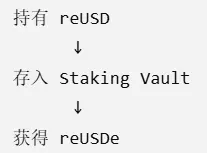
Subsequently:
Premium income continues to accumulate
Returns automatically compound
Net value continues to grow
Mechanism Analysis of reUSD & reUSDe
### Dual Token Structure
Re Protocol adopts a layered capital structure, issuing two types of yield assets:

Among them, reUSD is similar to senior capital in the insurance market, pursuing stable returns and stronger protection; reUSDe is akin to junior capital, taking on more risk for potentially higher returns.
Yield Mechanism
Yield primarily comes from two parts:
The first part: Reinsurance business returns
The protocol provides funds to vetted reinsurance companies in the form of Surplus Notes to support insurance underwriting operations. After deployment, funds can earn insurance premium income and SOFR (Secured Overnight Financing Rate) returns.
The second part: Yield from idle on-chain funds
Funds not yet involved in insurance operations are stored within the protocol, earning returns through Ethena's sUSDe Basis Trade.
Thus, overall yield is composed of:
Reinsurance returns + on-chain fund returns + tranche yield premiums.
## Capital Protection Mechanism
Re Protocol employs a three-layer loss absorption structure:

This means that even in the event of significant insurance payouts, the self-capital of reinsurance companies will be consumed first, before affecting reUSDe, and finally potentially impacting reUSD.
Thus, the security of reUSD is significantly higher than that of reUSDe.
## Surplus Note Model
The protocol does not directly participate in insurance operations but provides capital to reinsurance companies through Surplus Notes.
Surplus Notes are a common subordinate capital tool in the U.S. insurance industry, with a repayment order lower than that of policyholders but recognized by regulators as insurance capital.
For insurance companies:
Increases underwriting capacity
Improves capital adequacy
Reduces financing costs
For Re Protocol:
Gains real insurance premium income
Brings insurance cash flow on-chain
Redemption Mechanism

## Risk Control System
The protocol combines traditional insurance industry risk control with DeFi risk control:

All trust asset balances, premium income, and claims expenditures are synchronized to the chain via Chainlink, achieving near real-time transparent management.
Tron Commentary
Re Protocol's advantage lies in its introduction of the traditionally closed reinsurance market to the on-chain space, allowing DeFi users to access yields derived from real insurance premiums and reinsurance business, rather than relying on crypto market lending rates or funding rate arbitrage, thus providing a yield source with low correlation to the crypto market; at the same time, the combination of Surplus Notes, Chainlink reserve proofs, Fireblocks custody, actuarial audits, and insurance capital buffer mechanisms enhances transparency and risk management levels, granting yield assets strong DeFi composability.
Its disadvantage is that underlying yields ultimately depend on the performance of the reinsurance business and insurance payout situations, with risks of extreme disaster events leading to yield declines or even capital losses; additionally, the protocol involves multiple aspects such as insurance regulation, off-chain trust accounts, actuarial assessments, and institutional partnerships, making the overall structure more complex compared to purely on-chain protocols, and introducing a certain degree of off-chain execution and compliance reliance.
# III. Industry Data Analysis
1. Overall Market Performance
1.1. Spot BTC vs ETH Price Trends
BTC
ETH
# IV. Macroeconomic Data Review and Key Data Release Points for Next Week
This week, the macro narrative is the marginal cooling of U.S. inflation, but consumption has clearly weakened. The U.S. CPI rose 0.1% month-on-month in July, with a year-on-year rate of 3.4%, further down from June's 3.5%; the core CPI year-on-year fell to 2.5%, indicating some easing of inflation pressure. The July PPI also showed that production-side price pressures have cooled, but remain at high levels; meanwhile, July retail sales unexpectedly fell 0.6% month-on-month, significantly weaker than market expectations, indicating that consumer momentum is beginning to weaken. Overall, "cooling inflation + weakening consumption" reduces the urgency for the Federal Reserve to raise rates further in September, but oil prices and geopolitical risks still limit the space for policy to turn dovish.
Key Points for Next Week (August 17 - August 21)
|-------|------------------------------|------------------| | Date | Key Data/Event | Focus Points | | August 17 | U.S. August New York Fed Manufacturing Index | Manufacturing sentiment | | August 18 | U.S. July Housing Starts, Building Permits, Industrial Production | Real estate and real economy strength | | August 19 | Federal Reserve FOMC Meeting Minutes, U.K. July CPI, Eurozone July CPI | Core of the week, observe the Fed's policy inclination for September | | August 20 | U.S. Philadelphia Fed Manufacturing Index, Initial Jobless Claims | Employment and manufacturing | | August 21 | U.S. August Manufacturing/Services PMI Preliminary | Latest temperature of economic growth |
# V. Regulatory Policies
United States
From August 10 to 15, the core of U.S. crypto regulation remains focused on the structure of the digital asset market and the SEC regulatory framework. The CLARITY Act was not able to advance this week due to the Senate entering its summer recess, with key votes postponed until September; meanwhile, the SEC's planned public meeting on August 14 to discuss the new "Regulation Crypto Assets" framework, which involves exemptions for crypto project financing, multi-year registration exemptions, and safe harbors for investment contracts, was canceled due to scheduling issues before it could be held, and no new date has been announced, further delaying U.S. crypto securities regulatory reform in the short term.
On the other hand, the OCC is signaling more proactive digital asset banking regulation, encouraging more crypto and digital asset companies to apply for federal banking licenses, indicating that the U.S. is exploring ways to further incorporate compliant crypto institutions into the traditional banking regulatory system.
United Kingdom
This week, the regulatory focus in the UK is mainly on preparing for the upcoming comprehensive crypto asset regulatory system. The UK has shifted from a previous regulatory model focused on anti-money laundering registration to a complete financial services authorization system covering trading platforms, custody, stablecoin issuance, trading, and staking; the FCA has determined that relevant companies need to apply for formal authorization under the new regime, and existing registration qualifications will not automatically convert to new licenses.
It is important to note that this week is more about the new system entering the implementation preparation phase rather than the introduction of a completely new set of regulatory rules, so the FCA's final rules released on June 30 should not be counted again as new policies for August 10 - 15.
European Union
During the period from August 10 to 15, there were no new MiCA core regulations formally coming into effect or significant new legislation; the regulatory narrative remains focused on the comprehensive implementation of MiCA and the first round of institutional reviews. The final national transition period for MiCA ended before July 1, 2026, so current EU crypto companies have fully entered a unified licensing and regulatory system; meanwhile, the European Commission is advancing the MiCA Review, assessing whether current regulations need adjustments in areas such as stablecoins, CASP, DeFi, staking, lending, and tokenized assets. Therefore, a more accurate definition for this week is "comprehensive implementation of MiCA + ongoing institutional review," rather than the emergence of new significant regulatory legislation.
 Risk warning




Popular articles





