








Bitget UEX Daily Report | Temporary ceasefire between the US and Iran expires, oil prices surge; 30-year US Treasury yield hits a new high since 2007; Microsoft and Meta plummet, dragging down technology (August 18, 2026)
 Core Viewpoint

 Bitget UEX Daily Report
# 1. Hot News
Federal Reserve Dynamics
Long-term U.S. Treasury sell-off intensifies, 30-year yield hits new high since 2007
- The yield on the 30-year U.S. Treasury bond rose nearly 6 basis points to 5.31% on Monday, reaching a new high since 2007; the 10-year yield is around 4.72%.
- Last week's auction of new 30-year bonds saw a winning yield of 5.216%, the highest since 2001.
- The market is concerned that the nearly $2 trillion annual fiscal deficit will continue to push up supply, compounded by inflation remaining persistently above target and increased corporate bond issuance driven by AI infrastructure.
Market Impact: The rapid rise in long-term yields raises financing costs, putting pressure on high-valuation growth stocks, while reinforcing cautious pricing of the Federal Reserve's policy path.
International Commodities
U.S.-Iran temporary ceasefire agreement expires, risks in the Strait of Hormuz rise again
- The temporary ceasefire agreement signed by the U.S. and Iran in June expired on Monday, with Trump stating he would not extend it.
- A senior Iranian official stated that if diplomatic efforts fail to reach a permanent arrangement, they will shift to a "full offensive" military posture and prepare to act against U.S. naval blockades.
- The main disagreement between the two sides centers on control of the Strait of Hormuz; Brent crude oil closed up over $2 to $90.87 per barrel, and the average price of gasoline in the U.S. rose above $4 per gallon.
Market Impact: Geopolitical risk premiums are rising rapidly, oil prices are significantly increasing, reigniting inflation concerns, and short-term volatility in the energy market is intensifying.
Macroeconomic Policy
Overseas holdings of U.S. Treasuries decline; U.S. plans to ask allies to "choose sides" in the U.S.-China AI framework
- In June, overseas investors reduced their holdings of U.S. Treasuries by $72.1 billion, with Japan and China seeing simultaneous declines.
- According to a draft internal letter from the U.S. State Department seen by Reuters, the U.S. is preparing to ask relevant countries to choose between a U.S.-led or China-led framework for AI cooperation, with those joining China's initiatives potentially excluded from the U.S. "Pax Silica" alliance.
- Anthropic's annualized revenue run rate has surpassed $65 billion, with commercialization accelerating.
Market Impact: Concerns over U.S. Treasury supply and geopolitical tensions, along with the politicization of AI, increase market uncertainty; while AI commercialization progress is gaining attention, the risk of policy divergence is rising.
# 2. Market Review
Commodity & Forex Performance
- Spot Gold: Approximately $4,432 per ounce, +0.37%
- Spot Silver: Approximately $66.46 per ounce, +1.05%
- WTI Crude Oil: Approximately $84 per barrel, +0.35%
- Brent Crude Oil: Approximately $87.12 per barrel, +0.29%
- U.S. Dollar Index (DXY): Approximately 99.54, -0.02%
Driving Factors Analysis: The expiration of the U.S.-Iran temporary ceasefire agreement and unresolved differences between the two sides have raised risks in the Strait of Hormuz, driving significant increases in oil prices. Gold and silver are supported by geopolitical risk and a weakening dollar. The asset linkage logic is clear: geopolitical stalemate → rising oil prices → inflation expectations rebound → long-term U.S. Treasuries under pressure, while risk assets face valuation pressure. Short-term commodity volatility will heavily depend on subsequent statements from the U.S. and Iran and the actual navigation situation in the Strait.
Cryptocurrency Performance
- BTC: Approximately $664,357, 24h change of about +2.2%
- ETH: Approximately $1,910, 24h change of about +1.7%
- Total Cryptocurrency Market Cap: Approximately $2.28 trillion, +2.5%
- Market Liquidation Situation: Total liquidation in 24h is about $220 million, with $180 million in short liquidations.
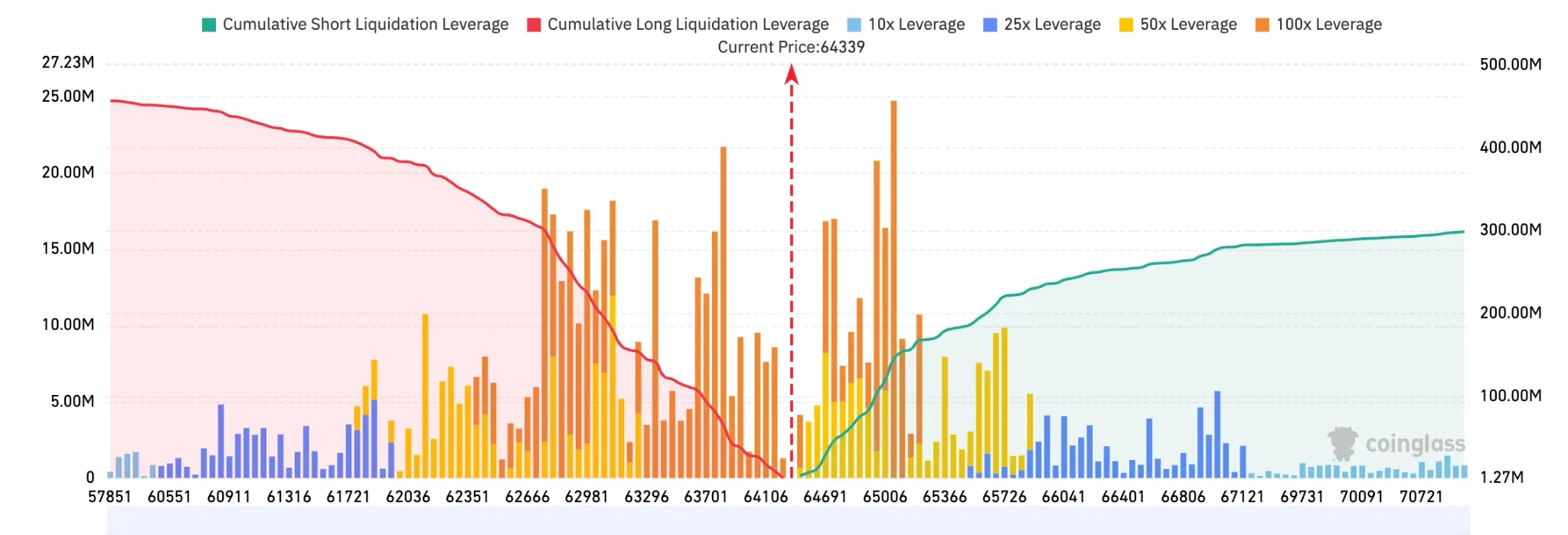
- Bitget BTC/USDT Liquidation Map: Current BTC price is about $64,339, with concentrated long liquidations around $63,700--$64,100; if it falls below $63,700, it may trigger a cascade of long liquidations. Concentrated short liquidations are in the $64,700--$65,100 area; if it breaks above $64,700, it may trigger a short squeeze, with short-term focus on the $64,000--$65,000 range.
- Spot ETF Net Inflow/Outflow: BTC spot ETF saw a net inflow of $137 million yesterday.
Driving Factors Analysis: Rising geopolitical risks and increasing oil prices have boosted risk-averse sentiment, but the overall cryptocurrency market has slightly rebounded with risk appetite. BTC has regained above $63,000, with ETH strengthening in tandem. The net outflow of ETF funds indicates that institutions are cautious in the short term, and the scale of leveraged liquidations is manageable. On a macro level, the rise in long-term bond yields and geopolitical stalemate create a hedge, with short-term cryptocurrencies likely maintaining high-level fluctuations, focusing on subsequent U.S.-Iran developments and inflation data.
U.S. Stock Index Performance

- Dow Jones: Closed at 53,459.78 points (-0.51%), slightly down.
- S&P 500: Closed at 7,745.06 points (-0.52%), retreating from highs.
- Nasdaq: Closed at 26,644.91 points (-0.32%), pressured in tech.
Tech Giants Dynamics
- NVDA: $225.01 (-0.07%)
- AAPL: $305.59 (-0.11%)
- MSFT: $480.35 (-3.04%)
- GOOGL: $344.00 (-0.55%)
- AMZN: $261.31 (-0.51%)
- META: $568.97 (-3.54%)
- TSLA: $339.30 (-0.87%)
Performance Summary and Driving Analysis: On Monday, all three major U.S. stock indices closed down, with Microsoft and Meta dropping over 3%, becoming the main drag. The rapid rise in long-term U.S. Treasury yields has increased valuation pressure, putting software and some large tech stocks under pressure. Meanwhile, the storage and optical communication sectors performed strongly against the trend, indicating continued rotation of funds within the AI infrastructure chain. The market is weighing between geopolitical risks, long-term bond sell-offs, and AI earnings realizations, with overall risk appetite somewhat contracting.
Sector Movement Observation
Optical Communication
- Representative Stocks: Credo (+8.82%), Coherent (+7.79%), Mellanox (+5.54%), Lumentum (+4.62%)
- Driving Factors: Nvidia announced that the Spectrum-X Ethernet silicon photonic switch has entered full production, confirming the demand for high-speed interconnects in data centers.
Storage Concept
- Representative Stocks: SanDisk (+8.88%), Micron (+4.13%)
- Driving Factors: The ongoing demand for high-bandwidth storage in AI data centers continues to attract funds into the performance realization chain.
Software/Large Tech
- Representative Stocks: Microsoft (-3.04%), Meta (-3.54%)
- Driving Factors: The rapid rise in long-term yields has increased discount rates, putting pressure on high-valuation software stocks.
# 3. In-Depth Analysis of U.S. Stocks
1. Microsoft (MSFT) - Down over 3%, under pressure from long bond yields
Event Overview: Microsoft's stock price fell about 3.04%, becoming one of the top decliners among large tech stocks. The rapid rise in long-term U.S. Treasury yields to multi-year highs has increased valuation pressure on growth stocks. Market Interpretation: Concerns about the return cycle of AI capital expenditures in a high-interest-rate environment have resurfaced. Although Microsoft has advantages in cloud business realization, high-valuation stocks are generally under pressure in a trading environment dominated by long bond sell-offs. Investment Insight: Pay attention to the subsequent growth rate of the cloud business and its alignment with capital expenditures, as well as whether long-term yields can stabilize.
2. Meta (META) - Down over 3.5%, leading the software sector decline
Event Overview: Meta's stock price fell about 3.54%, underperforming most tech giants. Market Interpretation: The impact of rising long-term yields on high-valuation software stocks that rely on future cash flows is more pronounced. Concerns about previous capital expenditure scales combined with the macro interest rate environment have led to reduced exposure. Investment Insight: Continuous tracking of the resilience of advertising business and AI monetization progress is necessary, as short-term volatility may increase.
3. SanDisk (SNDK) - Up nearly 9%, storage continues to lead gains
Event Overview: SanDisk's stock price rose about 8.88%, with the storage sector overall performing strongly. Market Interpretation: The ongoing demand for high-bandwidth storage in AI data centers continues to be realized, with funds rotating from software to hardware infrastructure within tech. Stocks that have previously seen significant gains are still being pursued. Investment Insight: The long-term logic of AI storage remains intact, but caution is needed regarding profit-taking and supply-demand data verification after high gains.
4. Optical Communication Sector - Collective Surge
Event Overview: Stocks like Credo up 8.82%, Coherent up 7.79%, and Lumentum up 4.62% have collectively strengthened. Nvidia announced that the Spectrum-X Ethernet silicon photonic switch has entered full production. Market Interpretation: The demand for high-speed optical interconnects in data centers has received direct catalysis, confirming the logic of extending AI infrastructure from computing power to networking layers. Investment Insight: As a key link in AI infrastructure, optical communication shows outstanding short-term elasticity, and attention should be paid to the visibility of subsequent orders.
5. SpaceX (SPCX) - Up over 4%, relatively independent
Event Overview: SpaceX's stock price rose about 4.45%, significantly outperforming most tech stocks. Market Interpretation: In an environment where overall risk appetite is contracting, SpaceX demonstrates relative independence due to its business progress and positive analyst evaluations. Investment Insight: Focus on the progress of Starlink and AI-related businesses, as well as the liquidity impact after the lock-up period.
# 4. Market & Project Dynamics
Cathie Wood's Ark Invest purchased $15.4 million worth of Block Inc. stock, $1 million of Securitize stock, and $22.8 million of Nvidia stock on Monday.
Bitcoin mining company IREN, transitioning to AI infrastructure, has delivered the first of four "Horizon" AI deployments under a five-year, $9.7 billion cloud services contract to Microsoft. Horizon 1 is a 50-megawatt direct chip liquid cooling deployment located in Childress, Texas, with the remaining three phases to be delivered throughout the year, totaling 200 megawatts of IT capacity and Nvidia GB300 GPUs.
Michael Saylor, Executive Chairman of Strategy, stated on Monday that the company is currently prioritizing STRC preferred shares, cash reserves, and credit business over stock buybacks. Affected by the decline in Bitcoin, MSTR has fallen about 38% this year. Saylor mentioned that if MSTR's relative asset net value shows a "very deep discount," buybacks may be considered, but it is not a priority at the moment.
Anthropic's annualized revenue run rate has surpassed $65 billion, with commercialization progress accelerating, and it has secretly submitted IPO documents.
Nvidia has lowered the credit guarantee cap for its AI data center in Ohio in partnership with SB Energy to $10.5 billion and invested $1.5 billion to acquire equity.
Quantitative trading giant Jane Street disclosed in SEC regulatory filings that it holds approximately $990 million in Bitcoin spot ETFs, equivalent to about 15,394 BTC at current prices, with $828 million directed to BlackRock's iShares Bitcoin Trust. This position is achieved through ETFs rather than direct holdings of digital assets.
The Kobeissi Letter analyzed on the X platform, stating that the U.S. stock market in 2026 has shown unprecedented resilience, potentially becoming the first complete year in at least 30 years without a day of "80% downside volume" on the New York Stock Exchange (NYSE). The so-called "80% downside volume day" refers to a day when at least 80% of the NYSE's trading volume comes from declining stocks, typically seen as a significant signal of widespread selling pressure in the market.
Data shows that during the 2008 global financial crisis, there were 49 such trading days on the NYSE; 33 during the 2022 bear market; and 9 in 2025. Since 1997, this indicator has averaged about 21 occurrences per year, and no complete year has previously been below 5 occurrences. The Kobeissi Letter pointed out that so far in 2026, the market has seen almost no widespread selling pressure, indicating that investor selling behavior is relatively limited, and the market structure shows strong support. The institution stated that the current U.S. stock market exhibits "unprecedented resilience," but this phenomenon also means that market risks may be more concentrated on potential future liquidity changes or unexpected events.
# 5. Today's Market Calendar
Data Release Schedule
|----|----|----------------|-------| | This Week | U.S. | Retail sales and other consumer data and corporate earnings | ⭐⭐⭐⭐ | | Focus | Global | Follow-up on U.S.-Iran ceasefire and developments in the Strait of Hormuz | ⭐⭐⭐⭐⭐ |
Important Event Forecast
August 18 (Tuesday)
- The U.S. will release July housing starts and building permits, import/export price indices, industrial production and capacity utilization, and pending home sales;
- ★★★★ Home Depot (HD) will release earnings before the market opens, core verification of housing improvement demand, resilience in large-ticket consumption, and real estate-related spending in a high-interest-rate environment; Baidu (BIDU) before the market opens;
- Toll Brothers, Keysight Technologies (KEYS, testing and measurement equipment), and others after the market closes.
August 19 (Wednesday)
- ★★★★★ The Federal Reserve will release the minutes of the July FOMC meeting (evening UTC+8), following last week's CPI, becoming the most important macro event of the week. Key observations will include details of the three dissenting votes against maintaining interest rates, discussions on inflation stickiness, the labor market, and the policy path for September;
- Target (TGT), Lowe's (LOW), TJX, Analog Devices (ADI) will release earnings before the market opens, testing retail consumption health and semiconductor/AI-related demand (ADI focuses on industrial, data center power, and communication ends);
- EIA crude oil inventory data.
August 20 (Thursday)
- The U.S. will release the August Philadelphia Fed Manufacturing Index, weekly initial jobless claims, and July leading indicators;
- ★★★★ Walmart (WMT) will release earnings before the market opens, core testing of low-end consumer resilience, grocery, and general merchandise demand; Alibaba (BABA), NetEase (NTES), Deere (DE) will also release earnings;
- Ross Stores and others after the market closes.
August 21 (Friday)
- ★★★★ The U.S. will release the preliminary value of the August S&P Global Manufacturing/Services PMI, verifying economic expansion momentum and soft landing continuity;
- Other significant events are limited.
*After last week's CPI/PPI slowdown, interest rate hike expectations have significantly cooled. If the minutes show limited dissent and retail/housing data remains robust, soft landing trades and growth stocks are likely to continue; conversely, if the minutes lean hawkish or consumer guidance is weak, it may raise tightening pricing again and test high-valuation sectors. Market volatility is expected to be moderately high, with a focus on the wording of the minutes and the pricing reaction to retail earnings exceeding or falling short of expectations.
Institutional Views:
Analysts generally believe that with the expiration of the U.S.-Iran temporary ceasefire agreement and unresolved differences, risks in the Strait of Hormuz are rising again, leading to significant increases in oil prices and reigniting inflation concerns. Meanwhile, the 30-year U.S. Treasury yield has hit a new high since 2007, with long-term sell-offs directly pressuring high-valuation tech stocks, leading to declines in Microsoft and Meta. The storage and optical communication sectors have performed strongly against the trend, indicating that funds within the AI infrastructure chain are still rotating. The overall consensus is that geopolitical factors and long-term bond yields will become dominant short-term factors, potentially increasing market volatility.
Disclaimer: The above content is compiled by AI search, with human verification for publication, and should not be considered as any investment advice. Data in the text may inevitably contain deviations; please refer to real-time market data.
 Risk warning


Popular articles





